Career Lessons from 3M’s Kathryn J. Coleman: Be Open to New Opportunities

​If Kathryn J. Coleman’s HR career of 25-plus years has been defined by one thing, it’s the constancy of change. As senior vice president, chief talent and diversity officer at 3M, which makes Post-its and more than 60,000 other products, Coleman sees opportunity in the new, and embraces it.

Above: Coleman (center), with 3M colleagues (from left) Michael Stroik, Jacqueline Berry, Jeannee Hoppe and Heather Cavallaro, says that truth, candor and kindness are central to her leadership approach.

That’s what Coleman did in August, when she agreed to expand her position as senior vice president of talent, learning and insights, where she oversaw talent management globally, by taking on the added responsibilities of overseeing diversity for 3M and its 90,000+ employees worldwide. 

In her expanded role, she’s helping 3M adapt to its changing talent needs. In the past, about four-fifths of the company’s new hires were recent college and university graduates, and the remainder were experienced professionals—but now, that ratio has reversed. Coleman will focus more heavily on partnerships with minority-serving professional associations and similar groups that can help 3M meet its talent needs and build a more diverse workforce.

Moving forward, Coleman wants to ensure that the company supports both diversity and inclusion. “We have made commitments to increasing representation, but we can’t do that well if we don’t also make sure we have an inclusive environment,” she says. “Otherwise, you just cycle people in and out.”

Utilizing AI: Meet Max and Harriet

In her previous position at 3M, Coleman welcomed another new challenge when she recognized the need to adopt AI and automation, which she considers one of the HR field’s biggest near-term tests. “The challenge will be to figure out how we leverage AI, because AI is here to stay,” she says. “But it also can help us.”

One of 3M’s first efforts with AI was to implement an interactive bot technology called Max to assist with talent acquisition. Prior to Max, job applicants sometimes complained that their applications never received a response or that their questions took a long time to be answered.

Now, Max quickly answers applicants’ questions and schedules their interviews. Before Max, it took about 45 minutes to schedule an applicant interview; today, it takes just 19 seconds, Coleman says. A similar bot called Harriet supports existing employees—for example, by answering questions about benefits.

At 3M, AI technology for HR has been so successful that prospective and current employees often don’t know they’re interacting with a bot. “We get notes from candidates and from internal people all the time thanking ‘Max’ because they don’t know Max is AI,” Coleman says.

By using AI to answer important yet routine questions from candidates and employees, Coleman has enabled her HR team to focus on more value-added activities. 

“It frees up time for us to work on deeper challenges that require more time, so we can think and operate more strategically,” she says.

Screen Shot 2023-11-15 at 114140 AM.png

Shifting to Hybrid Work

Coleman helped 3M adjust to another profound change during the COVID-19 pandemic: the move to hybrid work. As the company’s employees demonstrated that they could work remotely, they also expressed different preferences for working remotely, in person or a combination of the two.

“We trust our people,” Coleman says. But she knew 3M couldn’t just talk about trust—it also had to walk the talk. So in 2021, Coleman helped create and implement a policy that allows employees to determine how, when and where they work. And for employees whose roles in manufacturing or research and development require more in-person work, 3M provided greater flexibility through shift work and job sharing. postit 1.png

“It’s been hugely successful and really significant from an engagement standpoint,” Coleman says of the global policy.

However, Coleman realized that 3M had to do more than simply announce such a transformative shift. “We had to spend a lot of time with the change,” she says. “We had to be clear with employees that there wasn’t a change in the expectation of delivering a job—they’re just delivering it elsewhere.” 

3M also had to ensure its culture remained strong, even among a distributed workforce. To do that, Coleman helped create a policy that promotes “moments that matter”—times when teams convene in person. 

“That’s not about everyone coming in so the manager can look at them work,” she says. “It’s about having intentional time for teams and team members to come together and feel connected to one another.”

Embracing Change

Coleman is no stranger to leading transformation at 3M. Several years ago, she successfully executed what she calls “the herculean task” of implementing a new platform that delivers customized learning experiences. The platform launched after just one month of development that took place around the clock and around the world. 

“That’s not something you can do by yourself—you can only do that with a team aligned in the same way,” she says. “I’m not successful if the only person progressing is me.”

Throughout her life, Coleman has learned repeatedly the importance of saying yes to change. In college, she planned on studying neuroscience. But as she took pre-med classes, she decided that while she could do the work, she didn’t really want to. Her mother wasn’t too pleased. 

“After my mom stopped passing out—because she saw me becoming a neurosurgeon in the future—I got my psychology degree,” Coleman says. “I always knew I had an interest in and affinity for people, and I was able to build rapport quickly.” She earned her bachelor’s degree in psychology from Macalester College in 1994, followed by a master’s degree in psychology from the University of Minnesota in 1997.

After working in recruiting at what was then the William Mitchell College of Law for a couple of years, Coleman held people-focused roles at the University of Minnesota for almost a decade, most recently as director of diversity for its business school. In 2005, she earned her doctorate in education policy and administration, also from the University of Minnesota.

Coleman started her career in academia—and could well have ended it there. “I never thought I would leave higher education,” she says. In 2008, when SuperValu, at the time one of the country’s largest grocery retailers, contacted Coleman about an HR role, she thought, “I’m good. I love what I’m doing.”

But Coleman decided she wanted to expand her experience and knowledge. So she made the move into the private sector—first as SuperValu’s manager of diversity recruitment and then as its senior manager of talent acquisition.

History repeated itself a few years later when 3M approached her. Again, Coleman thought, “I’m happy. I have a great team doing amazing things.” But then she considered the opportunity to move from a solely U.S.-focused organization and gain global experience. In 2011, she joined 3M, first in U.S. talent acquisition and, soon afterward, in global talent acquisition.

Linda Johnson, chief human resources and communications officer at grocery retailer Food Lion, vividly remembers that time. As an HR executive at SuperValu, Johnson had to find Coleman’s replacement amid many changes in the company’s talent acquisition function. But Coleman didn’t simply say, “Thank you and goodbye,” Johnson recalls; instead, Coleman helped find her own replacement.

“It was a tough time for us to have to replace her role,” Johnson says, “but we were able to do that efficiently because of her commitment to making sure we had a great candidate slated for her role. And she did that with care and deliberation.”

To Coleman, “Be open” is perhaps the central theme of her career. “If I limited myself to just my knowledge set, I’d still be in a university, because that’s all I thought I’d do, and I was happy to do it,” she explains.

14_D6A0316-Enhanced-NR.jpg

Valuing Candor

Coleman says she successfully leads change—such as helping 3M spin off its health care business into a separate company—in part by delivering communications in different ways for different people at different times. “Sometimes folks need you to talk, sometimes they need you to listen,” she says. 

Coleman’s attentiveness to people’s needs speaks to her leadership approach, which she describes in this way: “You have to tell people the truth—but balance candor with kindness.” 

It’s a leadership style that has impressed Coleman’s boss, Zoe Dickson, CHRO of Minnesota-based 3M. “Kathryn is candid and courageous,” Dickson says. “She speaks truth to leaders and to her teams. And that’s been really helpful, especially in a Midwest organization where that’s not always the narrative we have.”

postit 1.png

Coleman had seen the value of candor, and of adapting to new demands, when she was working at the University of Minnesota. Coleman recalls a meeting in which the university’s president turned to her mentor at the time, Charles Muscoplat, a now-retired professor, and asked him a question. Muscoplat answered, “I don’t know, but I’ll find out.” His honest response to the school’s top leader took Coleman by surprise and made a lasting impression on her. “If you don’t know, say you don’t know. And then figure it out,” she says.

But Coleman’s ability to welcome new challenges was shaped long before her HR career began. While she grew up mostly in Florida, her mother—who worked as an English teacher, as well as a consultant in the public and private sectors—made sure that Coleman and her two older siblings regularly enjoyed new experiences, such as various kinds of foods and films. “She focused on exposing us to things that were unusual and unfamiliar,” Coleman says.

Coleman also manages any change and challenge by modeling the work/life balance she wants her team to enjoy. One example: Every evening at 5:30, Coleman has dinner with her husband—no matter what. “Something could blow up at the company, but I’m sitting at the dinner table with my husband,” she says. “You have to carve out that sacred time. If I don’t model that for my team, I can’t expect them to do it.”

She adds, “I can’t tell my team, ‘You don’t have to be online at 3 a.m.,’ and then they get an email from me at 2:45 a.m.” If HR leaders exhibit the behaviors they want their people to emulate, Coleman explains, everyone can bring their best selves to their work, to the benefit of the organization and its people.  

Novid Parsi is a freelance writer based in St. Louis. 

Photography by Joe Szurszewski 

Limiting Distractions and Promoting Independence in the Workplace

​The modern workplace is distraction central. From emails to pinging Slack notifications, alerts on project management apps and frequent meetings, it can be hard for employees to actually get any work done.

According to research from McKinsey & Company, this problem has even affected senior-level employees, with 80 percent of executives stating they were going to change, or were already changing, their meeting structure and cadence as a result of this workplace evolution. Additionally, most executives report that they spend “way too much time on pointless interactions that drain their energy and produce information overload.”

Some companies are fighting back against the distraction trend—whether employees are remote or in the office—and aiming to ensure that everybody gets the time and space they need to do their jobs.

“Constant interruptions, making every deadline due yesterday or constant pivots are all signs of poor planning and coordination,” said William Sipling, SHRM-PMQ, director of workforce transformation at Hubstaff, a fully remote, U.S.-based workforce management software company with 100 employees. “If you’re someone marked by poor planning and communication, your best team members will realize that their career and personal growth are capped out by you.”

So, how do you keep the workplace environment as distraction-free as possible while giving your workers their independence? How do you manage employees without micromanaging? Here are some tips from the pros. 

Encourage Employees to Use Productivity Tools

Sipling has found that the Pomodoro Technique—a time management method that involves periods of focused work followed by short breaks of nonfocused tasks—works perfectly for him, and he encourages his employees to try it out. For instance, he’ll do 35 minutes of in-the-zone writing, followed by 10 minutes of catching up on messages or handling a few short or one-off tasks.

“During the focused-work portion of the Pomodoro sprint, it’s important to close Slack, Gmail, or any other input software and tools,” he said. “It’s all about closing or blocking the things that will disrupt your full attention. Everything else can queue up to be handled when your 10-minute focused work break comes around.”

Sipling has worked with employees to help them implement the Pomodoro method as well. When he did it, all team members would operate on the same clock.

“We’d put our heads down collectively for 30 minutes, and then engage in collaboration and cross-talk for 10 minutes,” he said. “[You could] set expectations that team members shouldn’t expect a response if they send a message to a team member during their focus time.”

Put Distance Between Employees and Managers

When employees are in the office, it’s important to put some space between them and their managers, an approach practiced by Tim Connon, founder and CEO of ParamountQuote Insurance Advisors, a final expense insurance company in Tennessee.

“Typically, we just have our managers’ desks in the back of the room so the
employees can have the front,” said Connon, who oversees 55 employees. “The amount of distance between managers and employees helps them not feel monitored or watched.”

According to Connon, this relieves some of the pressure on employees.

“When someone is standing over their shoulder, they feel as if they are being criticized, which makes them nervous,” he said. “If an employee is nervous, they cannot work to their full ability.”

Be Clear from the Start

If managers are clear from the start—whether they are hiring an employee and explaining the role or introducing a new project to an existing employee—then everyone will be on the same page. There won’t be a need for overcommunication.

“When employees clearly understand what is expected of them, they can work independently towards achieving those goals,” said Mary Alice Pizana, human resources generalist at Herrman and Herrman PLLC, a law firm in Texas with more than 200 employees. “It’s also important to communicate openly and regularly with your team. By having transparent conversations about their progress and any challenges they may face, you can build trust and ensure everyone is on the same page.”

Limit the Meetings

Meetings are a serious productivity killer. Yet, across the board, employees report that they are in too many meetings, which takes away from their work.
 
HireInfluence’s Director of People and Culture Cyndi Rooks, SHRM-CP, who oversees 25 employees at the influencer marketing company, tries to limit meetings as much as possible for this very reason, and hopes other employers will do the same.

“Aside from weekly team meetings, we reserve meetings for prospective and current clients to give our employees the time and space they need to focus on the things that matter,” she said.

Use Software to Your Advantage

While software and apps can be distracting, they also come with an upside: There are ways to use them for focusing. Just like the iPhone has a “Do Not Disturb” option, work software can be turned off temporarily, too.  

“Use software integrations to make announcing focus time easy,” Sipling said. “For instance, Slack integrates with Google Calendar so that when your calendar shows you’re busy (with a focus time block), it can update your Slack status to say, ‘Focus mode,’ so team members will know that you’re not available for a quick reply.”

Let Your Employees Work Independently

Figure out what works best for your employees, whether it’s coming into the office, logging in remotely or a mix of both. At HireInfluence, employees are fully remote so they can enjoy flexibility and work/life balance.

“We believe it is important to give employees freedom to work remotely and at their own pace for maximum results,” Rooks said. “Providing employees the flexibility they need encourages them to do the best they can. We have been remote since our founding, and our team has consistently exceeded client expectations. This goes to show employers do not have to micromanage teams to foster great results.”

Sipling emphasized how letting workers be independent can lead to higher retention as well.
 
As we know, people leave managers, not jobs,” he said. “Therefore, ensure your team members are able to be independent, and you’ll see increased retention and productivity among top performers.”

Pizana has a similar approach to employee management.

“Sometimes, the best way to support your employees is by stepping back and letting them shine,” she said. “It’s essential to create a work environment that encourages trust and autonomy while maintaining open communication channels and setting clear expectations for all employees. By finding this balance, you can ensure that your team is productive and happy in their roles.”


Kylie Ora Lobell is a freelance writer based in Los Angeles.

SHRM Report Underscores Global Importance of Workplace Culture

​Workplace culture remains vital for organizational success. Regardless of the country where they live, employees who rate their workplace culture highly are more satisfied at work and more committed to their organization, according to a new SHRM report: “The State of Global Workplace Culture in 2023.”

In fact, employees who rate their organization’s culture as “good” or “excellent” versus “poor” or “terrible” are 790% more likely to feel satisfied at work and are 83% less likely to be actively looking for a new job.1

“Workplace culture has never been more important than it is now, and I find it to remain true for the foreseeable future,” said Andrew Adeniyi, founder and CEO of AAA Solutions, an inclusion, equity and diversity consulting firm in the greater Indianapolis area.

In 2023, SHRM broadened the annual study’s scope and depth by surveying over 11,000 employees from 15 countries. This expansion allowed SHRM to obtain a more comprehensive global perspective and gain deeper insights into workplace cultures worldwide, explained Ragan Decker, Ph.D., SHRM-CP, lead researcher at SHRM.

Despite the evolution in the study’s methodology, the core findings paralleled those of last year’s report. One key trend was the enduring resilience of positive workplace culture perceptions.

“This positivity persists even in the face of the political and economic turbulence experienced in both 2022 and 2023,” Decker said. “What’s more, irrespective of the country where employees reside, SHRM research over the past two years affirms the numerous benefits of fostering and sustaining a positive workplace culture for both employees and the business bottom line.”

While feelings of positivity emerged as the key trend, it’s important to note that the results are a snapshot in time and may not be universally true for all workplaces.

“It very much depends on the organization,” said Sarah Harvey, founder of Savvy Conversations, a Chichester, England-based consulting firm focused on helping organizations build culture. “I know of some organizations where workplace culture is viewed very positively, and employee satisfaction is higher than it has been in recent history. On the flip side, some organizations who have been working hard at achieving positive engagement scores and pride themselves in focusing on creating a positive workplace culture have seen dips in employee engagement despite their concerted efforts.”

5 Dimensions Influence Workplace Culture Perceptions

Respondents were presented with more than 50 employer practices. SHRM Research then examined which practices were consistently associated with positive workplace culture perceptions and how those practices could be grouped to create actionable areas for employers.

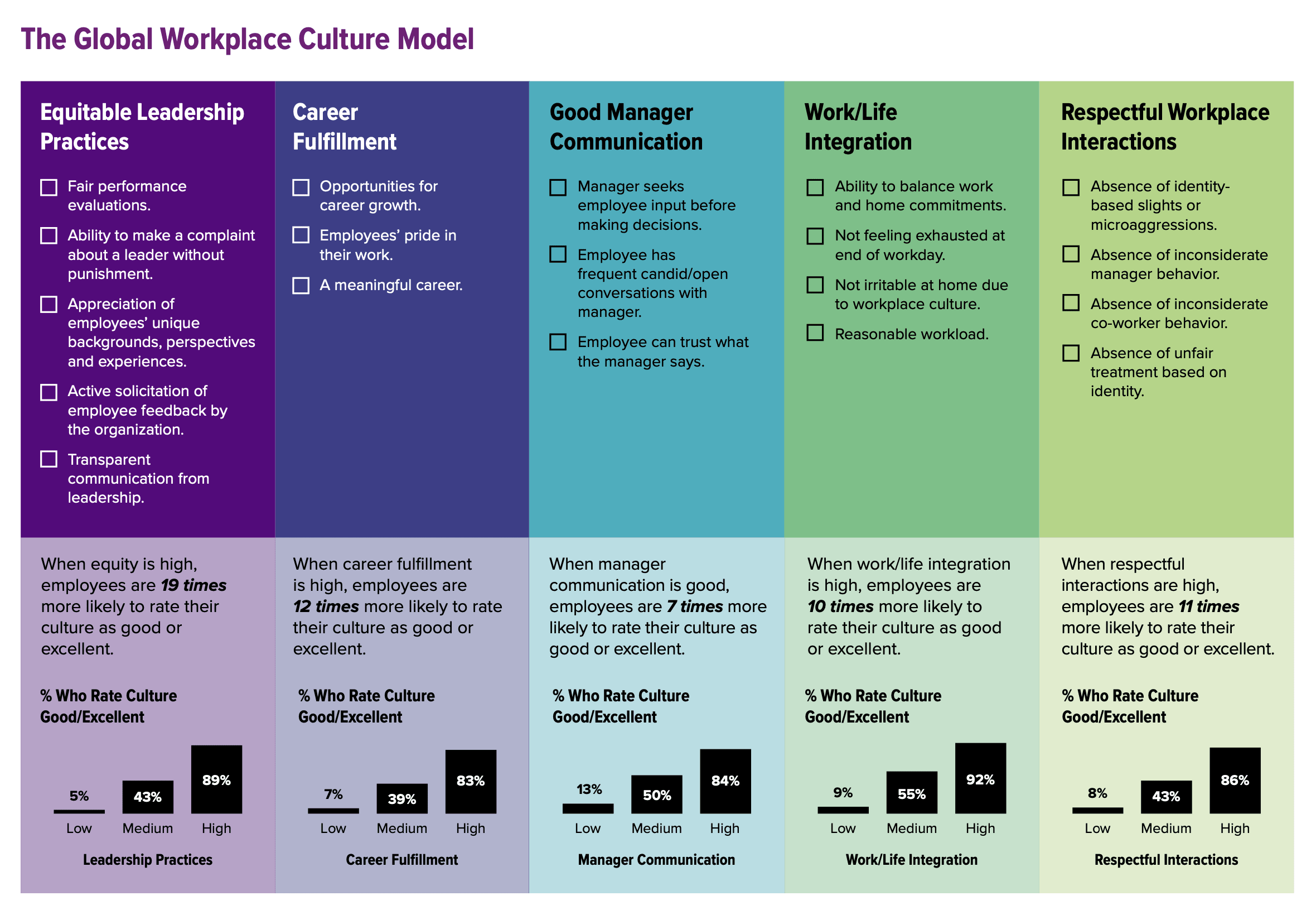
“We found that five key dimensions influence employees’ workplace culture perceptions regardless of the country where they work,” Decker said. “These dimensions are summarized in SHRM’s Global Workplace Culture Model.”

This model offers a concrete framework for organizations worldwide that seek to position themselves as sought-after employers, and it highlights critical areas of focus for organizations seeking to improve their workplace culture.

The Global Workplace Culture Model

Equitable Leadership Practices are by far the most influential dimension in the Global Workplace Culture Model. This is the foundation on which all change efforts should be built and the one employers will likely see the biggest payoff from addressing.

“The investment in enabling the leaders to understand, internalize and apply those concepts is key,” said Silvio Trindade, a Sao Paulo-based human resources director at DocuSign-Latin America. “It is important because it aligns with the majority of the company’s philosophy/values and because the profile of the workforce has changed. It is a game changer when it comes to attracting, developing and retaining talent.”

Kerri Nelson, Ph.D., director of policy and partnership research at SHRM, noted that this principle is not a recent revelation. “As far back as 2018, SHRM Research revealed that 88 percent of U.S. workers considered fairness to be of very or extremely high importance in the workplace.2 What’s more, recent SHRM research has shed light on an interesting shift in worker expectations. Forty-five percent of individual contributors say they have higher expectations for their organizational leaders now as compared to seven years ago.3 These findings collectively highlight the enduring desire for equity among workers while underlining the changing landscape of leaders’ roles in fostering equity in the workplace.”

Additionally, career fulfillment—doing work that feels meaningful, having a job one feels proud of and having opportunities to grow—is the most important predictor of employee commitment. Employees who rate their career fulfillment highly are four times more likely to be committed to their organization than those who do not and are 12 times more likely to feel satisfied at work than those who do not.

For employers that cannot afford to “buy their way out” of a talent shortage, ensuring that employees have a meaningful career is the best alternative. Harvey suggested offering coaching and mentoring to encourage personal growth, engaging in corporate social responsibility initiatives and creating an inclusive workplace environment as strategies that can support employee feelings that they are “doing valuable work.”

“Don’t underestimate the value of providing regular feedback and recognition,” she added.

The Top 10 Drivers of a Positive Workplace Culture

The top 10 drivers of a positive workplace culture belong to the Equitable Leadership Practices, Career Fulfillment and Good Manager Communication dimensions. Employers can identify their areas of weakness on these 10 features to determine which actions to target first.

Top 10 drivers of positive workplace culture:4

  1. Transparent communication from leadership.
  2. Fair performance evaluations.
  3. Employees’ pride in their work.
  4. Active solicitation of employee feedback by the organization.
  5. Employee can trust what the manager says.
  6. Appreciation of employees’ unique backgrounds, perspectives and experiences.
  7. Ability to make a complaint about a leader without punishment.
  8. A meaningful career.
  9. Manager seeks employee input before making decisions.
  10. Opportunities for career growth.

Room for Improvement

Respectful Workplace Interactions are a common challenge, with only 50 percent of workers in all countries rating their employer highly on this dimension. HR needs to be leading vocally on this front, Trindade emphasized.

This is achieved through communication, according to Adeniyi, who believes that respectful interactions are no longer guided by the Golden Rule (“Treat others as you want to be treated”), but instead by the “Platinum Rule.”

“It’s about treating people how they want to be treated, which may be different than how I want to be treated,” he explained.

Employees worldwide struggle to balance work and personal commitments. Globally, only 32 percent of employees experience high Work/Life Integration.

“The companies, and those who represent the ‘entity,’ need to understand that it is OK for employees to leave at a certain point,” Trindade said. “It’s OK to assume that as human beings, the talents have their cycles in the work environment that may vary from company to company, depending on the industry dynamic. The employee’s life cycle doesn’t overlap the human being’s life cycle in our journey by continuously looking for improvements, whatever it means to all of us.”

Top Reasons Employees Leave Globally

Top five reasons why employees worldwide plan to leave their employer
(% of responses):

  • Inadequate pay (58%)
  • Insufficient career growth opportunities (36%)
  • Poor management (29% tie)
  • Insufficient learning and professional development opportunities (29% tie)
  • Unfair treatment (28%)

Multiple Factors Influence Employees’ Decisions

It is important to note that this survey reflects the moment in time it was completed, and that it’s possible that national economic conditions may have somewhat colored employees’ subjective perceptions of the workplace.

“It is important to reiterate that employees’ decision to stay with their organization or look elsewhere is complicated,” Nelson said. “Both workplace culture and financial factors play pivotal roles in this decision-making process.”

Nelson added, “That being said, SHRM’s research shows that four of the top five reasons employees leave their employer globally are tied to workplace culture. For that reason, it’s unlikely higher pay alone can make up for the damage caused by a poor work environment. Employers that invest in fostering and maintaining a positive workplace culture can differentiate themselves in a cost-effective way that yields a high return on investment.”


Katie Navarra is a freelance writer based in New York state.


1 Based on relative risk ratios obtained from predicted probabilities of binary logistic regression models on each outcome while controlling for social desirability and acquiescence (weighted by country size). Predicted probabilities were obtained at average levels of social desirability and acquiescence.

2 Citation: November Omnibus, SHRM Research, 2018.

3 The Changing Face of Leadership, People + Strategy Summer 2023 Issue, SHRM, 2023.

4 Based on a Shapley regression weighted by country using Lindeman, Merenda and Gold (LMG) indices on organizational culture perceptions as predicted by all items of the Five-Dimension Model of Cross-Cultural Organizational Culture.

Aligning Workplace Culture with Employee Mental Health: 6 Steps to Success

​Last year, nearly all (94 percent) HR professionals believed organizations could improve workplace mental health through the provision of benefits, according to SHRM’s Mental Health in America: A 2022 Workplace Report. But today, workers and experts are saying benefits and self-care perks alone don’t address the root causes of the burnout and exhaustion crisis in the workplace. 

The just-released 2023 Mental Health at Work Report from Mind Share Partners, a nonprofit focusing on workplace mental health, reveals that workers want changes that go beyond traditional health benefits and self-care apps. In fact, 58 percent of surveyed workers rated a healthy, sustainable work culture as “very or extremely helpful” for their mental health, while only 35 percent of them rated self-care resources as “very or extremely helpful.”

Treating Causes vs. Symptoms

The World Health Organization (WHO) supports workers’ preference for a heightened focus on workplace culture. The WHO says burnout “result[s] from chronic workplace stress that has not been successfully managed.” In poorly managed work cultures, employees are less productive and sicker because: 

  • They lack healthy boundaries between work and life. 
  • Work hours and workloads are unsustainable. 
  • People are not recognized for their work. 
  • Toxic workplace relationships may exist.  

“At an organizational level, [culture] translates into whether your business is built upon a model of human sustainability or built in a way that churns and burns your people,” said Bernie Wong, principal and senior manager of insights at Mind Share Partners. 

Culture Change Is Hard

While a supportive workplace culture may be more supportive of employees’ mental health, it’s typically harder for organizations to change workplace culture than to offer wellness-related perks.

“Workplace culture is the water that people swim in and the air they breathe each day,” said Sue Haywood, president and owner of Human Resource Blueprints, an Ontario-based HR consultancy. “There isn’t a full realization of the hidden costs of an unhealthy workplace culture, including on mental health, long-term retention, absenteeism-related costs, future benefit costs, and beyond.”

Driving cultural change is hard because “it’s about changing the minds, behaviors and sometimes the values of diverse groups of individuals, all of whom have their own set of values, behaviors and habits,” Wong said. Change management efforts require more consistency and focus than offering a meditation app.

But the financial value of aligning workplace culture with mental health is clear. “A meta-analysis done by Deloitte found that awareness-raising efforts around mental health have an almost 6-to-1 average return on investment (ROI) compared to reactive approaches you can buy off the shelf [e.g., a self-care app], which have a 3-to-1 average ROI,” Wong explained.

The bottom line? You get nearly twice as much bang for your buck from investments in culture change versus reactively treating symptoms.

Actionable Steps to Change Workplace Culture 

So what steps can organizations take to change workplace culture and improve employee mental health? 

1. Support learning. “Learning can happen in different ways and can serve as a bridge to access [mental health] resources,” Wong said, “but it also starts culture change because you’re equipping your agents of culture change with the knowledge and skills they need to drive change.”

2. Leadership advocacy. C-suite leaders should share their personal experiences around mental health. Advocacy is a way to catalyze conversations and create safe spaces because workers don’t often hear leadership discussing mental health. “Traditionally, leaders who showed vulnerability were perceived as weak,” Haywood said. “But today, leaders who’ve overcome mental health challenges actually show more strength than those who say they’ve never had a problem.” 

Of course, leadership advocacy must be consistent. “Leaders who talk about the need to have healthy boundaries but then send emails to employees after hours can breed further resentment or mistrust,” Wong said. “They need to walk the talk.”

3. Iterative steps. There’s no single magic step, or series of defined steps, that works for every industry, function and organization. But appropriate first steps might encourage your workers and managers to discuss maintaining a sustainable workload or establishing healthy boundaries between work and life. 

Further steps could involve having employees talk about their different working styles or what they need to prioritize outside of work. 

4. Don’t drive all initiatives from the top. Bottom-up initiatives tend to work better. They need support from the top, of course, but the work has to start with creating an environment where employees feel safe discussing what they want from a mental health perspective. “If, for example, employees say they’d like an environment that’s more supportive of flexible work hours, the leadership team could take action by starting a pilot and measuring the results,” Haywood said.

5. Start with confidential conversations. Depending on the organization’s level of mental health awareness, initiatives might benefit from starting out as confidential, allowing people to share anonymous feedback. You can then move to more in-person and group dialogues where people don’t feel singled out. 

6. Don’t forget middle managers. Much of the workload in driving culture change is on midlevel managers who interact with employees daily and must back up words with actions. 

Managers need to be prepared for this role. “Conversations around work and mental health are hard, so managers need to learn not to jump to conclusions,” Haywood said. “After all, who knows what’s going on in an employee’s life? If you have an open dialogue, you can understand where the person’s coming from, and that requires managers to listen with empathy and without judgment.”

Lead, Follow or Get Out of the Way

Today’s workers, especially younger ones, have more awareness of the negative impacts toxic work cultures can have. “Newer generations already care deeply about mental health and know what they want,” Wong said, “so employers can either step up and be part of the solution, or they can get dragged along.” 

Employers need to go back to basics on workplace culture, concludes Haywood: “Offering wellness apps but giving little or no attention to workplace culture is like eating unhealthy 95 percent of the time, but then eating salads as an occasional snack. That won’t work. Benefits should be on the side,” and fostering a workplace culture that supports mental health should be your nutritional staple. 

Joseph Romsey is a freelance writer in Boston.

Middle Managers

​Middle managers have long spoken out about the difficulties they face in trying to communicate and enforce directives from company leaders without having a say in or knowing the full reasoning behind those directives.

“They’re often the voice of the top layer toward the lower levels, so they must convince people at the bottom to do things decided at the top, often without full information,” says Zahira Jaser, associate professor of organizational behavior and director of the MBA program at the University of Sussex Business School in Brighton, U.K.

The pervasive, unflattering image of the middle manager prevalent in today’s corporate—and popular—culture doesn’t help matters. A prime example is the fictional character Michael Scott, a middle manager at a paper company on the popular sitcom “The Office.” Scott’s bumbling leadership is most often the source of the comic dysfunction that plagues his Pennsylvania-based team.

The negative attributes of middle managers embodied by Scott, played by Steve Carell, have been reinforced by some notable company executives when their revenues sank. For example, after Meta and Twitter (now called X) made headlines by laying off large numbers of workers earlier this year, their respective CEOs, Mark Zuckerberg and Elon Musk, took to social media to characterize middle managers as drags on their companies and to boast about thinning their ranks.

ATW_Infographics_marijuanaatwork_Graph1_560x610.png

While Musk commented that Twitter “seems to have 10 managers for every employee who writes code,” Zuckerberg was quoted as saying, “I don’t think you want a management structure that’s just managers managing managers, managing managers, managing managers, managing the people who are doing the work.”

Jaser says this impression of midlevel managers as hapless enforcers of unnecessarily multilayered company structures can be disillusioning for managers who would prefer to inspire and guide their teams, were it not for all the other duties assigned to them.

“In our culture, we think of leaders as heroes,” says Jaser, who has interviewed hundreds of middle managers for her research. “Often, our imagination of middle managers is that they’re mediocre. This is not right. If top leaders think of middle managers as mediocre, they’re quick to get rid of them.”

Workplace experts who have studied middle managers say that eliminating midlevel positions to increase productivity and profit is not the answer. There’s a more effective solution: The C-suite should give managers the tools, resources and trust they require to take on real organizational roadblocks, and their enthusiasm will inspire others—leading to higher productivity and profits. Experts say the way many companies are currently structured has led to long-perpetuated middle-manager stereotypes and pressures that burn out many workers. Executives can change that.

Help Wanted

The plight of the middle manager—the multiple demands, never-ending meetings, administrative overload and lack of company support—is a familiar story. But a McKinsey Global Survey of middle managers  released this year paints a picture that’s far more draining and soul-crushing than business leaders may have suspected.

The survey asked midlevel managers about their experiences at work. Only 20 percent said their organizations help them be successful people managers, and 42 percent said that either their organizations don’t help, or they’re unsure if they do.

“Middle managers are absolutely critical to an organization’s success,” says Emily Field, a McKinsey partner and co-author of the survey report. “It’s time to clean-sheet that role of the middle manager. What do they need? What are they uniquely suited to do, versus others in the organization? How do we remove the things that are burdening them?”

Post-Pandemic Challenges

“The last few years have been a time of macroeconomic and sociopolitical uncertainty,” says Katherine Ullman, an independent consultant in Cambridge, Mass. “Companies … have downsized, hired and downsized again. Middle managers have not only themselves, but their teams’ livelihood to think about. This … pressure can create a workforce that is hard to motivate.”

Meanwhile, Ullman says, attracting and retaining talent in a tight labor market, the growing demands of younger workers, new dynamics between employees and employers, and the rise of pandemic-induced remote work have put additional pressure on middle managers.

“The effects of remote work on communication were in some cases larger for managers,” Ullman says. “The switch to remote work caused larger increases [of work] for managers than individual contributors in [the number of] IMs sent, emails sent and unscheduled video/audio call hours.”

Denise Hamilton, an inclusion strategist, CEO and founder of multimedia platform WatchHerWork, acknowledges these post-pandemic challenges in a December 2022 MIT Sloan Management Review article titled, “Middle Managers Are Exhausted. Top Teams Need to Listen.”

“[T]hese challenges have required managers to stretch beyond the leadership skill sets that many possess or were trained for,” Hamilton writes. “For example, managers used to be trained to avoid asking their employees questions about their personal lives … now, suddenly, managers are being told that they must engage in deep conversations with their employees in order to adjust for their unique work-life challenges. These changes in expectations can add additional stress for managers.”

Administrative ‘Time Sucks’

Unfortunately, the remarkable cultural and economic changes that have dominated life in the U.S. over the past few years have joined with traditional management headaches to magnify the pressures that have long plagued middle managers.

For example, despite the lip service many companies have paid to injecting experimentation and collaboration into employee performance reviews, most remain wedded to stale, periodic evaluations, says Smaranda Boros, associate professor of intercultural management and organizational behavior at Belgium’s Vlerick Business School. Many companies have moved from annual reviews to more frequent—even bimonthly—standardized check-ins.

“We talk about moving toward agile forms of organization and cultures of experimentation,” Boros says, “while we evaluate [workers] in the same way we always have.” For example, despite increased talk about the importance of soft skills, many companies don’t look at them when evaluating employees.

“[Few] of these things are [measured] anywhere in our [performance review] processes,” Boros says. This can constrain managers, who often find reviews tedious—even useless—if the process allows them to “grade” workers only on tasks and goals that ignore a large part of their contributions, she adds.

 ‘We talk about moving toward agile forms of organization and cultures of experimentation, while we evaluate [workers] in the same way we always have.’


Smaranda Boros

ATW_Infographics_marijuanaatwork_Graph1_560x610.png

Meetings are another longtime frustration for middle managers. Although companies have known for years that middle managers can increase team productivity by cutting back on the number and length of meetings, regular, long meetings persist, further sapping managers’ time and energy.

Ullman says the tendency to hold multiple regular meetings is due in part to unquestioned company organization and tradition. “Meetings are [about] organizational layers and functional divisions,” she says, explaining that meetings have become the fallback way for people in separate divisions to communicate with one another.

Piling On

Unnecessarily cumbersome administrative tasks such as employee evaluations and mandated meetings take up significant real estate in managers’ already constrained calendars. Middle manager respondents to McKinsey’s survey  say they spend 49 percent of their time on nonmanagerial work. Meanwhile, less than a third of their time (28 percent) is spent on talent and people management—purportedly their principal function. Of the many tasks that distract middle managers from actually managing their teams, organizational bureaucracy is cited most often.

Field, co-author of the book, Power to the Middle: Why Managers Hold the Keys to the Future of Work (Harvard Business Review Press, 2023), says another often-unnecessary bureaucratic task that eats up managers’ time is the elaborate processes some companies require for managers to approve employee expense reports.

“Do [middle managers] need to be the people checking expenses?” Field asks. “Or are there systems that allow the middle manager to handle only a few expense reports?”

Field once worked with an organization where middle managers had to approve a new company credit card if a subordinate lost theirs. The approval had to go through several senior levels and took a lot of time. They didn’t think to question the process and whether such time-consuming work was necessary, she says.

Referring to findings from the McKinsey study, Field asks, “How do we perceive the role of the manager when we see middle managers spending 18 percent of their time—nearly a day a week—on administrative work?”

ATW_Infographics_marijuanaatwork_Graph1_560x610.png

Excessive, unnecessary or redundant administrative tasks can make midlevel managers feel they aren’t trusted enough to go beyond basic management tasks and be a force for real change, Field says. When asked how they most prefer to be rewarded for a job well done at work, respondents to McKinsey’s survey said they want increased autonomy—more so than bonuses, raises or promotions.

Outdated Structures

In a 2018 study published in the Journal of Change Management, researchers compared the rate of technological change at companies over the past 70 years with the rate of organizational change that companies made over that same period. While the former increased exponentially, the latter remained almost flat, indicating the structure of middle management has not kept pace with significant changes in the workplace.

Experts say changes to company structures must be “radical” to make a difference for managers—but this process requires a great deal of reflection, observation, research, data collection, expertise and patience—and often, a lot of money. It can be tempting, Field says, for busy executives to retreat to their comfort zones and keep companies organized as they long have been—arranged by levels of seniority, with top-down directives, siloed departments and managers pigeonholed into the same roles with the same tasks they’ve always had.

Field adds that for executives, the prospect of spending money on a restructuring they’re not sure will relieve middle managers in the first place can keep them permanently stuck in their traditional models.

But if updating company structure is the solution to middle-manager misery, Field says, executives must first be able to recognize that their company structure may be to blame for their market shortcomings—not the middle managers tasked with upholding that structure.

If higher-ups can be convinced to overhaul their structures, Ullman says, then such an overhaul must start with more and better communication between middle managers and the people who lead them. Because midlevel managers have the ear of both those at the top and the bottom ranks of a company, executives would be foolish to not solicit their input.

“Middle managers are in an excellent position to offer insights and advice on solutions,” Ullman says. “There needs to be clear alignment between middle managers and leaders on what it means for managers to be successful. [Leaders must] ask managers what they believe gets in the way of their success and try to find a solution.”

For example, if managers are navigating too many employee emotional crises, then executives should enable HR to provide better mental health services, Ullman says. And if they find themselves in too many low-value meetings, executives should conduct a companywide audit to determine which meetings are worth keeping—and which result in wasted time.

Progress on the Front Lines

Workjam CEO Steven Kramer says he does see middle-manager workloads easing among front-line workers. These are not employees who sit at desks—the focus of the McKinsey study—but rather those interacting with people at restaurants, distribution centers, retail stores, manufacturing plants, warehouses and hospitals.

Leaders in these industries, Kramer says, are so slammed by the labor crunch; middle-manager resignations; and new consumer demands for speed, knowledge and quality that they “are all trying to remove the manager burden because they need those managers to run more efficient and productive businesses.”

For example, Kramer—whose Montreal-based company designs programs to relieve administrative workloads for front-line employers—sees more executives getting serious about giving their managers the technology, training and support they need to support workers. This enables managers to have “more time to be on the floor, to coach employees, to be with customers, to actually fulfill their job descriptions,” he says.

That commitment to free up managers’ time so they can actually manage can include technologies that not only allow a team to collectively communicate in one space (think Slack), but also assign workers appropriate tasks based on their digital skills, education, training, expertise, experience and even soft skills.

Such technology can enable employees to log into a common digital space and choose among the tasks a manager has posted. Some programs enable managers to flag posted jobs for specific workers who have the needed skills, while others can guide workers through the certification and training processes required to perform new tasks and advance their careers.

Kramer says this “democratization of tasks,” which he sees being used largely in companies with front-line workers, puts autonomy and power in the hands of employees and relieves managers of having to assign new tasks throughout the day or think too much about who would be best for a given assignment.

 ‘Very good middle managers have to develop very human skills, such as the ability to connect, influence, explain complexity and understand human dynamics.’


Zahira Jaser

ATW_Infographics_marijuanaatwork_Graph1_560x610.png

Such changes provide another benefit for middle managers, Jaser says: When companies recognize the need to reorganize, the role of the middle manager evolves.

“Very good middle managers have to develop very human skills, such as the ability to connect, influence, explain complexity and understand human dynamics,” she says. “If you want to motivate, you need someone who tells [workers] why they shouldn’t leave for a competitor. If people burn out, … managers are the ones who can provide emotional connection and empathy that you definitely can’t get through any algorithm.”

212156_SubstanceAbuse_Sidebar-1000x250.png

Many employees are promoted to management positions due to the quality of their work—not necessarily because of their management prowess. Yet few receive the instruction or tools they need to succeed. As a result, new managers typically face a steep learning curve before they become effective leaders. Department heads should play an active role in giving both new and experienced managers the resources they need to support their teams by:

  • Asking. Be proactive in regularly asking managers how they and their teams are doing and if they need any assistance. Don’t assume managers will come to you with problems. They may feel that, as managers, they should have all the answers themselves.
  • Listening. When you ask managers if they need help, be prepared for them to answer. Lend an empathetic ear when managers vent their frustrations, and help them determine the root causes of their problems. Work with managers to develop potential solutions, and coach them through the process of resolving any issues.
  • Sharing. Draw on your experiences to proactively share with struggling managers ideas about behaviors and practices you’re seen work in the past. As the people in charge of their teams, managers may be reluctant to ask questions about topics they feel they should already know.
  • Supporting. Offering struggling managers resources on leadership such as books, classes and training is important. But not much can take the place of putting them in contact with people who’ve been there before. Seek out potential mentors for managers who can share what has and has not worked for them in the past.
  • Giving constructive feedback. When managers ask for feedback, remember that as a general rule, it’s not always what you say, but how you say it. If you’re honest about areas for improvement and offer practical solutions, managers will be more likely to consider your suggestions.
  • Just being there. If you sense a manager is struggling, unhappy or perhaps about to quit, reach out and let them know you’re there to help. By serving as a sounding board, you can help managers vent and identify potential solutions. —D.W.

Dana Wilkie is a freelance journalist based in Ormond Beach, Fla.


Explore Further

SHRM provides information and research to help business leaders better support and champion their valuable midlevel managers.

First-Time Managers Often Are Ill-Prepared for New Role
When rookie managers are thrown into their new roles unprepared, the consequences can be devastating. With no training in decision-making, running a meeting or knowing how to handle conflicts, a new manager can harm even a well-oiled team.

How to Support Middle Managers in a Hybrid Workplace
Nearly half of middle managers say they’re burned out—the highest of any job level. While the people they manage report higher levels of satisfaction and productivity due to greater workplace flexibility, middle managers feel less connected to their companies and are far more likely to look for a new job.

Your Career Q&A: How to Explain HR to Managers
Want to help managers understand how HR roles help your company? This sample presentation on the roles of HR business partners and HR generalists can help.

SHRM Toolkit: Managing Difficult Employees and Disruptive Behaviors
This resource looks at some of the most common types of difficult and disruptive employee behaviors, identifies the potential risks to your organization if the behavior is not corrected, and offers suggestions for helping managers handle individuals exhibiting these behaviors in the workplace.

Here’s How People Managers Can Support Employees Who Are Caregivers
“Caregiver” is the fastest-growing employee group, with 73 percent of all employees having some type of current caregiving responsibility. Research shows that managers can play a key role in helping these employees feel more supported at work.

Tips for New Managers Supervising Former Peers
Taking on a management role can be demanding. It can be even more challenging when a promotion places an employee in a role that supervises former co-workers.

SHRM Toolkit: Developing Management
Managers must have certain knowledge, skills and abilities (KSAs) to be able to achieve organizational goals and engage employees. Lacking these KSAs, managers will need basic or advanced training, depending on their place within an organization.

Subscribe to the All Things Work Newsletter

Middle Managers Are Crucial—and Overlooked

​Middle managers have long spoken out about the difficulties they face in trying to communicate and enforce directives from company leaders without having a say in or knowing the full reasoning behind those directives.

“They’re often the voice of the top layer toward the lower levels, so they must convince people at the bottom to do things decided at the top, often without full information,” says Zahira Jaser, associate professor of organizational behavior and director of the MBA program at the University of Sussex Business School in Brighton, U.K.

The pervasive, unflattering image of the middle manager prevalent in today’s corporate—and popular—culture doesn’t help matters. A prime example is the fictional character Michael Scott, a middle manager at a paper company on the popular sitcom “The Office.” Scott’s bumbling leadership is most often the source of the comic dysfunction that plagues his Pennsylvania-based team.

The negative attributes of middle managers embodied by Scott, played by Steve Carell, have been reinforced by some notable company executives when their revenues sank. For example, after Meta and Twitter (now called X) made headlines by laying off large numbers of workers earlier this year, their respective CEOs, Mark Zuckerberg and Elon Musk, took to social media to characterize middle managers as drags on their companies and to boast about thinning their ranks.

ATW_Infographics_marijuanaatwork_Graph1_560x610.png

While Musk commented that Twitter “seems to have 10 managers for every employee who writes code,” Zuckerberg was quoted as saying, “I don’t think you want a management structure that’s just managers managing managers, managing managers, managing managers, managing the people who are doing the work.”

Jaser says this impression of midlevel managers as hapless enforcers of unnecessarily multilayered company structures can be disillusioning for managers who would prefer to inspire and guide their teams, were it not for all the other duties assigned to them.

“In our culture, we think of leaders as heroes,” says Jaser, who has interviewed hundreds of middle managers for her research. “Often, our imagination of middle managers is that they’re mediocre. This is not right. If top leaders think of middle managers as mediocre, they’re quick to get rid of them.”

Workplace experts who have studied middle managers say that eliminating midlevel positions to increase productivity and profit is not the answer. There’s a more effective solution: Give managers the tools, resources and trust they require to take on real organizational roadblocks, and their enthusiasm will inspire others—leading to higher productivity and profits. Experts say the way many companies are currently structured has led to long-perpetuated middle-manager stereotypes and pressures that burn out many workers. Executives can change that.

Help Wanted

The plight of the middle manager—the multiple demands, never-ending meetings, administrative overload and lack of company support—is a familiar story. But a McKinsey Global Survey of middle managers  released this year paints a picture that’s far more draining and soul-crushing than business leaders may have suspected.

The survey asked midlevel managers about their experiences at work. Only 20 percent said their organizations help them be successful people managers, and 42 percent said that either their organizations don’t help, or they’re unsure if they do.

“Middle managers are absolutely critical to an organization’s success,” says Emily Field, a McKinsey partner and co-author of the survey report. “It’s time to clean-sheet that role of the middle manager. What do they need? What are they uniquely suited to do, versus others in the organization? How do we remove the things that are burdening them?”

Post-Pandemic Challenges

“The last few years have been a time of macroeconomic and sociopolitical uncertainty,” says Katherine Ullman, an independent consultant in Cambridge, Mass. “Companies … have downsized, hired and downsized again. Middle managers have not only themselves, but their teams’ livelihood to think about. This … pressure can create a workforce that is hard to motivate.”

Meanwhile, Ullman says, attracting and retaining talent in a tight labor market, the growing demands of younger workers, new dynamics between employees and employers, and the rise of pandemic-induced remote work have put additional pressure on middle managers.

“The effects of remote work on communication were in some cases larger for managers,” Ullman says. “The switch to remote work caused larger increases [of work] for managers than individual contributors in [the number of] IMs sent, emails sent and unscheduled video/audio call hours.”

Denise Hamilton, an inclusion strategist, CEO and founder of multimedia platform WatchHerWork, acknowledges these post-pandemic challenges in a December 2022 MIT Sloan Management Review article titled, “Middle Managers Are Exhausted. Top Teams Need to Listen.”

“[T]hese challenges have required managers to stretch beyond the leadership skill sets that many possess or were trained for,” Hamilton writes. “For example, managers used to be trained to avoid asking their employees questions about their personal lives … now, suddenly, managers are being told that they must engage in deep conversations with their employees in order to adjust for their unique work-life challenges. These changes in expectations can add additional stress for managers.”

Administrative ‘Time Sucks’

Unfortunately, the remarkable cultural and economic changes that have dominated life in the U.S. over the past few years have joined with traditional management headaches to magnify the pressures that have long plagued middle managers.

For example, despite the lip service many companies have paid to injecting experimentation and collaboration into employee performance reviews, most remain wedded to stale, periodic evaluations, says Smaranda Boros, associate professor of intercultural management and organizational behavior at Belgium’s Vlerick Business School. Many companies have moved from annual reviews to more frequent—even bimonthly—standardized check-ins.

“We talk about moving toward agile forms of organization and cultures of experimentation,” Boros says, “while we evaluate [workers] in the same way we always have.” For example, despite increased talk about the importance of soft skills, many companies don’t look at them when evaluating employees.

“[Few] of these things are [measured] anywhere in our [performance review] processes,” Boros says. This can constrain managers, who often find reviews tedious—even useless—if the process allows them to “grade” workers only on tasks and goals that ignore a large part of their contributions, she adds.

 ‘We talk about moving toward agile forms of organization and cultures of experimentation, while we evaluate [workers] in the same way we always have.’


Smaranda Boros

ATW_Infographics_marijuanaatwork_Graph1_560x610.png

Meetings are another longtime frustration for middle managers. Although companies have known for years that middle managers can increase team productivity by cutting back on the number and length of meetings, regular, long meetings persist, further sapping managers’ time and energy.

Ullman says the tendency to hold multiple regular meetings is due in part to unquestioned company organization and tradition. “Meetings are [about] organizational layers and functional divisions,” she says, explaining that meetings have become the fallback way for people in separate divisions to communicate with one another.

Piling On

Unnecessarily cumbersome administrative tasks such as employee evaluations and mandated meetings take up significant real estate in managers’ already constrained calendars. Middle manager respondents to McKinsey’s survey  say they spend 49 percent of their time on nonmanagerial work. Meanwhile, less than a third of their time (28 percent) is spent on talent and people management—purportedly their principal function. Of the many tasks that distract middle managers from actually managing their teams, organizational bureaucracy is cited most often.

Field, co-author of the book, Power to the Middle: Why Managers Hold the Keys to the Future of Work (Harvard Business Review Press, 2023), says another often-unnecessary bureaucratic task that eats up managers’ time is the elaborate processes some companies require for managers to approve employee expense reports.

“Do [middle managers] need to be the people checking expenses?” Field asks. “Or are there systems that allow the middle manager to handle only a few expense reports?”

Field once worked with an organization where middle managers had to approve a new company credit card if a subordinate lost theirs. The approval had to go through several senior levels and took a lot of time. They didn’t think to question the process and whether such time-consuming work was necessary, she says.

Referring to findings from the McKinsey study, Field asks, “How do we perceive the role of the manager when we see middle managers spending 18 percent of their time—nearly a day a week—on administrative work?”

ATW_Infographics_marijuanaatwork_Graph1_560x610.png

Excessive, unnecessary or redundant administrative tasks can make midlevel managers feel they aren’t trusted enough to go beyond basic management tasks and be a force for real change, Field says. When asked how they most prefer to be rewarded for a job well done at work, respondents to McKinsey’s survey said they want increased autonomy—more so than bonuses, raises or promotions.

Outdated Structures

In a 2018 study published in the Journal of Change Management, researchers compared the rate of technological change at companies over the past 70 years with the rate of organizational change that companies made over that same period. While the former increased exponentially, the latter remained almost flat, indicating the structure of middle management has not kept pace with significant changes in the workplace.

Experts say changes to company structures must be “radical” to make a difference for managers—but this process requires a great deal of reflection, observation, research, data collection, expertise and patience—and often, a lot of money. It can be tempting, Field says, for busy executives to retreat to their comfort zones and keep companies organized as they long have been—arranged by levels of seniority, with top-down directives, siloed departments and managers pigeonholed into the same roles with the same tasks they’ve always had.

Field adds that for executives, the prospect of spending money on a restructuring they’re not sure will relieve middle managers in the first place can keep them permanently stuck in their traditional models.

But if updating company structure is the solution to middle-manager misery, Field says, executives must first be able to recognize that their company structure may be to blame for their market shortcomings—not the middle managers tasked with upholding that structure.

If higher-ups can be convinced to overhaul their structures, Ullman says, then such an overhaul must start with more and better communication between middle managers and the people who lead them. Because midlevel managers have the ear of both those at the top and the bottom ranks of a company, executives would be foolish to not solicit their input.

“Middle managers are in an excellent position to offer insights and advice on solutions,” Ullman says. “There needs to be clear alignment between middle managers and leaders on what it means for managers to be successful. [Leaders must] ask managers what they believe gets in the way of their success and try to find a solution.”

For example, if managers are navigating too many employee emotional crises, then executives should enable HR to provide better mental health services, Ullman says. And if they find themselves in too many low-value meetings, executives should conduct a companywide audit to determine which meetings are worth keeping—and which result in wasted time.

Progress on the Front Lines

Workjam CEO Steven Kramer says he does see middle-manager workloads easing among front-line workers. These are not employees who sit at desks—the focus of the McKinsey study—but rather those interacting with people at restaurants, distribution centers, retail stores, manufacturing plants, warehouses and hospitals.

Leaders in these industries, Kramer says, are so slammed by the labor crunch; middle-manager resignations; and new consumer demands for speed, knowledge and quality that they “are all trying to remove the manager burden because they need those managers to run more efficient and productive businesses.”

For example, Kramer—whose Montreal-based company designs programs to relieve administrative workloads for front-line employers—sees more executives getting serious about giving their managers the technology, training and support they need to support workers. This enables managers to have “more time to be on the floor, to coach employees, to be with customers, to actually fulfill their job descriptions,” he says.

That commitment to free up managers’ time so they can actually manage can include technologies that not only allow a team to collectively communicate in one space (think Slack), but also assign workers appropriate tasks based on their digital skills, education, training, expertise, experience and even soft skills.

Such technology can enable employees to log into a common digital space and choose among the tasks a manager has posted. Some programs enable managers to flag posted jobs for specific workers who have the needed skills, while others can guide workers through the certification and training processes required to perform new tasks and advance their careers.

Kramer says this “democratization of tasks,” which he sees being used largely in companies with front-line workers, puts autonomy and power in the hands of employees and relieves managers of having to assign new tasks throughout the day or think too much about who would be best for a given assignment.

 ‘Very good middle managers have to develop very human skills, such as the ability to connect, influence, explain complexity and understand human dynamics.’


Zahira Jaser

ATW_Infographics_marijuanaatwork_Graph1_560x610.png

Such changes provide another benefit for middle managers, Jaser says: When companies recognize the need to reorganize, the role of the middle manager evolves.

“Very good middle managers have to develop very human skills, such as the ability to connect, influence, explain complexity and understand human dynamics,” she says. “If you want to motivate, you need someone who tells [workers] why they shouldn’t leave for a competitor. If people burn out, … managers are the ones who can provide emotional connection and empathy that you definitely can’t get through any algorithm.”

212156_SubstanceAbuse_Sidebar-1000x250.png

Many employees are promoted to management positions due to the quality of their work—not necessarily because of their management prowess. Yet few receive the instruction or tools they need to succeed. As a result, new managers typically face a steep learning curve before they become effective leaders. Department heads should play an active role in giving both new and experienced managers the resources they need to support their teams by:

  • Asking. Be proactive in regularly asking managers how they and their teams are doing and if they need any assistance. Don’t assume managers will come to you with problems. They may feel that, as managers, they should have all the answers themselves.
  • Listening. When you ask managers if they need help, be prepared for them to answer. Lend an empathetic ear when managers vent their frustrations, and help them determine the root causes of their problems. Work with managers to develop potential solutions, and coach them through the process of resolving any issues.
  • Sharing. Draw on your experiences to proactively share with struggling managers ideas about behaviors and practices you’re seen work in the past. As the people in charge of their teams, managers may be reluctant to ask questions about topics they feel they should already know.
  • Supporting. Offering struggling managers resources on leadership such as books, classes and training is important. But not much can take the place of putting them in contact with people who’ve been there before. Seek out potential mentors for managers who can share what has and has not worked for them in the past.
  • Giving constructive feedback. When managers ask for feedback, remember that as a general rule, it’s not always what you say, but how you say it. If you’re honest about areas for improvement and offer practical solutions, managers will be more likely to consider your suggestions.
  • Just being there. If you sense a manager is struggling, unhappy or perhaps about to quit, reach out and let them know you’re there to help. By serving as a sounding board, you can help managers vent and identify potential solutions. —D.W.

Dana Wilkie is a freelance journalist based in Ormond Beach, Fla.


Explore Further

SHRM provides information and research to help business leaders better support and champion their valuable midlevel managers.

First-Time Managers Often Are Ill-Prepared for New Role
When rookie managers are thrown into their new roles unprepared, the consequences can be devastating. With no training in decision-making, running a meeting or knowing how to handle conflicts, a new manager can harm even a well-oiled team.

How to Support Middle Managers in a Hybrid Workplace
Nearly half of middle managers say they’re burned out—the highest of any job level. While the people they manage report higher levels of satisfaction and productivity due to greater workplace flexibility, middle managers feel less connected to their companies and are far more likely to look for a new job.

Your Career Q&A: How to Explain HR to Managers
Want to help managers understand how HR roles help your company? This sample presentation on the roles of HR business partners and HR generalists can help.

SHRM Toolkit: Managing Difficult Employees and Disruptive Behaviors
This resource looks at some of the most common types of difficult and disruptive employee behaviors, identifies the potential risks to your organization if the behavior is not corrected, and offers suggestions for helping managers handle individuals exhibiting these behaviors in the workplace.

Here’s How People Managers Can Support Employees Who Are Caregivers
“Caregiver” is the fastest-growing employee group, with 73 percent of all employees having some type of current caregiving responsibility. Research shows that managers can play a key role in helping these employees feel more supported at work.

Tips for New Managers Supervising Former Peers
Taking on a management role can be demanding. It can be even more challenging when a promotion places an employee in a role that supervises former co-workers.

SHRM Toolkit: Developing Management
Managers must have certain knowledge, skills and abilities (KSAs) to be able to achieve organizational goals and engage employees. Lacking these KSAs, managers will need basic or advanced training, depending on their place within an organization.

Subscribe to the All Things Work Newsletter

Dealing with Toxic Employees

In the midst of the pandemic, the Great Resignation shook the American workforce. Between April and September 2021, a record 24 million Americans resigned from their jobs. Employers were left desperate for staff, offering attractive signing bonuses and wage bumps. Still, many employees held out for more attractive proposals. Scores of employers were left scratching their heads and wondering why.

Revelio Labs—a provider of workplace intelligence—supplies data that gives some insight. Revelio analyzed 34 million online employee profiles as well as company reviews to identify U.S. workers who left their employers for any reason between April and September 2021 and the reasons why they left. 

Revelio’s data revealed that a toxic corporate culture was the No. 1 reason most workers left their jobs. In contrast, how frequently and positively employees mentioned compensation ranked 16th in predicting employee turnover. A toxic corporate culture was more than ten times as likely as compensation to predict a business’s attrition rate compared to its industry peers.

Infectious Toxicity

Though theres no doubt that toxic culture can flow from the top down, it may also originate with rank and file workers. Employees who are toxic can make their colleagues feel uncomfortable, damage productivity and morale, and lead to other workers becoming disengaged and ultimately quitting their jobs.

In this age of increasingly unruly behavior, employers need to grow their spines and be prepared to manage toxic behavior, a.k.a. unacceptable conduct, confidently, says Laura Crawshaw, Ph.D., author of Grow Your Spine & Manage Abrasive Behavior: A Guide for Those Who Manage Bosses Who Bully. Failure to do so will be costly, calculated in terms of attrition of good employees, paralysis of production and a perception on the part of employees that management fails to intervene because they are weak or tacitly condone toxic behavior. To prevent toxic employees from infecting an entire team or department, Crawshaw says, managers must first learn how to identify those employees.

‘Toxic employees differ from a difficult employee based on the notion that difficult employees can be reasoned with and are open to conversations regarding what is affecting their behavior.’            —Jennifer Libby

There are several different ways to do this. According to Lisa Sterling, chief people officer at Perceptyx, Inc., a provider of an employee listening and people analytics platform in Temecula, Calif., a toxic employee is disruptive, talks poorly about leadership and does not get along with other employees. Behaviors demonstrated by toxic employees include withdrawal, lack of engagement, higher frustration, easily agitated, lack of pride in their work and complaints about the organization/leadership, Sterling says.

Jennifer Libby, district manager at the HR consulting firm Insperity in St. Louise, Mo., echoed that sentiment. Toxic employees can be identified as individuals who exhibit mean behavior, possess a put down spirit and continuously make the effort to disrupt morale, Libby says. This type of employee usually self-isolates and is heavily self-centered.

While some employees may be truly toxic, its important for leaders to keep in mind that there is a distinction between toxic and difficult. For one thing, difficult employees may be more likely to hear managers out. Toxic employees differ from a difficult employee based on the notion that difficult employees can be reasoned with and are open to conversations regarding what is affecting their behavior, Libby says.

If an employee is remote, it may be harder to determine whether they are acting in a toxic manner. According to Libby, some behaviors to watch out for include verbally micromanaging others during group calls and initiating gossip with other attendees via chat. These actions can be toxic and quickly bring down morale, she says. As with every work arrangement, leadership must outline behavior, performance and communication expectations from the start.

Managers who know how to manage toxic employees and be proactive about solving issues before they get out of hand are more likely to be able to perpetuate peace in the workplace. Here are some ways to do that:

  1. Address the behavior right away.

    Regardless of whether an employee is toxic or difficult, remote or in person, managers should take swift action to intervene before the behavior drives down morale in the department or organization as a whole. 

    When it comes to dealing with toxic employees, managers should act right away, Sterling says. Waiting until they disrupt others can create far more problems and cause retention issues with your best people.
     

  2. Document everything.

    To protect every party involved—including the company they work for—managers should thoroughly detail whats going on to create a record should action need to be taken against an employee. It is important for leadership and management to properly document the issue, any steps taken to address it and any disciplinary actions taken, Libby says.

    Its also vital for managers to record the steps theyve taken to address the employees behavior. Listen to employees and any issues they may have with another employee, Libby says. When a toxic behavior has been identified, it could be helpful to separate [the employees] from each other, which may mean a different desk arrangement or shifting teams. All these solutions should be documented.

    Managers should also detail the services or resources they give the toxic employee and how they did or didnt change in response, Libby adds. Document any formal peer views or complaints that could support a potential termination.
     

  3. Confront the employee directly.

    Managers should personally confront the employee in question one-on-one to give them a chance to address their toxic behavior. The behavior could be due to issues with leadership or individuals in the workplace, private matters outside work, or in some instances, the employee may lack the self-awareness to see the harm they are causing their colleagues, Libby says. When addressing concerns, foster a space of honest communication.

    Crenshaw suggests outlining with the employee the limits of and consequences for their behavior, while also offering help via internal mentoring or external coaching for employees companies want to retain. If the abrasive employee can turn around their interactive style, great, Crenshaw says. If they cant, they need to go.

    Cara Shortleeve, co-founder and CEO of The Leadership Consortium, a producer of a leadership development platform in Cambridge, Mass., says managers should give the individual direct and specific feedback and make your expectations clear [by saying] XYZ behavior is not acceptable on our team.

    ‘If you dont see a change, make the tough call and part ways fast. The long-term pain associated with toxic employees is never worth the short-term gain.’ —Carla Shortleeve

    Even if an employee brings tremendous value to a company, they can also cost it a great deal, Shortleeve says. The challenge for leaders of toxic employees is that their value is often easier to quantify than their costs, she explains. That is because their value is known today. For example, Timmy Toxic always exceeds his sales quota, Tina Toxic is the best engineer we have, Ted Toxic has our highest win rate as a litigator, etc. The costs of their toxicity are often only apparent down the line, for example, through increased employee attrition spikes or increased reputational risk.

    Its critical to think about not only the immediate impact, but also the long-term effect a toxic employee can have. If you dont see a change, make the tough call and part ways fast, Shortleeve says. The long-term pain associated with toxic employees is never worth the short-term gain.

  4. Cultivate a positive and productive workspace.

    Hopefully, with some feedback, toxic employees will change their behavior. But if it comes down to a choice between the person’s employment and the well-being of a team or department as a whole, managers must be prepared to terminate toxic workers. The needs and productivity of impacted employees should come first.

    Organizations must ensure every employee is given the opportunity to be in a toxic-free environment, Sterling says. It’s up to leadership and managers to create a space where employees can be their most authentic selves and thrive at work.

Kylie Ora Lobell is a freelance writer based in Los Angeles.

What Are the Right Communications Platforms for Your Team?

Employees often cite “poor communication” as a prime reason for their frustration at work. But given the vast and expanding options for communication available to today’s workers, the problem is far from a lack of opportunity. Rather, it’s the plethora and inconsistent use of communications options that may stand in the way of clear, efficient exchanges between managers and their team members.

Today’s managers have at their fingertips access to a wide suite of communications platforms. While email has withstood the test of time as the default communications method for many managers, same-time messaging apps such as Teams and Slack are now widespread, although there are still those who prefer to pick up the phone.

Depending on the nature of your industry and your role in it, you may text, email, call and instant-message different members of your team all in the same day. But without a well-thought-out, clearly communicated communications policy and practice, you can spend a good part of each day chasing down answers to questions you needed yesterday. 

Real-Time Communication Becomes the Norm

As the COVID-19 pandemic disrupted the workplace and drove many employees into home offices, managers were forced to become more deliberate in choosing how best to communicate with their newly relocated team members. Same-time messaging and video platforms quickly became the dominant means of communication in many companies, and that remains the case today.

Before the pandemic, Servicon, a provider of hospital environmental services and commercial cleaning, relied heavily on in-person conversations and email for daily communication. Since many of the company’s employees were essential workers who had to continue cleaning hospitals during the height of the pandemic, Servicon’s managers needed to quickly come up with a faster, more efficient way to share information with their teams.

‘When your employees know what type of communication will be served in a specific place, they will be more inclined to engage, read and retain its information.’ —Hollie Castro.

As the company’s headquarters in Culver City, Calif., shut down, and in-person conversations were curtailed, communication among the company’s 2,000 office-based and field employees shifted mostly to email, “which clogged everyone’s inboxes and was hard to manage, especially for our team members who were still out in the field,” says Greg Mahdesian, Servicon’s communications manager. Servicon managers already had access to Microsoft Teams, and it became the company’s go-to mode of communication for collaboration, quick chats and questions. “It certainly isn’t a perfect platform,” Mahdesian says, but “the more people get accustomed to it, the more useful it can be.” 

After the onset of the pandemic, some of Servicon’s employees who were previously located in California moved to different states, including Texas, Arizona and New Mexico. “None of it would have been possible without something like Teams,” Mahdesian says.

Setting Expectations

Hollie Castro, chief people officer at Miro, which is co-headquartered in San Francisco and Amsterdam, says that with the wealth of communications channels available to managers, it’s critical to identify the types of content that should get shared on each channel. “When your employees know what type of communication will be served in a specific place, they will be more inclined to engage, read and retain its information,” Castro says.

Managers at Miro, a provider of a visual collaboration platform, primarily use Slack to communicate with their employees, and Castro says her company is mindful that messages posted to the general announcement channel are timely, relevant and actionable.

Managers shouldn’t take for granted that their employees will automatically know and adhere to an organization’s or a team’s communications preferences, say workplace experts. Rather, managers should proactively set expectations for how they expect their reports to communicate with them and with one another, and which medium they should use for different tasks. Such expectations are more likely to be followed if managers work to obtain buy-in from their staff and then hold them accountable.

Efficiency is obviously of great importance and never something we can ignore, but it can’t come at the cost of burnout or invading employees’ time off the clock. —Kevin Miller

Erica Dhawan, author of Digital Body Language: How to Build Trust and Connection, No Matter the Distance (St. Martin’s Press, 2021), recommends that managers designate team members to moderate the various communications channels a team decides to use, so if someone uses email when they should be using Slack, for instance, it’s flagged to help employees develop new habits. Team leaders should also be clear about setting expectations for when responses to communications are expected. With the wealth of information flooding in, says Dhawan, “everyone is triaging.”

Dhawan asserts that “every team is unique,” and she recommends that managers and their teams work together to develop a list of which communications channels work well for their purposes and which do not. The use of tools such as email, Slack, Zoom and text may vary based on the complexity of the information managers and their teams are sharing, the urgency of the message and the frequency of communication, says Dhawan.

When determining what types of communications tools to use within their teams, workplace experts say managers should take into consideration a range of factors:

  • Are your team members remote, hybrid or always expected to be in the office?
  • Are your team members in different time zones?
  • Does your organization or department have a policy regarding off-hours texting or emailing? (If not, should you?)
  • Do you require that team members respond to queries within a specific time frame? 
  • Does your team have frequent deadlines?
  • Are your team members in an office, out in the field, or a combination?
  • How easy is it for team members in the field to access various means of communication?
  • Are your reports expected to work during specific “core hours” each day, or are their workdays more flexible? 

Respecting Boundaries

Kevin Miller, co-founder and chief executive officer at Gr0, a digital marketing and SEO firm in Los Angeles, recommends that managers settle on one or two means of communication with their teams. Everyone at Gr0 relies on Slack and email. “Even our writers with the tightest deadlines and pressure to make or deliver content are only reached via one of those platforms, to keep communication streamlined and respectful of work-life boundaries,” Miller says.

It’s important that managers do not abuse the convenience of instant communication. Miller says that while it might seem to make sense to just send a personal text to an employee to quickly get something done, “we opt out of that, prioritizing our employees’ mental health and boundaries above productivity. If we need to send a message, we use the agreed-upon platforms, even if we need to mark it as urgent,” Miller says. “Efficiency is obviously of great importance and never something we can ignore, but it can’t come at the cost of burnout or invading employees’ time off the clock.”

You have to be separated from work sometimes, and with [Teams] you are always connected, which is convenient, but also problematic. —Cara Davis

The same is true at the event marketing platform RainFocus. According to Susan Hanson, the company’s chief people officer, if a communication is sent outside an employee’s work hours, there is no expectation for them to respond immediately. While half of Rainfocus’ 350 employees reside near the company’s headquarters in Lehi, Utah, most work remotely. The other half work in different cities around the country and the world. That makes it important to take various time zones into account when scheduling a virtual meeting, Hanson says.

Like RainFocus, Miro also has employees located around the world, and there is an understanding that they don’t have to respond to communication at the crack of dawn, Castro says. “That really takes a lot of pressure off.”

“Communication has had to evolve so quickly over the past few years,” says Cara Davis, director of continuous improvement for member solutions at Suncoast Credit Union in Tampa, Fla. Davis and her team members all work remotely, and she said she’s reluctant to make use of Teams on personal cellphones. “You have to be separated from work sometimes, and with [Teams] you are always connected, which is convenient, but also problematic.”

Susan Ladika is a freelance writer based in Tampa, Fla.

The Great Compromise: The Evolution of Return-to-Office Policies

There’s a new lounge in the administrative offices at Ability Beyond where employees can take a break or hold an informal meeting. There are also quiet offices for private conversations and heads-down, need-to-concentrate work at the Bethel, Conn.-based provider of services for people with disabilities. The enhancements were added in hopes of coaxing roughly 250 of the nonprofit organization’s employees, who largely had been working remotely since the pandemic began, back to the office. But they weren’t much of a draw.

Last year, Ability Beyond’s leaders asked their administrative department heads to gauge how their teams would feel about returning to the office five days a week, says Kara Chamberlain, the organization’s talent acquisition manager. Most of the nonprofit’s 1,100 employees had to be onsite during the pandemic anyway, and some had commented that the administrative offices were still sparsely populated, even though the crisis was over.

“People said no [to coming in five days a week],” says Chamberlain, explaining that employees questioned the need to return when they had been successfully doing their jobs remotely for more than two years. “How can you argue with that?”

There was no fight; instead, there was an arrangement. Leadership and administrative staff agreed to a new hybrid schedule in which most administrative employees returned to the office two to three days a week.

“It wouldn’t be in our best interest to not offer flexibility and hybrid schedules,” says Chamberlain. She notes that as a nonprofit, Ability Beyond can’t match the salaries and benefits of other local employers, but scheduling flexibility is a perk it can offer.

Screen Shot 2023-09-05 at 124801 PM.pngAs the pandemic has further receded, more employers are asking—or requiring—that workers return to the office either full time or on a hybrid schedule. The need for collaboration and maintaining workplace culture are the top two reasons cited, according to a SHRM survey of 1,500 HR professionals done in June. Moreover, 49 percent of managers say their hybrid workers are struggling with loneliness and other mental health issues that can be better addressed in the office.

Many employees, on the other hand, don’t share executives’ enthusiasm for in-person work. They counter that working remotely allows them to achieve better work/life balance as they manage child care and elder care issues; saves them money not spent on commuting and office attire; helps offset what some perceive as lower pay or a lack of career advancement; and allows them to get more tasks accomplished each day. A recent Microsoft survey found that 52 percent of employees want to work hybrid or remotely for the rest of their careers.

Welcome to ‘the Great Compromise’

With unemployment at historic lows and talent shortages widespread, many employers have been accommodating employees’ desire for remote and hybrid work. It costs about one-third of an employee’s salary to replace them, according to industry norms, and that’s only if HR can find a qualified candidate who is willing to accept the position.

The good news for companies implementing return-to-office policies is that while employees may say they don’t want to go back, most report that the return has been a positive experience. About 3 out of 4 workers who returned to the office say they are more satisfied with their jobs and are more effective and productive, according to SHRM Research.

Screen Shot 2023-09-05 at 124815 PM.png

Still, there has been significant pushback. Office employees staged a walkout at Amazon after being told they had to return three days a week, while workers at Apple and the Walt Disney Co. signed petitions to protest policies that would force them back onsite. Farmers Insurance Group’s reversal from the work-from-anywhere policy it instituted last year to a hybrid schedule that would require in-person work three days a week ignited an uproar, with some employees threatening to quit or unionize—especially those who had moved far away from the company’s headquarters when they were told it would allow fully remote work as a permanent benefit.

And recent research from Clarify Capital, a financial consultancy in New York City, found that nearly 7 in 10 employees (68 percent) said they would rather look for a new job than return to the office. That number is even higher among Generation Z workers, 79 percent of whom said they would look for a new job rather than go back to the office.

A Potential Career Setback for Women?

Providing flexible work options has helped many ­companies attract more women to their workforces, especially those located in less diverse areas. In fact, more than 50 percent of women say they enjoy working remotely and would like to continue to do so, compared with 41 percent of men, according to a 2022 Harris poll. Research also shows that caregivers, who are primarily women, appreciate the flexibility afforded by remote work.

So while many company leaders and managers say they prefer that their teams be in the office, that attitude can hurt the careers of women. Nearly 70 percent of ­supervisors believe that remote workers are more easily replaced than onsite workers, according to SHRM Research. About 42 percent of supervisors say they sometimes forget about remote workers when assigning tasks, and nearly three-quarters say they would prefer their direct reports to be in the office.

There’s already evidence that calling people back to the office is taking a toll on women’s careers. When Mumbai, India-based Tata Consultancy Services ordered employees to return to the office three days a week, women left in greater numbers than men, according to the company’s annual report.

“Intuitively, I would think working from home during the pandemic reset the domestic arrangements for some women, keeping them from returning to office even after everything normalized,” company CHRO Milind Lakkad said in the annual report. “The higher attrition among women in FY [fiscal year] 2023 is a setback to our efforts to promote gender diversity, but we are doubling down on [our diversity efforts].”

There’s concern that U.S. companies will see the same results if they force more female employees back into the office.

“I really think it’s going to push women back even farther in their careers if companies insist on a return to office—I think it’s going to drive them into positions that aren’t as prone to advancement,” says Pam Cohen, Ph.D., president of WerkLabs, the research division of The Mom Project, a Chicago-based organization that provides support for ­mothers in the workplace. 

Cohen says that hybrid employees must be strategic in timing their office visits to ensure that supervisors see them and that they keep their managers abreast of their ­accomplishments. But she encourages companies to provide the flexibility employees need and to remember what can be accomplished using Zoom, Slack and other tools that were popularized during the pandemic, adding that offering options can lead to a more diverse workplace.

For example, Airbnb allows employees to work from ­wherever they choose, and its employee base is the most diverse it has ever been, according to a company spokesman. As a result, women accounted for 52 percent of Airbnb’s new hires in the U.S. over the last year, the spokesman said.

“Companies run the risk of losing some excellent talent by being extremely rigid in those return-to-office scenarios,” Cohen says. —T.A.

Is Falling Productivity to Blame?

Leaders’ communication styles can be a cause of friction, says Flo Falayi, a partner at Korn Ferry in Atlanta. Falayi says that when employers sent workers home during the pandemic, executives talked about wanting to keep them safe and offered flexibility so they could tend to their families’ needs during a time of epic upheaval. “There was this sense around ‘Let’s do what’s right for each other.’ Everybody was on the same page,” Falayi says. But while CEOs demonstrated humanity and empathy during the pandemic, many aren’t currently displaying those qualities now, he says. “Things are lost in translation today. Leaders are not perhaps communicating to the level that the employee is accepting the message.”Image33.jpeg

One theory is that company leaders don’t want to disclose their true motivation, because 85 percent of them say hybrid work has made it difficult to have confidence that their workers are productive, according to another Microsoft survey conducted last year. In that survey, 87 percent of workers say they are productive.

Meanwhile, a PwC study conducted last year found that nearly 40 percent of CEOs say their organizations won’t be economically viable if they continue on their current path. And worker productivity in the U.S. has fallen in each of the last five quarters, according to the U.S. -Bureau of Labor Statistics.

“I think that the heart of this issue [about returning to the office] is about trust,” says Julia Lamm, a New York-City based partner in PwC’s Financial Services, People & Organization practice. “I think that’s adding anxiety as some leaders worry about business performance.”

Lamm agrees that business leaders could better explain why they want employees back in the office and advises against threatening to lower bonuses or withhold promotions for employees who balk at in-person attendance, as some organizations have done. Such approaches can lead employees to become disengaged.

“Leaders have to frame the narrative in a way that takes into consideration the issues at the top of people’s hearts,” she says. 

Job Requirements

To be sure, many employees have returned to the office without any fuss or compromise. The city of Farmington, N.M., has about 1,000 employees who worked remotely during the pandemic, and they have all been back in the office for two years, according to Jamie Wagoner, deputy HR director for the city. She says they were all told during the crisis that they would eventually have to return, and only one person balked and eventually left.

Screen Shot 2023-09-05 at 124801 PM.png

“Citizens expect us to be in the office,” Wagoner says. She adds that the bulk of the city’s employees could never work remotely, so it’s not fair that certain workers have the option. “We wanted to show solidarity,” she says.

Of course, some employers are creating special return-to-office terms for certain jobs. Software
engineers at the travel company Vegas.com protested and threatened to quit when they were told they would need to return to the office three days a week. Managers explained that the organization was trying to preserve its culture and create bonds within its workforce. 

A compromise was reached, and the 25 engineers now work in the office one day a week. While some nonengineering employees initially resented their colleagues’ preferential treatment, the arrangement is working well, says Renata Kilibarda, SHRM-CP, HR manager with Vegas.com.

“We just don’t have a lot of that type of talent here,” says Kilibarda, who adds that replacing those software engineers with others in the Las Vegas area who would be willing to work onsite would be very difficult.

Why CEOs Want Employees Back in the Office

Business leaders widely agree that the drawbacks of remote work far outweigh the benefits, for a range of reasons. Here, based on SHRM’s extensive research and reporting, are CEOs’ and the C-suite’s four biggest concerns about remote work. READ NOW

The Human Element

While many businesses have been willing to compromise on office attendance since the beginning of the pandemic, others have started more recently. The 6,000 employees at St. Augustine, Fla.-based Carlisle Interconnect Technologies (CarlisleIT) worked onsite throughout the pandemic, in part because the company’s leadership didn’t think the crisis would last so long and believes that employees work better when they’re together.

Working onsite, “there’s camaraderie, relationship-building and less stress on the leadership team for figuring out how to manage people remotely,” says Jamie Lomason, CHRO at CarlisleIT, which manufactures, tests and certifies products such as wires and cables for high-tech industries. “There are opportunities to engage and collaborate and to keep the business from being siloed.”

However, after the pandemic abated and employees realized the benefits of remote work, some started leaving the company. Turnover in the accounting and HR departments was 35 percent and 50 percent, respectively. Now, CarlisleIT allows hybrid and remote work for some positions, and decisions are left up to individual managers.

Image.jpeg

Establishing Guidelines

The difficulty of managing remote teams is often cited by proponents of full-time, in-office work as a reason to have everyone onsite. However, companies that have successfully created hybrid and remote workforces insist that organizations must deliberately plan for flexibility. 

Surprisingly, many employers that were forced to send workers home without any preparation when the pandemic hit still haven’t created specific guidelines for remote and hybrid work. Nearly half (48 percent) of the 749 companies in a 2022 Mercer survey have only informal and ambiguous guidelines to manage flexible work, while 17 percent have no rules. Just over a third (34 percent) have formal policies.

Creating guidelines for employees in this newer way of working is crucial, says Kayla Velnoskey, senior research principal in the Gartner HR practice. Only 41 percent of remote-capable employees surveyed by Gartner are performing optimally. Busywork and exhaustion are two reasons, according to Velnoskey. But she adds that companies have given employees flexibility without guidance on how to make good choices for themselves and the company.

“Employees are motivated to make the best decision for their career and the company, but sometimes they don’t have all the information or support they need to do it,” Velnoskey says.

It’s generally more challenging for leaders to manage remote teams, says Kerry Norman, executive vice president of operations for CHG Healthcare, a Midvale, Utah-based physician staffing company with 4,000 employees. 

Norman says the company’s division managers determine hybrid schedules, but the firm is continually providing training, tools and employee surveys to help those managers develop best practices.

One policy she recommends—and adheres to—is having team members come in on the same days so they can work on projects that benefit from them being together, as well as just spend time with one another.

“Nothing feels worse than going to the office and you’re the only one there,” Norman says.   

Theresa Agovino is the workplace editor for SHRM.

Illustrations by James Boast.

Subscribe to our Newsletter