 Global mobility was overwhelmingly the most popular theme among the most-read global HR articles on SHRM Online in 2023.
Global Mobility, Pay Transparency Dominate News in 2023

Squarehr
Global mobility was overwhelmingly the most popular theme among the most-read global HR articles on SHRM Online in 2023.
Remote work skyrocketed during the COVID-19 pandemic, becoming part of the new normal for many businesses. Although remote work was forced upon employers by a global health crisis, it allowed them to geographically expand their talent pool and meet some of their inclusion, equity and diversity goals. The number of U.S. residents working “remote-first” more than tripled from 9 million in 2019 to 27.6 million in 2021, according to the U.S. Census Bureau.
But since 2022, the remote-only hiring trend has been moving in the opposite direction.
Remote Job Listings Reach a 3-Year Low
“Remote job postings have now declined to the lowest share of new job postings in the last three years,” said Lauren Hasson, senior vice president, workplace strategy at commercial real estate firm JLL. “That share peaked in January of 2022 at 20.7 percent, but has declined to 9.1 percent as of August of 2023, according to LinkedIn’s job data.”
James Neave, head of data science at job search engine Adzuna, has seen the same trend line in his data. “Prior to 2020, remote-only listings were just 3-4 percent of our total listings. That percentage started to grow during the pandemic, peaking at around 18 percent in the middle of 2022,” he said. “But in 2023, remote-only listings have steadily and significantly declined to just below 10 percent of all listings.”
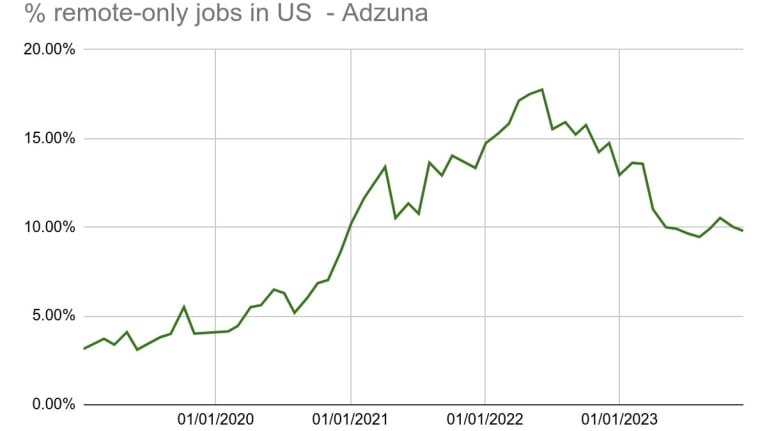
Why are employers posting fewer remote-only job ads, and what will happen with remote-only hiring in 2024 and beyond?
7 Factors Driving the Decline
Experts said the following issues are contributing to the drop in remote-only job listings:
1. Remote-only hiring can create two unequal classes of employees. Hasson said that having two distinct classes of employees, remote and onsite/hybrid, created big challenges in treating both groups equitably.
“It’s challenging for organizations to ensure that both groups have the same access to mentoring and development, learning opportunities, and access to leadership,” she said. “Fully remote employees can sometimes become the forgotten class.” In particular, Hasson added, workers who attend meetings remotely miss out on crucial opportunities to chat with others beforehand and afterwards.
2. Multistate tax and compliance concerns. “Some of our clients have been digging out from underneath a lot of paperwork related to remote-only hiring and having employees working remotely from other states,” Hasson said. “Organizations want to find a way to keep their talent and make everything work, but complexities around taxes and compliance can present challenges.”
3. Generational preferences for onsite work. “There’s often a split between younger and older employees about working remotely,” Neave said. “People early in their careers value being in the office to network and to learn new skills. Later in careers, people may not need to learn as much and also might have kids, elderly relatives and other commitments at home.”
Declan Daly, managing partner at Bundoran Group, a recruitment agency, has noticed some misconceptions about which generations want to work in person. “I’ve been reading about how Baby Boomers are blaming Millennials for wanting to work remotely, but the Millennials I talk to prefer to go into the office,” he said. “It’s the Boomers who I hear complaining the most about long commutes. Gen Z college graduates, on the other hand, tell me they wouldn’t even consider a job unless there was an office component. They don’t want to work remote-only.”
4. Concerns about lower productivity of remote-only workers. A 2023 study co-authored by Stanford University professor Nicholas Bloom found that fully remote work appeared to lower average productivity by between 10 percent and 20 percent. Other research published this year by the National Bureau of Economic Research seemed to support the Stanford study, but the authors said more research needs to be done.
For example, the authors of both studies said they didn’t take into account the real estate costs companies might have saved with a remote-first approach.
5. Nostalgia among leaders for the pre-pandemic workplace. After three years of dizzying workplace change, many business leaders seem to want a return to the workplace of 2019, according to Neave. “There seems to be a combination of risk aversion, nostalgia and laziness among some business leaders who are either uncomfortable or unwilling to invest resources into effectively supporting remote-only work,” he said. “These leaders don’t quite understand how organizations can trust people to do their work at home and not be lazy.”
6. Complexities around fostering an organizational culture. Many organizations have invested in technologies and policies to address the complexities of connecting and managing distributed teams, but massive challenges remain. “It’s definitely easier to build an organizational culture if all your people are in the office, interacting with each other face-to-face,” Neave said. “Leaders are asking themselves, ‘How the heck can we build a company culture when so many of our people are working remotely?’ This has become one of the most powerful arguments for bringing people back to the office.”
Hasson noted that in-person work can also be more meaningful. “Having employees back in the office has reminded us about the power and impact of bringing people together, how much more innovative people can be and how much easier it is to collaborate and give feedback when you’ve spent in-person time with others,” she said.
7. The impact of AI and automation. Routine and repetitive jobs may soon be replaced by artificial intelligence, Neave said. “So instead of hiring remote-only employees, an organization might eliminate or reduce the number of roles and replace people with ChatGPT or automation tools,” he explained. “That negatively impacts remote hiring.”
What’s Next for Remote-Only Hiring?
Neave predicted that remote-only hiring will further decline next year. “I expect remote-only listings to continue decreasing in 2024, but the percentage will eventually stabilize somewhere between 5 percent to 8 percent of all listings,” he said. While that’s still double the pre-pandemic level, it’s far from the 2022 peak.
Hasson agreed that remote-only jobs will drop off, but she doesn’t expect the same for workers who combine remote and in-person work. “Just because fully remote hiring is starting to taper off, it doesn’t mean everybody’s going back to the office five days a week. Hybrid and flexible work are here to stay,” she said. “They enable organizations to offer their employees more choice and control, but lets you bring people together to build relationships and increase opportunities for learning, mentoring and development.”
Joseph Romsey is a freelance writer in Boston.

U.S. Citizenship and Immigration Services (USCIS) recently published a comprehensive proposed rule related to the H-1B visa program for skilled workers.
Experts agree that much of the proposal codifies current policies and practices in favor of most employers that use the program, but new regulatory language has raised questions. One aspect in need of further clarification is the program’s most important: the eligibility criteria for an H-1B approval.
USCIS is proposing to significantly modify the regulatory definition of a “specialty occupation,” the standard used to determine if a position qualifies for H-1B sponsorship.
Currently, the statute defines a specialty occupation as “an occupation which requires theoretical and practical application of a body of highly specialized knowledge” and “which requires the attainment of a bachelor’s degree or higher in a specific specialty, or its equivalent, as a minimum.”
The proposed rule would codify the following:
Immigration attorneys disagree on whether the proposed regulatory language will be more limiting or more amenable for employers and workers. There’s even disagreement over whether the codifying language is indeed based on current practice.
“I get the impression that USCIS was trying to clear things up,” said Kevin Miner, a partner in the Atlanta office of global immigration law firm Fragomen. But the language in the proposed rule still leaves a lot of uncertainty as to how USCIS adjudicators will evaluate H-1B petitions, and that lack of clarity is a real concern, he said.
“When there’s a change in regulations, there is always some concern about how those regulations will be applied and what they will mean on a day-to-day basis,” said Angelica Ochoa, a partner in the Denver office of Fisher Phillips. “But for the most part, the proposed rule codifies a lot of the guidance and policies that USCIS has already been using for years. And having that certainty is beneficial for employers.”
Experts agree that codification of practices provides solid assurance for practitioners, but in this case, there is no clear consensus yet on what USCIS ultimately intends with its changes to the definition of specialty occupation.
Some experts say that allowing multiple degrees to qualify for a position is an expansive direction for the agency, while others argue that requiring that each degree directly relate to the position is a more restrictive position.
Multiple Degrees with a Direct Link
The proposed rule would revise the definition of specialty occupation for H-1B purposes to allow for a position to require a range of academic degrees, provided the degrees are related to the role. Immigration attorneys agree that the way USCIS puts this language into practice will be very impactful—it’s just not clear how that will be done.
Andrew Wilson, a partner at Lippes Mathias in Buffalo, N.Y., explained that during the Trump administration, USCIS was leaning toward challenging an H-1B petition where more than one degree was listed as potentially qualifying for the position. “So if an engineering position required either a degree in mechanical or electrical engineering, they were starting to say that is not a specialty occupation because you are not requiring a degree in a specific specialty,” he said.
“This proposed rule allows that a specific specialty does not have to be a single field of study. It can be more than one field of study, as long as there is a direct relationship between the required degree field and the position. For example, the H-1B candidate can have a degree in mechanical or electrical engineering to qualify for a position as an engineer, as long as the degree fields can be directly related to the position.”
Wilson conceded that the burden of proof will be on the employer. “If you submit a candidate with multiple degrees, that is fine as long as it can be proven that all the degree fields relate to the position,” he said.
Ochoa sees the change as beneficial for employers. “As an employer, you’re looking for a minimum of a bachelor’s degree in a specialty field, which has sometimes been interpreted as a singular field,” she said. “But in the real world, that is not necessarily the case. A qualified employee could have a degree in a number of related fields, with the skills required to qualify for the position. This proposal will allow for greater flexibility with respect to being able to hire people with a wider range of degrees.”
But others question how literal the agency’s interpretation of the new regulatory language will be. “The language in the proposed regulation could be used by adjudicators at USCIS to deny H-1B petitions where the degree field doesn’t precisely match what the adjudicator believes would be required to perform the role,” Miner said.
He added that in practice, it’s obvious that an applicant must have a learned skill set related to the role, and many times the person’s educational degree lines up with the role, but in those cases where the degree is not a direct connection, the applicant’s coursework can qualify eligibility.
“Right now, we can argue how the coursework qualifies the person,” Miner said. “If you have a role which requires quantitative analysis, you might hire somebody with a degree in physics, who completed quantitative data coursework, or you could hire someone with a finance or mathematics degree with the same quantitative data coursework to satisfy the role’s requirements. And maybe that understanding will continue, but if the agency intends to match the specific degree with the job and not take the coursework into account, that is concerning.”
USCIS gives an example in the proposed rule, saying that a petition with the requirement of “any engineering degree” in any field of engineering for the position of software developer will generally not satisfy the eligibility requirement.
“That’s just not accurate with reality,” Miner said. “The reality is that a chemical engineering program, for example, could include a lot of software engineering as a part of coursework. And that goes for other engineering studies as well.”
Other experts add that the focus on degree relevance neglects the importance of related experience. “It is a common mistake to think there is an exact correspondence between field of degree and occupation in the technical labor force,” said Mark Regets, a labor economist and senior fellow at the National Foundation for American Policy (NFAP) in Arlington, Va. “In reality, employers often hire workers who have gained the necessary skills through other coursework and experience. It is unclear how closely USCIS intends to require an exact match between occupational and degree titles, but even assuming they use very broad categories, many current workers with temporary work visas might not meet the new criteria.”
Regets pointed to NFAP research showing that 51 percent of U.S.-born workers and 18 percent of temporary visa holders working in computer occupations have a degree in a subject other than computer science or electrical engineering, and 48 percent of U.S.-born chemists and 15 percent of temporary visa holders have a degree in a subject other than chemistry.
Miner said the final rule must clear up this question. “There is hope that the final rule will contain language that will allow all of a person’s educational evidence to be properly considered,” he said. “USCIS would be far better off focusing on the entire course of study—including specific coursework completed—rather than the degree field.”
No General Degrees
One change in the regulation that will be problematic for some employers is that a general degree, such as one in business administration or liberal arts, without further specialization, is not sufficient to qualify for an H-1B position.
“The proposed rule codifies the longstanding notion that some bachelor’s degrees are general whereas others are specific, but provides little guidance in determining which degrees are too general,” said Adam Moses, senior counsel in the New York City office of Harris Beach.
“A general degree will not work under this new proposal,” Wilson said. “That’s always been the case, but it would now be in the regulation. A position for a marketing manager that requires a [bachelor’s degree] in business administration, for example, would not qualify for an H-1B. The degree would have to have a specialization in marketing or finance, for example.”
Moses noted that if the provision on multiple degrees is as restrictive as some experts believe, then listing a general degree as one acceptable degree could preclude the position from being approved for an H-1B.
“For example, if an employer advertising for a marketing director role would accept a bachelor’s degree in marketing, communications or business administration, the position would not meet the new regulatory definition of a specialty occupation,” he said.
Miner said he has worked with many employers who hire people with MBAs for certain roles.
“When I file for someone with an MBA, I don’t just say this person has an MBA,” he said. “I say that she did X, Y and Z in her coursework in order to make the broader argument. And maybe that will still be OK. But if USCIS takes the proposed language and says we will only look at the degree field from now on, and not what the person actually learned, that will be a problem. And it would be a big change from what is practiced now.”
‘Normally’ Is Not ‘Always’
One clarification that experts mostly welcome is the adoption of the definition that “normally” does not mean “always.”
“The proposed rule would define the term ‘normally’ in the H-1B regulations to state that it means ‘conforming to a type, standard or regular pattern,’ and that it does not mean ‘always,’ ” Moses said. “This change would clarify that just because there may be some employers who do not require a degree in a specific specialty for entry into an occupation, the occupation may nevertheless be a specialty occupation if a degree in a specific specialty is normally required.”
The term “normally” had been interpreted in a more restrictive manner during the Trump administration, and the broader definition will now be codified.
Wilson explained that during the Trump years, USCIS argued that an occupation was not a specialty occupation if it did not “always” require a bachelor’s degree.
USCIS claimed the definition of “normally” was “always” and used this to exclude computer programmers based on the Department of Labor’s Occupational Outlook Handbook, which said computer programmers “normally” had a bachelor’s degree as a minimum requirement for entry.
The Trump-era 2017 policy memorandum that redefined “normally” was rescinded by USCIS in 2021.
Ochoa said the proposed rule is simply codifying what has been the understanding among practitioners for many years: that a job usually or typically required a certain degree, even if some employers do not require it.
Laurel McDowell’s retirement didn’t last long. In 2019, two months after she had ended her 27-year tenure with the staffing company ManpowerGroup, the 66-year-old was back working there again.
But there were a few key differences the second time around. McDowell now works remotely and just part time as the head of the Milwaukee-based company’s new initiative to match older adults to work opportunities, a role that particularly resonated with her.
“To continue to benefit from my expertise and labor market perspectives, Manpower found a way to keep me in a position that was relevant to me, interested me, and met my needs and preferences at this stage of my life,” says McDowell, project coordinator for the Mature Worker Program at ManpowerGroup, an organization with more than 28,000 employees.
Companies asking retired employees to return—or asking older workers to slow down their retirement—isn’t unheard of, and such trends are only likely to accelerate. Why?
Many employers are waking up to a stark reality: The workforce is rapidly aging and the labor force is shrinking, but the number of jobs is only growing. In fact, the U.S. Bureau of Labor Statistics (BLS) expects 8.3 million more jobs to be added to the economy between 2021 and 2031.
With not enough new workers to replace those who are leaving, employers are taking a more serious look at retaining and attracting older workers.
While company recruiting efforts typically don’t focus much on this demographic, in 2022, 3 in 5 employers said they gave a “great deal” or “quite a bit” of consideration to recruiting candidates ages 50 and older, a 2023 Transamerica Institute report found.
“In today’s age of qualified worker shortages, companies will need to look to the mature job seeker pool to solve their labor needs to survive and thrive for now and into the future,” McDowell says.
Filling Workforce Gaps
Quite simply, people are retiring faster than new workers are entering the workforce to replace them. The aging of the Baby Boomers would have been felt even more acutely by now, except that people are working longer than they once did. Today, 41 percent of Americans expect to work past age 65, a Bain & Company study found. Thirty years ago, just 12 percent did.
But employers can’t escape this staggering truth: By 2030, a whopping 150 million jobs globally will have shifted to workers over 55, according to Bain. That’s a large part of why many companies are devising solutions to solve workforce gaps, including focusing on retaining or hiring older workers. For example, more than 1,000 household-name companies, including Microsoft, Humana and McDonald’s, recently signed on to AARP’s Employer Pledge, which includes a promise to recruit and consider job candidates regardless of age, and ensure that older adults “have a level playing field.”
Companies aren’t just concerned with how many people are leaving the workforce, but also with who is leaving and the impact such knowledge loss has on the workplace, says Michael Kellar, senior vice president and head of talent at Lincoln Financial Group, a financial services company with more than 11,000 employees headquartered in Radnor, Pa.
“It’s the level of experience that’s leaving,” Kellar says. “The people leaving tend to be on the higher end of the leadership teams.”
When experienced leaders retire all at once, it can leave the generation behind them unprepared to fill their roles. That’s why some companies are focused on “attracting and retaining seasoned talent to have them mentor less-tenured employees, sharing their technical knowledge and well-honed soft skills,” McDowell says.
That knowledge can be as complex as helping an organization weather a pandemic or as simple as getting tasks done more efficiently, says Michael Monahan, a Melville, N.Y.-based managing principal at Grant Thornton, a tax services firm with about 9,000 employees in the U.S.
“I can prepare a report and get an analysis done for a client in 15 minutes that a younger colleague might need to take three hours to do, because I’ve been doing it for so long,” Monahan says. “It’s important that they learn how to do it from me so that when they get to be my age, they can do it in 15 minutes and teach somebody else how to do it.”
Preserving the knowledge that comes from experienced leaders is why Grant Thornton has developed a creative workaround to the company requirement that all partners retire by age 62. Rather than risk losing that collective body of experience, the company has launched specific programs to keep retired partners involved as mentors.
“We give them executive coach training that we pay for, and then we ask them if they’d be willing to come back and serve as mentors and coaches for our younger professionals after they’ve retired,” Monahan explains. “For them, and us, it’s a win. They still want to be retired, they’re OK being retired, but they’d love to stay connected by helping mentor great young professionals, and so we give them that chance.”
Some companies are also discovering that older workers can boost the bottom line in unexpected ways.
That’s the case at Assurance IQ, a Seattle-based subsidiary of Prudential Financial that provides health, life, home and car insurance.
Many of the company’s 2,500-plus insurance agents are over 50, a bonus in the eyes of the company’s customers, Chief People Officer Gulliver Swenson says.
“We sell Medicare Advantage products, for example, and our customers often prefer to talk to someone they can relate to, whether that be someone in a similar life stage or located in their geographic region,” Swenson says. “It’s also important that we have insight from multiple generations when designing our customer experience.”
What Older Workers Want
By 2030, roughly 40 percent of adults 65 to 69 are expected to still be working, according to the BLS. That’s up from 33 percent in 2020. This means there will be more older employees at workplaces in the near future, and their specific needs should be on employers’ minds.
Fortunately, the keys to keeping older workers happy and engaged are not all that different than those for workers of any age, Swenson says.
But there are certain qualities regarding work and the workplace that older workers consider more important:
Meaningful work. Before age 60, compensation is the top motivator for workers of any age, Bain research shows. But around 60, another motivator takes that top spot: the desire to do interesting, fulfilling work. For some older employees, that means the chance to master their craft, create a positive social impact or mentor younger workers.
“What we’ve found is that older employees want to feel valued and they want to continue to contribute—to mentor, coach and be proper stewards,” Monahan says. In fact, 90 percent of workers 40 and older said they would only accept a job that provides meaningful work, an AARP study found.
Flexibility. Older workers want work schedule flexibility, which is why many “prefer to work remotely or at least in hybrid roles,” McDowell says, especially since some may be caring for aging parents or have their own health concerns. Companies are responding by offering a host of options, such as:
At Lincoln Financial Group, flexible remote work has become a selling point for attracting and retaining employees.
“Not having to deal with traffic but having a job and a chance to be productive and be a part of a team is very, very attractive to folks,” Kellar says.
At Assurance IQ, Swenson cites one agent who solely works with the company during the Medicare annual enrollment period.

“His skills and experience are incredibly valuable during one of the busiest times of the year,” Swenson says. “It’s a win for us both—he has the opportunity to earn extra money and help people while only working for part of the year. This is increasingly a choice for many retirees in the U.S. who want to continue earning money in retirement, but also have more time to spend with family or on their hobbies.”
Training. Think older employees aren’t interested in training and development opportunities? Think again. In fact, one of the biggest mistakes employers make is giving older workers short shrift when it comes to training, McDowell says.
“Seasoned employees still have a desire to do interesting, challenging work and to advance in their duties and roles,” she says. Yet older workers are offered less training than younger ones, Bain’s research shows.
At Assurance IQ, all employees receive training throughout their careers, including coaching with their sales managers and opportunities to learn new skills or advance to sales management positions.
“Leaders need to shift away from assumptions that employees’ abilities are fixed, and embrace the opportunity to teach everyone new skills,” Swenson says.
Recently, Assurance IQ introduced a feature in its agent technology platform that allows agents of any experience level to proactively request one-to-one coaching. The company also launched a program where agents who have experience selling only one type of insurance can receive training on how to sell another type.
“Research has shown that the opportunity to learn on the job is a major factor in employee recruitment and retention, and we invest accordingly,” Swenson says.
Targeted benefits. Quality health insurance, retirement savings plans, generous paid time off and paid caregiving leave are benefits that are especially appealing to older workers, a 2023 AARP survey found.
Older workers who have Medicare are also often “keenly interested in robust vision, dental and auditory benefits offerings from their employer,” McDowell adds.
Access to free financial planning resources and health and wellness programs is appealing too, she says. More recently, McDowell has noticed some companies offering an interesting perk aimed at older workers: paid leave for the birth of a grandchild.
Finding Older Workers
In the past, the alumni network at Grant Thornton was a fairly exclusive group, Monahan says. It was limited to former employees who left on very specific terms, such as going to work for noncompetitors. But that has changed.
“We lifted all that,” Monahan says. “Now we’re keeping relationships with a lot of people who have left Grant Thornton, whether they were here for six months or 30 years. Unless they were fired for cause, that might be the only reason we don’t reach out to them.”
The company hosts alumni network receptions and has an active alumni social media presence, all of which gives Grant Thornton a pipeline to tap for job applicant referrals as well as prospective candidates.

Lincoln Financial Group, meanwhile, has officially launched an effort to attract former employees back to the organization, known as the Comeback Campaign. As a result, it has also wooed several former employees out of retirement, Kellar says.
“Where we’ve seen that be especially helpful is in our customer service roles,” Kellar says. “So people who worked in claims or the call centers who had retired have come back into the organization, either part time or full time. They make an immediate impact because they know the systems, they know the products, they know the customers, they know the culture of the company. The ramp-up is very quick.”
Social media platforms, professional associations and job boards that specifically reach older candidates—such as those offered by AARP and the American Society on Aging—can also be helpful places to connect with more seasoned workers or retirees who are contemplating either remaining in or jumping back into the working world.
“There are many advantages to hiring mature talent,” McDowell says.
Older workers “come with proven skills, need less training and can be productive right away,” she adds. “They’re creative and can offer different perspectives because of life lived. And no one disputes the dedication, reliability and loyalty they bring.”
Kate Rockwood is a freelance writer based in Chicago.
How to Make Older Workers Feel Welcome
The workplace isn’t always welcoming to older workers, 78 percent of whom say they’ve seen or experienced age discrimination at work, according to a 2020 AARP survey.
Age can also be a deterrent for workers seeking new job opportunities, says Laurel McDowell, project coordinator for staffing company ManpowerGroup’s Mature Worker Program. Older workers often struggle with how to rebrand themselves or highlight their transferable skills, she says.
For companies looking to broaden their candidate pool and attract or keep a more experienced workforce, here are small steps they can take to make their organizations feel more welcoming to older employees:
Bust biased language. The language companies use in a job description can be an immediate turnoff for some older workers. McDowell cautions companies to be careful of using terms such as “energetic,” “new grad” or “digital native” that can discourage older employees from applying for a role.
Check AI hiring tools. For companies that use artificial intelligence-based tools to prequalify, eliminate or rate applicants, ensure there are no parameters in place—such as limits on years of experience—that could screen out tenured workers, McDowell says.
In addition to missing out on older workers with vast experience, the company may be violating federal laws protecting against age discrimination, she says, even if unintentionally.
For example, if a company regularly hires candidates who graduated from college more recently, an AI algorithm could start to show selection bias toward the resumes of younger job candidates.
“And sometimes that realization doesn’t happen until an incident of inequity comes to light,” McDowell says, as was the case for the U.S. Equal Employment Opportunity Commission’s first AI-in-hiring-discrimination lawsuit against a tutoring company.
Present a message of inclusivity. While diversity, equity, inclusion and belonging (DEI&B) efforts often aren’t focused on age, McDowell says age should definitely be a consideration.
“HR departments can help to brand their organizations as multi-generational friendly and inclusive, since reports show that all age levels of candidates today are looking for employers that are [DEI&B] advocates,” she says.
McDowell also recommends companies consider presenting branding materials on their websites and social media channels that depict a multi-generational workforce. —K.R.

On Nov. 27, the California Privacy Protection Agency (CPPA) unveiled draft automated decision-making technology (ADMT) regulations that would set forth new protections for employees and consumers.
The draft ADMT regulations would govern businesses’ use of such technology by requiring pre-use notice to job applicants and employees, reinforcing rights to opt out of and access information about businesses’ use of automated tools, and requiring businesses to conduct risk assessments in certain situations.
The draft regulations would apply to California residents, including consumers, employees, job applicants, and other individuals in the business-to-business or employment context. In particular, the draft regulations would require employers that use automated tools to notify job applicants and employees that an employment decision (e.g., denial of employment opportunity or lowered compensation) was based on the use of ADMT and that the employee has a right to access information about how the technology was used.
The draft regulations are part of the CPPA’s regulatory authority established in amendments to the California Consumer Privacy Act (CCPA), which were approved by California voters in 2020 as part of Proposition 24, the California Privacy Rights Act of 2020, or the so-called CCPA 2.0.
However, while the draft regulations would put California on the forefront of regulating the use of ADMT, including artificial intelligence, with respect to individual privacy concerns, it is important to note that the regulations are merely a draft of potential regulations, and the formal rulemaking process has not begun yet.
The draft regulations were published to facilitate public comment and will be discussed at the CPPA’s board meeting on Dec. 8, along with previously released proposed regulations regarding cybersecurity audits and risk assessments. As a result, these proposed regulations are likely subject to change before they are finalized.
Draft Regulations
The regulations would apply to automated decision-making technology, which is defined as “any system, software, or process—including one derived from machine-learning, statistics, or other data-processing or artificial intelligence—that processes personal information and uses computation” to make or facilitate a decision.
Such decisions include profiling, which the regulations define as automated processing of personal information to analyze or predict a person’s job performance, behaviors, whereabouts, and other attributes, such as reliability, economic situation, or health. Profiling would include the use of some productivity monitoring tools, including keystroke loggers, attention monitors, facial- or speech-recognition technology, and social media and web-browsing monitoring applications.
The draft regulations would require businesses that use ADMT to provide employees with advance notice that informs them about the use of the technology, the decision-making process and outputs, and their rights to opt out of and access information about the use of such technology.
The notice should include the purpose of the technology’s use, a description of a person’s rights to opt out, a description of the person’s right to access information about the use of such technology, and an easy method for a person to get additional information about the use of the technology.
Such additional information includes:
Businesses would be required to allow employees and applicants to opt out of the use of the automated tool for “a decision that produces legal or similarly significant effects,” which includes employment opportunities and compensation.
The draft regulations would provide certain exceptions to the opt-out right in various instances, such as investigating security incidents, preventing fraudulent or illegal actions directed at the business, for safety purposes, where requested by the consumer, and if there is no reasonable alternative method of processing. There would be a rebuttable presumption that a reasonable alternative method of processing exists, and the business would bear the burden of establishing otherwise.
Additionally, the draft regulations would require businesses to provide employees, job applicants, and independent contractors with the ability to opt out of “profiling,” including the use of keystroke loggers, productivity or attention monitors, video or audio recording or live-streaming, facial- or speech-recognition technology, automated emotion assessment, location trackers, speed trackers, and web-browsing, mobile-application, or social-media monitoring tools.
The profiling provisions allow employees and consumers to opt out of profiling “while they are in a publicly accessible place,” which would include the use of Wi-Fi or Bluetooth tracking, radio frequency identification, drones, video or audio recording or live-streaming, facial- or speech-recognition technology, automated emotion assessment, geofencing, location trackers, or license-plate recognition.
Businesses using automated tools would have to provide two or more methods for consumers to submit opt-out requests. At least one of those methods would have to reflect the manner in which the business primarily interacts with the consumer.
Businesses would be allowed to provide consumers with the option to allow specific uses of automated tools, so long as an option to opt out of all uses is offered. Businesses would be required to wait at least 12 months from the date an opt-out request was received before asking consumers whether they want to consent to the use of automated tools.
Risk Assessments
The proposed regulations would work in tandem with the previously released proposed regulations governing risk assessments, which will also be discussed at the Dec. 8 board meeting. The proposed risk assessment regulations would require businesses to conduct risk assessments where the “processing of consumers’ personal information presents significant risk to consumers’ privacy.”
Employers in California may want to consider how the draft regulations would impact their businesses and current employment practices and policies. However, the draft regulations are far from being finalized, and there will be further opportunities for discussion and comment.
Simon McMenemy, Sean Nalty, Benjamin Perry, and Zachary Zagger are attorneys with Ogletree Deakins. © 2023. All rights reserved. Reprinted with permission.

States reported that 218,000 workers filed for new unemployment benefits during the week ending Nov. 25, an increase of 7,000 from the previous week’s revised level.
About 1.9 million workers continue to claim unemployment benefits, the highest level in two years. That number had been generally on the rise over the past two months, suggesting unemployed workers are increasingly having a harder time finding new jobs. Demand for workers is falling and the unemployment rate—at 3.9 percent—now stands at the highest level since late 2021.
From January 2022 to October 2023, the unemployment rate drifted between 3.4 percent and 3.8 percent, a historically low range, despite high interest rates and inflation. Labor market conditions remain tight, with 1.5 job openings per every unemployed person. Economists note that the rise in the unemployment rate since April has come mainly from an expansion in the size of the labor force rather than a decline in employment, although it also appears that hiring is dropping off.


States reported that 217,000 workers filed for new unemployment benefits during the week ending Nov. 4, an decrease of 3,000 from last week’s revised level. Unemployment claims remain at the low end of their typical range.
About 1.8 million workers continue to claim unemployment benefits, down from 1.86 million in mid-April. The unemployment rate was reported at 3.9 percent in October, the highest rate since January 2022. For much of the past two years, unemployment has drifted between 3.4 percent and 3.8 percent, a historically low range, despite high interest rates and inflation.

Second-chance hiring advocates argue that the fear of being accused of negligent hiring—one of the main reasons given for not hiring people with criminal histories—is overblown.
A recent report by the Legal Action Center and National Workrights Institute shows that while negligent hiring liability does exist, it is far less common than people might think. And when specific roles dealing with vulnerable populations or access to homes or financial assets are removed, there is virtually no risk, the study found.
The groups examined every reported negligent hiring decision from 1974 through 2022 and found that approximately 435 trial court decisions held employers liable for negligent hiring during that time—an average of 47 cases per year.
“Almost all cases in which employers have been found liable for negligent hiring occur in a small number of jobs involving specific risks and the employer’s vetting process of candidates very often was not comprehensive,” said Lewis Maltby, president of National Workrights Institute in Princeton, N.J. “Employers who conduct record checks and thorough background screens that also include employment history, skills and job-relevant competencies when making hiring decisions are rarely held liable.”
For most white-collar and blue-collar jobs, there is very little risk of liability from negligent hiring, said Roberta Meyers Douglas, vice president of state strategy and re-entry and director of the National H.I.R.E. Network at the Legal Action Center in New York City.
In 97 percent of cases in which an employer was found guilty of negligent hiring, the roles entailed:
When including negligent hiring cases that were settled before reaching a court decision, that number increases to around 2,260 cases total. It’s also important to note that employers can be found liable for negligent hiring for reasons other than prior bad conduct by the employee—typically when the worker is proven to be incompetent in the role.
Negligent Hiring Risk
Negligent hiring is a civil cause of action in which an employer is found liable because they hired someone they knew, or should have known, was likely to harm others in the position for which they were hired.
Employment attorneys interviewed by SHRM Online supported the assertion that negligent hiring lawsuits are rare.
“Anecdotally, there’s only one negligent hiring case I’ve dealt with in my over 20-year career,” said Eric Meyer, a partner in the Philadelphia office of FisherBroyles. “The likelihood of a business facing a jury trial on a negligent hiring claim is very low, although there are times that I’ve seen negligent hiring tacked onto broader discrimination or sexual harassment lawsuits against employers.”
Rod Fliegel has been practicing law since 1993. He is currently an attorney in the San Francisco office of Littler Mendelson and co-chair of the firm’s background screening practice.
“Overall, these types of claims are pretty infrequent and are more likely to occur in the categories enumerated in the report, like working with vulnerable populations or workers going into customers’ homes,” he said.
He added that he’s seeing an uptick in negligent hiring concerns because of the growth of gig work, where there is more contact with contractors and customers.
The main defense against a negligent hiring claim is exercising due diligence and reasonable care in the hiring process, including conducting a background check. Interestingly, it was the threat of negligent hiring lawsuits that many believe led to the increased practice of criminal background screening among U.S. employers starting in the 1990s.
“When an employer is held liable for negligent hiring, the reason is often because they did not conduct any background screening or review before they hired the employee involved,” Maltby said.
“That sounds logical,” Meyer said. “Negligence comes down to a reasonableness standard. Did the employer act reasonably? Doing a background check and conducting an individual assessment could cut in the employer’s favor. Will liability be 100 percent absolved? I can’t say that because each case is unique. But is a negligent hiring claim less likely to be successful? I think so.”
Another defense in negligent hiring claims is that the harm was unconnected to an employer’s negligence—essentially, the harm was unpredictable.
“Courts require that there be a connection between the nature of the employee’s prior behavior and the nature of the subsequent harm,” Maltby said. “Without such a connection, the employer is usually not liable.”
For example, a driving-while-intoxicated conviction has a nexus with a job operating a motor vehicle, whereas a prior conviction for theft would not. A conviction for a violent crime has a nexus with jobs involving access to a vulnerable population, but a theft conviction generally would not.
“Employers interested in fair chance hiring need to fold any risks into their overall risk calculus along with other competing risk considerations they have to account for in running their business,” Fliegel said. “The extent of the risk can vary for each employer depending on many factors. It’s a matter of perspective, not a right or wrong decision.”
Employer Recommendations
There are actions employers can take to protect themselves from legal liability while practicing second-chance hiring.
HR can start by documenting job responsibilities for every position to determine which ones are inherently risky. “The critical question is whether the job entails any job duty or activity in
one of the risk categories,” Meyers Douglas said. “Negligent hiring is not a significant risk for employers in the vast majority of jobs. The few jobs where it is a risk are well defined and the risk is avoidable.”
Next, obtain accurate records through a background check conducted by a trusted provider. “Where jobs with heightened risk are concerned, courts expect employers to evaluate applicants’ backgrounds before hiring them,” Meyers Douglas said.
Individualized assessments should be performed for candidates with criminal histories. Guidance from the Equal Employment Opportunity Commission directs employers to make individualized assessments about the appropriateness of hiring a particular applicant, including considering the nature and gravity of the past offense, the time that has passed since the offense, the nature of the job, and the evidence of rehabilitation.
Employers should also take advantage of resources from organizations willing to help.
“One of the most challenging situations for employers is evaluating whether someone with
a serious conviction record is rehabilitated,” Meyers Douglas said. “Many communities have workforce intermediary organizations that help formerly incarcerated people prepare for and secure appropriate employment and be successful on the job. They may offer life skills and case management services and be willing to support employers that hire these workers.”
The Legal Action Center maintains a list of some of these workforce intermediary organizations.
“We know that employers want to hire the most qualified candidates, keep their employees and customers safe, prevent unlawful behavior in their business, and preserve the company’s reputation and brand image,” Maltby said. “Although negligent hiring is a genuine concern, employers can offer fair chance employment opportunities without serious or increased risk of liability.”
Several states have enacted laws to attempt to protect employers from negligent hiring liability in situations where they have made a good faith decision to give someone with a criminal record a second chance.
“While the additional protection provided by the statutes is modest, they show that the law in this area is moving in the direction of protecting responsible employers,” Meyers Douglas said.

The U.S. Equal Employment Opportunity Commission (EEOC) released two new sets of FAQs, called Volume 2 and Volume 3, to help employers correctly submit their 2022 EEO-1 forms.
The guidelines, published on Oct. 31 and Nov. 1, confirm that employers must submit employee demographic data by job category, sex, race and ethnicity for all full-time and part-time employees, even those who resigned or were terminated after the reporting period. The Volume 3 FAQs focus on reporting for federal contractors.
Companies can start submitting their demographic data on the EEO-1 form now, and submissions are due by Dec. 5. Employers should pick a pay period between Oct. 1, 2022, and Dec. 31, 2022, to provide a snapshot of their employee demographics. Employees who work remotely must be included in an employer’s EEO-1 form by the specific worksite to which they report. An employee’s home address should never be reported on any EEO-1 report, the EEOC said.
All employers with 100 or more U.S. employees and federal contractors with at least 50 U.S. employees must submit an EEO-1 report every year.
“As employers continue to face pressure from various groups to make EEO-1 reports public, and as certain states—most notably California and Illinois—have linked their own reporting requirements to the EEO-1 format, it has become more important than ever to pay attention to the EEO-1 reporting process to ensure that the reports are complete and accurate,” Chris Gokturk and David Goldstein, attorneys for Littler in Tysons Corner, Va., and Minneapolis, wrote in an analysis.
Multi-Establishment Employers
A multi-establishment employer is an employer with more than one establishment where business is conducted or services are performed. An establishment is a single physical location where business is conducted or services are performed, the EEOC said.
A multi-establishment employer must submit three types of EEO-1 reports to the EEOC: consolidated report, headquarters report and establishment-level reports. The consolidated report will be autopopulated and autogenerated with data from the headquarters report and each establishment-level
report. A multi-establishment company cannot make changes directly to the consolidated report, but it can edit the headquarters report and/or establishment-level reports to ensure the consolidated report reflects accurate totals. A business can make updates to its 2022 EEO-1 reports until Jan. 9, 2024, but it must certify its reports on or before that date, the EEOC noted.
Establishments at different physical locations must be reported as separate establishments, even if they conduct the same business or perform the same services or industrial operations.
Employers should only include establishments located in the 50 states and Washington, D.C. They should not include establishments located in Puerto Rico, the Virgin Islands or other American protectorates.
If an employer has experienced an acquisition, spinoff or merger since the last EEO-1 reporting cycle, the employer must use the “report acquisition, spinoff, or merger” module in the EEO-1 online filing system to report any changes to the EEOC.
The EEO-1 form does not collect pay data, but some states, including California, have added that requirement, according to Caroline Burnett and Robin Samuel, attorneys with Baker McKenzie in San Francisco and Los Angeles.