

How HR Can Support Working Parents During Back-to-School Season

​Back-to-school season is a hectic time when parents are focused on ensuring their children have everything they need to succeed in the academic year ahead. Employers of all sizes should be aware that most of their employees with children in school are likely facing this annual challenge.

According to the Bureau of Labor Statistics, the share of U.S. families with at least one employed family member was 80.1 percent in 2022. And at the end of last year, the labor force participation of mothers stood at 72.9 percent, the highest level since 2019.

Knowing that parents are dealing with packed schedules in August and September, some employers are helping them have greater work/life balance. Here are some tactics being implemented by HR:

Provide Flexible Schedules

Kimberly Harris, director of people operations at Poll Everywhere, a software company in San Francisco with 78 employees, noted that working parents are always busy. However, things can become especially hectic when a new school year is looming.

“Year-round, but especially as the summer comes to an end and schools are back in session, the biggest consideration for working parents is flexibility,” said Harris, who is a working mother herself. “Allowing working parents more flexibility in their schedules, such as coming in later or leaving earlier and making up the time outside of normal working hours, can alleviate the burden of the back-to-school shift.”

Damein Jaywalter, co-founder and senior HR manager at cellphone service provider DirectUnlocks in New York, agreed, saying that giving employees the flexibility they request during back-to-school time is critical.

“It provides our employees the chance to drop off or pick up their children from school without the stress of rushing back to work,” he said. “We believe this flexibility contributes to a less stressful and more productive work environment.”

In addition, Tara Henning, founder of an HR consulting firm in San Francisco, said employers should encourage employees to use communication tools when their schedules change. Sharing status updates, such as, “Taking my kid to meet their teacher—will be offline from 11-12, back soon!” on Slack or Microsoft Teams, as well as blocking off unavailable times on their calendars, will keep everyone in the loop.

“If you don’t offer flexibility in your schedule, now’s a great time to consider it,” Henning said.

Offer Remote Work

While letting parents come in late or leave early can make a huge difference, giving them the chance to work remotely for part or all of the day, or even for a week at a time as needed, could ease their anxiety significantly, said Patrice Chew, an HR business partner at the University of Phoenix.

“If your company can accommodate such a need, I believe it’s beneficial,” she said. “Working remotely can cut back on the time spent in the car driving to work … [and] it also can offer the ability for your child to ride the bus home and you be there to greet them when they get off the bus.”

Offer Help with Spending

Last year, parents spent an average of $661 per child in kindergarten through 12th grade on back-to-school items, according to the National Retail Federation. Working parents, especially those with multiple school-aged children, are feeling even more burdened during this period of high inflation, and some employers are figuring out ways to make things easier.

For instance, the University of Phoenix, with more than 7,000 employees, provides a benefit called PerkSpot, which gives employees discounts at such stores as Target and Costco. Parents can use these offers to save on school supplies and clothes.

Another option is a flexible spending account, which can help parents budget for school-related expenses, Jaywalter said. “Our employees can use this pre-tax benefit to cover various costs, which indirectly can free up money for those back-to-school expenses,” he explained.

Harris added, “For companies that are financially able, providing a child care stipend would also be a major benefit to working parents.”

Ask Employees What They Need

Of course, it’s critical to communicate with working parents to find out what would help them the most, then put those requests into action.

“The most important thing as an employer is to give grace to those parents that may be struggling this time of year,” Chew said. “Making sure that all time-off options and benefits are communicated to the employee is vital, and simply asking what the need is can go a long way as a manager.”

In addition, Harris said working parents often find it challenging to balance their work and personal lives, which is why it’s important for HR to keep their perspective in mind all year long.

“I cherish the time I get to see my kids at school with their friends and in their classrooms or get more face time with their teachers,” she said. “It’s imperative to give employees the chance to live fulfilling lives outside of work, and for many working parents—including myself—opportunities like being able to attend school events during traditional business hours are very meaningful.”

For Jaywalter, supporting working parents has proven to be a small investment that pays off in terms of talent acquisition and engagement.

“It’s both socially responsible and smart management,” he explained. “It’s the right thing to do, and it also makes good business sense. When employees know we have their backs as caregivers, they tend to be more engaged, loyal and productive team members. A culture of empathy boosts morale and retention.”

Kylie Ora Lobell is a freelance writer based in Los Angeles.

Resumes with They/Them Pronouns More Likely to Be Ignored

Job applicants who include gender-neutral pronouns on their resumes are less likely to be contacted by employers, according to a recent study by Business.com.

In the report, researchers submitted two phantom resumes with a gender-ambiguous name to 180 unique job postings. The resumes were similar, except the test resume included the pronouns “they/them” and the control did not include any. The test resume with gender-neutral pronouns received 8 percent less interest, such as fewer interview invitations, than the control version.

Sixty-four percent of these companies are equal opportunity employers, indicating a potential gap between espoused and enacted values.

“As major layoffs sweep through the U.S. workforce, these timely data show that nonbinary individuals may have a more difficult time finding new jobs,” Ryan McGonagill, author of the report and director of industry research at Waltham, Mass.-based Business.com, said in a press release.

He noted that awareness of gender-related discrimination and the popularity of workplace bias training programs have grown but also said that employers “still have more work to do to erase discrimination from their hiring processes and workplaces.”

Mekayla Castro, an expert in behavioral science and head of curriculum at learning company Praxis Labs in New York City, said the study sheds light on the unique experiences and challenges experienced by nonbinary individuals.

“People underestimate the discrimination faced by nonbinary people,” she said. “This research is a glaring reminder of how far we’ve yet to go to minimize bias and increase equity.”

The study comes as state legislators have introduced a record number of bills negatively impacting LGBTQ+ individuals, leading to some LGBTQ+ job seekers expressing hesitancy about applying for jobs in those states.

What Hiring Managers Said About Pronouns

Researchers also sought feedback from hiring managers to understand why companies favored applicants who did not reveal their pronouns.

Using a new control resume without pronouns and a phantom resume either with or without pronouns, the report showed that 72 percent of hiring managers said they’d contact the applicant on the control resume, but only 69 percent would want to interview the applicant whose resume contained they/them pronouns.

When comparing resumes, hiring managers also felt:

  • The applicant with gender-neutral pronouns was 7 percent less qualified for the job.
  • 5 percent less positive about the resume with they/them pronouns.
  • 4 percent less likely to invite the applicant with gender-neutral pronouns for an interview.

When asked how applicants can improve their resumes, one hiring manager expressed their disinterest in the “drama that a person who thinks they are a ‘they/them’ brings with them,” while another said that adding pronouns to resumes is “off-putting and unnecessary.”

Respondents also spent less time considering the resume that included pronouns than those who saw the control resume without pronouns, the study found.

Ange Alvarez, HR and recruitment manager at Next PR in Colorado Springs, Colo., explained that companies often exercise bias against applicants who offer more information about themselves in the recruitment process—including their pronouns and gender.

“When it comes to unconscious or conscious bias, the less information recruiters have about the person, the more protected that person will be,” she said. “If work experience from your resume piques the company’s interest, you can offer a more holistic scope of yourself during the interview process.”

[SHRM Online: Supporting LGBTQ+ Employees: Where Companies Are Progressing and Falling Short]

4 Ways to Eliminate Bias in Hiring Process

Elizabeth Weingarten, head of behavioral science insights at people-development platform Torch in San Francisco, explained that biased hiring processes don’t get created in a vacuum and are often reflective of an organization’s broader culture.

“Discriminatory behavior from a hiring manager is a symptom of a larger problem,” she said. “Organizational leaders haven’t designed inclusive systems and norms that communicate that those behaviors are not just intolerable but also could be harming the future of the organization.”

Alvarez offered four tips for employers to eliminate bias from the hiring process and achieve a more diverse workplace:

  • Practice redacting personal information in the resume review process.
  • Track applicant data to a higher degree than what the U.S. Equal Employment Opportunity Commission requires. For example, assess how far along candidates of various backgrounds make it through the recruitment process.
  • Reflect on your four-fifths rule guidelines and examine how close you are to maintaining it. The four-fifths rule means that when you take the group with the highest percentage of hire, in comparison, other groups need to be hired at least 80 percent of that rate. If not, it’s seen that there is adverse impact.          
  • Conduct unconscious bias training. Keeping biases top of mind and remaining aware of your own is the best route to progress.

“The corporate culture of a company might not be fully reflected in every hiring manager, interviewer or recruiter,” Alvarez said. “Hiring managers and HR professionals have a duty to ask the hard questions when you receive feedback on a candidate that leans on a bias.”

New York City Clarifies Who and What Is Covered Under AI Bias Law

​New York City’s law regulating employers’ use of automated employment decision tools (AEDTs) in hiring and promotions entered its enforcement phase July 5 after months of delays.

The first-of-its-kind law requiring employers to audit their HR technology systems for bias and publish the results took effect Jan. 1, but enforcement was delayed while clarifications in the regulations were ironed out.

Material changes were made to the law at each rulemaking stage, keeping employers and other interested parties guessing as to what the final result might look like. The New York City Department of Consumer and Worker Protection released a set of frequently asked questions (FAQs) to accompany the July 5 enforcement date, providing more clarification on some of the law’s provisions.

“Following this law has been a journey, and there will likely be more changes in the future,” said Roy Wang, an artificial intelligence expert and general counsel at Eightfold AI, a talent intelligence platform in Santa Clara, Calif. “The legislation has over time become pretty clear, which is helpful. But it’s the first of other city and state legislation, and I hope that those jurisdictions will look to this New York City law as a model and not reinvent the wheel.”

An inconsistent patchwork of laws is always problematic for employers operating across locales. The New York City law comes amid a nationwide push to regulate increasingly more powerful automaton and AI technology at work. The U.S. Equal Employment Opportunity Commission, a handful of states and Washington, D.C., are all weighing their own legislation covering AI bias in hiring.

The New York City law is a powerful sign of government catching up to emerging technology before it wreaks havoc on the workforce, said Jonathan Kestenbaum, managing director of technology strategy and partnerships at AMS, a recruitment solutions provider and advisory firm.

“It’s a significant step forward in the ongoing fight against discrimination and bias in the workplace,” he said. “To be sure, AI has impacted corporate hiring in mostly positive ways. It has facilitated the more mind-numbing aspects of hiring, such as filtering through thousands of resumes, and removed unintended bias from hiring processes. But left unchecked, AI can also perpetuate unintended biases, violating both local and existing federal laws.”

Who and What Is Covered?

The FAQs clarify that the law applies to employers and employment agencies only when the job is located in New York City.

“If you are an employer, then the geographic analysis is simple … and driven by the location of the job, not that of the employer,” said Niloy Ray, an attorney in the Minneapolis office of Littler. “If the job is performed at an office or other corporate location outside NYC, the law does not apply. If the job is performed at an assigned corporate location in NYC, even in a partial or hybrid manner, then the law applies,” Ray clarified in a blog post.

And if the job is performed remotely, “then the law does not apply unless the person is attached to an NYC location of the employer,” Ray said.

Ray said that the provision covering employment agencies is less clear. “The FAQs suggest that the law applies to all jobs—even jobs performed fully outside NYC—if the hiring is done by an employment agency located in NYC,” he said. “We expect that such is not the intent of the agency and that the agency intends to regulate agency-based hiring only where the positions being hired for are at least partially located in NYC or are fully remote but attached to an NYC brick-and-mortar office.”

As for what tech tools are covered, the law defines AEDTs as “any computational process, derived from machine learning, statistical modeling, data analytics, or artificial intelligence, that issues simplified output, including a score, classification, or recommendation” that is used to “substantially assist or replace discretionary decision making for making employment decisions.”

If employers or employment agencies use an AEDT to substantially help them assess or screen candidates at any point in the hiring or promotion process, they must comply with the law’s requirements before using the technology.

AEDTs include tools used for screening, interviewing, assessing and scoring potential hires and employees for promotion. Covered technologies include those that use algorithms to analyze resumes, chatbots that conduct interviews, and assessment platforms that evaluate job seekers on skill sets, traits or aptitude.

Ray noted an important distinction covered in the FAQs—the law only applies when the technology is directed toward actual job seekers or employees, not before someone has applied for a job. That means employers can use unaudited technology to source candidates, scan resume databases and conduct outreach to potential candidates.

“The FAQ establishes that using an AEDT to search through an existing database of nonemployee resumes or other collection of potential-applicant data and/or merely encouraging those identified as prime candidates to apply for the position at hand does not activate the requirements of the law,” he said.

Bias Audits

The law requires that bias audits to assess AI tools’ potential disparate impact on sex, race and ethnicity be conducted by a third party that has no vested financial or other interest in the employer, which has led to the creation of a cottage industry of AI consulting firms and third-party auditors ready to assist New York City employers.

“Over the past six months, we have been receiving an increasing number of requests for audits to ensure compliance with the New York City bias audit law,” said Adriano Koshiyama, co-founder of Holistic AI, an AI risk management and auditing platform based in London. “Without a doubt, this law is an important step towards making tools safer and fairer for prospective and current employees by increasing transparency and accountability. With the increasing usage of AI in employment, this law also plays an important role as a major safeguard to New York City residents.”

The FAQs state that compliance responsibility rests with employers, not vendors. An AEDT vendor is not responsible for conducting a bias audit of its tool. Employers must ensure that a bias audit was performed on the AEDT within one year of using it.

Ray pointed out a few aspects of the audit process that were confirmed in the FAQs.

  • The law stops short of requiring corporate analysis and response to the bias audit. “The bias audit results are not intended to spur any specific subsequent actions on the part of the business,” he said.
  • A bias audit need not be specific to a job or job class—rather, a bias audit spanning multiple types of positions would suffice.
  • If there is a gap or insufficiency in demographic data for candidates, businesses may be able to rely on test data instead.

Wang said that Eightfold AI did a lot of internal work as an AEDT vendor as the law moved through its various stages, including interviewing independent auditing firms to partner with. Two auditors were selected, and multiple audits were conducted, including the latest one in June. “We published the audit so the public can see it and hopefully it can help our customers,” Wang said.

Employers and employment agencies must publish a summary of the results of the most recent bias audit along with the date the technology was first used.

The summary of results must include:

  • The date of the most recent bias audit of the AEDT.
  • The source and explanation of the data used to conduct the bias audit.
  • The number of individuals the AEDT assessed that fall within an unknown category.
  • The number of applicants or candidates, the selection or scoring rates, as applicable, and the impact ratios for all categories.

Employers and employment agencies can only rely on a bias audit for one year from the date it was conducted before a new audit is required.

Providing Notice

Employers and employment agencies must notify employees and job candidates who are residents of New York City that they are using an AEDT and the job qualifications or characteristics the AEDT will assess 10 business days before using the tool.

As an alternative, notice to job seekers can be posted on the employment section of an organization’s website and notice to employees can be included in a written policy.

Ray said that as the recent history of the New York City law illustrated, “regulating AI-driven employment activity is neither straightforward nor easily done in the abstract. Instead, much of the nuance to this and other similar legislative efforts will be teased out only as businesses begin efforts to comply.”

And positively for employers, the New York City Department of Consumer and Worker Protection “declared firmly its intent to collaborate with, rather than penalize, businesses working in good faith to meet the requirements of the law,” Ray said.

Pennsylvania Legislature Seeks to Refine Equal Pay and Antidiscrimination Laws

​The Pennsylvania legislature is considering measures that would expand the state Equal Pay Law and the Pennsylvania Human Relations Act (PHRA). The following is a summary of the latest developments.

Senate Bill 36 (now with the state legislature’s Labor and Industry Committee) would substantially expand the scope of the current Equal Pay Law by changing the word “equal work” to “comparable work.” This leads to the inevitable problem of defining “comparable work.” The amendment attempts to resolve this by defining comparative work as “work that is substantially similar in that it requires substantially similar skill, effort and responsibility and is performed under similar working conditions. A job title or job description alone shall not determine comparability.”

The amendment would allow employers a defense if they can demonstrate the following:

  • That the wage differential is based on a bona fide seniority system, merit system, system that measures earnings by quantity or quality of production or sales, or factor other than sex. including education, training, or experience. With respect to seniority, the amendment provides that time on leave because of a pregnancy-related condition or protected parental, family, and medical leave does not reduce seniority.
  • That each factor relied upon is applied reasonably.
  • That one or more factors relied upon account for the entire wage differential.

The bona fide factor defense is available only if the employer can show that it was job-related, consistent with business necessity, and not based upon or derived from a sex-based differential in compensation. “Business necessity” is defined as an overriding legitimate business purpose, such that the factor relied upon effectively fulfills the business purpose it is supposed to serve. The defense is not available if the employee shows that another practice would serve the same business purpose without creating the wage differential.

The legislation also provides that job title or job description alone does not determine whether two jobs are “comparable.” Employers would be prohibited from equalizing pay by reducing the pay of any employee.

The legislation demonstrates the difficulty of focusing pay on job title and responsibilities, rather than the merits of the individuals performing the jobs. As a result, the amendment could create a cavalcade of claims where employers might have to justify virtually all pay differentials within a single job title to the Pennsylvania Human Relations Commission.

If this bill (or a semblance of it) does become law, employers with Pennsylvania employees will need to have mechanisms in place to justify their pay differentials.

Revising Antidiscrimination Provisions

Under Senate Bill 238, marital status would be added to PHRA as protected category, and familial status would be expanded.

This bill would amend the PHRA by adding marital status as a protected category, and expanding the definition of “familial status,” which is already a protected category. The bill is currently referred to the Labor and Industry Committee. The addition of marital status to the list of protected classes would bring the PHRA into line with sister state New Jersey’s Law Against Discrimination.

“Familial status,” already contained in the statute, would be expanded significantly to include an individual “who is a provider of care, or is perceived to be a provider of care, for a family member, whether in the past, present or future.” For purposes of this definition, the term “family member” shall include the employee’s spouse, domestic partner, children, household members, parents and all other persons related to the employee and the employee’s spouse and children by marriage, blood or consanguinity. 

This proposed expansion is significant, and terms like “perceived to be a provider of care” and the rather vague “consanguinity” may leave employers scratching their heads.

Employers with Pennsylvania employees will need to be ready to add marital status and the expanded “familial status” to their nondiscrimination policies, and to ensure that recruiters and interviewers are adequately trained to avoid creating liability in job interviews and the hiring process.

John E. MacDonald is an attorney with Constangy Brooks Smith & Prophete in Ewing, N.J. and Philadelphia. © 2023 Constangy Brooks Smith & Prophete. All rights reserved. Reprinted with permission via Lexology.

Filling Manufacturing Jobs Requires Creativity, Partnerships, Image Reboot

?Factories are falling short of skilled workers.

Half of the 4 million U.S. manufacturing jobs that likely will be needed over the next decade are expected to go unfilled unless workers from younger generations are motivated to pursue modern manufacturing careers, The Manufacturing Institute has reported.

“Scaling up the colleges so they can meet industry’s demand for trained workers requires a growing supply of would-be students keen on the kind of programs that lead to a factory career,” Bloomberg reported. That’s proving to be a challenge, Bloomberg noted, even as big tax incentives “have led to a boom in factory construction.”

Manufacturing has an image that’s still stuck in the industrial age. It’s not seen as a career path for younger generations who have grown up in the digital age, think manufacturing doesn’t offer a viable career path or may fear automation will put them out of a job. Additionally, numerous surveys have shown younger generations prefer hybrid work environments—something that manufacturing plants aren’t known to accommodate.

Some employers are rising to the recruiting and hiring challenge in a variety of ways. SHRM Online collected the following news reports on this topic, including what employers must do—and are doing—to meet those challenges.

The U.S. Is Building Factories Again, but Who Will Work There?

America’s drive to compete with China in manufacturing requires lots more skilled workers. Tennessee’s experiment with free technical school, and its close partnerships with business giants like Volkswagen and Nissan, offer a glimpse of the future.
(Bloomberg)

Top HR Challenges in Manufacturing

As the manufacturing industry rebounds from the coronavirus, it will have to overcome skills gaps, retirements and an image problem.
(HR Magazine)

Manufacturers Strain to Attract Talent as More than 740K Jobs Go Unfilled

Companies are raising wages and adding flexibility in a bid to entice workers. However, manufacturers also need to overcome the perception-problem that manufacturing is a dated industry, according to Paul Wellener, Deloitte’s vice chair of industrial products and construction practice leader.

“Manufacturing has to compete with the other industries and make sure it shows that it’s attractive,” he said. “It’s not the dark, dirty and dangerous manufacturing that our mothers or fathers knew. It is a new cleaner, high tech, more innovative, more diverse manufacturing.”
(SupplyChainDive)

Creating Pathways for Tomorrow’s Workforce Today: Beyond Reskilling in Manufacturing

This report from Deloitte and The Manufacturing Institute is their fifth study of the talent shortage in manufacturing, the various factors contributing to that shortage and the measures manufacturers could take to address the shortage.
(The Manufacturing Institute)

The Skilled Labor Shortage: Strategies for Attracting Millennials and Gen Z to American Manufacturing Jobs

Manufacturing businesses that make targeted and intelligent investments in resource development stand the strongest chance of overcoming the critical skilled labor shortage. It’s time to tap into promotional strategies such as vocational school outreach programs, social media recruitment, and enhanced mentorship and training initiatives to expand your outreach.
(LinkedIn)

10 Manufacturing Recruiting Tips to Help You Find Great Workers

Manufacturing recruiting faces several hurdles, including industry image issues, difficulty finding skilled workers, lack of training and upskilling, and an aging workforce. Here are four of the most significant challenges facing manufacturing company recruiting.
(Workbright)

How Virtual Reality Technology Is Changing Manufacturing

Augmented reality (AR) and virtual reality can speed the onboarding of new workers and improve worker productivity by offering more immersive on-the-job training. AR smart glasses that project video, graphics and text can visually guide a worker, step by step, through assembly or maintenance tasks. All the worker needs to do to initiate a repair, for instance, is gaze at the machine part in need of fixing. (Business.com)

To Address Labor Shortages, Manufacturers Must Become Talent Creators

Because hiring is expensive, it makes financial sense to invest in models that let companies harvest the rewards of growing their own talent. For example, Taco Comfort Solutions, a family-owned HVAC manufacturer based in Rhode Island, works with local two-year and four-year colleges to provide in-house, on-site training for both new hires and valued long-time employees.
(Industry Week)

Report: Students of Color, Women Want Remote Jobs

?Heads-up to employers looking to hire for diversity among new graduates: Students of color and women are more likely to want to work remotely at least part of the time, compared to white students.

Also, more students of color are majoring in technology, and they are more likely to prioritize job stability over finding their “dream job.”

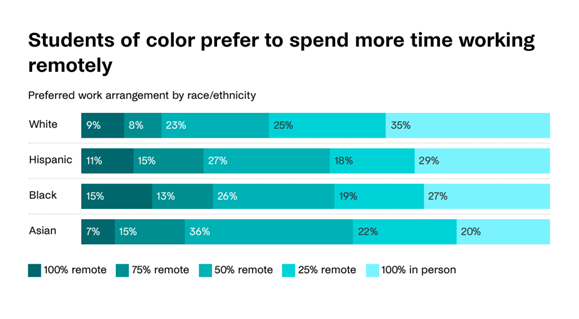
Less than 30 percent of Asian, Black and Hispanic students want to work in person full-time, compared to 35 percent of white students, according to recent research from Handshake.

The findings are from a 2023 survey of 3,809 randomly selected students from the online recruiting platform’s network of college students and alumni. Handshake is based in San Francisco.

Data on remote jobs was based on applications to full-time remote and in-person jobs submitted between January 2022 and April 2023 by bachelor’s degree students. The graphs below are from Handshake.

students of color.pngOther recent surveys have found that new graduates in general want hybrid schedules, which combine remote work with the opportunity for in-person networking and collaboration several days a week. Seventy percent of the 2,756 college seniors surveyed by LaSalle Network in March indicated they prefer working from home two to three days per week, a figure similar to the findings for 2022 graduates, according to the report, What the Class of 2023 Wants: How to Attract and Retain the Class That’s Never Satisfied.
An earlier survey from Handshake, conducted June 13 through July 6, 2022, also found a preference for hybrid schedules. Among the 1,432 job seekers in the survey, 55 percent said it’s important that they are allowed to work remotely, but only 15 percent wanted a fully remote schedule, and 23 percent wanted a fully in-person schedule.

But while a majority of students across all races prefer hybrid work, “there is a distinct racial gap when it comes to what ‘hybrid’ ideally means,” Kate Urban, Handshake senior research writer, noted in a company blog post.

White students were more likely to say they want to work remotely about 25 percent of the time. Students of color were more likely to say they want to be remote 50 percent of the time or more.

Many respondents of color, Handshake found, said they feel less day-to-day racial bias and less pressure to assimilate to workplace norms of a predominantly white culture when they work remotely.

Female students and students of color had “so many factors that [they] had to deal with pre-COVID,” such as not having a car, or having to deal with family-care issues, said Valerie Workman, Handshake chief legal officer.

“One of the upsides of going to remote work [was] they could get to work easily, and those barriers were removed,” Workman said. “They don’t want to give that up.”

Preference for remote work is not just a transportation issue, she added.

“Many of them felt there were stigmas in terms of how they were dealt with in the workplace … and challenges of acclimation and inclusion.” Those disappeared when they didn’t have to go into the office, Workman noted.  

In her blog post, Urban quoted a female Muslim student who said working remotely allows her the freedom to practice her religion without worrying about discrimination or compromising her religious beliefs by wearing traditional office attire to fit in.

If diversity, equity and inclusion are part of your recruiting efforts, Workman said, offering hybrid work schedules, or primarily remote work schedules, should be part of the recruiting process.

In the last three years, the number of companies that provided relocation to new hires “severely diminished,” Workman said.

“It’s almost become a rarity in the last 18 months,” she noted. “If they’re requiring [workers] to be onsite … they’re really going to have to start looking at starting relocation packages again.”

Tech Majors

Between 2014 and 2021, the tech industry produced only a 1 percent increase in Black representation within technical roles in large tech companies, according to the NAACP’s Kapor Center.

In its latest survey, Handshake found more students of color are majoring in technology:

  • Asian students: 38.2 percent in 2023, up from 34.2 percent in 2019.
  • Black students: 10 percent in 2023, up from 8.6 percent.
  • Hispanic students: 8.9 percent in 2023, up from 7.6 percent.
  • White students: 35 percent in 2023, down from 43 percent.

Higher percentages of students of color indicated interest in cybersecurity, software engineering, artificial intelligence, information technology and business analytics than white students surveyed, but all groups expressed an equal interest in data analysis, according to Handshake.

The findings show that the efforts of corporations, universities and colleges in encouraging students of color to participate in tech careers have paid off, Workman said. Additionally, these students are 1.5 to two times more likely than white students to say they plan to develop software engineering and cybersecurity skills over the next few years.

current economy job search.png

“This group wants to continue their education,” Workman said. “They know their degree is not the end-all,” and they are aware the skills required to work in technology rapidly change. “This group understands they need to keep learning in order to continue to be viable [employees].”

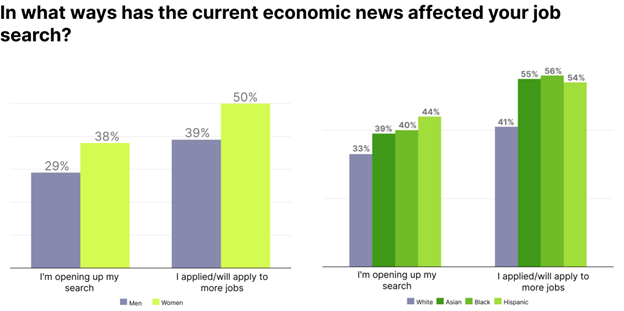
Female students were more likely than male students to indicate that news about the economy has led them to apply to more jobs, apply sooner, and open their job search to more industries, companies, and roles, according to the report. Handshake found a similar trend for students of color:

  • 44 percent of female students said they had applied or were applying to more jobs, versus 39 percent of male students.
  • 55 percent of Asian students said they applied or were applying to more jobs, versus 39 percent of white students.
  • 46 percent of Black students said they applied or were applying to more jobs, versus 39 percent of white students.
  • 42 percent of Hispanic students said they applied or were applying to more jobs, versus 39 percent of white students. 

Other SHRM Resources:
New Grads Use ChatGPT in Job Search, SHRM Online, May 4, 2023.

SHRM Touts Value of Skills-Based Hiring During Congressional Hearing

?As U.S. employers struggle to find workers with the competencies and skills they need, HR departments are beginning to adopt skills-based hiring practices, Mark Smith, SHRM’s director of HR thought leadership, told members of the House Committee on Education and the Workforce on June 22.

“Every day, businesses miss out on talented people because their gifts, aptitude and skills are more challenging to identify than a degree on a resume,” Smith said in prepared remarks. 

He was among four panelists appearing before the Congressional hearing, “Competencies Over Degrees: Transitioning to a Skills-based Economy.”

Other panelists were:

  • Karin Kimbrough, chief economist, LinkedIn Corp., based in Sunnyvale, Calif.
  • Papia Debroy, senior vice president of insights, Opportunity@Work, a nonprofit in Washington, D.C.
  • Dan Healey, head of people for customer success, SAP, which has U.S. headquarters in Newtown, Pa.

Smith’s testimony includes SHRM’s recommendations to Congress relating to the Workforce Innovation and Opportunity Act and the Advancing Skills-Based Hiring Act.

Rep. Virginia Foxx, R-N.C., chairs the education and workforce committee. The hearing covered a wide range of ways for workers to gain and employers to assess skills, including the value of formal and informal apprenticeships, Pell Grants, skill assessments and credentials.

“There is a growing recognition that the old ways of identifying talent are not working for today’s economy,” Foxx said in prepared remarks as she opened the hearing. “To address this issue, job creators across the country are shifting to skills-based hiring to broaden the talent pipeline and fill in-demand, good-paying jobs.”

Debroy pointed out that when employers use a college degree as a job requirement, they create a “paper ceiling” that “automatically screen[s] out 80 percent of Hispanic workers, more than 70 percent of African Americans, 75 percent of rural Americans and nearly 70 percent of veterans.”

There is a movement afoot among state governments to remove a college degree as a job requirement, she said, noting that more than a dozen states in the past 12 months have removed such requirements.

And Kimbrough pointed to LinkedIn data that indicated about 19 percent of job postings—or 1 in 5—in the U.S. no longer require degrees. That’s up from 15 percent in 2021.

SHRM’s 2022 Talent Research Trends report found 79 percent of HR professionals consider pre-employment skills assessments to be as, or more, important than traditional criteria such as degrees or years of experience when determining which applicants are most qualified for a job.

“It’s time we stop making the assumption the only place to get skills is through college and getting a college degree,” Smith told committee members. “Organizations should worry more about the skills and less about where they came from.”

Smith gave the committee information on how employers can use skill assessments to gauge a job applicant and broaden the pool of job applicants from which to hire.

Skills assessments, he pointed out, are not cognitive ability tests. They are “unbiased and validated assessments that measure the critical knowledge and skills required to perform specific jobs,” he said in written testimony. “It is the use of job-relevant tests of knowledge and skills.”

However, SHRM research has found the use of skills assessments is limited because:

  • Employers don’t believe the tests are worth the required time or effort.
  • Employers need more understanding about creating and validating the tests, which “does not have to be overly burdensome,” Smith said.

One approach is to rely on external credentialing organizations, such as the certifications large software companies create that involve rigorous testing to demonstrate various competencies, Smith noted.

He also pointed to O*NET, which the U.S. Department of Labor and the Employment and Training Administration developed to document tasks and worker requirements. It provides information about the nature of nearly 1,000 occupations.

  • Employers fear lawsuits or penalties from the Equal Employment Opportunity Commission or other government agencies and so believe it’s “prudent to avoid testing altogether,” Smith noted in his written remarks.

Skills-based credentials can be challenging for employers because of the increasing number of such programs, Foxx observed.

“Consistent and transparent information about credentials and the competencies they indicate is vital,” she said. Information on credentials should be funded “and easily accessed through the workforce system,” she added.

“It’s really time to rethink how we hire and grow talent,” Kimbrough said. “We see talent everywhere but not access to opportunities everywhere.”   

Other SHRM Resources:
SHRM Foundation Supported by CKF Announces Partnership to Elevate Skills-Based Hiring in the Workforce, SHRM press release, June 2023
Skilled Credentials: Skilled Credentials at Work, SHRM Foundation Resource Page, June 2023
Using Skills Assessments Over Education, Experience Requirements, SHRM Online, August 2022

Are White-Collar Jobs Disappearing? Not Really

?Recent reporting has pushed the idea that we are experiencing the extinction of some white-collar jobs due to a conflation of economic factors and the emergence of powerful automation and AI. Are we?

First, there were months of layoff announcements from technology firms and sectors impacted by higher interest rates. Then, generative AI like ChatGPT showed that artificial intelligence has the power to edge some knowledge workers out of some of their tasks and potentially modify existing professional roles. Changes are happening. But is a permanent shift in labor demand resulting in a sizable loss of white-collar roles really taking place? The data—and experts—point to no.

Preston Mui, senior economist at Employ America, a labor market and economic policy think tank in Washington, D.C., crunched the latest employment numbers from the Department of Labor and confirmed that there has been a significant uptick in white-collar layoffs over the last six months. But employment among many white-collar industries, including professional and business services, also has grown since before the pandemic.  

“Among occupational sectors, employment in professional and business services is the highest relative to before the pandemic,” he said. “There has been an increase in white-collar jobs since the pandemic. On the other hand, for example, there are fewer leisure and hospitality jobs than before the pandemic.”

Jay Denton, chief analytics officer at LaborIQ, a compensation and labor market analytics software company based in Dallas, pointed out that the average unemployment rate for white-collar jobs overall is 1.7 percent, an almost negligible number. “White-collar jobs have some of the lowest unemployment on record, which is the same as what it was a year ago, before the recent layoffs,” he said.

“The recent layoffs in the press represent a very small number of jobs relative to overall employment,” said Juan Pablo Gonzalez, senior client partner and sector leader for professional services at Korn Ferry. “Unemployment is still near historic lows, suggesting that there are more jobs than there are job seekers. You do see some displacement from large employers, but those folks are finding jobs, including joining startups and smaller businesses. The bottom line is that the labor market for white-collar jobs is incredibly dynamic.”  

Denton said that a breakdown of white-collar industries does reveal that certain areas—such as technology, finance and real estate—are challenged right now, and finding a job in those sectors has temporarily gotten harder.  

“The difficulty has been that some of these layoffs have been so concentrated in a certain industry that when you go to get another job, there are fewer openings and increased competition from so many people just like you who are looking for that same type of job,” he said.

But that’s to be expected as one of the hottest job markets on record cools down.

“Things are coming back into balance,” Denton said. “The job market will feel different than it did the last few years, because employers were starved for candidates then. Having a lobby full of people interviewing for the same job was not the case a couple of years ago. The candidate pipeline was dry, and everyone was a passive candidate. There are now more active job seekers, especially in certain industries.”       

Mui agreed that what employers are seeing is “more likely related to normalization after the pandemic and a slowdown in growth expectations. I don’t see this as related to long-term structural changes to the labor market.”

White-collar roles are growing, but there is some trepidation for certain job seekers, Gonzalez said. “Consulting and accounting firms are continuing to hire, for example, but when the economy slows, one of the first places to cut back on is consulting spend,” he said. “So, in some cases, among early-career hires, offers have been made but start dates may be delayed due to uncertainty.”

The contraction in hiring is the result of a cyclical slowdown in demand, he said. “For example, if the professional firm is servicing technology companies, they are likely experiencing a slowdown. But other sectors, like health care, are growing rapidly, so resources are shifted.”

Experts also disputed that any current job displacement is due to improved automation or AI.

“There is no evidence that any job losses are coming from new AI like ChatGPT,” Denton said. “We all use technology that eliminated jobs in the past, but here we sit with one of the lowest unemployment rates on record. Typically, innovations make things easier and create another set of jobs. We are seeing changes because of technology, but what’s happening is not matching up with the headlines I’m seeing out there.”

Gonzalez said that strictly defined functions may become obsolete as AI becomes more present at work, but overall, jobs will leverage technology and change, not go away.

“Work is being reimagined, not eliminated,” he said. “It’s not that the jobs are going away. The jobs are changing.”

Stay Abreast of Laws Restricting AI in the Workplace

?With employers relying more often on artificial intelligence (AI) to help hire new workers, states have begun implementing new laws and regulations to govern how employers can deploy such tools.

“You can expect more city and state regulation of this because they’re not going to stand around and wait for the federal government to step in. The states are moving to protect their citizens,” Kelly Dobbs Bunting, an attorney with Greenberg Traurig in Philadelphia, told attendees during a concurrent session at the SHRM Annual Conference & Expo 2023 in Las Vegas. “There is a tsunami coming of state regulation.”

Some businesses use AI software that scores job candidates based on their facial expressions, vocal intonation, word choice, eye movement and emotional responses during video interviews to determine if they are trustworthy.

There’s potential for algorithms in AI software to discriminate against Black people and people with disabilities.

“Maybe somebody’s got a speech impediment. Maybe somebody can’t hear very well. Maybe somebody’s got some sort of visual impairment, so if you’re using video to screen applicants, these people aren’t going to score very well, and it’s unlikely that they are going to be moved on to the next round” of the hiring process, Dobbs Bunting said.

Employers must offer an accommodation or an alternative screening process for applicants with disabilities, she said.

Focus on Enforcement

Four federal agencies have pledged to collaborate closely to prevent discrimination resulting from the use of AI and automated decision tools in the workplace. The U.S. Equal Employment Opportunity Commission, the U.S. Department of Justice, the Consumer Financial Protection Bureau and the Federal Trade Commission (FTC) recently highlighted their commitment to enforcing existing civil rights and consumer protection laws as they apply to AI in the workplace.

“Employers will be responsible for rooting out and curing any bias created by the AI software that they use in employment-related decisions,” Dobbs Bunting said. “This includes putting job advertisements on social media platforms that use AI tools to decide which resumes to push forward.”

In general, the FTC has found deceptive uses of facial recognition technology to be a violation of the Federal Trade Commission Act.

In 2019, the Electronic Privacy Information Center (EPIC) in Washington, D.C., filed a complaint with the FTC against HireVue, a South Jordan, Utah-based hiring software company. EPIC said HireVue engaged in unfair and deceptive trade practices because it didn’t tell users that it collected facial data during video interviews. Candidates do not have access to their algorithmic scores. HireVue later agreed to stop using facial analysis of job candidates. HireVue did not respond to a request for comment.

To prevent discriminatory outcomes, employers must “conduct ongoing analyses of the software, even if the vendor says, ‘Don’t worry; I got you. The software’s good.’ Do not believe that, because you will be held liable along with the vendor, if the vendor is mistaken about its impact on hiring,” Dobbs Bunting said. “You have a duty to understand the software, understand how it was tested and continue to test it.”

Human Touch

Employers shouldn’t base employment decisions on AI alone. “There’s got to be a human involved. It cannot be just a machine-driven analysis and result,” Dobbs Bunting said.

Having a machine render a final decision is not strategic or humane, said Otto Berkes, co-founder of Xbox and CEO of HireRoad, an Arlington, Va.-based talent acquisition platform.
“AI is a tool and shouldn’t be framed as being in competition with people. Ever,” Berkes said in an email, separately from the conference. “HR professionals may opt to leverage AI for rote tasks—things like job descriptions—but even then, I would recommend that a person be the final reviewer.”
Dobbs Bunting recommended companies develop policies that spell out when employees can and cannot use ChatGPT or other AI to perform their work, such as generating reports.
“Sooner or later, this [AI] is going to become the norm, but it’s moving so fast,” she said.

Anti-LGBTQ Legislation Stops Some from Applying for Jobs in Certain States

?Over three-fourths (77 percent) of LGBTQ job seekers said they’d hesitate about applying for a position in a state with anti-LGBTQ legislation, and 52 percent said that they would never apply for a position based in a state with anti-LGBTQ laws, according to a recent Indeed survey.

Examples of what is considered anti-LGBTQ legislation include bills limiting the ability to update gender information on IDs and records, bills attempting to weaken nondiscrimination laws, and bills prohibiting transgender people from using the public bathroom facilities they choose.

We’ve rounded up articles from SHRM Online and other outlets to provide more context on the news.

LGBTQ-Specific Benefits to Highlight

LGBTQ job seekers said they look to job postings to see if a potential employer offers LGBTQ-specific benefits, such as health care services with access to LGBTQ-friendly providers, mental health benefits and benefits extended to employees’ domestic partners.

(Indeed)

Progress Made, Still Work to Do

Great strides have been made for LGBTQ equality in the workplace, but absolute equality for LGBTQ employees is an ongoing struggle, and coming out at work is an exhausting, everyday reality for those who are lesbian, gay, bisexual, transgender, nonbinary or queer.

(HR Magazine)

How to Create an Inclusive Space for LGBTQ Workers

Many LGBTQ workers still find themselves feeling excluded, unwelcome and uncomfortable in their workplaces, which can increase stress levels and create additional psychological and physiological effects on these individuals.

(SHRM Online)

How Employers Can Avoid ‘Rainbow Washing’

If Pride celebrations aren’t coupled with meaningful action, such as implementing initiatives to ensure safe work environments for LGBTQ employees and donating to relevant causes, then the organization is engaging in “rainbow washing,” which can compromise recruitment and retention efforts while also discouraging workers from coming out at work.

(SHRM Online)

Transgender Inclusion at Work Reaches Record Numbers

As organizations around the world celebrate the accomplishments of transgender people, the number of companies incorporating policies to protect transgender workers has surged in recent years.

(SHRM Online)

Subscribe to our Newsletter