

HR Leaders Express Concerns About the Future of Generative AI

?In an effort to reassure the more than 450 senior HR executives that attended the recently held Irresistible 2023 global conference for HR leaders in Los Angeles, global HR analyst Josh Bersin found himself explaining what generative artificial intelligence can do for them and the various ways the technology will make their jobs easier.

Bersin, CEO of The Josh Bersin Company; Tracey Franklin, CHRO at Moderna; and Michael Fraccaro, chief people officer at Mastercard, fielded questions from journalists about their experiences using AI tools and their expectations of how their companies will use generative AI to meet their business needs.

Describing attendees as “worried” about predictions that generative AI will replace jobs, Bersin said so far, the AI tools used in HR technology have turned out to be a game changer that have identified skills faster, improved recruiting and training processes, and enhanced talent mobility efforts.  

However, while there are huge benefits for companies that use the technology, Bersin said many C-suite executives will see generative AI as an excuse to lay off employees. “Of course companies are going to try to eliminate jobs with AI. Every time there’s a new technology, that’s the first thing the CFO wants to do,” he said.

The conference comes at a time when there is growing evidence that ChatGPT, DALL·E 2, Midjourney and other generative AI tools can more completely automate work tasks.

Most HR executives have already implemented AI tools in many areas, and the software has helped them, for example, speed up the recruiting and hiring of job candidates, mitigate bias in hiring, glean insights from employee surveys, and create HR chatbots to answer questions from employees. 

Generative AI, however, brings a new dimension of capabilities to the workplace. Employees now can supercharge their ability to create and innovate.

For example, generative AI can produce images for virtual or augmented reality, documents, graphs, emails, videos and product designs.

“Individual workers in virtually every job are going to be super-powered with these tools,” Bersin said.

He added that HR executives will be forced to manage organizational ingenuity on a bigger scale, and that’s going to impact work design, job structure, promotions, pay. This intelligence age “is forcing the HR function itself to reinvent itself in a new way,” Bersin said.

However, since ChatGPT was launched late last year, analysts and IT experts have generally concluded that generative AI will disrupt a workforce that is still adapting to changes wrought by the COVID-19 pandemic, such as remote and hybrid work.

HR executives are now looking at further changes that will demand new approaches and innovative strategies that enrich the employee experience and are built on culture, relationships and, in many cases, a reinvention of work itself.

While analysts conclude that generative AI will create new jobs, the sobering fact is that many jobs will be lost.

A recent report from Goldman Sachs found that across the globe, generative AI is expected to eliminate, repurpose or redefine 300 million jobs.

Another report authored by researchers from Open AI, Open Research and the University of Pennsylvania concluded that “approximately 80 percent of the U.S. workforce could have at least 10 percent of their work tasks affected by the introduction of generative pre-trained transformers (GPTs), while around 19 percent of workers may see at least 50 percent of their tasks impacted.”

Among the jobs that generative AI will impact the most are personal finance advisors and brokers, insurers, data processors, news information and publishing professionals, and credit and mortgage brokers.

While employers might be eager to replace workers with the latest version of AI, Bersin said companies will still need human beings to get work done. “Once you have a bunch of customers depending on AI, you now need people behind the scenes to train it and monitor it and make sure it’s not giving the wrong answers,” Bersin said.

Fraccaro said that while Mastercard hasn’t deployed generative AI tools yet, executives are exploring possibilities, and employees are curious about what the technology can do. He added that Mastercard has established very clear guidelines for employees, telling them it’s OK to play with the tools, but that there are some uses of generative AI that employees should avoid at the workplace.

“For example, putting together a client brief or using it in the way of interacting with a particular client. There are some, again, guardrails, because at the moment, it is still nascent,” Fraccaro said. 

He also pointed out that generative AI uses large language models, and humans still need to verify the system’s responses to queries. Fraccaro added that “whether it’s the recruiter or the hiring manager, they still are accountable for what goes out there to the market.”

Currently, Mastercard uses AI tools to monitor and detect potential fraud, to screen job candidates and eliminate bias, to schedule appointments between job applicants and their hiring managers, and to drive its internal talent marketplace platform, where employees looking for opportunities within the company are matched with projects that are posted on its talent marketplace platform.

While Fraccaro expects that generative AI tools will improve over time, he said AI governance is critical to moving forward with the technology. “We’ve got an AI governance steering committee that will look at particular use cases. We want to make sure that there’s areas of focus around trust, data, and data privacy, security [and] who owns data. All of those principles are very important.”

The panel also discussed how organizations will change and what role HR executives will play as generative AI empowers employees with more knowledge delivered at faster speeds, giving them greater insights to make quicker and more informed decisions.

Franklin said that as generative AI tools are rolled out across organizations, HR executives will be faced with changes that will force them to pay attention to the ecosystem of the organization. She said how the workplace comes together to operate at a high level of effectiveness and efficiency will depend on everything from how HR executives are organized to how they’re governed to how they interact.

“HR being an architect over those things is a critical skill set as we think about moving forward,” she said.

Nicole Lewis is a freelance journalist based in Miami.
The Top 6 Best Employee Recognition Software in 2023

In a competitive business landscape, finding the best employee recognition software is now paramount for fostering a positive work culture and maximizing employee engagement.  Among the myriad options available, some solutions stand out as the top contenders for 2023: Nectar HR and WorkTango.  These platforms help you acknowledge and appreciate employee contributions, driving motivation, and […]

The post The Top 6 Best Employee Recognition Software in 2023 appeared first on Workology.

Are White-Collar Jobs Disappearing? Not Really

?Recent reporting has pushed the idea that we are experiencing the extinction of some white-collar jobs due to a conflation of economic factors and the emergence of powerful automation and AI. Are we?

First, there were months of layoff announcements from technology firms and sectors impacted by higher interest rates. Then, generative AI like ChatGPT showed that artificial intelligence has the power to edge some knowledge workers out of some of their tasks and potentially modify existing professional roles. Changes are happening. But is a permanent shift in labor demand resulting in a sizable loss of white-collar roles really taking place? The data—and experts—point to no.

Preston Mui, senior economist at Employ America, a labor market and economic policy think tank in Washington, D.C., crunched the latest employment numbers from the Department of Labor and confirmed that there has been a significant uptick in white-collar layoffs over the last six months. But employment among many white-collar industries, including professional and business services, also has grown since before the pandemic.  

“Among occupational sectors, employment in professional and business services is the highest relative to before the pandemic,” he said. “There has been an increase in white-collar jobs since the pandemic. On the other hand, for example, there are fewer leisure and hospitality jobs than before the pandemic.”

Jay Denton, chief analytics officer at LaborIQ, a compensation and labor market analytics software company based in Dallas, pointed out that the average unemployment rate for white-collar jobs overall is 1.7 percent, an almost negligible number. “White-collar jobs have some of the lowest unemployment on record, which is the same as what it was a year ago, before the recent layoffs,” he said.

“The recent layoffs in the press represent a very small number of jobs relative to overall employment,” said Juan Pablo Gonzalez, senior client partner and sector leader for professional services at Korn Ferry. “Unemployment is still near historic lows, suggesting that there are more jobs than there are job seekers. You do see some displacement from large employers, but those folks are finding jobs, including joining startups and smaller businesses. The bottom line is that the labor market for white-collar jobs is incredibly dynamic.”  

Denton said that a breakdown of white-collar industries does reveal that certain areas—such as technology, finance and real estate—are challenged right now, and finding a job in those sectors has temporarily gotten harder.  

“The difficulty has been that some of these layoffs have been so concentrated in a certain industry that when you go to get another job, there are fewer openings and increased competition from so many people just like you who are looking for that same type of job,” he said.

But that’s to be expected as one of the hottest job markets on record cools down.

“Things are coming back into balance,” Denton said. “The job market will feel different than it did the last few years, because employers were starved for candidates then. Having a lobby full of people interviewing for the same job was not the case a couple of years ago. The candidate pipeline was dry, and everyone was a passive candidate. There are now more active job seekers, especially in certain industries.”       

Mui agreed that what employers are seeing is “more likely related to normalization after the pandemic and a slowdown in growth expectations. I don’t see this as related to long-term structural changes to the labor market.”

White-collar roles are growing, but there is some trepidation for certain job seekers, Gonzalez said. “Consulting and accounting firms are continuing to hire, for example, but when the economy slows, one of the first places to cut back on is consulting spend,” he said. “So, in some cases, among early-career hires, offers have been made but start dates may be delayed due to uncertainty.”

The contraction in hiring is the result of a cyclical slowdown in demand, he said. “For example, if the professional firm is servicing technology companies, they are likely experiencing a slowdown. But other sectors, like health care, are growing rapidly, so resources are shifted.”

Experts also disputed that any current job displacement is due to improved automation or AI.

“There is no evidence that any job losses are coming from new AI like ChatGPT,” Denton said. “We all use technology that eliminated jobs in the past, but here we sit with one of the lowest unemployment rates on record. Typically, innovations make things easier and create another set of jobs. We are seeing changes because of technology, but what’s happening is not matching up with the headlines I’m seeing out there.”

Gonzalez said that strictly defined functions may become obsolete as AI becomes more present at work, but overall, jobs will leverage technology and change, not go away.

“Work is being reimagined, not eliminated,” he said. “It’s not that the jobs are going away. The jobs are changing.”

Technology Can Be Used to Achieve Pay Equity

?To achieve the maximum benefit from a mature pay equity practice, human resource executives will need the right technology to generate critical data that, when analyzed, can determine how to arrive at equal pay and compensation for employees. Employers must also commit to making pay equity core to their operations, which can be difficult to do.

Ask Julie Harding, senior vice president of people at Veritone, a Denver-based artificial intelligence company that provides an array of prebuilt and custom applications for its customers.

When Harding started working at Veritone in late 2019, pay equity was a concept the company discussed, but as the company’s revenue grew and the demand for AI projects increased during the pandemic, the company focused more intensely on building out a true compensation philosophy—with pay equity as a component. 

During the height of the pandemic, Harding and her team sought executive and board member alignment on the company’s pay equity philosophy as it designed the foundation of a pay equity program that will grow with the company over the next five years. 

The company began evaluating the different components of compensation, such as variable compensation, bonus and commissions in spiffs, equity in stock options or shares, and long-term incentives.

“It takes a lot of time, discussion and analysis to align where an employee fits and who their peers are within the market so that we can analyze and actually vet equitable compensation bands by role, by function and by level,” she said. “That alone took us about two quarters. At that point we had not started to assess actual internal employees.”

Veritone uses Workday’s human capital management and payroll system as its primary data source for information such as gender, ethnicity, tenure, education, time in the role, and performance, which are some of the factors included in the company’s assessment. 

The company also uses the Radford Global Compensation database to benchmark rewards and monitor workforce salary and compensation trends worldwide.

After defining the company’s philosophy and rewards strategy, bringing company leaders together to get behind the project, conducting job evaluations, performing skills assessments, and selecting the technology it would use to build out its pay equity practice, Veritone finalized its compensation bands in October 2021.

Harding added that individual employee analysis occurred in the last quarter of 2021 and the first quarter of 2022.

“We are constantly looking at pay equality and we are constantly reassessing the program, the practice, and the philosophy as we continue to evolve as an organization,” Harding said. “It doesn’t stop after you’ve got people equally paid. It’s something that you constantly have to assess if it’s going to makes sense for the employer and the employee.” 

How to Build a Pay Equity Framework

Analytics and technology are a critical part of building a pay equity framework, according to a report titled The Definitive Guide to Pay Equity, published by The Josh Bersin Company.

The authors recommend HR and other company leaders involved in a pay equity project use analytics and technology to:

1. Analyze internal and external equity. Define a process of reviewing both internal equity (i.e., comparisons to others in the organization) and external equity (i.e., comparisons to the broader market). Analyzing both these areas can result in more actionable outcomes, and technologies like Salary.com provide this capability in a single solution.

2. Define demographic categories. The report notes that organizations should determine which demographics will be used for pay equity audits (e.g., gender, ethnicity, nationality, sexual orientation, disability status, etc.). Data from The Josh Bersin Company reveals that 84 percent of companies don’t expand their demographics beyond gender. However, high-performing companies are 34 times more likely to consider a multitude of demographics in their pay equity analysis.

3. Conducting ongoing statistical analysis. Conducting statistical analysis to isolate issues and applying advanced statistical concepts and dedicated technology to scale the process will help companies gain a clearer picture of their pay equity issues.

“Since this process is complex, companies are well served using specialized technology for scale (e.g., Salary.com, Syndio, or Trusaic). Only 14 percent of companies use specialized technology for pay equity and those that do are 3.2 times more likely to engage and retain employees and 7 times more likely to attract needed talent,” the report stated.

Where to Find Vendors

Vendors are angling for a larger piece of this market. Meg Bear, president and chief product officer, SAP SuccessFactors, said pay equity tools are embedded in her company’s core human capital management product. She said the company’s data model understands all the layers such as the demographics and the actual data on pay.

Bear also explained that SAP SuccessFactors gives customers the tools to generate data and to use the tools to layer on the other pieces of their pay equity practice. 

“Our tools help customers answer questions such as, ‘How do you think about where you want to be within the pay range? How do you think about hybrid work? And, how do you think about regional pay bands.’ We are not in the business of market data,” Bear added. 

Data from Stamford, Conn., based research firm Gartner Inc. shows that pay equity is already on the radar of most organizations. In the 2022 Gartner Pay Equity and Transparency Survey, 72 percent of respondents said pay equity is a high or very high priority for their senior leaders.

Seventy-six percent said they understand that pay equity is more than just a compliance issue, and nine out of ten total rewards leaders said they are addressing role-to-role pay equity. Among HR leaders polled, 84 percent said they’ve already taken action on pay equity. 

Ron Hanscome, research vice president, HCM Technology Transformation at Gartner, noted large HCM vendors don’t have all the tools to build a mature pay equity practice.

Hanscome said the response to the market from large suites like Workday or SAP “is a complicated intersection between compensation administration or planning—which the suites don’t have—and compensation allocation—which the suites provide in varying degrees of depth—along with payroll, and talent analytics.”

He added, “HCM suites are currently focused on pay analytics, meaning they can slice and dice compensation data based on diversity factors, but most don’t have regression analysis on pay equity to show the defining factors of pay equity or pay equity built into other functionalities beyond compensation.” 

Hanscome said he believes there are enough specialist vendors like Syndio, ADP, Trusaic or PayAnalytics in Europe and an increasing array of compensation management vendors like Payscale, HRSOFT, Salary.com and Opencomp that can support a more proactive and systematic approach to pay equity.

As companies increasingly look to technology to find pay equity tools, Hanscome said many organizations chose point solutions versus using the suites for pay equity, and this trend will continue.

“Like many niche markets, point solutions operate to deliver deeper support than what the larger suites provide. We expect this will continue for the foreseeable future,” he said.

Nicole Lewis is a freelance journalist based in Miami.
Case Study: Feedback Tech Tools Can Spur Employee, Company Success

?Connecting managers with employees has always been an important component of employee and, ultimately, company success. Tools that deliver two-way feedback with speed and ease of use are critical in today’s fast-paced organizations. But trust and experience are still the foundation of great employee-manager interactions.

Gail Thakarar is a seasoned HR executive in New York City with experience in every area of HR, across industries ranging from health care to manufacturing. She now consults for CEOs of Fortune 500 companies, startups, and private equity and venture capital firms that are going through major organizational change and transformation while building resilience.

Thakarar said employee surveys, pulse surveys, Net Promoter Scores, one-on-one meetings and team meetings are important ways to collect feedback. But they only tell part of the story. She is a firm believer in creating a culture where employees feel free to approach a manager or supervisor at any time.

“This kind of culture requires trust, transparency and confidentiality. Take interest in your employees first as a person,” Thakarar said.

WorkTok: 2-Way Mobile Feedback

Lisa Leath, SHRM-SCP, chief people officer at Vantaca in Wilmington, N.C., is the founder of Leath HR Group, which provides fractional HR management to companies that don’t have an HR director, need HR support or want recruiting for hard-to-fill roles. Under her leadership, Leath HR Group developed WorkTok, a mobile and web-based application for collecting employee feedback that grew out of Leath’s personal experience.

While working for a health care practice administrator, Leath noticed the administrator rarely had positive interactions with her nurses because they were always with patients. The only time the administrator saw her nurses was when they were complaining or, worse, quitting. Leath visualized a tool that regularly checked in with the nurses without being too time- consuming or invasive and ensured that the administrator was thinking about them.

“My idea was to drive feedback between a supervisor and employee to build trust and rapport, give employees a voice before they quit, and give the supervisor the opportunity to ultimately retain them,” she said.

WorkTok provides simple, two-way mobile and web-curated conversations for employee check-ins. Managers can conduct quick two-way communication through the app. Toks can be set to recur daily, weekly or monthly and are launched with push notifications to employees’ mobile devices. Toks typically take 20 seconds to two minutes to answer, enabling employees to quickly provide feedback while walking between meetings or on the way to their car at the end of the day. WorkTok sends a push notification once per day until a Tok is answered. The feedback is saved to the cloud for future reference. When an employee answers a Tok, their submitted responses are sent to the manager’s mobile device with a push notification.

“This app is not meant to replace face-to-face communication between supervisor and employee, but to supplement and ensure two-way feedback is regularly happening,” Leath said.

Frontline managers can launch their own Toks to employees, so HR doesn’t have to take the lead. WorkTok also enables a supervisor to create custom check-in questions. Managers can respond to feedback right away via the app or respond later when they have had time to prepare responses. Employees who require follow-up or a live conversation are flagged, enabling managers to prioritize them.

The Technology Behind the Tool

Leath developed the skeleton version of WorkTok using Outlook Calendar, Slack and SurveyMonkey. She ultimately partnered with Wayne Hippo, a fellow Penn State graduate and managing partner of PS Solutions, a software development firm headquartered in Altoona, Pa., to enhance the tool. PS Solutions developed the latest version plus enhancements using mobile app push notifications and auto-emails with calendar reminders.

“It has taken three years to get the app working the way it does today,” Leath said.

She said that developing the app as a mobile tool was an easy choice. “People carry smartphones with them 16 hours a day. There is no better way to make feedback easy to give and receive than to push it to the employees’ phones and throw automatic reminders on their calendars,” Leath said. “And as managers continue to support remote workers with regular micro-touchpoints and two-way communications about morale, priorities, resiliency, work environment and performance, employees feel valued.” 

Positive Results with WorkTok

Supervisors from over 100 companies using WorkTok across industries have found it to be nonthreatening, quick and easy to use. “Responding from behind a screen is resulting in leaders receiving a lot of honest dialogue,” Leath said. “By asking for feedback regularly, WorkTok enabled the employee satisfaction needle to move in a positive direction. Teams have become empowered.

Leath, who often refers to herself as the “slayer of HR nightmares,” said WorkTok also goes beyond employee/supervisor check-ins. CyberTok, a collection of 20 security-focused templates within WorkTok, trains and delivers knowledge checks on cybersecurity. Requests for feedback about a specific project, COVID-19 check-ins, 401(k) communications, and meeting and training feedback are also integrated into the tool.

Ohanafy: Connecting Employees to Business Goals

Natalie Waggett is CEO of Ohanafy, a software company laser-focused on the craft beverage industry, which is typically lacking in HR structure and process. Ohanafy’s software is built on Salesforce serves as a customized end-to-end management tool from beverage production through sales, and enables easy manager-to-employee feedback. As Waggett and her co-founders—Ian Patrick, Chris Dowling, Davis Bryson and Matt Keeter— developed the HR components of the software, they set out to deliver the highlights of human capital management that worked for each of them in the past, particularly transparent communication on tangible, measurable goals matched to business growth. 

“We help our customers invest in the people who serve in this industry by keeping employees informed, giving them actionable feedback on a predictable schedule, and ensuring goals are clearly and concisely communicated,” Waggett said. “These capabilities give our beverage industry customers a competitive advantage in the marketplace.”

Managers can use the software to create employee feedback records specific to an individual’s performance on measurable goals with deadlines. Once set, goals are visualized on graphical dashboards. Workflow and automation then deliver immediate notifications when goals have been met.

Delivering a ‘Scalable Brewery-Specific Solution’

Waggett limited the functionality in the first software release to drive industry adoption. “Based on our belief that motivated, informed and inspired employees help drive success, we cut back on the sparkle and delivered the nuts and bolts,” she said.

She also employed an in-house development team. “Being former consultants, we were poised to ask the right questions and understood the impact of every feature we built into the tool as we delivered a scalable brewery-specific solution,” she said.

Ohanafy has additional functionality, including inventory control; equipment maintenance; raw materials and supplier data; delivery routes; and sales results. Brewery entrepreneurs can use the information to demonstrate performance to potential investors. The tool also stores interview feedback, creates offer letters and saves employee data necessary to employ a brewery worker legally. In addition, the platform delivers both generalized and industry-specific training.

“We made sure flexibility, security, safety, reliability and configurability were included in our tool,” Waggett said.

Beth A. Klahre is a freelance writer from coastal North Carolina with previous leadership experience in global HR operations.

Maxwell Wins SHRM’s 2023 HR Technology Startup Competition

?Maxwell, a platform for work/life balance benefits, has won the third annual SHRMLabs Better Workplaces Challenge Cup (BWCC). The announcement was made June 12 at the SHRM Annual Conference & Expo 2023 (SHRM23) in Las Vegas.

SHRMLabs is the workplace innovation hub and venture capital arm of SHRM. The competition aims to bridge the gap between companies that are creating workplace technologies and the end users of their products: HR professionals and their workforces.

“We would like to congratulate the Maxwell team for their creativity and resourcefulness to the human resource field,” said Alex Alonso, chief knowledge officer at SHRM. “As each new competition year passes, we get to see a new crop of competitors present new solutions to meet the existing gaps in the market. We’d also like to thank all the startup teams that submitted proposals—it’s exciting to see all the new ideas coming into this field.”

Based in Omaha, Neb., Maxwell is an app that provides a work/life balance benefits platform.

The startup was selected from a three-round competition involving over 450 initial submissions. At each round, innovators presented to a panel of judges composed of HR practitioners and business executives. The BWCC finalists gave one last pitch to a panel of judges at SHRM23, including celebrity judge Suzy Welch, bestselling author, “Today” show/CNBC contributor and Stern Professor of Management Practice at New York University; Amber Clayton, senior director of the SHRM Knowledge Center; Tim Sackett, president of HRU Technical Resources; William Tincup, president and editor-at-large of RecruitingDaily; and Jeff Wald, founder of Boomerang Intelligence.

Maxwell’s founder and CEO, Adriana Cisneros Basulto, recently spoke with SHRM Online about Maxwell and how it improves work and the practice of human resources.

“Maxwell helps employers retain employees by bringing them balance and joy and delivering the employee value proposition that HR teams have worked hard to build,” she said. “Employees receive a monthly budget to use how they choose to balance life/work via our technology. With their attention captured, Maxwell makes it easy to elevate traditional benefits; present important information you don’t want your employees to miss; create connection; and capture employee data like demographics, levels of productivity and stress, so employers can make better decisions.”

Cisneros Basulto added that there is a growing work/life imbalance worldwide. “There are talent segments and industries like health care that are struggling with burnout and a lack of balance,” she said. “We know that when employees feel valued by their employer and are able to recharge, they are better at their jobs. However, what helps someone balance and feel valued is uniquely personal. Maxwell helps employers meet the diversity of needs their employees have to find balance.”

Maxwell was awarded a cash prize of $50,000.

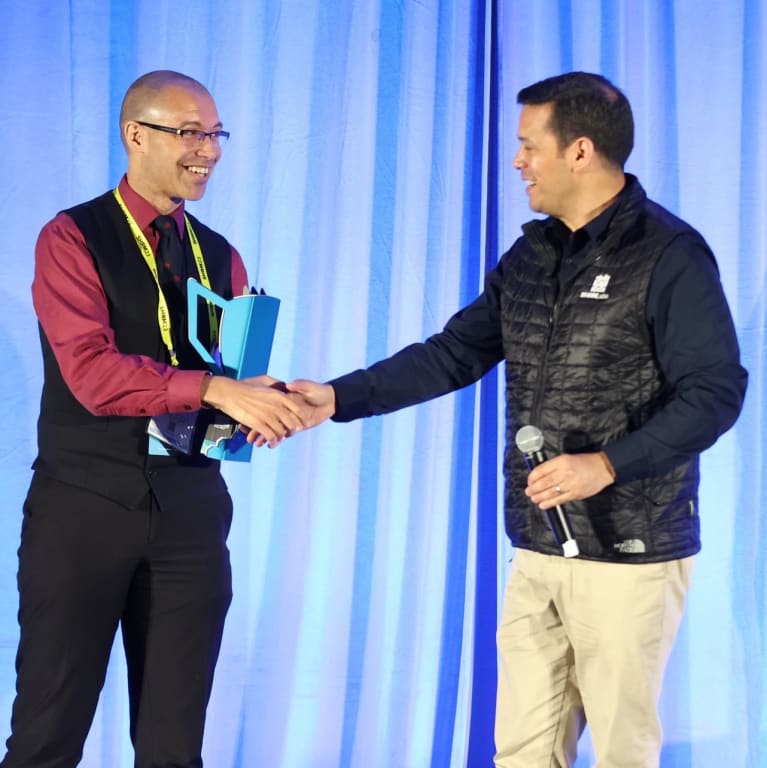
Collin Gehl shakes hands with Guillermo Corea.The other SHRMLabs 2023 BWCC finalist was Inuka, a coaching platform based in Amsterdam that improves employee resilience, engagement and business performance.

This year SHRMLabs also launched its member track, and the inaugural winner is Collin Gehl, human resources director for Say Yes Buffalo and president of the Buffalo Niagara HR Association. Gehl was recognized for creating a professional development program designed to help emerging leaders within his organization.

“Each year, I can’t help but be inspired by the next generation of innovators solving critical workplace challenges across the globe,” said Guillermo Corea, managing director of SHRMLabs. “The solutions presented have real-world impact, and we’re serving as a platform to make an even bigger impact. Congratulations to all the competitors, at each stage, for their work and dedication.”

HR Must Understand Risks, Benefits of AI

?Human resource leaders must educate themselves about AI so they can utilize its benefits in their work and explain to all employees how it can be implemented through the organization, according to a panel at the SHRM Annual Conference and Expo 2023 in Las Vegas.

Understanding AI will also help HR leaders discuss the technology with their elected officials as various levels of government consider legislation to regulate the technology that’s becoming more prevalent throughout the workplace and society at large.

“You don’t need to become a machine learning engineer,” Megan Smith-Branch, deputy lead, AI Ethics and Safety Team at Booz Allen Hamilton, told attendees at June 11 conference session, “The Road Ahead: The Intersection of Artificial Intelligence & Workplace Policy.” Smith-Branch suggested treating AI as a team member and that HR professionals should think about some of their biggest challenges and how AI might help solve them.

The panels acknowledged that some employees fear the technology and worry about losing their jobs because of it.

“We are not going to be enslaved to machines. That’s not the point,” said Anjelica Dortch, senior director government affairs at SAP. She said AI is a tool that can help individuals do their jobs.. For example, SAP has used technology to create job descriptions. It also considering how it might use AI to aid help to keep educating and developing staff.

However, Dortch added, companies must be aware of the risks of using AI.  For example, that EEOC recently issued guidance that employers can’t rely on assurances given by makers of the technology that it complies with civil rights laws. Dortch added that anyone who uses generative AI must ensure that the product it produces doesn’t violate any privacy or copyright laws. Employers must also beware that their workers aren’t loading proprietary information into open systems.

For example, on three separate occasions, Samsung employees in Korea put confidential company information into ChatGPT while using it to help them do their jobs, according to reports published in April. The employees’ actions came soon after Samsung had reversed a ban on using the technology; earlier this month the company reinstated the prohibition, reports said.

Jo Anna Lebo, vice president of HR at Lodging Dynamics Hospitality Group, a Provo, Utah-based hospital management company, said concerns about data safety and legal risks have kept her from embracing the technology.  However, she said that the idea of using it to create job descriptions and other materials was compelling.

Likewise, Sarah Priszner, senior HR manager for ABS, a Spring, Texas-based provider of certification services for the marine and offshore industries, said that safety concerns have kept her from utilizing AI. But she also said that she needs to learn more so she can fully understand the risks and benefits.

Ken Meyer, SHRM-SCP, principal, KWM HR Consulting LLC, said it is imperative for HR people to learn more so they can become advocates for their companies as more and more legislation about AI is considered.

In April, the U.S. Commerce Department asked the public for comments on potential accountability measures and policies to ensure that AI systems are legal, effective, ethical, safe and otherwise trustworthy. The agency said it would issue a report after examining the responses. And four other federal agencies recently pledged to collaborate closely to prevent discrimination resulting from the use of artificial intelligence and automated decision tools in the workplace.

“You need to engage with your public officials,” said Meyer, who is also the president of New York City SHRM.  He points out that NYC passed a law that said that employers can’t use AI tools to make hiring and promotion decisions unless the technology is audited by an outside vendor for bias.

He said that the small nonprofit health care systems he works with can’t afford such audits, and that puts them at a disadvantage because they compete against large hospital systems for staff.

“We have been regulated out of using such tools,” Meyer said.  

How Technology Supercharges Employee Referral Programs

?Employee referral programs continue to be one of the most effective ways to recruit new workers amid ongoing labor shortages. Studies show getting employees to refer candidates from their own networks results in lower recruiting costs, improved hiring rates and new employees who stay longer with a company. 

But the effectiveness of employee referral programs increasingly depends on the quality of the technology platform chosen to administer the process. Outdated systems or those lacking the right automated tools can result in lower participation rates among employees; more manual work for already time-starved recruiters; and referral programs that can work in opposition to diversity, equity and inclusion (DE&I) initiatives.  

How Technology Fuels the Referral Process

Interest continues to run high in technologies that help advertise, automate and track processes tied to employee referral programs. No longer do recruiters have to rely on an applicant tracking system (ATS) or company intranets with limited functionality to administer referral programs. Research from Select Software Reviews, a company that provides reviews of HR and recruiting software in Cambridge, Mass., found that interest in employee referral-based recruiting increased 64 percent in the past year.

“Companies are still looking to hire faster and in more cost-effective ways,” said Phil Strazzulla, founder of Select Software Reviews. “Many are hesitant to spend more money on yet another sourcing tool or more on LinkedIn and are doubling down on getting their employees to refer more qualified people in their own networks.”

Referral technology platforms can provide many benefits to recruiters and employees, but not all are created equal. SHRM Online spoke with recruiting industry analysts and practitioners to identify what capabilities separate the best referral platforms from the rest, how to get the most from an existing system and criteria to use when selecting a new platform.

Keep Employees Informed

One of the biggest frustrations employees have with referral programs—an issue that often makes them “one and done” with the referral process—is not being kept in the loop on the status of their referrals. People naturally want to know if their referral has been received, whether interviews have been scheduled and where their referred candidate stands in the hiring process.

“You don’t want employees to think they’re sending their referrals into a black hole,” Strazzulla said. “You need a platform that automates communication and keeps employees apprised of what’s happening to their referred candidates once they’ve been submitted.”

A platform also should be able to automatically track changes in referral outcomes as well as the progress of referred candidates through a hiring pipeline. For example, if an employee refers someone to a level 1 nursing job but they’re eventually hired as a level 2 nurse, the system should automatically calculate a different incentive bonus for the referring employee.

Build a Seamless Integration with the ATS

The foundation of an effective and user-friendly referral platform is a seamless integration with an ATS. Experts say that integration should be so strong that recruiters never feel they’re working in two separate systems.

“In terms of change management, you don’t want to change your recruiters’ core technology experience, which is within the ATS,” said Mike Stafiej, CEO of ERIN, an employee referral platform in Pittsburgh. “With a seamless integration they should still be able to do their referral work right out of the ATS without having to toggle between two platforms. The referral platform should simply feed more qualified candidates into the ATS.”

Provide Referral Recommendations

Employees often don’t have time to scour their professional or personal networks for contacts who are the best fit for open roles, and in other cases may not be current on the latest qualifications of many in their networks. For that reason, automated tools and artificial intelligence that can access employee networks and identify the best matches for job openings can be invaluable features of referral platforms.

“Most people don’t know all of the current skills and capabilities of everyone in their networks,” said Kara Yarnot, vice president of strategic consulting services at recruitment agency HireClix in Gloucester, Mass.

Strazzulla said top referral platforms have these “social graphing” capabilities. “A recruiter trying to fill an open engineering position might be able see an employee went to school with a certain contact, so the recruiter can then ping the employee and ask to be put in touch,” he said.  “That’s a good way to supercharge the recruiting process.”

But recruiting analysts say it’s essential that these recommendation engines be used in ways that are compliant with data privacy laws like the General Data Protection Regulation (GDPR) and the California Consumer Privacy Act. Such laws require companies to receive consent before storing any data from contacts in employees’ LinkedIn, social media or other networks who might be good referral candidates.

“Providing recommendations within employee networks is a feature many recruiters want, but there are legal hurdles involved,” Stafiej said. “It’s important to support the process with a very compliant workflow.”

ERIN, for example, has a feature in its platform that allows recruiters to turn on a GDPR-compliant workflow tool in these circumstances. “No personal data is stored in our databases when it’s turned on,” Stafiej said. “We send a message to the contact, but until they accept the message and give us explicit permission to store their data, we store no background on them.”

Mobile-First Design and Flexible Options

Recruiting analysts said today’s platforms should feature a mobile-first design that allows employees to easily refer candidates via text or email from their phones, especially if companies are looking to expand referrals beyond white-collar positions.

“Referrals used to be thought of only as a channel for recruiting white-collar workers, but they’re an increasingly successful strategy with blue-collar roles,” Strazzulla said. “That makes having a mobile-first strategy essential, since many blue-collar employees work in deskless environments and rely entirely on their phones.”

Employees also should have flexible referral options that allow them to either provide a resume for a referred candidate or simply send an email and phone number if that’s all they have to get a process started, Yarnot noted. “Employees should be able to share jobs with the networks via text, social media or by email using branded templates,” she said.

Boost Employee Participation with Rewards, Gamification

Next-generation platforms aim to address a long-standing problem with referral programs: the considerable period of time employees often have to wait to receive bonuses for referring candidates who are hired.

“Part of the problem historically is bonuses might be big, but they are too far out to motivate people,” Stafiej said. “It might take months to hire someone that’s referred, then the employee making the referral has to wait another 90 days or more during a waiting period after the hire before the bonus pays out.”

To counter that problem, more platforms now use micro-rewards and gamification strategies to reward employees not just for eventual hires but for participating in the referral program.

“People are rewarded for participating and sharing a job opening with their networks or logging into the platform with regularity,” Stafiej said. “It might be a gift card or things like points that go toward raffles for a large prize. It helps keep employees engaged and incentivized beyond the bonus they might receive.”

Yarnot said platforms also should have flexible leaderboard tools to help drive gamification.  “This allows you to run custom contests for individuals or between groups around referrals broken out by divisions, locations or employee resource groups,” she said.

Automatic Onboarding

Experts say platforms that automatically onboard newly hired employees into referral programs can help boost results and jump-start the referral process.

Research shows those most likely to make referrals are new hires, and automatically sending them an invite that explains the benefits of a referral program can get more employees enrolled in the process right away.

Solving Conflicts Between Referral Programs and DE&I Initiatives

A long-standing concern about employee referral programs is that they can work in opposition to DE&I initiatives. Because employees tend to refer those with similar educations and backgrounds—and often of similar race and gender—it can limit the diversity of referral candidate pools, research shows.

Yarnot believes when implemented with an eye toward DE&I, referral programs and technology platforms that administer them can actually increase candidate diversity. “The best first step is to engage with employee resource groups (ERGs) as you’re building your referral program and designing workflows on your technology platform,” she said.

One key is to involve a diverse group of leaders from your company who can effectively champion the referral program. “I’ve worked with many organizations that have leveraged their ERGs to increase diversity by running contests among groups for the most qualified, diverse referrals and by hosting recruiter visits during ERG group meetings,” Yarnot said.

Candidate, an employee referral platform in Seattle, takes a unique approach to the DE&I issue by soliciting referrals from outside an organization’s existing employee base. Candidate is a two-sided referrals marketplace where employers can post open roles with a corresponding referral bonus for individuals at large who make successful referrals.

“Making referrals shouldn’t just be limited to people working inside your four walls,” said Ryan Agresta, CEO and founder of Candidate. “By working to attract referrers from a wider range of backgrounds and specialty areas, we think the odds of making referrals of more diverse candidates grows.”

Stafiej said recruiters need to encourage and incentivize employees to think in terms of diversity when making referrals. “We have a client organization in Spain, for example, that gives employees a $500 bonus for referrals but increases that number to $1,000 if people refer a woman that gets hired in the sales department, since that group has historically been male-dominated,” Stafiej said.

Dave Zielinski is principal of Skiwood Communications, a business writing and editing company in Minneapolis.

The Top 5 Best Performance Management Tools in 2023

Having a top performance management system in place is paramount to drive organizational success. Read more about the best tools here.

The post The Top 5 Best Performance Management Tools in 2023 appeared first on Workology.

Survey Tools Used to Boost Employee Engagement, Well-Being

?Ever since Matthew Grossman became director and head of workforce analytics at Organon, he’s been building an employee feedback system that digitizes employees’ concerns and generates insights that help managers take action to improve the employee experience. 

Headquartered in Jersey City, N.J., Organon is a global health care company with a portfolio of therapies and products that target women’s health care. The company became its own entity in June 2021 after it successfully spun-off from Merck & Co.

Grossman, who started his job when the company began operations, knew that management wanted a better sense of what employees were thinking, not only about their transition to a new workplace, but also about how their remote-work schedules would evolve over time. 

Like many HR executives, Grossman understood the value that feedback from employee surveys could bring to developing strategies for Organon’s approximately 10,000 employees, many of whom transitioned from Merck.

Gaining insights into worker sentiments has numerous benefits. Recent data from global technology research firm International Data Corporation (IDC) shows that organizations that invest in Voice of the Employee (VoE) resources are:

  • More likely to realize revenue improvements owing in large part to improved operational success on goals, reduced turnover and improved operational efficiency.
  • More likely to realize improvements in productivity due, in part, to significantly stronger employee buy-in to an organization’s operational guidelines and goals. 

To tap into the benefits of employee survey data, Grossman and his team turned to Temecula, Calif.-based company Perceptyx, which provides an employee listening and people analytics platform. Grossman used Perceptyx’s tools to target three primary areas:

1. Employee engagement. Organon’s HR team wanted to encourage employees to feel connected to their work and understand their level of enthusiasm toward their job.

2. Employee well-being. Organon’s HR team wanted to know the extent to which employees feel supported and can balance their work with time to rest or recharge. This was especially important during the pandemic when employees shared their struggles with work/life balance and stress at work. 

3. Belonging. Organon’s leadership team wanted their workers to feel accepted for who they are and confident that they will be successful while being their authentic selves. 

“With Perceptyx’s tool, we’ve built an instrument that measures those and other areas about the employee experience that help us understand how we are doing in those three dimensions and what other areas we can work on as an organization that might be driving growth in those areas or detracting from growth,” Grossman said.

Putting Data to Work

The pandemic has slowed down since Organon began operations, and the company leveraged data from their surveys to inform U.S. corporate policy. For the 85 percent of employees who work overseas, work schedules are handled on a per country basis.

Initially, Organon gave U.S.-based employees the option to work in the office on a voluntary basis. To monitor employee sentiment over time, Organon’s surveys are conducted annually, the first of which occurred in September 2021. Its follow-up survey, conducted one year later, provided insights into employees’ behavior and revealed differences in how men and women felt about returning to the office.

“On average, when men came to work at the office, more often their engagement, well-being, and sense of belonging went up,” Grossman said. “On the flip side, when women came to work at the office more than once a week, their engagement, well-being and their belonging scores were lower on average.” 

Based on this data, Organon implemented a hybrid work model in the U.S. with the expectation that corporate employees who live within a certain radius of the office should all work in the office each Wednesday, and optionally come into the office more often. This, the company decided, helps employees achieve the work/life balance that works best for them. 

“The most important thing to do after a survey’s results are shared is to take action,” Grossman said. 

In addition to its annual survey of approximately 50 questions, which can be answered in roughly 13 minutes, Organon polls new employees 14 days after they’ve joined the company and follows up with two additional surveys at 30 days and 90 days.

They also survey employees on an ad-hoc basis to take deeper dives into programmatic initiatives as well as relationships with peers and managers and perceptions of growth opportunities.

Crunching the Numbers

As companies increase the frequency of their employee surveys, software vendors such as Perceptyx, Medallia, Qualtrics and others are providing cloud computing-based platforms that can accommodate tens of thousands of survey participants who use laptops, mobile phones or tablets to participate in surveys conducted anywhere and anytime.

Additionally, visualization tools that quickly present information through charts and graphs, giving HR managers a clearer picture of trends or artificial intelligence that can help organizations sift through employee comments to gain deeper insights, are the kinds of tools that link the employee experience with actions and behaviors. 

According to Joseph Freed, vice president of product at Perceptyx, the company uses natural language processing (NLP) to highlight sentiments and insights from the comments employees add when answering questions that require longer responses.

“We’ve developed our own natural language processing models which allow, for example, the customer to pull out intense comments that show anger, praise, wants, needs and concerns,” Freed said.

Employers using the NLP models “can use those insights to understand the drivers of things like attrition or burnout,” Freed added.

Employee survey software can form a common basis for VoE data collection that often gives HR the insights to drive organizational change while helping line managers identify immediate employee issues that then can be resolved in the flow of work, said Zachary Chertok, research manager, employee experience at IDC.

“Without integrated VoE insights with organizational and workforce performance guidance,” Chertok said, “organizations are missing an important foundational aspect of connecting employees into the nature of how the organization can and should evolve to meet employee needs around such aspects as well-being, engagement and belonging.”

Nicole Lewis is a freelance journalist based in Miami.

Subscribe to our Newsletter