Hollywood Actors Strike; UPS May Be Close Behind

​Hollywood actors are striking over pay and other concerns. Screen Actors Guild—American Federation of Television and Radio Artists (SAG-AFTRA), the union that represents film and TV actors, said negotiations with the Alliance of Motion Picture and Television Producers (AMPTP) broke down.

The leaders of SAG-AFTRA approved a strike on July 13, and actors will be on the picket line starting on July 14. We compiled a group of articles on the news from SHRM Online and other trusted sources.

Two Hollywood Strikes

SAG-AFTRA will strike for the first time since 1980 after failing to reach a new labor deal with the studios. The actors’ strike, alongside a simultaneous screenwriters’ strike, could lead to a quicker end to Hollywood’s labor war.

SAG-AFTRA is Hollywood’s largest union, which encompasses 160,000 members, including TV journalists, stage performers, stunt and background performers, radio personalities and fashion models.

AMPTP represents the major Hollywood studios and streamers, including Warner Bros., Paramount, Netflix, Disney and others.

The union and studios are fighting over how much workers are paid when their shows and movies are licensed to streaming services. Additionally, the rapid growth of artificial intelligence has caused concern among writers and actors that their work could be replaced or replicated by machines.

Actor Matt Damon said, “Nobody wants a work stoppage, but if our leadership is saying that the deal isn’t fair, then we gotta hold strong till we get a deal that’s fair for working actors. It’s the difference between having health care and not for a lot of actors, and we’ve gotta do what’s right by them.”

(Axios and USA Today)

Wages and Benefits

The separate unions for the actors and screenwriters share many of the same concerns and goals, including higher wages, increased residual payments and protections around the use of artificial intelligence.

In early June, roughly 65,000 members of SAG-AFTRA voted to authorize a strike. Almost 98 percent of the voters supported the authorization. The actors were looking to improve working conditions, health benefits and pension benefits. They also wanted more transparency from streaming services about viewership, so that residual payments can be made equitable to that seen on linear TV.

Screenwriters have been picketing for more than 70 days.

(The New York Times and CNBC)

Writers Could Be Terminated

If the Hollywood writers’ strike is lengthy, the entertainment industry might respond by cutting costs, including exiting talent contracts it no longer wants. Such cost-cutting happened during the last writers’ strike, in 2007 and 2008, which lasted about 100 days.

(SHRM Online)

UPS Strike Is ‘Imminent’

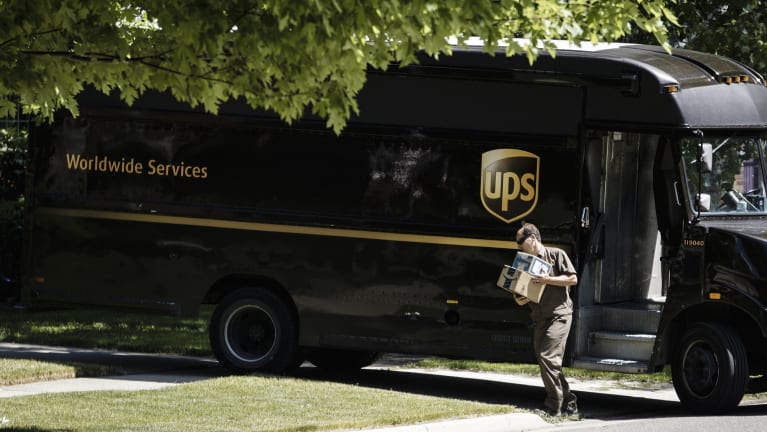
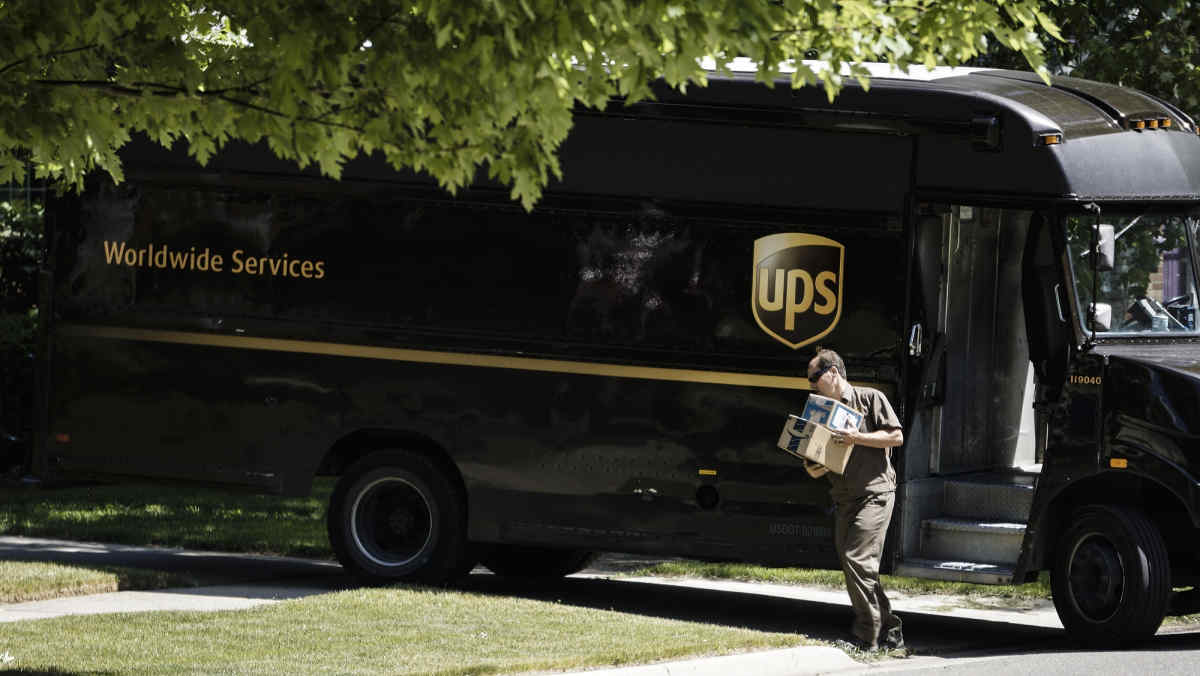
In other labor news, United Parcel Services (UPS) and the Teamsters union that represents UPS workers have walked away from the bargaining table, raising the likelihood of a potential strike this summer. If a strike occurs, it could result in higher prices and longer wait times for businesses and consumers to send and receive packages.

The two sides are pointing fingers at each other in regard to who walked away first from negotiations over a five-year contract. No additional meetings have been scheduled. The current contract expires on July 31.

UPS released a video showing workers marching in practice picket lines. The National Retail Federation, a trade group representing retailers, urged the two sides to resolve their differences before the holiday shopping season.

(Louisville Courier Journal and The Washington Post)

UPS Workers Agreed to Strike

The Teamsters said 97 percent of union members voted in favor of strike authorization if a deal isn’t reached by July 31. The union represents more than 325,000 workers.

The union wants higher pay, the removal of surveillance cameras from delivery trucks and more full-time positions.
(SHRM Online and The New York Times)

NLRB Rules Starbucks Violated Labor Law by Closing Ithaca Stores

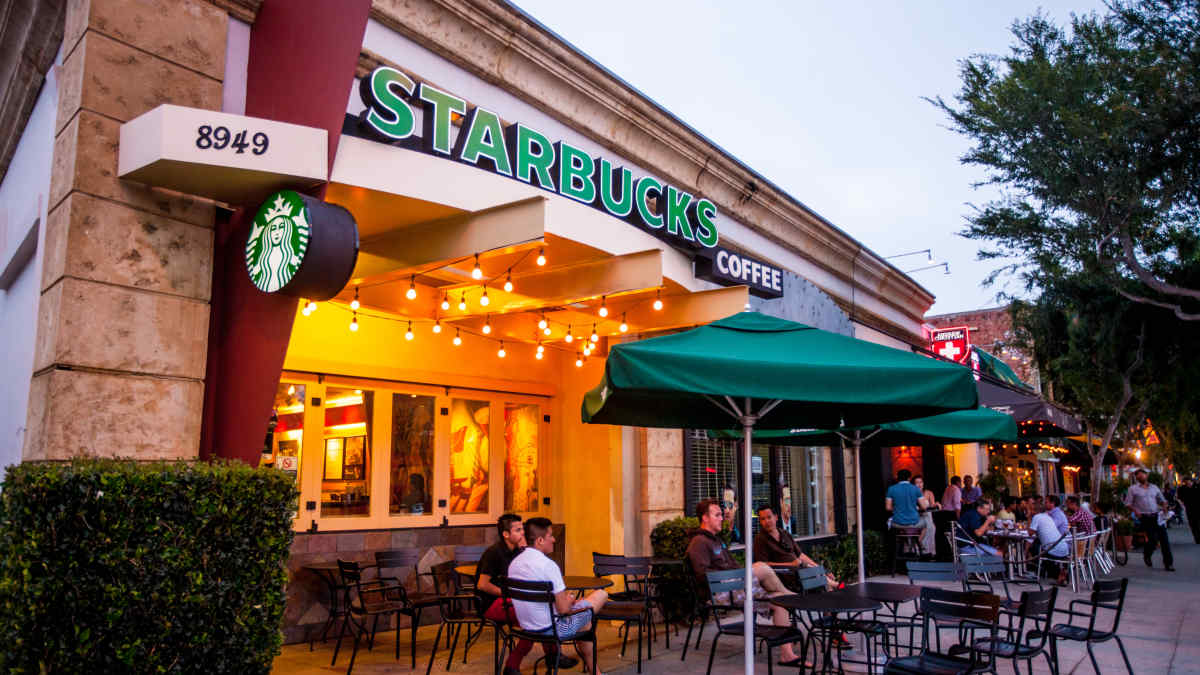
?The National Labor Relations Board (NLRB) on July 6 ordered Starbucks to reopen one of the three stores it closed in Ithaca, N.Y., and reinstate employees with backpay. It found the coffee retail chain engaged in unfair labor practices by closing unionized stores. Starbucks Workers United is the union that represents Starbucks employees.

We gathered a selection of articles on the news from SHRM Online and other news sources.

Starbucks Will Appeal

Deputy Chief Administrative Law Judge Arthur Amchan found the company violated federal labor law on numerous occasions, most of which were related to the treatment of employees at the company’s three unionized store locations in Ithaca—all of which have ceased operations.

Andrew Trull, Senior Manager of Corporate Communications at Starbucks, said the company intends to contest the NLRB’s findings and recommendations.

Starbucks Workers United lawyer Mike Dolce said the store Amchan ordered to be reopened, on College Avenue, will remain closed unless the NLRB files and successfully pursues an injunction in federal court, in support of Amchan’s decision.

Nationwide, about 300 Starbucks stores have unionized since 2021, but none have been able to negotiate a contract. Starbucks did not respond to SHRM’s request for comment.

(The Ithaca Voice)

NLRB Finds Unfair Labor Practices

Amchan concluded that Starbucks violated the National Labor Relations Act several times by dismissing and punishing employees and by more harshly enforcing company policies after the company knew of unionization efforts in its Ithaca stores. He said the company showed anti-union bias by cutting operating hours at stores, telling employees that the College Avenue location would permanently close before an official decision was made, and failing to negotiate with the union.

The NLRB ordered Starbucks to bargain with the union, remove any reference to the unlawful dismissal and penalties given to 11 former employees from their personnel files, post a notice about working rights in all locations nationwide, and distribute that information electronically.

(The Cornell Daily Sun)

Three Stores Closed

The NLRB ruling comes just over a year after the company closed the College Avenue cafe. That closure, on one of Ithaca’s busiest and most heavily traveled commercial corners, came weeks after staff at all three Ithaca locations overwhelmingly voted to unionize. Less than a year after that location closed, the company decided to close both remaining cafes in Ithaca.

(14850.com)

Resistance to Union at Buffalo and Rochester Stores

Last year, Ithaca, N.Y., became the first town nationwide where every Starbucks employee was unionized. Employees in a Buffalo, N.Y., store recently tried to decertify the union, Workers United, which said the decertification was due to union-busting tactics. Likewise, employees at a union in Rochester, N.Y., filed a decertification petition on May 8.

(SHRM Online)

Lawsuit Over Reorganization at Seattle Stores

The NLRB on July 6 sued Starbucks over the coffee chain’s refusal to rehire 33 workers as it reorganized three downtown Seattle stores, including its flagship store in Pike Place Market. In a petition filed in Seattle federal court, the agency called Starbucks’ plan to reorganize the stores into a “Heritage District,” and force 73 workers to reapply for their jobs, an illegal response to unionization efforts at one of the stores, at 1st Avenue and Pike Street.

The petition seeks an injunction to block Starbucks from firing or disciplining workers, denying them higher wages and benefits, or forcing them to reapply for jobs because of their union activities.

(Reuters)

Former Starbucks CEO Denies Union-Busting

Former Starbucks CEO Howard Schultz defended the company’s labor practices, garnering praise and criticism from lawmakers in a U.S. Senate Health, Education, Labor and Pensions Committee hearing on March 29. Schultz said the company has not broken federal labor law. However, Sen. Bernie Sanders, I-Vt., said the company has done so in more than 100 instances.

Senate Committee Approves Workplace Bills

?A U.S. Senate committee recently pushed ahead three bills that could impact union activity, paid sick leave and pay equity requirements for employers.

On June 21, the Senate Health, Education, Labor and Pensions committee voted to advance the Richard L. Trumka Protecting the Right to Organize Act (PRO Act), the Paycheck Fairness Act and the Healthy Families Act on June 21. All three pieces of legislation have companion bills in the U.S. House.

Democrats mostly hailed the bills as beneficial for average workers, while Republicans mostly criticized the bills as being too pro-union.

The bills garnered support from the AFL-CIO, the American Federation of Government Employees, the American Federation of Teachers, the American Postal Workers Union, Communication Workers of America, the Economic Policy Institute, the National Urban League, and Oxfam America, according to Committee chairman Sen. Bernie Sanders, I-Vt.

“These are not radical ideas. Poll after poll shows these are what the American people want to see happen,” Sanders said.

However, Sen. Bill Cassidy, R-La., said, “This legislation will not pass. Why? This is a deeply controversial and partisan set of bills that will never be signed into law. We don’t have agreements on principle, nor agreements on key issues.”

The PRO Act

The PRO Act would:

  • Replace secret-ballot union elections with card-check elections.
  • Prohibit employers’ captive-audience meetings to discuss union activity.
  • Overturn state-level right-to-work laws that say workers can’t be required to join a union or pay union dues as a condition of the job.
  • Require employers to give employees’ personal contact information to union organizers.
  • Stipulate that a worker is an independent contractor only if they are free from the employer’s control and direction in how the work is performed, customarily engaged in an independently established occupation, and performing work outside the employer’s usual course of business.
  • Change the federal joint-employer standard to make franchisors liable for actions by their franchisees.
  • Permit secondary boycotts, meaning a union boycotting an employer’s customer or supplier.

“Workers in America have the constitutional right to assemble and form a union,” Sanders said.

Cassidy said the PRO Act is part of “a disturbing trend by President [Joe] Biden and congressional Democrats to erode a worker’s individual rights,” such as the ability to not pay union dues if they don’t want to join the union.

Sen. Rand Paul, R-Ky., said, “The PRO Act invades workers’ privacy by forcing employers to hand over their personal cell phone numbers, email addresses and home addresses to union organizers, exposing them to unwanted solicitation, harassment and intimidation.”

Secret ballot elections protect workers from intimidation and retaliation related to union votes, Cassidy said. “Policymakers should not be creating an environment that facilitates worker coercion or intimidation,” he added.

The committee voted against amendments from Republican lawmakers that would have struck language allowing secondary boycotts, required union voting by secret ballot, prohibited remote voting in union elections and limited the type of personal contact information employers must share with union organizers.

The U.S. Chamber of Commerce, the International Franchise Association, the National Federation of Independent Businesses and other business groups have spoken out against the PRO Act.

The Paycheck Fairness Act

The Paycheck Fairness Act would stop employers from using salary history in hiring decisions, require employers to show a legitimate reason for gender pay disparities, make it easier for workers to join class-action lawsuits against companies for systemic wage discrimination, and protect workers against retaliation for discussing their salary with co-workers. This bill aims to close the gender pay gap, which currently refers to how U.S. women earn 77 cents for every dollar U.S. men earn.

“Women across the country have been shortchanged for far too much for far too long,” said Sen. Patty Murray, D-Wash. “Women are still being paid less than men, and employers are still able to brush off reports of discrimination with flimsy excuses like ‘he’s a better negotiator’ or ‘he was paid better in his last job.’ “

The pay disparity compounds over the course of a career. “When women are paid less hour after hour, year after year, a lifetime spent working under the wage gap cheats women out of a life-changing amount of money,” Murray said. “We have to limit the use of previous wage history in the hiring process because otherwise we are just letting employers lock in pay discrimination, and we’re just letting the pay gap follow workers from job to job.”

However, Cassidy said, “The Paycheck Fairness Act has the potential to benefit trial attorneys more than working women. It is already illegal to discriminate on the basis of gender, so the law that we’re considering is redundant.”

Healthy Families Act

The Healthy Families Act would guarantee workers seven paid sick days, or 56 hours of paid sick time, per year. Small employers with fewer than 15 employees can provide unpaid sick days, instead of paid sick days. Employers can choose to provide more than the required amount.

“In my view every employee in America deserves paid sick days, regardless of where they work,” Sanders said.

Many private businesses voluntarily give paid sick days to their workers, Cassidy noted. “The market is clearly responding, so let’s let the market work,” he said. “It’s important to the employer that they not be hampered with additional costs and headaches associated with compliance with government mandates.”

Ninety-five percent of employers offered sick leave this year, compared with 96 percent in 2022, according to SHRM Research.

UPS Workers Vote for Potential Strike

?More than 325,000 Teamsters union members at United Parcel Service (UPS) voted on June 16 to strike if no agreement is reached with the company by the time the current contract ends on July 31. We’ve gathered articles on the news from SHRM Online and other media outlets.

Union Concerns

The union wants higher pay; the elimination of two-tier wages, where new workers are paid less than more senior ones for the same job; the removal of surveillance cameras from delivery trucks; and more full-time positions.
A UPS spokesperson said that strike votes are common in contract negotiation and was confident an agreement would be reached before July 31.

(CBS News)

Economic Considerations

UPS said that the average full-time delivery driver with four years’ experience makes $42 an hour. Part-time workers who sort packages make $20 an hour on average after 30 days.

A strike could delay deliveries, resulting in suppliers struggling to quickly ship goods and possibly causing production slowdowns. UPS handles about one quarter of parcels shipped each day in the U.S., according to the Pitney Bowes Parcel Shipping Index.

(The New York Times)

Huge Private-Sector Contract

The UPS Teamsters National Master Agreement is the largest private-sector contract in North America. UPS Teamsters are working for a new five-year agreement. The vote to strike if an agreement isn’t reached “shows that hundreds of thousands of Teamsters are united and determined to get the best contract in our history at UPS,” said Teamsters General President Sean O’Brien. The vote was 97 percent in favor of striking if a strong contract isn’t reached.

(International Brotherhood of Teamsters)

Heat Safety Agreement

UPS and the Teamsters have reached an agreement on heat safety, including vehicle enhancements to improve airflow and temperature. The company has agreed that all newly purchased U.S. small package delivery vehicles will have air conditioning starting Jan. 1, 2024. New vehicles will be allocated to the hottest parts of the country first. UPS also agreed to have a cab fan retrofitted in package cars within 30 days of contract ratification. A second fan in vehicles without air conditioning will be installed by June 1, 2024.

(UPS)

Strikes Were Up Sharply in 2022

Strikes occurred much more frequently in the U.S. last year than in 2021, according to the Cornell University School of Industrial and Labor Relations (ILR). There were 417 strikes and seven lockouts in 2022, up from 279 the previous year, the ILR found.

(SHRM Online)

West Coast Ports Reach Deal with Workers

?West Coast port operators and a union for dockworkers reached a bargaining agreement after some workers had slowed or stopped work.

“The leaders of the International Longshore and Warehouse Union (ILWU) and the Pacific Maritime Association (PMA) reached a tentative agreement covering 22,000 workers and 29 West Coast ports, demonstrating once again that collective bargaining—though sometimes difficult—works,” said Acting U.S. Labor Secretary Julie Su, who met with both sides. “The tentative agreement delivers important stability for workers, for employers and for our country’s supply chain. This important milestone is welcome news to all.”

The workers were seeking higher wages. The work disruptions impacted operations at ports in Los Angeles, Long Beach, Oakland and Hueneme in California, as well as Seattle and Tacoma in Washington.

We’ve gathered articles on the news from SHRM Online and other trusted sources.

Long Negotiations

The previous contract between the two groups expired on July 1, 2022, so they were working for nearly a year to hammer out a deal. The new six-year deal comes after worker stoppages that closed various West Coast port terminals in recent weeks. The work disruptions began June 1.

(CNN and SHRM Online)

Higher Pay

The new contract includes a wage increase of 8 to 10 percent for the first year, according to a person briefed on the details who was not authorized to speak publicly. The deal also includes retroactive pay at that increased rate for the hours that dockworkers worked during the eight months without a contract.

Another long-standing flash point for the union and port management concerned automation—namely, the extent to which port managers can bring in machinery to do jobs currently performed by longshoremen.

(The Washington Post)

Key Ports for Retailers

The agreement is still subject to ratification by both parties. The ILWU and PMA declined to provide details on the deal.

During the negotiations, some businesses had shifted cargo to rival East Coast and Gulf Coast ports to avoid potential labor disruptions. The tentative deal came as retailers are starting to land merchandise for the critical back-to-school, Halloween and Christmas retail shopping seasons. Manufacturers, automakers and food producers who import or export goods rely on the West Coast ports.

(Reuters)

Possible UPS Strike

The outcome on June 14 somewhat mirrored past negotiations with dockworkers. In 2015, as talks went on for nine months, officials in the Obama administration intervened amid work slowdowns and increased congestion at ports.

It is also the second time in six months that the Biden administration has intervened in a labor dispute that could have caused major damage to the U.S. economy. In December, President Joe Biden signed legislation to impose a labor agreement between rail companies and workers.

On the horizon is the prospect of another disruption to the nation’s freight system. The Teamsters contract with United Parcel Service (UPS), covering approximately 340,000 workers, expires on July 31. The union announced the results of a strike authorization vote on June 16. UPS workers agreed to strike if no agreement is reached with the company by the time the current contract expires on July 31.

(The New York Times) and (CBS News)

Tesla Violated the NLRA when CEO Posted Prediction on Twitter

?Takeaway: Regarding Musk’s post, the court found that, while Musk later tried to explain his statement by saying the United Auto Workers’ bargaining would likely cause a loss of stock options, he did not clarify this at the time. The statement, standing alone, could be objectively read as a threat to withdraw stock options if the union were elected.

?The United Auto Workers (UAW) established that Tesla violated the National Labor Relations Act (NLRA) when it fired a union supporter for making a disparaging posting about a nonunion coworker, and when CEO Elon Musk tweeted that employees might not continue to have stock options if UAW became Tesla’s union, the 5th U.S. Circuit Court of Appeals recently held.

Tesla Inc. is a technology and design corporation with a car manufacturing facility in Fremont, Calif. In the summer of 2016, a Tesla employee reached out to UAW to unionize Tesla employees. As part of the unionization effort, the UAW created a voluntary organizing committee of employees who acted as union organizers. As part of the UAW campaign at Tesla, employees who supported unionization leafleted, distributed union paraphernalia, and brought union jackets and shirts into work. In February 2017, an employee posted an online article describing safety conditions and wages of Tesla and advocating unionization.

In September 2017, three Tesla employees, including one who was not a union supporter, went to the California legislature at the behest of Tesla to testify in a public hearing against legislation supported by the UAW. A supporter of the UAW watched a video of the hearing and noted the names of the employees who testified, and he used Tesla’s Workday program to search for them. He took screenshots of their profiles and sent the names to another union supporter. At the time, Tesla had no policy prohibiting nonbusiness use of the Workday program.

The union supporter posted two screenshots, including a screenshot of the employee, to a private “Tesla Employees for UAW Representation” Facebook page. He commented that the pictured employees were in Sacramento, saying the union supporters are lying about how things are at Tesla. He described the testifying employee as making $130,000 a year and said that this proves how much “sucking up” and “riding on people” gets you at Tesla while the ones who do real work get passed over. Someone sent a copy of the post to the named employee, and he objected to the union supporter against the name-calling, after which the union supporter removed the post from Facebook.

The referenced employee also sent a text message and screenshot of the post to HR. He told the HR representative by phone that he felt harassed and targeted. The HR representative sent the complaint to Tesla’s employee relations team and contacted a Tesla investigator about the situation. The investigator wrote a report that recommended firing the union supporter for lying during the investigation and for accessing Workday for nonbusiness purposes.

In addition, Elon Musk maintained the Twitter handle “@elonmusk” to tweet about Tesla’s business decisions and plans, finances, production goals, staffing matters, and breaking news. On May 20, 2018, in response to a tweet that asked Musk, “How about unions?” he tweeted, “Nothing stopping Tesla team at our car plant from voting union. Could do so tmrw if they wanted. But why pay union dues & give up stock options for nothing?”

Several days after the May 20 post, Musk stated he believed that the “UAW does not have individual stock ownership as part of the compensation at any other company,” and as such, Tesla employees would lose stock option if they unionized because “UAW does that.”

Legal Action

The UAW, the fired worker and two other employees filed multiple unfair labor practice charges regarding the firing, the May 20 tweet and other allegedly anti-union conduct. An administrative law judge (ALJ) held a 13-day trial and issued a recommended order and decision against Tesla on most of the alleged violations.

The National Labor Relations Board (NLRB) upheld the ALJ orders for reinstatement of the fired employee and for Musk to delete his May 20 tweet.

Tesla appealed the decision to the 5th U.S. Circuit Court of Appeals, and the UAW appealed seeking a notice-reading remedy at the Fremont facility. The NLRB moved to enforce its orders.

The 5th Circuit denied the petitions of Tesla and the UAW, and granted the NLRB motion to enforce. It found that the evidence indicated that the union supporter had not violated any policy regarding use of Workday before he was fired. The 5th Circuit thus enforced the NLRB’s orders.

Tesla Inc. v. NLRB, 5th Cir., No. 21-60285 (March 31, 2023).

Jeffrey Rhodes is an attorney with McInroy, Rigby & Rhodes LLP in Arlington, Va.

NLRB Case Modifies Independent Contractor Standard

?A new ruling from the National Labor Relations Board (NLRB) alters the standard employers must use to determine whether someone qualifies as an independent contractor.

In the June 13 ruling, the board concluded that the makeup artists, wig artists and hairstylists who work at the Atlanta Opera are employees, not independent contractors. The workers had filed an election petition with the board, seeking union representation.

The NLRB rejected the previous ruling in SuperShuttle that entrepreneurial opportunity for gain or loss should be the animating principle of the independent contractor test. Instead, it said entrepreneurial opportunity should be taken into account alongside a list of traditional common-law factors.

Those factors include:

  • The extent of control the employer exercises over the details of the work.
  • Whether the work is usually done under the direction of the employer or without supervision.
  • Whether the worker is engaged in a distinct occupation or business.
  • How much skill is required in the particular occupation.
  • Whether the employer supplies the tools and the place of work.
  • The length of time for which the worker is employed.
  • The method of payment, whether by the hour or by the job.
  • Whether the work is a part of the regular business of the employer.

“Applying this clear standard will ensure that workers who seek to organize or exercise their rights under the National Labor Relations Act (NLRA) are not improperly excluded from its protections,” said NLRB Chairman Lauren McFerran.

The SuperShuttle ruling “cannot be squared with board precedent, with the common law, or with Supreme Court precedent,” the NLRB wrote in its opinion.

In this case, the creative workers did not have true entrepreneurial opportunity because in reality there was no other opera across town that they could take their talents to, according to David Korn, an attorney with Phelps Dunbar in New Orleans.

“Hypothetical opportunity should not be considered,” said James Evans, an attorney with Alston Bird in Los Angeles.

The new ruling “is designed and intended to make it much more difficult for employers to classify workers as independent contractors and therefore avoid the potential for those workers to organize,” said Jason Reisman, an attorney with Blank Rome in Philadelphia. “This new decision will serve potentially as a solid deterrent for many employers and create doubt for others, or at least make them think twice and re-evaluate how and how often they utilize independent contractors.”

In light of the NLRB decision, “it might be time to re-evaluate what our written agreement looks like” for independent contractors and how it’s working in practice, said David Pryzbylski, an attorney with Barnes & Thornburg in Indianapolis. “Anybody using independent contractors needs to take notice of this. The gig economy is top of mind.”

“Employers should know is it not enough to rely upon the method of payment or industry past practices and norms to classify and treat service providers as independent contractors,” said Michael Gotzler, an attorney with Littler in Madison, Wis. “The legal risks and attendant financial exposure are too great nowadays for any business to ignore this evolving area of law.”

However, Todd Lebowitz, an attorney with BakerHostetler in Cleveland said, “This is a low-impact decision. More than anything else, it just reflects that different board members have different perspectives when applying the same common-law test, just like different judges have different perspectives when applying the same test,”

How Employees Differ from Independent Contractors

Under federal law, employees may be entitled to union rights, minimum wage, overtime pay and other benefits. Independent contractors are not entitled to such benefits, but they generally have more flexibility to set their own schedules and work for multiple companies.

Contractors can’t form unions and can’t file unfair labor practice charges with the NLRB, Pryzbylski said.

SHRM filed a friend-of-the-court brief with the NLRB in favor of keeping the SuperShuttle standard. “In order to recruit and retain the best talent, especially during these challenging economic times, [businesses] must offer a myriad of work relationship options that provide the 21st-century worker the autonomy necessary to make the best decisions for them and their families. To that end, the availability of independent work is not only valuable to workers, but necessary for businesses to compete in today’s global marketplace,” SHRM stated, noting that almost 50 percent of Generation Z and 44 percent of Millennials engage in some form of independent work.

DOL Action

In October 2022, the U.S. Department of Labor (DOL) issued a proposed rule to clarify who is an independent contractor under the federal Fair Labor Standards Act (FLSA). The DOL is seeking to rescind a 2021 rule in which two core factors—control over the work and opportunity for profit or loss—carried greater weight in determining the status of independent contractors. Under the proposal, employers would use a totality-of-the-circumstances analysis, in which all the factors do not have a predetermined weight.

The comment period ended in December 2022, but the agency hasn’t issued a final rule yet. “The DOL’s proposed rule seems to track” the latest NLRB ruling, Pryzbylski said.

West Coast Ports Face Work Disruptions

?Dockworkers on the West Coast are slowing or stopping work in order to seek higher wages in union negotiations with their employers. The actions have impacted operations at ports in Los Angeles, Long Beach, Oakland and Hueneme in California, as well as Seattle and Tacoma in Washington State.

We gathered a set of articles on the news from SHRM Online and other trusted sources.

Negotiations Going Slowly

Unionized dockworkers throttled cargo operations at several West Coast ports on June 5, extending job actions that have snarled imports at some of the country’s biggest trade gateways.

The disruptions, which began June 1, are continuing as the dockworkers and their employers wrangle over a new multiyear labor contract that covers more than 29 ports from California to Washington State. The sides have been negotiating for more than a year and have reached tentative deals on benefits and on terms for the use of automation but have hit a roadblock on wages.

(The Wall Street Journal)

Acting Labor Secretary Working on Agreement

More than 22,000 dockworkers have been working without a contract since July 2022. Contract talks between the employers’ Pacific Maritime Association (PMA) and workers’ International Longshore and Warehouse Union (ILWU) are in the final stretch, but frustrations are running high after more than a year at the negotiating table.

A source familiar with the talks said Acting Labor Secretary Julie Su is engaging with the parties.

ILWU International President Willie Adams on June 2 said dockworkers played a vital role in keeping goods moving in the early days of the COVID-19 pandemic and would like to share in the record profits reaped when cargo surged.

(Reuters)

Retailers Raise Concerns

The National Retail Federation is calling on the Biden administration to intervene in negotiations to resolve the labor dispute ahead of the summer, heading into the peak holiday shipping season.

“Thousands of retailers and other businesses depend on smooth and efficient operations at the ports to deliver goods to consumers every day,” said David French, senior vice president of government relations at the National Retail Federation.

(CNN)

Growing Number of Strikes

Strikes occurred much more frequently in 2022, compared to 2021, according to the Cornell University School of Industrial and Labor Relations (ILR). There were 417 strikes and seven lockouts in 2022, up from 279 the previous year, the ILR found. Approximately 224,000 workers were involved in the work stoppages last year, up from 140,000 in 2021—a 60 percent increase.

(SHRM Online)

Rules for Permanent Replacements

Under existing law, employers may not use permanent replacements during an unfair labor practice strike or during a lockout. The office of the general counsel for the National Labor Relations Board recently recommended adding significant restrictions to when employers may use permanent replacements during economic strikes—when workers seek higher wages, shorter hours or better working conditions.

(SHRM Online)

The Evolution of HR and Labor Relations

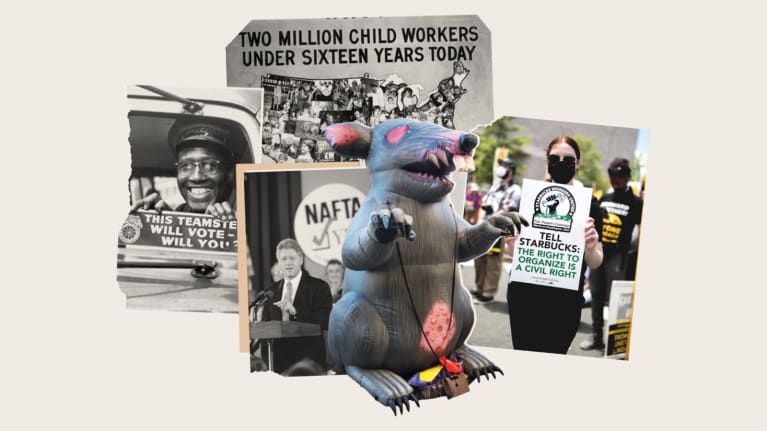
?The history of labor unions in the United States encompasses more than 150 years of negotiating for better pay, benefits and working conditions for American workers. 

The first U.S. labor union was launched in 1866, and in the decades that followed, unions played a critical role in guaranteeing worker safety and fair pay. But after peaking in the mid-1950s, union membership rates have fallen steadily ever since.

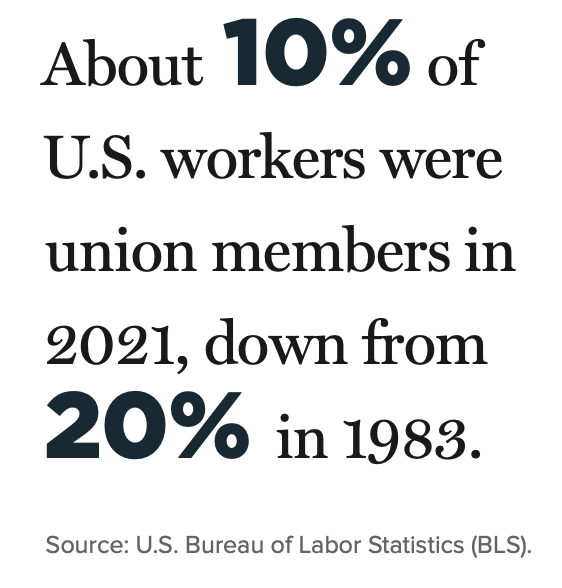
About 10 percent of U.S. workers were union members in 2021, down from 20 percent in 1983, according to the U.S. Bureau of Labor Statistics (BLS). The union membership rate of public-sector workers (34 percent) was five times higher than the rate of private-sector workers (6 percent) in 2021, and the highest unionization rates were among workers in education, training and library occupations (35 percent) and protective service occupations (33 percent), the BLS reported. Screen Shot 2023-06-02 at 91141 AM.png

New state and federal laws, and the deindustrialization and globalization of the American economy have all contributed to the decline of union membership, according to Steve Bernstein, an attorney with Fisher Phillips in Tampa, Fla. 

In addition, employers have changed their practices in order to recruit and retain good workers; doing so may have reduced the attractiveness of unions. “Frankly, employers are just treating people better” by embracing more fairness and consistency, Bernstein says. “They’ve had little choice. It’s a competitive issue.”

Still, there’s been no lack of attempts to unionize. High-profile wins were notched for new unions at Starbucks and Amazon in recent months, but these victories haven’t been enough to staunch the overall membership decline nationwide. 

“Unions are winning a greater percentage of representation elections than they have in quite some time,” Bernstein says. “They’re just not having enough elections.”

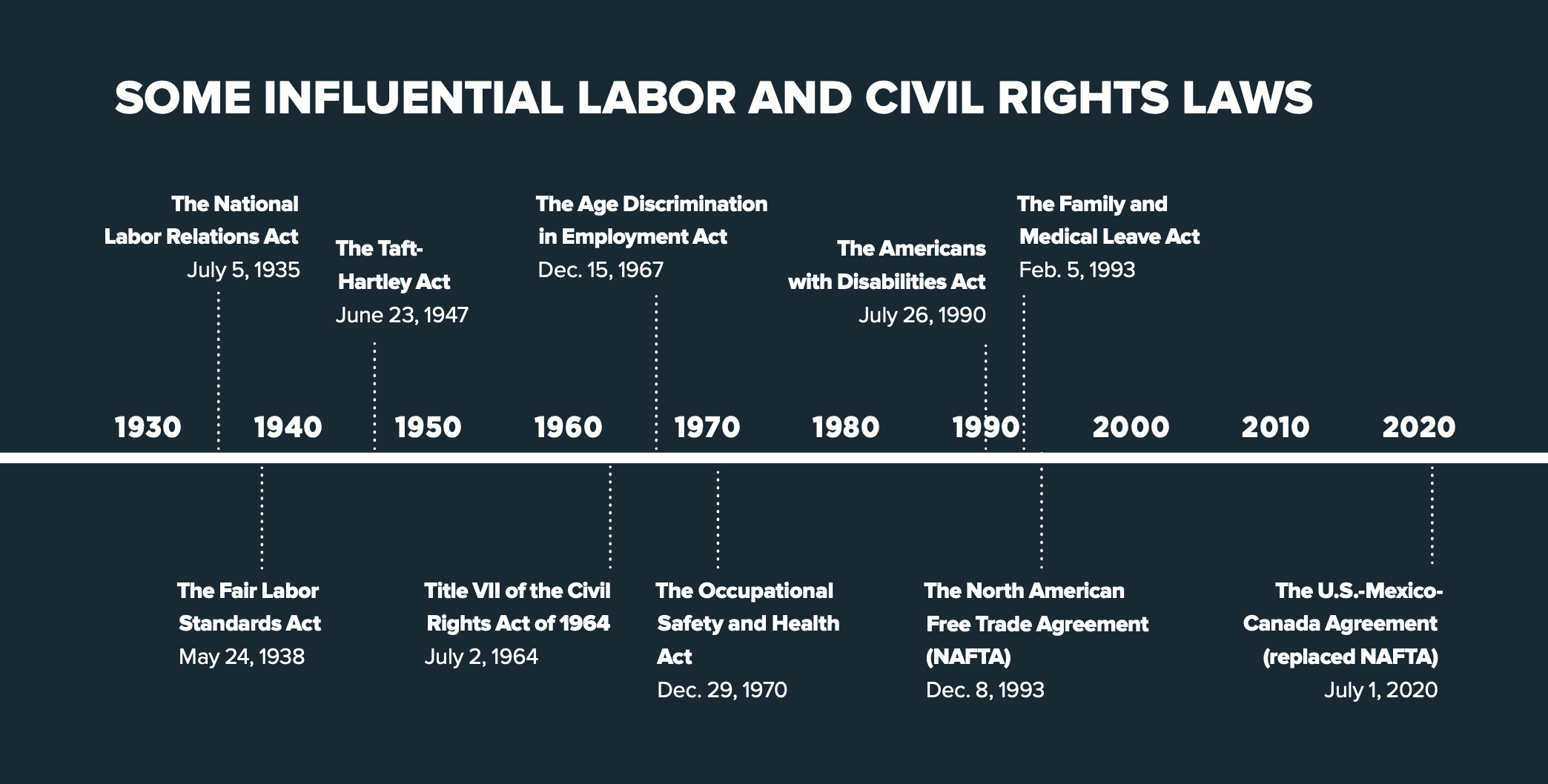
Pivotal Laws

Several federal laws were critical in shaping the power and trajectory of labor unions in this country. They include the National Labor Relations Act, the Fair Labor Standards Act and the Occupational Safety and Health Act (OSH Act).

In some cases, union ­representation may have seemed less necessary after state and ­federal laws were passed to ­protect workers and improve working ­conditions. 

steve.png
‘Unions are winning a greater percentage of representation elections than they have in quite some time. They’re just not having enough elections.’
STEVE BERNSTEIN

“A lot of promises that organized labor was making were more impactful in the absence of federal protections,” Bernstein says.

But employers shouldn’t underestimate the influence of unions in getting some of those labor laws passed. Unions pushed harder for the passage of the OSH Act than other institutions, Bernstein notes.

timeline.png

Global Economy

Globalization weakened U.S. ­labor unions during the last 20 years ­because many companies moved their operations overseas. This led to the collapse of the U.S. steel industry, which was heavily unionized, ­according to Matthew Fontana, an attorney with Faegre Drinker in ­Philadelphia. 

“Unions are struggling to find ­relevance in that dynamic,” ­Bernstein agrees.

The U.S. economy has become more knowledge-based and ­service-based. There’s been a shift away from the traditional union industries, such as steel and manufacturing, toward more unions in health care, education, food service and janitorial service. 

“Unions had trouble figuring out how to organize the jobs that remained,” Fontana says. “They’ve figured it out now.”

The rise of globalization and the fall of union membership aren’t a blip in the longer trajectory, Bernstein says: “These trends are not short-term trends. They carry the weight of history. It’s going to take a lot to slow down these trends.”

However, public-sector unions didn’t see the same impact from globalization as private-sector unions did. “Public-sector union [membership] has stayed steady,” Fontana says.

steve.png
‘Because domestic workers work in private residences, they have faced unique challenges in organizing to improve workplace conditions.’
HAEYOUNG YOON

Younger Generation

Today’s entry-level employees want different things than workers in the past did. For example, they are asking for flexible schedules and remote work. 

“It’s a fight for the hearts and minds of these workers,” Bernstein says. “They’re more sympathetic. They view unions more favorably. They’re more independent-minded.”

Some young workers gravitate toward unions for social justice and political solidarity. 

“That’s something that often surprises employers,” Fontana says. “Workers believe in what unions stand for. They believe collective bargaining can be part of a social justice framework. You’re seeing a real energy among younger folks.” 

Unlike in the past, today’s union organizers are a more diverse group and include young workers, women and people of color. 

“What you’re seeing now—the changing face of organizing—reflects the changing face of the workforce,” Fontana notes.

An example is the National Domestic Workers Alliance (NDWA), which has more than 70 chapters in 30 cities and represents nannies, housecleaners and others who are primarily women of color and immigrants. U.S. domestic workers started unionizing in the 1960s with the National Domestic Workers Union of America before the organization changed its name to NDWA.

“Because domestic workers work in private residences, they have faced unique challenges in organizing to improve workplace conditions,” says Haeyoung Yoon, senior director of policy and advocacy at the NDWA in New York City. 

“Domestic workers are specifically excluded from federal labor protections like anti-­discrimination and harassment laws and the right to unionize, and almost all domestic workers are not covered under the federal minimum wage law. Despite these barriers, domestic workers have organized for decades.” 

While many things have changed about employees and union members, some things have not. 

“The worker of today isn’t so different from the worker of yesterday in terms of their core human needs,” Bernstein says. “What people really want in the workplace is to be listened to, to have access to decision-making and to be in a position to at least influence their workplace.”  

Leah Shepherd is SHRM’s senior legal editor.

Illustration by Valerie Chiang.

Strikes Not Legal If They Harm Property

A new ruling from the U.S. Supreme Court demonstrates how unions may have to pay hefty penalties if a strike causes damage to a company’s property.

In Glacier Northwest v. International Brotherhood of Teamsters, the court ruled 8-1 on June 1 in favor of an employer that sued in state court after a strike risked significant damage to its trucks.

The National Labor Relations Act (NLRA) gives workers the right to strike, but those protections don’t apply if workers fail to take reasonable precautions to avoid foreseeable, imminent harm to the employer’s property.

“The ruling means that employers stand a better chance of succeeding in their lawsuits against unions for damages resulting from property damage,” said Dan Altchek, an attorney with Saul Ewing in Baltimore. “That, in turn, could cause unions to think twice about striking if there is a concern that the strike could cause property damage and could also be found to be unprotected under federal labor law.”

“The ruling in this case is actually quite narrow. It will permit a tiny fraction of cases where strikers damaged the employer’s property, or even injured people, to be decided by a state court,” said David Miller, an attorney with Bryant Miller Olive in Miami. “Only those cases where it can be shown that the strikers or union essentially intended to cause the damage will squeak through the crack into state court. All other such cases will continue to be heard by the very union-friendly National Labor Relations Board (NLRB).”

“I think in the end the result was correct. I’m not sure it’s significant expansion of current doctrine,” said Arthur Telegen, an attorney with Seyfarth in Boston. “What may change a little bit is some of the strategic responses to a strike.”

Background

Glacier Northwest, a building materials company in Seattle, sued its employees’ union, the International Brotherhood of Teamsters, after workers started a strike while concrete was scheduled to be batched and delivered. The company claimed the striking workers intentionally sabotaged its business operations and property because they waited until the concrete was loaded into the trucks to strike. The union argued that the employer’s state-law claims were pre-empted under federal law.

A Washington state trial court agreed that the state law against intentional property destruction was pre-empted because the union’s actions did not involve vandalism or violence. The Washington Court of Appeals agreed, stating that the strike was arguably protected as a legitimate bargaining tactic.

The Supreme Court reversed and remanded that decision.

“Given that Glacier alleges that the union took affirmative steps to endanger Glacier’s property, rather than reasonable precautions to mitigate that risk, the NLRA does not arguably protect the union’s conduct,” Justice Amy Coney Barrett wrote in the majority opinion.

The court noted striking during work shifts without warning to the business is permissible. “The union’s decision to initiate the strike during the workday and failure to give Glacier specific notice do not themselves render the union’s conduct unprotected,” the court said.

Unions don’t have to prevent the incidental loss of perishable products when they strike, but this case is different because the truck drivers prompted the creation of a perishable product (concrete), the court noted. Thus, the employer could bring its state-law claims.

The Supreme Court “typically applies a high bar before concluding that federal law strips state courts of jurisdiction to hear their own state claims,” Justice Clarence Thomas wrote in a concurrence.

Justice Ketanji Brown Jackson dissented, arguing that Congress intended the NLRB, not the courts, to investigate and address this type of labor dispute. The NLRB is “uniquely positioned to evaluate the facts and apply the law in cases such as this one,” she wrote.

Lessons for Employers

Companies and unions “should evaluate the extent that a strike is likely to cause property damage or losses, as opposed to being merely disruptive,” said Jack Sullivan, an attorney with Dorsey & Whitney in Minneapolis.

Employers should be prepared to respond quickly to strikes, even when perishable products aren’t involved.

“Strikes are often unexpected, at least as to the exact day and hour. When they occur, management must be on the scene as fast as possible and try to assess and, if possible, mitigate property damage and personal injury,” Miller said. “Evidence, including the testimony of management witnesses, must be gathered immediately. All this will be necessary for evaluation of whether the circumstances show intent to do harm. Intent is very difficult to prove circumstantially.”

Subscribe to our Newsletter