56 percent of new hires who met with their onboarding buddy at least once in their first 90 days said the buddy helped them to quickly become productive in their role.
73 percent of new hires who met two to three times with their buddy in their first 90 days said they were more productive.
86 percent of new hires who met four to eight times with their buddy in their first 90 days said they were more productive.
97 percent of new hires who met with their buddy more than eight times in their first 90 days said they were more productive.
Creating a Buddy Program
There was a conscious decision in creating Wasserman’s program to use a diversity, equity and inclusion lens by pairing new employees with buddies from different backgrounds, as well as those outside shared work teams or departments, Mendez said.
“We wanted diverse identities to work together for a common goal, and generational diversity was definitely something that we wanted to normalize in the office,” she said. Pairing people from different departments also encourages the new staffers to develop work relationships beyond their immediate office, she noted.
Restricting the relationship to the new hires’ department could result in new employees getting overly attached to their buddies and becoming uncomfortable branching out on their own, she added.
Microsoft takes a different approach, according to the Harvard Business Review article. It found pairing people who report to the same manager more beneficial because the buddy is more familiar with the new employee’s role and responsibilities.
“We’ve found that when matching buddies with new hires, buddies should have deep knowledge about the new hire’s role and nature of the work, as well as a strong job performance history” said Joe Whittinghill, corporate vice president of talent, learning and insights at Microsoft.
“Having experience with the type of work the new hire will be doing helps our buddy share specific role-related sources; share best practices, tips [and] tricks; and help answer specific questions related to a new hire’s role and team.”
The following tips and lessons were learned from the NYU and Microsoft programs:
Leadership buy-in is key. As with any initiative, do your research before proposing a program and tie it to a specific business purpose or outcome.
Involve external stakeholders. “Our steering committee partnered with the NYU HR department to create a professional development session for both [buddies] and [employees] at the end of the program,” Mendez said. “This partnership truly legitimized the program,” by showing one of its goals was to provide leadership development to staff. This prompted staff members to volunteer as buddies.
Keep a buddy’s tenure in mind. The buddy should be someone who has been at the organization for a while—a year minimum, Mendez said, although two years or more is preferable. “The [buddy] has to serve as an expert and guide to the culture, structure, regulations and unspoken rules of the office.”
Consider the buddy’s workload. The work may need to be reprioritized—or some of it reassigned altogether—so the buddy has time to work with the new employee, according to Microsoft. If an employee who was chosen as a buddy is working on a tight deadline or key deliverable, consider selecting a different teammate to step in.
Use surveys to help determine goals and the pairing of buddies. A new employee might indicate a preference to be paired with someone who specializes in an area the new employee is interested in learning more about, Picone explained. Buddies might also have goals in mind for the new hires. At the Wasserman Center, for example, the buddy might indicate that a goal for the new hire is to learn more about external partnerships or the different divisions within student affairs at NYU.
Keep generational trends in mind. For employers building a program based on the trends and preferences of Generation Z members, Mendez recommended implementing a pairing system that takes into account how that generation prefers to learn and socialize.
“Since Gen Z workers prefer working from home, make sure that you incorporate hybrid programming and also that you don’t schedule anything outside of work hours, as the Gen Z workforce is big on creating boundaries around their work and personal lives,” she advised. “Make sure that you tap into the concept of creating a meaningful work environment,” with the buddies contributing to this environment.
Provide structure. A proper structure is important, otherwise the buddy and new employee “don’t know their roles and they are left to figure out their outcomes on their own,” Mendez said. NYU created a set of “Buddy Guidelines.”
However, it’s important to allow the buddy and new employee to have flexibility, Picone said. “[They] can choose how they want and where they want to meet, whether they decide to meet virtually or in person for a structured meeting, or to get coffee or lunch together.”
Microsoft provides buddies with specific resources, such as checklists, timelines, and suggested conversations or talking points to make sure they are on track, Whittinghill said. Prior to the new employee’s start date, the company also provides managers with a tentative schedule that guides them through best practices and a meeting agenda. The Microsoft buddy is responsible for welcoming the new employee and, working together, deciding the best format and frequency for their meetings.
Send timely reminders. Microsoft sends automated reminders to the new employee, the new employee’s manager and the buddy “to encourage consistent engagement, particularly during the first 90 days of employment,” Klinghoffer, Young and Haspas noted in their article.
Openness is key. “The mentors have to be willing to be open and honest about the realities of the office,” Mendez said, “as well as give their time to build the relationship around the needs of the [employee].”
Collect quantitative and qualitative data to assess intended outcomes. Providing this to leadership will help in the program’s continuation and in assessing the intended outcomes, Mendez said.
Let the program evolve, based on your organization and the responses you receive from buddies and the employees with whom they’re paired. The original program at the Wasserman Center was six months long but was retooled to three months when turnover impacted the number of available mentees, Mendez said.
?In the ongoing effort to engage and retain workplace talent, one distinct trend rings true: Employees who are happy in their jobs are more likely to stay there.
But what does it take to improve your employees’ level of happiness? Here are seven suggestions:
1. Provide Greater Flexibility.
The pandemic changed the way many employees think about going to work. Those who were forced to work from home or other remote locations proved that they don’t always have to be in the office to get work done. Companies that are more flexible about allowing employees who want to work from home the opportunity to do so—at least some of the time—will have less trouble retaining workers.
There’s even a trend of giving workers more free time to help cultivate a happier workplace. In instances where workers are fully remote, this could mean encouraging them to turn off their computers at the end of the workday or to not look at e-mail again until the next morning. For others, it could mean being creative about hybrid or in-office schedules and breaks, depending on the employee’s preferences and family obligations.
“Offering a flexibility is critical to creating a happy workforce,” said Brett Allcorn, CEO and founder of Albany, N.Y.-based Pineapple Co., a health supplement provider with 100 employees and $50 million in global sales last year. As an example, Allcorn shared that he has an employee in the operations department who “asked if it was OK if she could go the gym to work out every afternoon. I immediately agreed since she had already proven herself at the company and I trusted that she would still get her work done.”
2. Clearly Explain the Company’s Values, Purpose and Culture.
Pursuing work that is meaningful and satisfying is a key way to cultivate happiness at work among employees, said Ahron Friedberg, clinical professor of psychiatry at Mount Sinai School of Medicine in New York City and co-author of Towards Happiness—A Psychoanalytic Approach to Finding Your Way (Routledge, 2022). There must be a good fit between workers and their work, he said, which comes from a combination of the positive personalities that most employees bring to their jobs and the fulfilling nature of working for an organization that shares their values and vision.
3. Minimize Micromanaging.
Nobody likes to be micromanaged. Trusting your employees to do the right thing helps to foster a happy workplace, said Jason Cavness, who spent 30 years in the Army in human resources before launching his own company, CavnessHR in Seattle. The happiest workplaces are those where senior leadership trusts employees to get their work done without micromanaging, he said. “If an employee wants to take some time to go to a ballgame with his child, that should be OK,” since employees should be trusted to get their work done in the best way they see fit, Cavness said.
4. Offer Opportunities for Advancement.
Happy workplaces are workplaces where employees “feel a sense of purpose” and believe they have an opportunity to grow their skills and career, said Will Yang, head of growth at Chicago-based Instrumentl, an institutional fundraising platform that helps nonprofits in their pursuit of grants. “Employees who feel like they are stuck in a dead-end position are more likely to be unhappy at work,” he said.
5. Offer Competitive Compensation.
Employees need to feel that they’re being compensated fairly and in a way that reflects their position and work efforts, according to pay and benefits research. Hourly employees especially need to earn enough to pay their bills and have discretionary spending, as well as to create an emergency fund for peace of mind. Workers who think they are earning less than what they should—or that their skills and credentials qualify them to earn more somewhere else—will focus on money when defining their happiness at work. In this case, receiving a raise may be a lot more important for their happiness than the other six happiness factors listed in this article.
6. Encourage Workplace Friendships.
When seeking happiness at work, “relationships with colleagues and co-workers are super important,”Friedberg said. He shared examples of employees who could earn more money at other jobs, but who choose to stay at a current job because “they like their peers, they like their boss and there is an opportunity to learn more.”
In her experience, the most common reason why employees are unhappy is because they don’t have rewarding workplace relationships, said Jeannie Moravits Smith, a leadership coach and HR consultant in San Diego. “People are sticking around in organizations because they feel a sense of joy, they feel they belong,” she said.
When employees are not happy in their jobs, Moravits Smith will ask why. “The lack of connection with their direct manager is No. 1” as the reason workers feel unhappy, she explained. “When there is a mutual relationship of trust and concern, the sky’s the limit in terms of productivity, commitment and even fostering a happier workplace.”
7. Offer Psychological Safety.
On occasion, employees need to share when there is something in their lives that is especially tough for them to handle, said Jenn Lim, bestselling author of Beyond Happiness: How Authentic Leaders Prioritize Purpose and People for Growth and Impact (Grand Central Publishing, 2021) and CEO of Delivering Happiness, a consulting firm in Emeryville, Calif., dedicated to helping companies achieve a happier workplace.
“Happiness starts from within and is tied to that sense of higher purpose,” Lim explained. An open door and resources that allow employees to discuss personal issues helps them feel that their workplace is there for them as they work through issues that are stopping them from being happy, Lim said.
“Happiness starts when people feel they’re heard, they’re seen and they matter,” added Bridgitt Haarsgaard, CEO and founder of The GAARD Group, a New York City-based business consultancy firm.
Jan Yager, Ph.D., is a sociologist in Stamford, Conn., whose 50-plus award-winning books, translated into 35 languages, include 365 Daily Affirmations for Happiness and Productive Relationships (Hannacroix Creek Books, 2012). For more information, visit her website athttps://www.drjanyager.com.
?SHRM President and Chief Executive Officer Johnny C. Taylor, Jr., SHRM-SCP, is answering HR questions as part of a series for USA Today.
Do you have an HR or work-related question you’d like him to answer? Submit it here.
Over the past few years, my work life has become considerably more stressful. It is to the point where my work has become less productive, and I seem to be more exhausted at the end of the day. Can you recommend any practical methods for managing stress at work? —Troy
Johnny C. Taylor, Jr.: Let me first say, you are not alone. According to an American Psychological Association study, nearly 60 percent of those surveyed reported work-related stress marked by lack of motivation or energy and lack of effort at work. No sector, industry or vocation is immune from work-related stress. Fortunately, there are some practical steps you can take to preserve your well-being.
Give yourself permission to prioritize your self-care and well-being. Maintain a healthy diet, exercise regularly, seek professional support when needed and take mental health days as you can. Look into your company’s employee assistance program (EAP) or seek out options through your health insurance. There are also several mental health apps available to help you relax and manage your day-to-day concerns. Self-care and well-being are key factors in decreasing stress.
The last few years have been challenging for us all, but you have survived. Give yourself some credit. Play to your strengths and don’t forget your accomplishments.
Find ways to manage workplace expectations. Try some time management exercises like developing a list of priorities each day, then checking them off as you complete them. When you have conflicting priorities, work with your supervisor to determine a plan of action.
Try not to project too far into the future. Stay in the moment. You can’t control the future. Planning can be helpful—even therapeutic for some—but even the best-laid plans need to have some flexibility built in.
I’ll add this: Remember that it’s OK to ask for help. As humans, we aren’t meant to operate in isolation. Connecting and collaborating with others is how we survive and thrive. It’s OK to admit when you need assistance with a project or task. It’s perfectly acceptable to respectfully decline to take on another project at work that would affect the deliverables of projects you are currently working on.
By using these methods, you can reduce your stress. Reducing your stress will give you your confidence and energy back and allow you to be more productive.
After two years of working remotely, my company will be requiring a return to working in the office three days per week, with the potential for five days in the future. I have grown to prefer working from home. Should I make the case to my supervisor for continuing a portion of remote work, or would I be better off finding a new full-time remote position? —Marcella
Johnny C. Taylor, Jr.: The level of remote work we’ve seen in response to the pandemic isn’t likely to last, especially as we inch toward an economic downturn. While some industries, businesses and positions thrive with remote work, most operations are more productive, efficient and innovative with fully in-person or hybrid work. This means remote work may not be as prevalent as it once was. In this light, if your preference is to stay in your current position, be prepared to make your case for continuing remote work.
Demonstrate why continuing remote work will be beneficial to both you and your employer. Are you more productive and engaged when you can work remotely? Are you able to build and sustain working relationships both virtually and in person? Can you be more productive because you are no longer commuting? Provide a detailed assessment of what work can be done at home and what work is best accomplished at the office.
Before making your decision, consider some of the struggles employees face when working from home, such as feeling isolated, difficulty remaining in front of leadership and any long-term effects it may have on their career. How do you plan to handle those challenges?
I encourage you to see the situation from your employer’s perspective. With remote work, employers are often concerned about the loss of collective productivity and morale, which can be strengthened and improved through interacting in person, developing co-worker relationships and collaborating regularly. Understanding your supervisors’ concerns will help you build a compelling case.
In your justification to your supervisor, cover how you’ll set goals with your supervisor, communicate progress, measure outcomes, and schedule changes with your team and the others with whom you interact. Highlight how you will contribute to the overall productivity of your workgroup, not just your individual performance.
If you don’t get the outcome you were hoping for, remain flexible and prepared to compromise or continue negotiations. Business is always changing, and your supervisor may be more open to the possibility of working from home at a later point in time. Determine what the barriers were in the decision to decline remote work and address them, if possible.
If continuing the conversation is not possible, consider other options such as revisiting the idea within a certain time frame. If your job is not conducive to permanent remote work, assess what is best for your career and personal needs and whether you should seek another job to meet your preferences.
Chris works in a call center that tracks and shares statistics on representatives—the number of calls they handle, the average length of calls, the percentage of successful resolution of calls, etc. Chris—and Chris’ colleagues—know where they stand, and Chris’ standings are pretty dismal. So Chris begins applying for as many internal transfers as possible and finally manages to land a position in another department. Chris’ supervisor, glad to hear the news, remains mum about Chris’ poor performance.
***
Pat has a reputation for being difficult to work with, rude and, on occasion, bordering on engaging in harassment of other employees. Pat’s manager arranges for a transfer to another department in the organization—a lateral move that doesn’t negatively impact Pat’s salary but is to a position with less visibility and less authority.
***
Robin and Fran have both applied for an internal transfer to a position in the sales department—a coveted role representing the opportunity to boost their income through generous sales incentives. Robin gets the job. Fran, who is 65 years old and has more experience with the company, as well as a record of strong performance, feels she was overlooked because of her age.
***
Each of these situations represents potential risks that can be created through internal transfer practices. It’s important to understand the risks and how to successfully manage internal transfers to benefit both employees and the company.
Should You Transfer Underperformers?
Matt Gomes is a partner at Weinberg Wheeler Hudgins Gunn & Dial in Atlanta. “Transferring an underperforming employee creates the possibility that, after the person is disciplined or discharged [from that second job], he or she challenges the decision by arguing that their past poor performance could not have been that bad,” Gomes said. “Otherwise, they wouldn’t have been transferred, but rather, disciplined or discharged.”
Another risk may be that the employee perceives the internal transfer as retaliation, said David C. Miller, a labor and employment attorney at Bryant Miller Olive in Miami. For instance, he says:
§ What if the new assignment is in a location that makes the employee’s commute longer or changes the worker’s hours? § What if it conflicts with child care arrangements or some other personal issue?
“If that difficult employee has complained in the past about anything that could be construed as discrimination or whistleblowing, you have set up a retaliation claim,” Gomes said.
Whether to transfer an underperforming employee may hinge on the reason the employee is struggling. Gomes drew a distinction between a skills or experience mismatch and misconduct.
“Behavioral problems or misconduct are tougher to excuse than substandard performance,” Gomes said. “If someone is engaging in bad behavior in a job, rather than underperforming, there may be an attitude problem that will recur in a new position.”
It’s important, though, he added, not to give up on employees too soon.
The Right Approach to Take with Internal Transfers
“Most people believe in the value of second chances, and sometimes, moving an employee from a position in which they have not been successful to a different one can rehabilitate them,” Gomes said.
Tim Rowley, the CTO of PeopleCaddie, a gig-work platform in Chicago, said employers first have to examine the employee’s behavior and decide if that worker is eligible for transfer. Reflecting on his time with a previous company, Rowley said, “the worst person I had on my team was a person that transferred over from another group.” At the time, he says, Rowley was relatively new to the organization and not familiar with that individual’s history—”and nobody apprised me of that.”
If the issue is a simple skills mismatch, Rowley said, try to find a position in the company that’s a better fit. But, if the worker is just not a fit with the culture, the individual “should not be allowed to transfer, and the manager they’re currently working for should be forced to deal with the problem.” Managers should not “pass problems along,” he added.
Transfer as Retention Tactic
Opportunities to transfer into new roles can be important retention tools, Rowley said. “Employees should not be barred from pursuing other opportunities.” If they are, they might just decide to pursue those opportunities elsewhere.
That said, Rowley does believe that supervisors and managers should be notified when their employees are interested in pursuing another position within the organization. “I don’t think that managers should be blindsided. They should be fully aware that the employee is interested in other opportunities in the company,” he said.
McLean & Company’s Preparing for an Internal Talent Marketplace blueprint suggests that employers have an opportunity to be proactive and strategic in managing their internal talent. Technology can play an important role here, such as by using AI to identify internal talent and match it to internal opportunities. Companies that do this, McLean researchers said, “are 24 times more likely to be high performing in terms of overall organizational performance.”
They’re also more likely to support a strong culture that leads to employee engagement and retention.
Building and Boosting Culture
Aside from potential legal risks related to internal transfers, there are cultural implications, as well, said Ethan McCarty, CEO of Integral, which recently released its 2022 Integral Employee Activation Index, a survey of U.S. employees designed to understand the drivers of employee attitudes and behaviors. “We’ve observed in our work with organizations large and small that while global company culture is important, the relationships we have with our immediate team—and especially our immediate managers—have incredible bearing on the mindset we bring to work,” McCarty said.
These relationships can spark or hinder employees’ interest in moving into another role in a different department or division. His advice: “Enlist your high performers when developing the selection criteria for rotational assignments, enable them to make choices along the way, and make it socially acceptable to pass on any given opportunity for a rotation without shame or consequence.”
Having policies around internal transfers can be helpful in ensuring that everyone understands the rules and expectations—and the implications of simply attempting to “kick the can” when dealing with poor performers.
“Because these situations tend to be very fact dependent, I don’t believe that a one-size-fits-all written policy would be productive,” Gomes said. “Rather, supervisors should be advised to work closely with human resources to determine whether a particular employee might benefit from a transfer to a different job where he or she might be more successful.”
There are both upsides and downsides to internal transfers. The upside is that internal transfers can offer employees new opportunities and the potential to learn new skills and gain new experiences. For employers, transfers provide the ability to move employees into positions where they may be more successful and productive. The downside is that, in some cases, these internal transfers may be seen as retaliatory and may result in a “bad apple” being shifted around the organization rather than being appropriately disciplined or terminated. Taking the right approach to internal transfers can help companies match employees’ skills with the right positions, support a strong culture, boost engagement and retention, and minimize potential risks.
Lin Grensing-Pophal is a freelance writer in Chippewa Falls, Wis.
?The Great Resignation of employees from the workplace during and following the COVID-19 pandemic is a historic trend that isn’t slowing down. Most organizations have offered greater compensation as a solution to the crisis. While pecuniary interest is a prominent employee consideration, it’s not working; there’s more to the story.
The pandemic has caused nearly two-thirds of workers surveyed by McKinsey “to reflect on their purpose in life,” a purpose in part derived from their employment. Nearly 41 percent of employees surveyed by the Society for Human Resource Management (SHRM) are still actively seeking new jobs, driven by such nonpecuniary interests as improved work/life balance, career change and advancement opportunities.
The scale of the Great Resignation reflects the impact of factors that converged to shift the landscape and expectations of work. Employees’ hunger for change persists because we have not addressed the root of the trend. The pandemic experience exacerbated extant fragilities. It was the final straw for an antiquated approach to work teams.
The modern team requires resilience. Resilient teams absorb stress, recover critical functionality and thrive in new circumstances. The Great Resignation demonstrates that we have not built teams sufficiently resistant to the levels of stress and environmental pressure that we require employees to consistently navigate.
How do senior leaders build resilient teams? The three building blocks of resilience are stability, connection and agility.
Stability: Communicating Purpose
Stability is the foundational element of a resilient team whose members are clear on who they are, what they do and why they do it.
Communication is central to building stability. A leader must communicate the team’s meaning and purpose, focusing on both language and approach as key drivers. Team members will retain their sense of purpose when it is clearly and consistently reflected in the context of their daily work.
A wise leader regularly and proactively reinforces the team’s common purpose in recognition of certain existential risks. In times of stress and crisis, for instance, members’ sense of identity and value within the team can become blurred and distorted. In addition, individual employee experiences inevitably ebb and flow, especially in the context of a larger market environment (such as the one we are in now).
Beyond articulating to members an inspiring vision and compelling mission, providing stability means that leaders must reveal the inner workings of their decision-making, making clear how the team’s common purpose informs and guides their actions.
Leaders should evaluate team decision-making with encouragement, support and coaching, which breed confidence and openness among members. Cultivating their ongoing engagement in this way imbues trust and preserves the team’s common purpose. Second-guessing and interventions to substitute one’s own opinion, on the other hand, will erode or eliminate any gains that a leader may have made in building team resilience.
Connection: Sharing Information
Members of resilient teams overcome moments of disengagement through the strength of the group, leaning and relying on each other. To harness that strength, a successful team must be tightly connected both functionally and emotionally.
Sharing the right information is vital for building connection. Connection thrives when the team has the information necessary for making good decisions and conveys it in a timely manner to those who need it.
A resilient team has systems and processes to navigate through information overload, recognizing what is and is not truly important. It also establishes norms to provide information and resources in relevant context, transforming them into useful, actionable knowledge.
How frequently information is conveyed is just as important as its relevance.
Every team has an operating rhythm—the habitual cadence of how members meet, share information, and disperse to get work done—which usually develops by accident. A resilient team actively fights passive adherence to its operating rhythm, instead monitoring its pulse and routinely fine-tuning it to match the speed of the environment.
Agility: Adhering to Simple Rules
A resilient team has a bias for action. It proactively shapes its environment and positions itself for effective response. Grounded in realism, team members know they will inevitably make mistakes. They also know that mistakes, leveraged effectively, can produce powerful insights. The key is to mitigate the negative impact of mistakes by sharing vital lessons learned, then pivoting appropriately to stay ahead of the competition.
Even in the most dynamic or chaotic situations, a resilient team can function as a cohesive unit because all members are using the same playbook of simple rules. They have clear expectations and a shared understanding of what needs to be done, and so can act in a coordinated fashion. Decision-making is quicker, easier and more consistent.
Simple rules are powerful weapons for combatting the complexity that threatens to overwhelm individuals and teams. Resilient teams regularly employ two particularly important types: boundary rules and prioritizing rules.
Boundary rules limit the number of options one has, based on pre-determined criteria. (An example: the guideline for mountain climbers to return to camp if they don’t reach the summit by a certain time of day, which helps prevent overly ambitious climbers from getting caught on the mountain after sundown.) Prioritizing rules clarify the order of importance of actions to be taken under time or resource constraints. (An example: a fire chief’s directive to save people first and the burning structure last, which helps coordinate and align firefighters, enabling them to make quick decisions in the midst of chaos.)
Learning How to Build Resilience
In these times of upheaval and uncertainty, a culture of resilience is attractive. Skilled talent is drawn to join high-performing teams that do meaningful work and function with trust and transparency.
The importance of building resilient teams is well known to Stan McChrystal, retired U.S. Army general, who has recently partnered with SHRM to develop a new leadership program. In the wake of the Great Resignation and other unforeseen or unprecedented disruptions and challenges, McChrystal says, some teams will fail or “merely survive,” but other teams “will take the necessary steps to engineer true resilience—absorbing the hits, redirecting the force to bounce higher in the end—and ultimately come out on top.”
The new program, Inspiring Resilient Teams, is designed for senior-level HR professionals and executives. It will be presented live online over four weeks beginning Oct. 24.
SHRM-certified attendees who complete the program will be awarded 14 professional development credits (PDCs) toward their recertification requirements.
Peden Gray is an HR generalist at McChrystal Group LLC. Jennifer Keister is a senior principal at McChrystal Group LLC. Liz Lacey is SHRM’s director of education programs. David Livingston is managing partner at McChrystal Group Academy.
?Sometimes the most important lessons we learn at work are from the mistakes we make.
Roberta Matson was 24 when she was promoted to director of HR for a commercial real estate firm. She devoted most of her time to tasks and neglected building relationships with peers. Huge mistake, she learned.
“Six years later, I got caught in the crosswinds of two executives jockeying for position,” she told SHRM Online. “I hadn’t built strong enough relationships with any of these people, and as a result, I became collateral damage.
“In retrospect, I would have spent less time working on HR tasks and more time getting to know the people that would eventually determine my future,” said the talent consultant and author of Suddenly in Charge: Managing Up, Managing Down, Succeeding All Around (Nicholas Brealey America, 2011).
“This is a common mistake many leaders make, especially HR professionals. They’re so focused on task-related activities that they don’t take the time to build important relationships with the people above them.”
Everyone experiences failure at some point, but like inventor Thomas Edison, the key is to learn from mistakes and failures. Edison tried 2,000 materials in his search for a filament for the light bulb. When his assistant lamented that all of their work was in vain, Edison replied, “Oh, we have come a long way and we have learned a lot. We know that there are two thousand elements which we cannot use to make a good light bulb.”
Sometimes the mistakes we make offer organizationwide learning opportunities.
Kevin Mercier, HR manager at Peugeot S.A., a Paris-based multinational automotive manufacturer, said his employer spent a lot of time and money on recruitment, but about 25 percent of new employees were leaving within their first six months on the job—mainly because of poor onboarding.
“It took us a while to realize this mistake, and [we] decided to take action,” Mercier said.
“We mapped onboarding to strategic activities that would better welcome employees into the company and enhance the company culture. These include peer monitoring, assessments of future training needs, access to training resources, and setting up meetings with other teams.”
The improved onboarding program increased new hire retention by 62 percent, Mercier said.
Learning from Mistakes
Don’t confuse errors and mistakes.
“I think mistakes are good; they create innovation. But I think errors are terrible,” said Chris Dyer, company culture consultant and author of The Power of Company Culture (Kogan Page, 2018).
Errors, he said, come from multitasking, carelessness, overwork or lack of aptitude for a task. Mistakes come from trying to innovate; having poor systems in place; or being confused due to bad information or lack of clarity around a task, project, or assignment.
“We should be talking to people about their behaviors,” Dyer said. However, when mistakes are confused with errors, workers become fearful of trying new things, he added.
Admitting mistakes starts at the top, Dyer said, with leaders saying, “This is what we did, and this is what we learned.”
He shared these recommendations during the concurrent session “Why Failure Doesn’t Suck: How to Rejoice in Your Face-Palm Moments” during the Society for Human Resource Management’s Annual Conference & Expo 2022 in New Orleans:
Accentuate the positive. Start with acknowledging what works and what you do not need to change: ” ‘These 15 things went really, really well. It’s No. 16 we need to fix.’ We’ve got to start with the positive,” Dyer said.
Appreciate the process. Talk about who needs to be on or off the team for a given project.
“So many companies don’t have a [process] in place to talk about what went wrong,” Dyer said.
“Was it really a mistake? What is really a failure? Just because Tom in accounting thinks this was the worst thing ever, was it really? Have a conversation.”
Reward, don’t punish, people for admitting mistakes. Ask employees to share the biggest mistake they made this month and randomly give out a substantial gift card to those who speak up.
“We want to learn from mistakes. We want [employees] to show up and say, ‘I made a mistake, and this is what I learned.’ “
Sometimes mistakes happen when an organization is rolling out a large initiative.
“Are we trying to do something really big all at one time?” Dyer asked. “If we understand we’re in a high-stakes situation, we can empower our people to understand we’re not going to get it right. This goes hand-in-hand with innovation. … It’s really good for employees to understand that it’s OK if we don’t figure it all out. We don’t expect perfection.”
Be transparent.
In 2010, a pricing engine mistake on retailer 6pm.com, the sister site of online shoe retailer Zappos, mistakenly capped all items at $49.95 for six hours one morning—resulting in a loss of more than $1.6 million for the company.
“We’ve thrown [failure] parties and sent a bottle of wine on a Friday [to employees]” to commemorate a huge mistake that cost the company thousands of dollars, Dyer said.
Make sharing mistakes part of the culture.
“Is it part of your review and how you evaluate [employees]?” he asked. “You’ve got to have those conversations happening all the time or it won’t be the change you want” in your organization.
?On June 24, moments after the U.S. Supreme Court overturned Roe v. Wade, Justice Clarence Thomas wrote in a concurring opinion that the court should reconsider Griswold v. Connecticut, Lawrence v. Texas and Obergefell v. Hodges—the rulings that protect contraception, same-sex relationships and same-sex marriage.
Thomas argued that the constitution’s Due Process Clause does not secure a right to an abortion or any other substantive rights, and he urged the court to apply that reasoning to other landmark cases. He contended that Griswold, Lawrence and Obergefell were “demonstrably erroneous” and that the court has “a duty to ‘correct the error’ established in those precedents.”
However, Justice Brett Kavanaugh said in a separate concurring opinion that the reversal of Roe does not necessarily mean the court will be overturning other landmark decisions, including Griswold and Lawrence.
“I emphasize what the Court today states: Overruling Roe does not mean the overruling of those precedents and does not threaten or cast doubt on those precedents,” Kavanaugh said.
In 1965, the court ruled in Griswold v. Connecticutthat married couples have a right to access contraception. In the 2003 Lawrence v. Texas decision, the court concluded that states could not restrict two people of the same sex from engaging in consensual sex. And their 2015 decision in Obergefell v. Hodges instituted a constitutional right to same-sex marriage.
[Read the statement from the Society for Human Resource Management on the Supreme Court’s overturning of Roe v. Wade.]
LGBTQ Activists React
Moments after the release of Thomas’ opinion, the Human Rights Campaign (HRC) tweeted their dissatisfaction with the suggestion that LGBTQ rights could be rolled back in the future.
“This new vision of the constitution will embolden state legislators to make trouble—but today, it has no immediate legal effects on the right to same-sex marriage or same-sex intimacy,” HRC’s Twitter post read. “Our fight right now is centered on ensuring people still have access to the abortion and reproductive services they need, but make no mistake: We will not back down from defending the progress we have made and keeping the fight for full LGBTQ+ equality going.”
Amit Paley, CEO and executive director of LGBTQ nonprofit The Trevor Project, said in a statement that the Roe reversal and potential overturning of LGBTQ-related court decisions could have lingering consequences.
“Overturning Roe v. Wade will allow states to further restrict and regulate essential health care and reduce access to the already limited number of LGBTQ-competent providers in many parts of the country, posing a threat to the health and safety of young LGBTQ people,” the statement read. “In undermining decades of jurisprudence on the constitutional right to privacy, this decision could also jeopardize the rights afforded to LGBTQ people in the landmark Obergefell and Lawrence decisions—to love who you love and be who you are without fear of criminalization.”
Geri Johnson, chief operating officer for public relations firm Next PR, is an openly queer woman who is still coming to grips with the Roe reversal as well as the suggestion that the erosion of LGBTQ rights could be next.
“To be told that not only is my bodily autonomy being stripped away by the very people assigned to ‘protect’ me, but next could be my legal right to be married to my wife is troubling,” Johnson said. “What’s more is that I know I’m not the only one on my team experiencing these emotions as I attempt to focus on work today.”
How CEOs Should Handle the News
Ben Greene is a transgender man who is a St. Louis-based public speaker, consultant and LGBTQ-rights activist. He said that Thomas’ concurring opinion elicits fear in many LGBTQ employees.
“Most of us aren’t shocked, especially as a member of the trans community, we’ve known these attacks were increasing in intensity and have seen this coming, but we’re still terrified,” Greene explained. “We carry that fear around with us—on our minds and our hearts 24/7—and when we go to work that fear shows up as wondering who around us is in support of these bills and rulings. Who is going to become emboldened and empowered to hate me, to fire me or [to do] something worse?”
Johnson said that profound feelings of uncertainty that may have subsided when legal protections were afforded to the LGBTQ community will now be reignited, and that the workplace is not an island unaffected by these emotions.
“I’m a leader at a company that’s women-led, owned and operated. I would be remiss to not acknowledge a day like [June 24], and that’s exactly what I plan to do on our [next] all-company meeting,” Johnson said. “I advise other leaders to do the same.”
She said it is the responsibility of business leaders to prioritize the well-being of their workforce. If workers aren’t feeling safe and protected in their own home and by their own government, they certainly aren’t feeling safe and protected at work, Johnson said.
“You don’t have to take a stance,” she added. “Something as simple as, ‘We want to take a moment to acknowledge the news on Friday and that it may have an impact on a lot of individuals here. Please reach out to your manager if you need support.’ “
Johnson also noted that, “Silence will allow others to create a narrative for you, and it may be one that has consequences for your business, like team members leaving.”
The Society for Human Resource Management provides resources to help companies foster a more inclusive workplace for LGBTQ employees. These resources include tips for effective practices, the importance of using preferred pronouns, information about federal regulations and more.
?Creating and insisting on a coachable management culture can help companies better find their next superstar employees.
Speaking at a June 13 concurrent session during the SHRM Annual Conference & Expo 2022 in New Orleans, motivational speaker and former NBA player Walter Bond shared how being coachable helped him reach the highest levels in his sport—and how those practices can apply to today’s workers.
Bond was a struggling high school student, yet accomplished athlete, when growing up during the Michael Jordan era in Chicago. Mentored by his high school principal, he eventually landed a scholarship offer at the University of Minnesota, but was sitting on the bench for the Gophers’ basketball team.
But by constantly asking those around him what he needed to do to get better, he continued to improve his game, eventually joining the NBA as an undrafted free agent. Bond spent four years in the league and was on the Dallas Mavericks’ starting lineup for opening night in 1992.
The power of coaching is immeasurable, he said, noting that he was constantly asking his coaches and mentors how he could get to the next level.
“You have to have a ‘shark’ mindset,” said Bond, whose book Swim! (Wiley, 2019) explains how that hard-working mentality applies in the workplace.
Studies show that employees are 21 percent more productive if they work at companies with a coaching culture, Bond said. And confidence is the most important part of having a healthy mindset, he added.
Carry a Whistle, Not a Machete
In the workplace, Bond said, leaders can either carry a machete or a whistle.
“If they are carrying a machete, all they worry about is cutting what’s not working,” he said. “But those with a whistle coach their employees so they can improve.”
Too many executives will come to the HR team and say, “Find me the next superstar employee,” Bond explained. “You can flip the script on them by telling them that employee could already be at the company, they just need to be coached-up so they can reach the next levels.”
In their minds, Bond said, some HR managers could be thinking, “Don’t pressure me to find that superstar if you’re not able to appropriately and effectively coach who you have.”
Focus on the ‘C’ Students
Coaching, mentoring and training from within is where the next top employees come from, according to Bond.
He said that academic society today is designed to address the A students with special honors programs and the F students, sending them to detention. This largely dismisses the average students, who don’t have enough opportunities for growth.
“The C students, and there are plenty of them, do not have programs,” Bond said. “In the workplace, successful companies look at those level of employees and build them up through coaching.”
Companies such as McDonald’s and Jersey Mike’s are perfect examples of looking inward to develop top talent.
“They are really just training organizations that masquerade as fast-food joints,” Bond said.
Coaches Build Confidence
Ultimately, a coach’s job is to build confidence in their players, be honest with their team and set new expectations. The same can apply to people managers.
Those professionals who exude confidence make a big difference on the playing field and the office, Bond said. ” ‘We’re going to win because I’m on your team’ is an attitude the great players have: Tom Brady, Michael Jordan.”
He then reminded the audience that teams lose because of who’s not on their team.
“You have that power because you are on the team—in sports or in the office,” Bond said. “If you aren’t reaching your goals and you change your mindset, you can succeed.”
Bond compared eager workers to sharks. “Sharks never look down,” he said. “They are always looking up—observing what’s above them and not so much worrying about what’s below them.”
Bond noted that sharks never stop moving or they die, and sharks remain positive.
“Don’t ever speak negatively about others on your team,” he said. “When negativity or poor outcomes arise, ask yourself, ‘Is this a deal or a big deal?’ Complaining about a deal is petty and unproductive.”
Bond added that sharks are the most curious fish in the ocean, making them “the smartest fish in the ocean. As professionals, by being curious, you become more coachable.”
The voices of childless workers regarding unfair treatment by employers are growing louder. In this recent study, employees told ResumeLab about how managers treat parents vs. non-parents at work.
“Come on, if you had kids, we would let you take the extra time you needed.”
“What personal reason? You don’t have kids to pick up from school.”
“Parents need that day off more.”
Raise your hand if you’re a childfree employee who has never heard some version of the sentences above. No volunteers? Well, not surprising.
These people are both men and women, college graduates, and people without a degree. And above all, these are employees. So it’s a logical assumption that as the number of childless people increases, the number of childless workers also rises. And some researchers believe that soon the number of non-parents may overtake the number of parents in the workplace.
And here come the problems. Unfair treatment of the growing childfree community is becoming more and more visible. And with increasing awareness of our rights and condemnation of discrimination and unequal treatment, the voices of unsatisfied childless employees are growing stronger.
At ResumeLab, we heard them. But at the same time, we didn’t ignore parents. Read on to listen to both perspectives on how childfree workers are treated.
Parents vs. Childfree Employees
Bigfoot. Yeti. Childfree by choice. Unicorns. The Loch Ness Monster.
Does any element of this list stand out? Once, it probably wouldn’t, but now it does.
Childfree by choice.
We have come a long way to understand that some people don’t want children. Or, for various reasons, they can’t. And they shouldn’t be considered fantastic beasts. Nor should we ask where to find them. They’re in every workplace.
But as research shows, like fantastic beasts, they are misunderstood, their needs are marginalized, and their activities and responsibilities outside of work are baffling. Why? Because they don’t have children. So it’s clear that they have nothing to do after work, true? Well … no.
Childfree employees have hobbies, a second job, or sick parents they need to take care of. They participate in courses and postgraduate studies or go for physiotherapy. Whatever. But they still know how to spend their personal time after work.
So why are we willing to increase their workload, make them do overtime, or deny them a day off? Do parents need it more?
At ResumeLab, we assume that both sides need it equally.
Hope that the above data grabbed your attention. Let’s take a look once again.
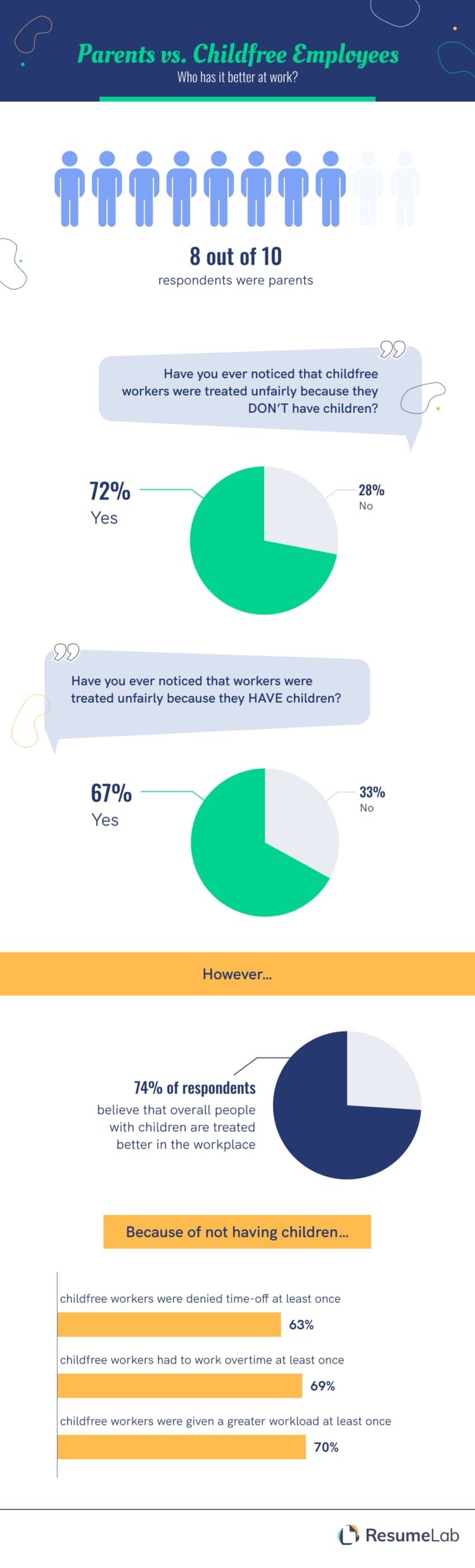
Unfair treatment applies to everybody, both childfree workers and people with children. According to our respondents, 72% noticed that childfree workers were mistreated because they don’t have children. The same goes for parents. 67% observed that parents were mistreated because they have children.
Parents strive to maintain the balance between being productive employees and responsible parents. They still worry that employers may not extend their contracts or fire them because of their family responsibilities. But non-parents face difficulties balancing their job (or two jobs) and family too.
If we wanted to satisfy both sides and remain neutral so as not to offend anyone, we could’ve stopped there. But we didn’t. And as we asked more questions, the responses became less neutral.
74% of respondents believed that people with children are treated better in the workplace. And surprise! This wasn’t the opinion of people without children only. Actually, our respondents were dominated by employees with kids. 8 out of 10 survey takers were parents.
But why do both parents and non-parents believe this? As sociologist Amy Blackstone at the University of Maine said, “there’s very little that protects their [childfree] time to care for themselves and their families and enjoy work-life balance.” So, “I have children” as the best excuse at work isn’t just a myth?
Well…
Our respondents say that in their workplace, because of not having children, childfree coworkers at least once:
were denied time-off – 63%
had to work overtime – 69%
were given a greater workload – 70%
So can we say the fair treatment of employees without children is a fairy tale? Not so fast. We can conclude that the situation is very personal for both childfree and parents. But there is much more to discover.
The Hidden Benefits (or Lack of Them)
For a long time, society believed that parents and children come first. A career was of secondary importance. Thus, parents-only benefits are not a myth. This child-centered approach may overwhelm non-parents. Especially childfree women who may be worried that these “family-friendly” workplace policies are “collapsing women’s identity into motherhood.”
So, now childfree workers start to ask: what about us?
Well, nothing. Has anyone ever heard of benefits only for employees without children?
And here we come to some aspects that our respondents observed (and let me remind you of this – they’re mostly people with children).
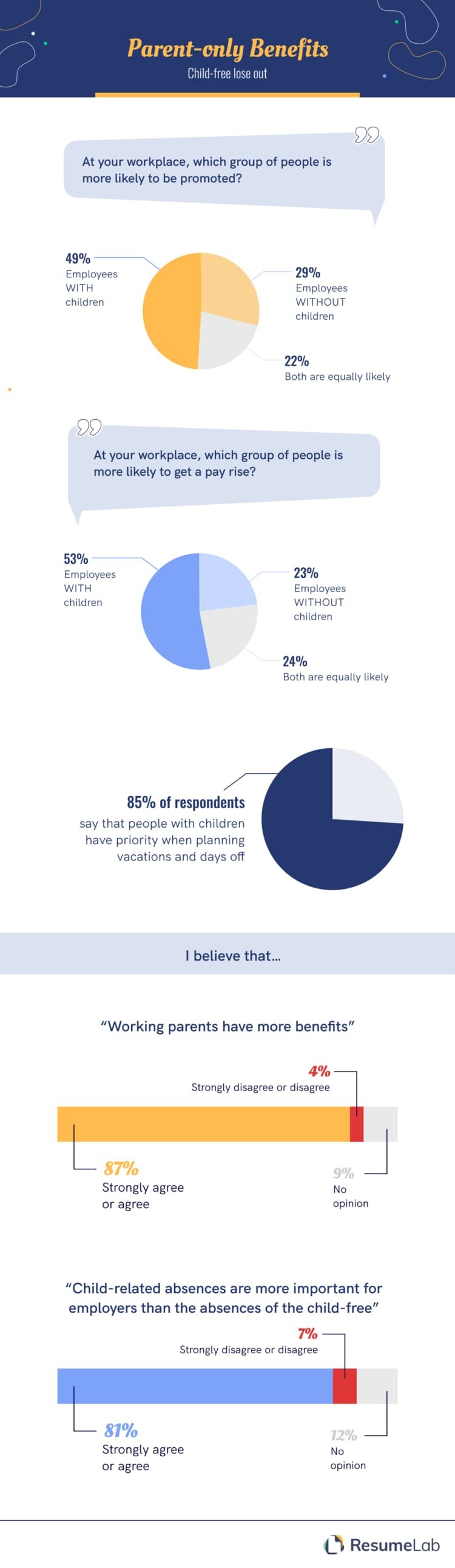
49% of respondents believe that employees with children are more likely to be promoted in their workplace. In the minority, 29%, we have survey takers who say that people without children are more likely to be promoted. At the same time, 22% are convinced that having children or not doesn’t matter. In their workplaces, both are equally taken into consideration.
The situation is not bad, but it’s leaning toward the parents.
But what about a pay rise? Similarly.
According to our respondents, employees with children are more likely to get a pay rise, 53%. The belief that childfree people are more likely to get a pay rise is shared by 23%. The rest, 24%, think that having children doesn’t really matter.
So again, no children means smaller chances for a pay rise.
What else are childfree workers complaining about? Vacations and days off.
85% of respondents say that people with children have priority when planning vacations and days off. At this point, talking about the unfair treatment of non-parents is quite reasonable.
Anything else to back up such statements?
Respondents themselves admit that working parents have more benefits. This view is shared by 87%. Also, 81% assume that child-related reasons for absences at work are more important for their employer than the reasons of childfree employees.
Let’s make a case here for parents. Parenthood serves as a full-time job, 24/7, always on duty. There is no greater responsibility than equipping the little ones to live a good life. Whatever effort it takes. No doubt here.
But nevertheless, can we be blind to the needs of the childless? Where would it take us?
A case study of Facebook and Twitter illustrated this for us. After introducing COVID-related policies, Facebook employees argued that those have primarily benefited parents, while Twitter childfree workers accused parents of not pulling weight.
Both companies quickly corrected their mistakes, but the distaste remained.
This leads us to paraphrase the wisdom of Yoda: Unfair treatment leads to employee dissatisfaction, dissatisfaction leads to anger, and anger leads to the cold war between employees.
So let’s not go down that road leading to…
Unspoken Pressure
People without children are often taken for granted when there’s a need for extra hours or postpone vacation because “parents need more time.” Society still assumes that childfree are more readily available compared to parents. So their justifications for why they cannot work are often considered less meaningful and trivial.
Are people with children aware of that?
Hopefully, our respondents are aware of this hidden pressure on the childfree. They note some benefits that only people with children can enjoy. At the same time, these areas create pressure on the childless to work longer and harder because the “job must be done.”
Respondents admit that:
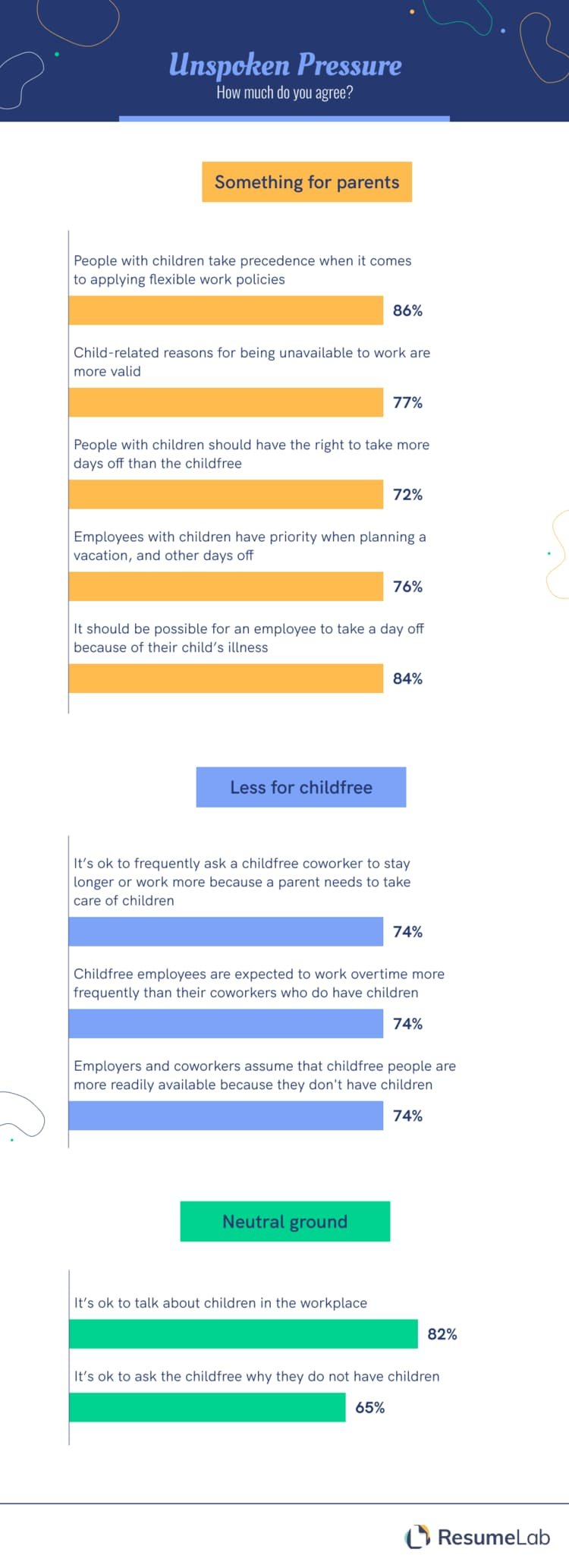
Parents take precedence when it comes to applying flexible work policies (86%)
Child-related reasons for being unavailable to work are more valid (77%)
Employees with children have priority when planning a vacation, and other days off (76%)
Employees should be able to take a day off because of a child’s illness (84%)
People with children should have the right to take more days off than the childfree (72%)
These are examples of special treatment of parents. We asked our respondents if they agree with particular concepts that take place in some workplaces. The vast majority agree with them. This is both good and bad. On the one hand, it’s good that people notice the different approaches to employees with children, with the childfree being aggrieved. On the other hand (especially from a parent’s point of view) they don’t necessarily think it’s a bad thing.
Let’s stop here for a minute and look at the last bullet. 72% believe that people with children should have the right to take more days off than the childfree. What about single people with children or men and women with children? Does this apply to them too?
Watch out because we’re going to reveal information not included in the graphic. Also, single moms or dads need special consideration. According to respondents:
77% think single women with children should have the right to take more days off than those who share parental duties with a partner.
74% admit that single men with children should have the right to take more days off than those who share parental duties with a partner.
We find some equality here. But this equality applies to parents. The childless, unfortunately, still have much to complain about.
74% of our respondents believe that:
It’s ok to frequently ask a childfree coworker to stay longer or work more because a parent needs to care for the children.
Childfree employees are expected to work overtime more frequently than their coworkers who have children.
Employers and coworkers assume that childfree people are more readily available because they don’t have children.
It doesn’t give much hope to people without children.
And more is coming. The majority (65%) also see no problem asking childfree why they do not have children.
Is this actually not a big deal? When, according to CDC, about 10% to 20% of men and women report infertility problems in the United States, some may not agree. And those who use medical help additionally spend thousands of dollars to be able to have a child. What if the treatment doesn’t work?
At the same time, 48% of couples admit to having difficulty with conceiving. In their case, we are not yet talking about fertility problems, but the topic is still sensitive.
Considering the above cases, a simple question can be painful. What else, the whole idea of special treatment of parents might be difficult.
Moreover, have you ever considered that such a question might be sexist? Especially asked a woman by a man. Particularly when she can’t have children.
Any neutral ground? Yes. Our respondents believe it’s ok to talk about children in the workplace (82%). Unless you are upsetting people who are trying to have a child and are medically unable to do so.
And here we are. On the one hand, we have parents for whom children are a massive part of life, affecting work. On the other hand, we have childless employees who also have a life outside of work, although without children.
Can we call the situation a deadlock? Any winners?
Should childfree people do nothing, following Google’s former head of human resources Laszlo Bock’s criticism?
Or should they strive for communication, as Krystal Wilkinson, a Manchester Metropolitan University lecturer, advises?
The conversation is vital. It’s easy to accuse childless people of being selfish or parents of acting entitled. But there is a third party in this dispute who should act like a judge—the employer. It’s their job to support all workers and ensure equality.
Let’s Talk About Equality
If we remain silent, we risk being told that these policies are justified… because everyone supports them; if we speak out about our concerns or our exclusion, we risk being accused of selfishness, pettiness, indifference to the plight of hardworking parents and innocent children, or worse.
Childfree or parents, we all want to be equal. And the good thing is that we don’t want to take that equality away from others to make it better for us. And that very sentence is the key summary of the information presented in the infographic.
Equality is a key, as:
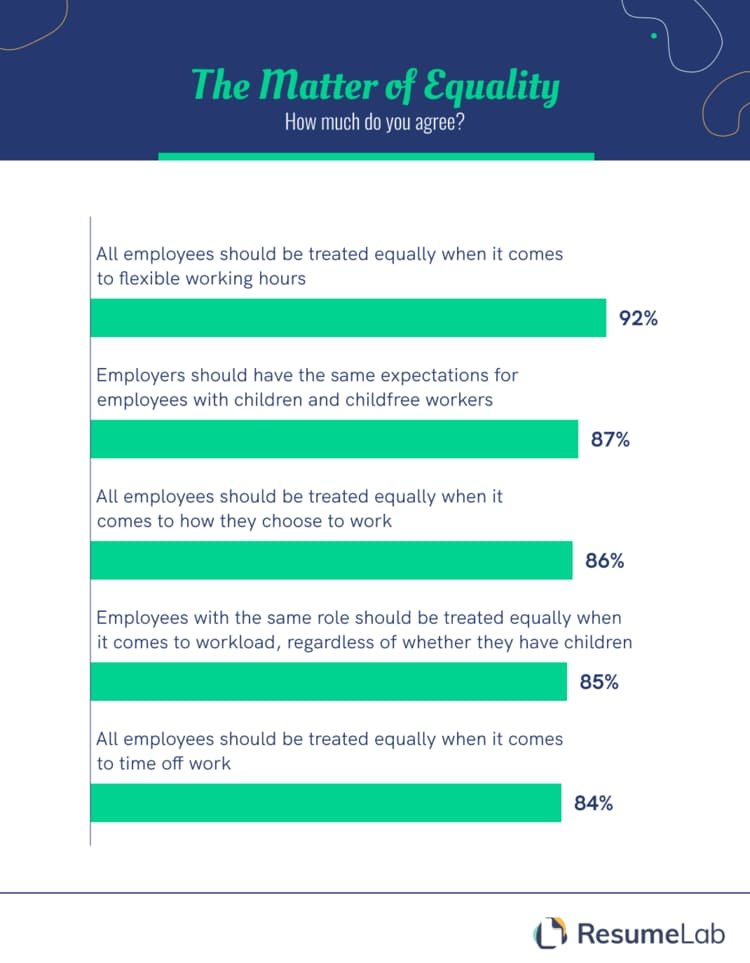
92% of respondents are convinced that all employees should be equally treated regarding flexible working hours.
87% think that employers should have the exact expectations for employees with children and childfree workers.
Equality between parents and childless people is also found when talking about the mode of work (remote or office-based). 86% believe that employees should be equally treated regarding how they choose to work.
Most of the respondents, 85%, share the view that employees with the same role should be equally treated when it comes to workload, regardless of whether they have children.
And last but not least, 84% agree that employees should be equally treated when it comes to time off work.
As you can see, in the end, we found aspects that apply both to people with and without children. And both sides agree here, attributing great importance to equality. This is good because it is an essential aspect of our lives, especially our professional lives.
Ideal Worker vs. Ideal Parent
There are no winners or losers. But there is a win-win situation. It assumes a perfect scenario in which:
Employees without children understand that parents need more time and flexibility to take care of their kids.
Parents understand that childfree coworkers have a life outside work, and they don’t use “I have children” as an excuse.
We should stop embracing two conflicting norms: the “ideal worker” sacrificing for work and coworkers, and the “ideal parent” thinking only about family and ignoring the needs of childfree colleagues.
So, let’s travel the road of mutual understanding, choosing the scenario that currently fits our situation.
Methodology
The findings presented were obtained by surveying 938 respondents using a bespoke online polling tool. All respondents included in the study passed an attention-check question. They were asked a series of questions related to their opinions on differences in how parents and childfree employees are treated at work. These included yes/no questions, scale-based questions relating to levels of agreement with a statement, questions that permitted the selection of multiple options from a list of potential answers, and questions that allowed open responses.
Limitations
The data we are presenting rely on self-reports from respondents. As experience is subjective, we understand that there are many potential limitations with self-reported data as some participants and their answers might be affected by recency, selective memory, attribution, exaggeration, self-selection, non-response, or voluntary response bias.
Some questions and responses have been rephrased or condensed for clarity and ease of understanding for readers. In some cases, the percentages presented may not add up to 100 percent; depending on the case, this is either due to rounding or due to responses of “neither/neutral/unknown” not being presented.
Dominique is a career expert specializing in resume and cover letter writing advice. Having worked for both start-ups and corporations, she knows all the ins and outs of the recruitment process. At ResumeLab, Dominique shares her knowledge with job seekers at all stages of their career paths, from interns to directors to C-suite members.
?”Busy does not equal results,” admonished Julie D. Burch during her laughter-filled, standing-room-only concurrent session at the SHRM Annual Conference & Expo 2022 in New Orleans on June 13.
“It’s about [being] efficient, effective and productive” and thinking about how we spend our time. “We do not find time in big chunks. We find it in small pieces—it’s minutes here and minutes there,” she pointed out during her presentation, “Crash Course to Effectiveness: Time Management for the Overworked, Overstressed and Overwhelmed.”
Burch is an author, training and development expert, and president of Julie Burch Speaks, based in Flower Mound, Texas.
People tend to fall into one of four destructive time-management styles, she said:
The Busy Bee. This person has their hands in everything, doing a little bit of everything and finishing nothing.
The Fire Chief. This person is constantly reacting to the next crisis, taking care of everyone else while not getting their own work done.
The Superhero. This person zooms in with good intentions to help others, leaving little time for their own tasks. “The reality is, the superhero is super-stressed,” Burch said.
The Procrastinator. This person is always in deadline mode. People typically procrastinate by diverting their time to less important tasks, rationalizing “it’ll just take 10 minutes.” Pretty soon, all those 10 minutes add up and there is no time left to tackle the big project, which gets pushed aside.
Tips and Techniques
“Everybody only gets 24 hours in the day. If we’re going to invest our time in something, it needs to be a good investment of our time. Pay attention to what you’re spending your time on,” Burch advised.
She shared the following recommendations for how to do that:
Batch. Perform similar tasks together and at regularly scheduled intervals.
Break tasks into small pieces.
Be accountable. Tell someone else what you plan to work on today, and then have them check in with you later to ask if you followed through with your intentions.
Reward yourself when you accomplish a task.
Create two to-do lists—a master list extending far into the future and a focused daily to-do list. Use them to prioritize and track what you need to accomplish. “Learn to schedule your priorities, not prioritize your schedule,” Burch said. Consult your master list and daily list first thing in the morning, and update the daily list throughout the day. As you tackle the items on your list, ask yourself this power question, Burch advised: “Is this a ‘today’ task or an ‘after-today’ task? If today, it goes on the focused to-do list.”
Establish a weekly block plan on how you will use your time. Chip away at a large goal, for example, by dedicating time for it on your calendar, closing your door and treating that time as inviolate. “We bounce from thing to thing, reacting to the urgent demands of others. Learn to set boundaries. It’s not about telling people ‘no’; it’s about telling people ‘yes … later. I’m happy to help you. Here’s when [I’m available],’ ” she advised.
Take action. “You can’t spend your whole day saddlin’ up and not riding,” Burch said, invoking a Texas saying.
Jennifer Costa, HR manager at Roots Community Health Center, an Oakland, Calif.-based company with 200 employees, expects that these tips will help her prioritize at work.
“There’s a project I’ve been putting off that I’m [now] looking forward to tackling,” she said. “It’s a handbook I’ve been putting off for a year.”