?Do you want to be more persuasive in your HR role? Incorporate herd mentality, fidelity, reciprocity, authority, scarcity and likeability, said Brad Karsh, CEO and founder of JB Training Solutions, a Chicago-based learning and development company.
Karsh shared those secrets of success during a June 13 concurrent session, “Become an InfluenceHR,” at the SHRM Annual Conference & Expo 2022 in New Orleans.
At the core of persuasiveness is understanding the person or audience and adapting your message accordingly, not being manipulative, Karsh said.
“Persuasion starts with that most human of skills—empathy,” he said, quoting Robert B. Cialdini, an American psychologist and author of Influence: The Psychology of Persuasion (Harper Business, revised edition 2006).
Karsh explained each of the six principles of persuasiveness:
Herd Mentality
“There’s safety in numbers. We kind of like to do what everybody does,” Karsh said.
The comfort of knowing what others are doing when making a business decision can be supplied by getting buy-in from others, offering relevant case studies and presenting a trio of options.
For example, you can use this approach to convince management to implement a new performance management system that you’re recommending, by:
Noting you’ve run this idea by 15 managers who all loved it, or pointing out that the system has been tested with three internal groups who all liked it.
Sharing a case study of what a leading Fortune 500 company has done with the system.
Presenting three options, not necessarily all cost-related.
Option one might include mostly elements of the current performance management system, option two might include both new elements and those of the current system, and option three might include only new elements.
Fidelity
Fidelity is the idea of defending a commitment you have made. And whether that commitment is to a sports team or a business decision, when challenged, individuals tend to hold fast and defend their choice.
You can tap into this feeling of fidelity by posing questions designed to elicit agreement, Karsh advised. The conversation might look something like this:
“You agree our current system could be better? And you’d agree that we need to deliver feedback more regularly? Then you’d also agree that in order to do that, we need to make sure our people have the right system?”
Follow this up by asking what drawbacks your audience sees in the organization’s current system, and ask permission to research different systems.
Reciprocity
Reciprocity is the idea of exchanging something for mutual benefit, such as bringing a dessert to share for a friend who is hosting a dinner party. In the business world, you can use reciprocity to gain concessions for an idea you are pitching. Or it might be as simple as thanking your audience for taking time to discuss the new system because it shows their concern for the organization.
A part of reciprocity may involve making concessions, Karsh noted, because this recognizes your audience’s concern while allowing what you’re pitching to be considered on a trial basis. For example, if management balks at introducing a wholly new system, suggest it be tried as a pilot program.
Authority
Get backing for your idea from someone in your organization who is seen as credible and has authority—and make that approval known.
Also, if presenting to key stakeholders, consider inviting a high-level member of your organization who likes your idea to your presentation.
And don’t forget to dress with authority when making your presentation. Suits and uniforms convey a sense of professionalism, Karsh advised.
Scarcity
The idea that a product is scarce or an opportunity is fleeting can persuade others to take action, Karsh said. It could be a small window in being first to market, an expiration date or limited supply of a product you are recommending to your organization. If that is the case, include that information in your presentation.
Management may find it compelling to know, for example, that the price for the new system you are recommending increases in four weeks or a decision is needed by a given date in order for the organization to launch it by an important deadline.
Likability
Being someone who is trustworthy and likable can go a long way in being influential, Karsh noted. He cited findings by Harvard social psychologist Amy Cuddy, who found likability is driven by:
Listening more than you talk.
Shifting the spotlight to others.
Giving before you receive.
Not acting self-important.
Admitting your failings.
Integrity is at the core of being persuasive, Karsh noted.
“When it is done the right way,” he said, quoting Dorie Clark, author and professor at Duke University’s Fuqua School of Business, “persuasion is simply a subset of effective communication.”
?Robert Bogue, president of Indiana-based technology company Thor Projects, and Terri Bogue, the company’s chief operations officer, have both experienced burnout in their lives. They’ve dealt with high levels of stress that created personal and professional challenges for them.
Over time, they learned to manage their priorities to prevent the physical and emotional exhaustion that leads to burnout.
“For instance, I’m a private pilot but I don’t fly because I don’t have time for that aspiration,” Robert explained. “You can do that with everything you have. Say, ‘I can’t do the family vacation. I can’t do this. The math doesn’t add up.’ “
On June 12, Robert and Terri led a concurrent session, “Extinguish Burnout and Ignite Engagement,” at the SHRM Annual Conference & Expo 2022 in New Orleans. The session aimed to equip workers, HR professionals and business leaders with the tools and techniques needed to help them prevent or recover from burnout.
“Burnout occurs when your internal fire is out and you have no more fuel left,” Robert said. “It can result in a negative attitude, a lack of productivity, high stress, a lack of teamwork and a negative transparency.”
79 percent experienced work-related stress in the month before the survey.
Nearly 60 percent reported negative effects of work-related stress, including a lack of interest, motivation or energy and a lack of effort at work.
44 percent reported physical fatigue.
36 percent reported cognitive weariness.
32 percent reported emotional exhaustion.
“We have this perception of how much time we have to give different people in our lives,” Terri explained. “But sometimes we get out of balance with reality. Your perception of what you should be able to do might not match reality.”
5 Ways Employees Can Combat Burnout
A combination of family, work and social stressors can contribute to burnout, which can impact workers at all levels, including business leaders. Robert and Terri offered several ways in which workers can avoid or reduce burnout:
Change your attitude. Are you thinking about momentary challenges or the long-term results? Try to maintain an optimistic point of view when dealing with work challenges.
Reframe your perceptions. Robert explained that many people harbor false perceptions of the expectations others place on them. What beliefs do you accept as fact that are just your perceptions?
Give yourself some credit. Robert asked, “Would you let anyone talk to your best friend the way you talk to yourself? Probably not.” It is OK to give yourself a pat on the back for great work.
Focus on self-care. This includes maintaining a healthy diet, exercising regularly, taking mental health days and seeking professional support when needed.
Find ways to limit your demands. There are ways we can manage the demands we place on ourselves, Terri said. For example, why do we always say “yes”? It’s OK to admit when you cannot handle something, whether it is a work or personal task.
“We need to make sure our expectations, perceptions and results match,” Terri said. “When they don’t, that’s when we experience burnout.”
How Employers Can Help
Business leaders play a crucial role in helping workers avoid and overcome burnout, creating a positive work atmosphere and igniting engagement:
Recognize great work. Let your employees know when work is done well—and do not let them downplay the significance of their accomplishments.
Offer support. Create a culture in which seeking help is encouraged. In addition, proactively ask workers what you can do to help them perform their jobs better and avoid unnecessary stress.
Promote a healthy work/life balance. Life happens. Let your workers take time to deal with personal responsibilities. As Robert said, “It is important for a leader to demonstrate their own work/life struggles.”
Set realistic expectations. Robert emphasized the importance of placing realistic expectations on what a company’s workforce can accomplish and understanding that an increased workload may require changing deadlines for other projects.
“To prevent burnout, we as leaders need to engage with employees and give them a rest from time to time,” said Jamilu Dawaki, deputy director of HR for the Central Bank of Nigeria, who had traveled from Abuja, Nigeria, to attend the conference. “That will help them do their jobs better in the long run.”
?Networking can open doors to career growth. But reaching out to people you don’t know can be intimidating for some people.
“So many of us are excited when we have the opportunity to enter into new spaces and meet new people, learn from their experiences, their stories, their insights,” said Daniel Horgan, CEO and founder of CoLabL.
Horgan’s Arlington, Va.-based company provides customized training and consultation in areas such as program design and management and employee development. CoLabL has partnered with the Society for Human Resource Management (SHRM) and the SHRM Foundation in the past to design and facilitate a variety of their mentorship programs.
“We’re not quite sure what to say or how to approach somebody that we don’t know yet. We walk into that room full of strangers and suddenly we just don’t know what to do, where to go or what to say,” Horgan said.
But as scary as it may seem, networking is important, he added. It opens doors and creates connections to the work and to the people who are advancing an organization’s mission.
Networking and Self-Awareness
Building great relationships requires “a solid understanding of who we are, what we like, what we dislike, what values drive us, why we make the decisions and take the actions that we take,” Horgan explained.
There should be purpose to your networking, “not just networking for the sake of making more connections on LinkedIn or meeting as many people as you can meet,” he said. Think about your goals and the types of people you want to meet.
Having a clear sense of your values and what you’re seeking in networking “gives you the opportunity to be more focused, to be more prepared in those experiences—ultimately leading you to be able to accomplish your goals and build more meaning and purpose,” Horgan said.Developing characteristics of self-awareness and reflecting on the influences in your life can help you network successfully. Keep in mind factors such as:
An understanding of what facets make up your identity—such as race, religion, economic status, sexual orientation and gender—because these elements shape who you are, how you view yourself, and how you interact and engage with others.
Knowledge of your skills and strengths.
Who you spend your time with. “The group of people that you surround yourself with really does, in fact, impact your personal brand,” Horgan said.
Your experiences, which influence how you participate in groups and converse with others.
The values that guide your actions and decisions. “If you have a strong sense of your value system and you put those values into action, you take time to reflect on and make sure that you stay aligned to those values,” he said. “You also strengthen your relationships—often being drawn to people who are aligned to your values and not in direct competition with them,” he said. “You have sort of this compass guiding you each day,” which boosts your confidence and helps reduce stress when networking.
Your personal and professional goals.
Tools and Resources
Horgan shared the following tips and free resources that may help as you cultivate your networking abilities:
Scientific survey of character strengths from the VIA Institute on Character, www.viacharacter.org. This assessment helps you understand your best qualities.
LinkedIn. The profile you create helps others get a sense of who you are. Make sure you display a friendly expression in your photo and stay away from distracting backgrounds.
Use keywords in the headline that explain “what you bring to the table,” Horgan said. Write a short summary—five to nine sentences—about your experience. This should include some top skills and strengths and key passion areas, then end with one to two sentences about future goals.
Be purposeful in how you reach out to people on LinkedIn, Horgan recommended. For example, instead of sending a generic connection request, you might note that the other person has more than five years of experience in an area you’ve worked in for two years and explain that you would like to hear how that person pivoted to a different HR function.
Follow up immediately when you receive a response to your networking request—thank them, create a calendar invitation and perhaps send an article you have read related to the topic you’re interested in discussing. This shows your initiative.
Know When to Pursue and When to Back Off
Use cues around you to adopt a conversational style when you begin your conversation. At SHRM22, for example, you might ask what your new acquaintance thought of the previous main stage speaker or the conference venue. If you are networking virtually, also consider if you have enough lighting and if the other person can see and hear you.
Sometimes, after an exploratory conversation, it’s apparent there is no true connection. That’s OK, Horgan assured attendees.
“Move on to someone else or to another group that’s present at that event or present [at] the virtual experience that you might be a part of,” he advised.
If you know someone in your network who could better benefit from meeting your new acquaintance, offer an introduction. And if someone you meet introduces you to another contact, always circle back to the initial contact to thank them for the introduction.
“When you do that,” Horgan said, “it increases your chances of that person introducing you to more people from their network because you’re showing a genuine appreciation for the time and the effort they took to think about you.”
SHRM President and Chief Executive Officer Johnny C. Taylor, Jr., SHRM-SCP, is answering HR questions as part of a series for USA Today.
Do you have an HR or work-related question you’d like him to answer? Submit it here.
I was terminated after I had a manic episode at work. My employer was well aware that I am bipolar I, and this was supported by my psychiatrist of 25 years. Do I have any recourse in fighting this termination? —Sebe
Johnny C. Taylor, Jr.: It takes strength and courage for you to disclose your medical condition. While the Americans with Disabilities Act (ADA) does protect employees from discriminatory employment actions based on disabilities, known or perceived, it does not completely shield employees from adverse employment action.
Employment is at-will in all states except Montana, which means an employer or employee can terminate the relationship at any time, with or without notice or reason, as long as the termination does not violate a law, such as anti-discrimination laws. Therefore, the reason for termination cannot be based on protected class status such as race, sex, color, age, religion, national origin, disability and genetic information.
On its face, you may have a legitimate case under the ADA, but it will depend on your prior work performance. Before you fight the termination, think about your job performance. Have you had any performance discussions or performance improvement plans? Did your employer document any misconduct or violation of policy or other work rules? If you had performance problems, your employer could be justified in its decision to end your employment.
Assuming there are no problems with your performance, your employer may have violated the law. Were you engaged by your employer in the ADA interactive process to determine if any reasonable accommodations were needed to support you? Do you know if other employees experienced similar workplace health crises but didn’t have their employment terminated? You may want to look to your employer’s policy regarding grievances or consider contacting the Equal Employment Opportunity Commission (EEOC) or speak with legal counsel regarding the circumstances.
One last thing to keep in mind: Even if you had an accommodation in place, your employer may still be able to take adverse actions against you if the accommodation presented is or becomes an undue hardship, or if you were deemed a direct threat to yourself or other employees.
I know this is sensitive matter, and I hope you can reach an amicable conclusion.
My company went to 100 percent remote work during the height of the pandemic. We have been back in office fully for a couple of months. I feel like I can get my work done from home or within an alternate schedule. What is the best way to approach my employer to request schedule flexibility (four-day workweek or remote work)? —Leanna
Johnny C. Taylor, Jr.: You are among a growing contingent of workers looking for work flexibility. Virtually every employer is facing this rising demand for remote work and alternative scheduling. It is important for workers to share their preferences with employers that are making critical workplace decisions. Employers are constantly trying to weigh business needs and workforce needs to find solutions that benefit both.
As you build your case for schedule flexibility, be sure to include how it will benefit business performance. Draw from your experiences during your remote-work period. Highlight how your work was positively impacted during that time. Point to some opportunities to improve remote-work experience and effectiveness. In preparation for speaking with your people manager, consider what type of flexibility you are seeking and why. Outline the benefits of the options you seek.
Your company may already be exploring flexible work options. In today’s tight labor market, many employers are finding telework and flexible scheduling to be valuable incentives in attracting and retaining talent.
Your company’s decision will come down to what makes sense for their business needs and workplace culture. Even if the answer is “no,” you will have done the right thing in giving respectful and informative feedback to your employer. I hope you find the work arrangement that suits you best.
Four finalists were selected from over 150 initial submissions. They will go on to make their last pitch to a panel of judges as well as an audience of investors, leading HR professionals, fellow innovators and the media. The pitch fest will be held June 14 at the SHRM Annual Conference & Expo 2022 (SHRM22) in New Orleans, and the winner will be announced from the SHRM22 Main Stage by SHRM Chief Knowledge Officer Alex Alonso, Ph.D., SHRM-SCP.
Here’s a look at one of the finalists, Automation Workz, based in Detroit.
Ida Byrd-Hill, founder and CEO of Automation Workz, spoke with SHRM Online about the product and how it improves work and the practice of human resources.
SHRM Online: What does your product do?
Byrd-Hill: The Automation Workz Life Culture Audit is a mobile app assisting HR professionals and corporate leaders to motivate front-line workers to digital career and training success. The Life Culture Audit reduces turnover and absenteeism by coaching front-liners through coding games and creation of their life vision so they realize they have the skills and potential success for new digital careers.
Acknowledging a front-line worker’s vision and goals allows for their humanity and purpose, setting up commitment to career development, training and a positive performance cycle. Gartner found that when corporate goals are tied to workers’ personal goals, those workers were 17 percent more productive than other employees—and almost twice as likely to stay at their organization.
SHRM Online: How does the technology improve the workplace?
Byrd-Hill: Front-line workers, mainly people of color, are not as valued as they should be around the world. They are compensated below a living wage and are rarely groomed for higher-paying careers. Automation Workz created the Life Culture Audit for recruitment, performance management and digital career training assessment to highlight their value.
Recruitment: Leaders can fine-tune the selection of purpose-driven front-liners to reduce turnover and absenteeism. Individuals, by completing soul-searching reflection, will develop their purpose, eliciting long-term commitment.
Performance management: Very few managers know the personal vision or goals of their front-liners and hence rarely build their performance expectations to align with their WIIFM (What’s in It for Me) philosophy.
Digital career training assessment: While every front-liner does not need to learn how to code computer software, they do need to think, act and thrive in a world of robotics, AI, data analytics, autonomous vehicles and other emerging tech.
SHRM Online: What specific HR problem does the technology solve?
Byrd-Hill: Front-liners are seeking higher-paying careers. Many corporations are afraid they will not achieve a positive ROI if they invest in digital reskilling for front-liners to acquire higher-paying jobs. Hence, these workers do not feel valued, trusted or empowered. Consequently, front-line workers are not committed to their job, their work schedule, fellow colleagues or customers. This lack of commitment has turned into high turnover, high absenteeism and supply chain issues, leading to declining business growth in 2022.
Editor’s Note: SHRM has partnered withHarvard Business Reviewto bring you relevant articles on key HR topics and strategies.
Despite the gains workers have made through the Covid pandemic in increasing flexibility in where they work, bigger workloads have meant that there is little slack in the system for people to take time out and recover. The effects are obvious. In 2020, 62% of employees reported that they had experienced burnout “often” or “extremely often” in the previous three months, and in 2021, 67% of workers reported that stress and burnout had increased since the pandemic began. Perhaps it is no surprise then that initiatives such as the four-day workweek, remote and hybrid working, unlimited paid time off and the right-to-disconnect have been gaining in popularity in an attempt to tackle these high-workload, always-on cultures.
But do these solutions really offer change for workers? Can they help employees and managers rebalance demands? The answers to these questions are complicated and not easily answered without addressing the real problem: the issue of excessive workloads and intensification. By focusing so strongly on the where and when of work, policymakers appear to have lost sight of how and how much we are working.
To illustrate, in a recent study about New Zealand’s move to the four-day workweek, researchers Helen Delaney and Catherine Casey found that not only was work intensified following the change, but so too were managerial pressures around performance measurement, monitoring and productivity. Indeed, several well-regarded studies into the four-day workweek are promoted in the media on the basis that productivity should not fall (or indeed, should increase) if the change is managed well.
It can hardly be sustainable or reasonable to expect already frazzled employees to keep working to existing workloads with one fewer day a week, which is why, while we support four-day workweek initiatives, employers need to be aware of two important factors. First, a reduction in hours must also be accompanied by a revision of or even a reduction in workload. Second, time at work could become even more intense and stressful for workers, even if there are productivity benefits to be had. Here’s what leaders need to understand before trying a four-day workweek.
Reducing Working Hours Does Not Necessarily Reduce Work
Unfortunately, removing access to work (voluntarily or not) does not mean that the work itself is removed. Existing research suggests that the extent to which people like to remain connected out-of-hours is often based on individual differences and circumstances. We also know that remaining connected to work out-of-hours can be stressful, but that voluntariness, personal preference and job role can mitigate this.
Contemporary approaches to performance management also call into question the extent to which individuals truly have a choice when it comes to out-of-hours working. Research shows that people with more intensive workloads tend to ruminate about work outside of working hours and are unable to switch off until their work problems have been solved. On the other hand, research has shown that some people want to be able to check in on work and keep connected because it worries them more when they do not have oversight of what is going on, which prevents them from feeling in control.
As organizations and governments consider four-day workweeks, it’s important that researchers ask how different types of time off translate into both well-being and performance benefits. For example, in the four-day workweek, is it having a full day off each week or is it working four days’ worth of hours across the week that helps? Can time-use diaries be used to show that people are actually switching off from work when disconnected from it and engaging in activities that promote well-being and meaningfulness? Are diverse groups and those with caring responsibilities equally benefitting when they cannot access their work at certain times of the day or week?
Reducing Hours Should Not Increase Work’s Intensity
The New Zealand four-day workweek pilot found that, to fit in their “real work,” employees took shorter breaks and spent less time lingering to socialize in order to resume their measurable tasks. According to Wired, while “some workers enjoyed the ‘exhilarating’ and ‘full-on pace,'” others felt “the urgency and pressure was causing ‘heightened stress levels,’ leaving them in need of the additional day off to recover from work intensity.” Participants in the research bemoaned that there was no more time for “banter” and that creativity and innovation were being stifled.
The New Zealand four-day workweek trial rings some alarm bells, in that reductions in working days did not necessarily create well-being benefits as workers struggled to meet the demands of their job roles. It is perhaps telling that much of the publicity around the success of Microsoft Japan’s four-day workweek trial rested on how productivity increased substantially during the study period. Employers may need to be careful about promoting outputs over well-being if they want to be seen as investing in their workforce’s work-life balance.
Finding Solutions
While the ideas of a right-to-disconnect or a four-day workweek are clearly laudable and well-intentioned, there is a danger in fixating on specific initiatives. A four-day workweek probably sounds great to many employees (and maybe even their managers). But, as with so many things, success lies in the details.
There is no easy way to address concerns about how (and how much) we work, but our research tells us that no matter what we do, taking a holistic, long-term focus on the well-being of the workforce is the best path to both happiness and prosperity. Maybe the answer is a four-day workweek. Or maybe it’s something else. But we must start with an honest appraisal of how productivity and time trade-offs impact the well-being of workers.
Emma Russell is a Chartered and Registered Occupational Psychologist, Co-Lead of the Data Observatory and Mid-Early Career Research stream at the ESRC-funded Digit Centre, and a Senior Lecturer in Occupational and Organisational Psychology at the University of Sussex. Caroline Murphy is a Senior Lecturer in Employment Relations, and Director of the MSc in HRM at the Department of Work and Employment Studies at the Kemmy Business School, University of Limerick. Esme Terry is a is a Research Fellow at the Centre for Employment Relations, Innovation and Change (CERIC), Leeds University Business School. Her role is funded by the ESRC-funded Digit Centre.
?Like many people who started new jobs mid-pandemic, Monique Jefferson was onboarded remotely when she became the CHRO for New York Public Radio (NYPR) in February 2021. She used that experience to identify ways the nonprofit media organization could improve remote and hybrid work for everyone.
Under Jefferson’s leadership, for instance, the HR team arranged for NYPR’s health insurance provider to offer free online mental health counseling. HR also provided opportunities for employees to gather at parks and participate in ice skating events.
“Little things like that go a long way in terms of engagement,” says Jefferson, who oversees a nine-member HR team serving NYPR’s 350 employees and contingent workers.
The actions Jefferson took relate to two themes—change and equity—that have dominated an HR career spanning more than two decades.
“The only constant is change,” she says.
When managing through change, such as the shift to remote and hybrid work, Jefferson says she leads with resilience and agility to address the three ways employees tend to respond: with acceptance, resistance or ambivalence.
She has also experienced lots of change in her own career. As an HR professional, she has worked in a variety of industries, including pharmaceuticals, wealth management, life insurance, legal services and now broadcast media.
The second central theme of Jefferson’s career is her advocacy for employees at all levels, not just those at the top.
“I’m focused on not creating an organization of haves and have-nots,” Jefferson says, and that involves aligning a company’s values with its actions. “I always try to leave the organization better than when I arrived.”
Closing Gaps
Identify ways to improve the organization during her first 90 days at NYPR, Jefferson conducted a listening tour and studied employee engagement data and survey results.
One thing quickly became clear to her: The organization needed to focus more on career development generally and management development specifically. So, Jefferson implemented a mandatory four-session, 12-hour management training course focused on communication, coaching, inclusive leadership and productive performance feedback.
“If we start with our leaders and managers and get that right, they’ll be able to lead and develop healthy, vibrant teams,” she says.
Another gap Jefferson identified led her to put in place what she calls a career-leveling framework across the company. As a result, HR provides greater clarity and visibility on what employees need to do, and the skills and competencies they need to have, to advance in their careers within the organization.
Importantly, this framework dispels the idea that the only way to get ahead or earn a pay bump is by managing others.
“That’s not always the best path for everybody,” Jefferson says. “Some employees don’t want to manage people. That might not be their strong suit.” With this structure, which Jefferson has implemented twice before (at New York Life Insurance Company and law firm Hogan Lovells), “you let employees know they can be individual contributors and still advance their careers.”
Plus, Jefferson has worked to ensure fair, market-rate pay for NYPR’s employees—which aligns the organization with the goals of New York City’s wage-transparency law, effective November 2022, requiring that all employers with at least four workers provide the minimum and maximum pay in all job listings.
Notably, in February, NYPR and labor union SAG-AFTRA settled a long-running dispute alleging unfair labor practices. The settlement included wage increases for certain employees and the resolution of claims pertaining to individual NYPR staff members. Both parties said in a statement that they “look forward to working together to continue to resolve workplace matters cooperatively.”
Jefferson’s commitment to seeing her organization through all employees’ eyes—in short, her empathy—also means she continually considers the support staff who enable client-facing and revenue-generating employees to do their jobs.
“That’s why I focus on equity, making sure we’re fair across the board,” she says.
Equal Opportunity
For Jefferson, fairness also involves an intense focus on diversity, equity and inclusion (DE&I). NYPR had created a Race Equity Action Plan prior to her joining the organization. Since then, Jefferson, in close collaboration with Brenda Williams-Butts, NYPR’s senior vice president of DE&I, has helped implement many of the plan’s 19 commitments, such as securing a diverse slate of qualified candidates for every open position and reporting annually on hiring and retention rates. The organization is working on a new action plan for 2022.
Jefferson also displayed her dedication to equity at her previous employer, Hogan Lovells, which she joined in 2016. At law firms, typically only the attorneys are eligible for incentive compensation such as bonuses. But within her first six months as the head of HR for business services in the Americas, Jefferson helped develop and implement a program that extended the potential for incentive compensation to everyone, including business services staff such as paralegals and HR team members. Jefferson freed up $2 million to fund the new incentive program.
“This was a big win for the firm,” she says. “It positioned the firm to become more competitive in the market, attract more high-performing talent and increase employee engagement.”
Alaiki Harris, director of benefits and well-being at Hogan Lovells in Washington, D.C., recalls how Jefferson built a business case for broadening the incentive program and made the case to senior leadership. She attributes Jefferson’s success with that initiative not only to her leadership skills but also to her deep knowledge of both standard and best practices.
“She’s extremely knowledgeable about her field, she’s extremely persistent, and she’s very bold in her approach,” Harris says. “She also knows how to convey concepts in a professional, diplomatic way.”
While at the law firm, Jefferson noticed another disparity: The DE&I initiatives and the employee resource groups tended to serve the lawyers only. “I was quite vocal that there needed to be the same opportunities afforded to the business services staff,” she says. Right before she left for NYPR, the firm created a DE&I committee targeting those staffers’ needs.
Also under Jefferson’s leadership, the firm began offering onsite mental health counseling services to all employees a few days a week. “Being aware of and sensitive to employee health and wellness has a direct correlation to productivity,” she says.
Showing Leadership
Julissa Rodrigues has witnessed Jefferson’s leadership and learned from it. From 2011 to 2015, Rodrigues was supervised by Jefferson at New York Life, where Jefferson served as a senior HR business partner and reported to the CHRO. Rodrigues recalls how Jefferson adroitly collaborated with members of the executive committee during a company reorganization.
“Monique has great business acumen, and she’s a fearless leader who challenges the status quo,” says Rodrigues, now an HR business partner for Apple in New York City. “She taught me what it takes to be fearless and always show up with facts and solutions.”
Jefferson’s intense interest in equity extends to her nonwork life. She volunteers for The Links, Incorporated, an international nonprofit that promotes service and friendship among women of African descent. Jefferson serves on the group’s youth committee, helping with a STEAM (science, technology, engineering, arts and mathematics) program at a Brooklyn middle school and tutoring students as they prepare for their high school entrance exams. Jefferson also serves on the board of CALIBR, a nonprofit group that helps advance Black business leaders into senior positions.
“Both these organizations speak to my passion for helping BIPOC [Black, Indigenous and people of color] youth and Black professionals develop and advance their careers,” she says.
Jefferson sees a direct link between how she leads and how she was raised. “I got my work ethic and competitive spirit from my parents,” she says. “They instilled confidence in me and told me I was as good as anyone else. I learned at an early age to advocate for myself and speak up, especially when I see something that’s not fair or right.”
As she grew up on Long Island, her parents emphasized the importance of education—and of making sacrifices to obtain it. Her father worked two jobs: public school teacher and administrator and, after school, recreation center director. Her mother held various positions in the U.S. Postal Service and went back to school to get her bachelor’s degree while Jefferson was in elementary school. Later in life, Jefferson’s mother also earned a master’s degree.
“They worked so hard to provide for me but also to make sure I had things they didn’t have as children, like travel and extracurricular activities,” Jefferson says. “While I may not have spent as much time with my parents as my peers did, I never held that against them.”
After getting her undergraduate degree in accounting at Bentley University, Jefferson began working as an auditor at global accounting and consulting firm EY in the mid-1990s. She quickly realized it wasn’t a good fit. In 1998, she joined global business services and consulting company PwC as a junior HR generalist and knew she had found the right career path.
“I realized I loved HR and wanted to stay in it,” says Jefferson, who earned a master’s degree in human resource management from the New School in 2003. “I loved being able to work with leaders and employees to help solve their problems. At the end of the day, I see my job as not only minimizing risk [for the employer] but always doing what is right, whether that’s for the employee or the organization.”
Her love of HR informs the advice Jefferson now offers younger professionals. “I always tell them to find careers that align with the three P’s: purpose, passion and profession,” she says. “Being an HR leader has allowed me to do that.”
Novid Parsi is a freelance writer based in St. Louis.
The voices of childless workers regarding unfair treatment by employers are growing louder. In this recent study, employees told ResumeLab about how managers treat parents vs. non-parents at work.
“Come on, if you had kids, we would let you take the extra time you needed.”
“What personal reason? You don’t have kids to pick up from school.”
“Parents need that day off more.”
Raise your hand if you’re a childfree employee who has never heard some version of the sentences above. No volunteers? Well, not surprising.
These people are both men and women, college graduates, and people without a degree. And above all, these are employees. So it’s a logical assumption that as the number of childless people increases, the number of childless workers also rises. And some researchers believe that soon the number of non-parents may overtake the number of parents in the workplace.
And here come the problems. Unfair treatment of the growing childfree community is becoming more and more visible. And with increasing awareness of our rights and condemnation of discrimination and unequal treatment, the voices of unsatisfied childless employees are growing stronger.
At ResumeLab, we heard them. But at the same time, we didn’t ignore parents. Read on to listen to both perspectives on how childfree workers are treated.
Parents vs. childfree employees
Bigfoot. Yeti. Childfree by choice. Unicorns. The Loch Ness Monster.
Does any element of this list stand out? Once, it probably wouldn’t, but now it does.
Childfree by choice.
We have come a long way to understand that some people don’t want children. Or, for various reasons, they can’t. And they shouldn’t be considered fantastic beasts. Nor should we ask where to find them. They’re in every workplace.
But as research shows, like fantastic beasts, they are misunderstood, their needs are marginalized, and their activities and responsibilities outside of work are baffling. Why? Because they don’t have children. So it’s clear that they have nothing to do after work, true? Well… no.
Childfree employees have hobbies, a second job, or sick parents they need to take care of. They participate in courses and postgraduate studies or go for physiotherapy. Whatever. But they still know how to spend their personal time after work.
So why are we willing to increase their workload, make them do overtime, or deny them a day off? Do parents need it more?
At ResumeLab, we assume that both sides need it equally.
Hope that the above data grabbed your attention. Let’s take a look once again.
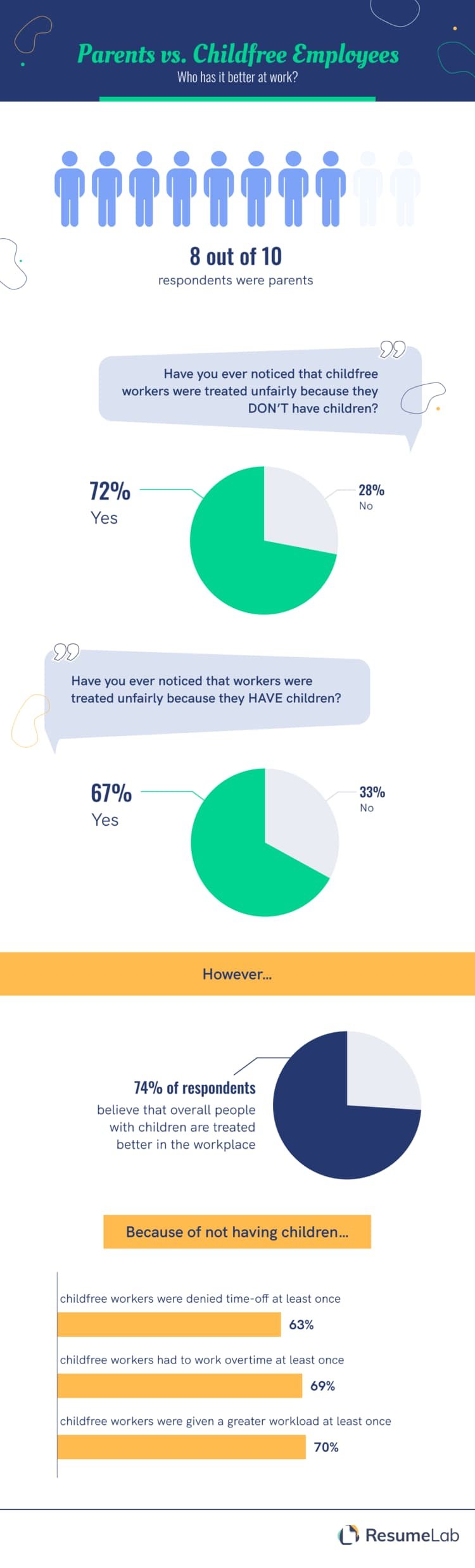
Unfair treatment applies to everybody, both childfree workers and people with children. According to our respondents, 72% noticed that childfree workers were mistreated because they don’t have children. The same goes for parents. 67% observed that parents were mistreated because they have children.
Parents strive to maintain the balance between being productive employees and responsible parents. They still worry that employers may not extend their contracts or fire them because of their family responsibilities. But non-parents face difficulties balancing their job (or two jobs) and family too.
If we wanted to satisfy both sides and remain neutral so as not to offend anyone, we could’ve stopped there. But we didn’t. And as we asked more questions, the responses became less neutral.
74% of respondents believed that people with children are treated better in the workplace. And surprise! This wasn’t the opinion of people without children only. Actually, our respondents were dominated by employees with kids. 8 out of 10 survey takers were parents.
But why do both parents and non-parents believe this? As sociologist Amy Blackstone at the University of Maine said, “there’s very little that protects their [childfree] time to care for themselves and their families and enjoy work-life balance.” So, “I have children” as the best excuse at work isn’t just a myth?
Well…
Our respondents say that in their workplace, because of not having children, childfree coworkers at least once:
were denied time-off – 63%
had to work overtime – 69%
were given a greater workload – 70%
So can we say the fair treatment of employees without children is a fairy tale? Not so fast. We can conclude that the situation is very personal for both childfree and parents. But there is much more to discover.
The hidden benefits (or lack of them)
For a long time, society believed that parents and children come first. A career was of secondary importance. Thus, parents-only benefits are not a myth. This child-centered approach may overwhelm non-parents. Especially childfree women who may be worried that these “family-friendly” workplace policies are “collapsing women’s identity into motherhood.”
So, now childfree workers start to ask: what about us?
Well, nothing. Has anyone ever heard of benefits only for employees without children?
And here we come to some aspects that our respondents observed (and let me remind you of this – they’re mostly people with children).
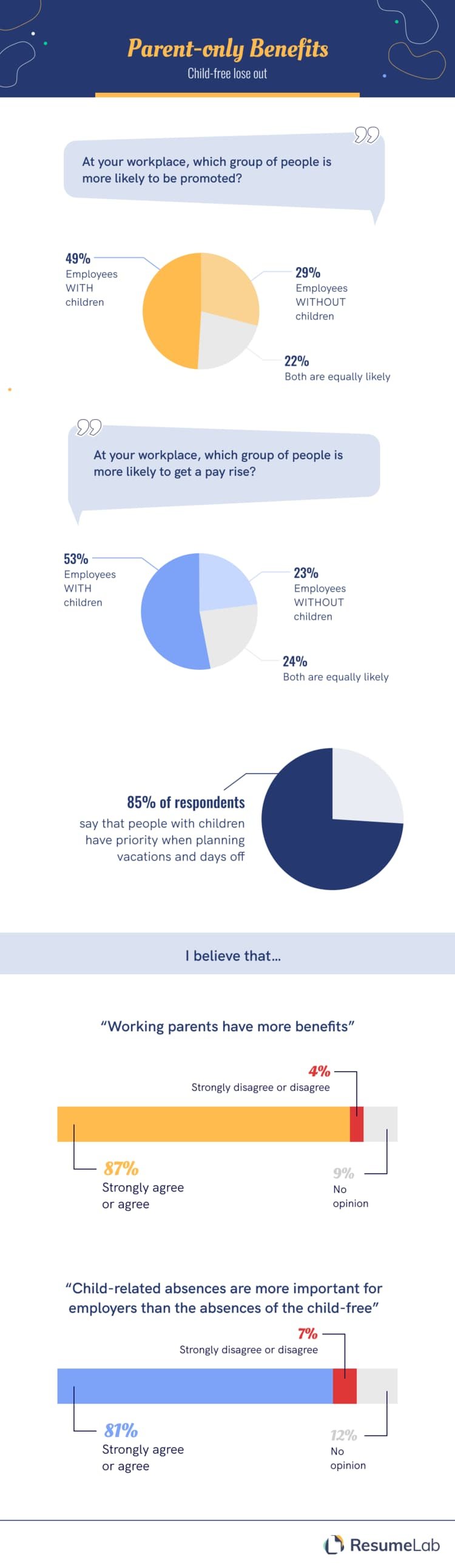
49% of respondents believe that employees with children are more likely to be promoted in their workplace. In the minority, 29%, we have survey takers who say that people without children are more likely to be promoted. At the same time, 22% are convinced that having children or not doesn’t matter. In their workplaces, both are equally taken into consideration.
The situation is not bad, but it’s leaning toward the parents.
But what about a pay rise? Similarly.
According to our respondents, employees with children are more likely to get a pay rise, 53%. The belief that childfree people are more likely to get a pay rise is shared by 23%. The rest, 24%, think that having children doesn’t really matter.
So again, no children means smaller chances for a pay rise.
What else are childfree workers complaining about? Vacations and days off.
85% of respondents say that people with children have priority when planning vacations and days off. At this point, talking about the unfair treatment of non-parents is quite reasonable.
Anything else to back up such statements?
Respondents themselves admit that working parents have more benefits. This view is shared by 87%. Also, 81% assume that child-related reasons for absences at work are more important for their employer than the reasons of childfree employees.
Let’s make a case here for parents. Parenthood serves as a full-time job, 24/7, always on duty. There is no greater responsibility than equipping the little ones to live a good life. Whatever effort it takes. No doubt here.
But nevertheless, can we be blind to the needs of the childless? Where would it take us?
A case study of Facebook and Twitter illustrated this for us. After introducing COVID-related policies, Facebook employees argued that those have primarily benefited parents, while Twitter childfree workers accused parents of not pulling weight.
Both companies quickly corrected their mistakes, but the distaste remained.
This leads us to paraphrase the wisdom of Yoda: Unfair treatment leads to employee dissatisfaction, dissatisfaction leads to anger, and anger leads to the cold war between employees.
So let’s not go down that road leading to…
Unspoken pressure
People without children are often taken for granted when there’s a need for extra hours or postpone vacation because “parents need more time.” Society still assumes that childfree are more readily available compared to parents. So their justifications for why they cannot work are often considered less meaningful and trivial.
Are people with children aware of that?
Hopefully, our respondents are aware of this hidden pressure on the childfree. They note some benefits that only people with children can enjoy. At the same time, these areas create pressure on the childless to work longer and harder because the “job must be done.”
Respondents admit that:
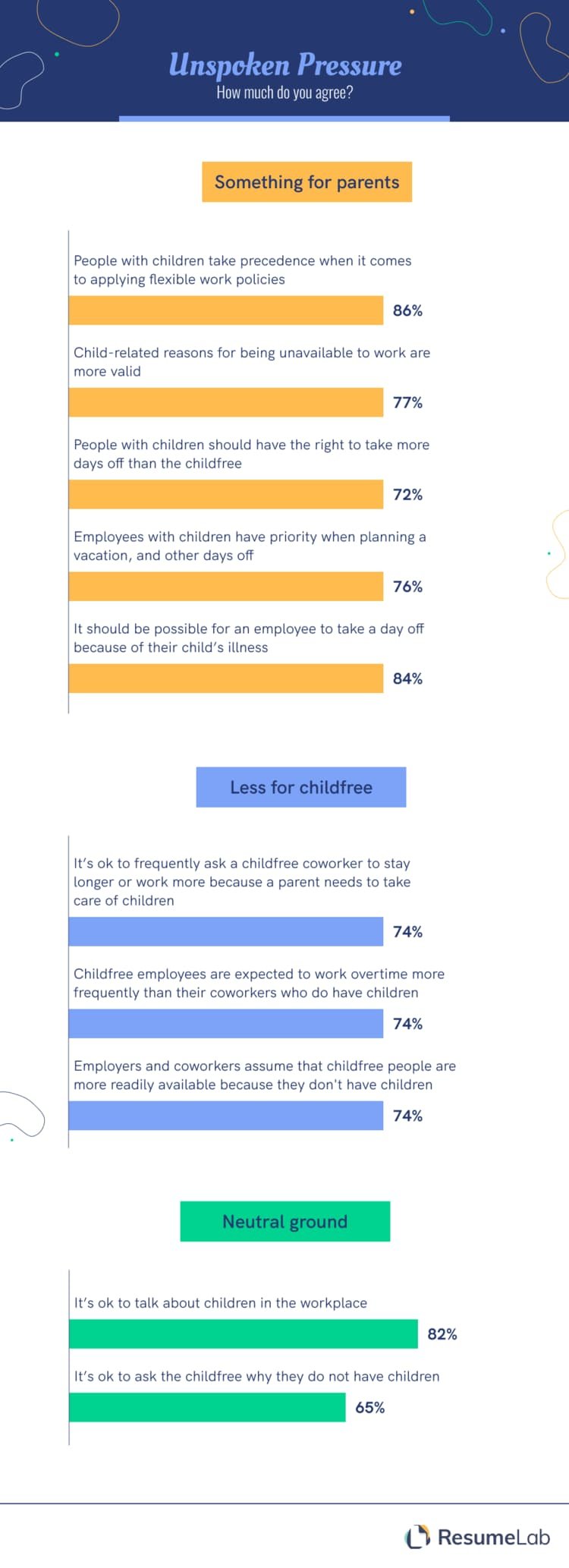
Parents take precedence when it comes to applying flexible work policies (86%)
Child-related reasons for being unavailable to work are more valid (77%)
Employees with children have priority when planning a vacation, and other days off (76%)
Employees should be able to take a day off because of a child’s illness (84%)
People with children should have the right to take more days off than the childfree (72%)
These are examples of special treatment of parents. We asked our respondents if they agree with particular concepts that take place in some workplaces. The vast majority agree with them. This is both good and bad. On the one hand, it’s good that people notice the different approaches to employees with children, with the childfree being aggrieved. On the other hand (especially from a parent’s point of view) they don’t necessarily think it’s a bad thing.
Let’s stop here for a minute and look at the last bullet. 72% believe that people with children should have the right to take more days off than the childfree. What about single people with children or men and women with children? Does this apply to them too?
Watch out because we’re going to reveal information not included in the graphic. Also, single moms or dads need special consideration. According to respondents:
77% think single women with children should have the right to take more days off than those who share parental duties with a partner.
74% admit that single men with children should have the right to take more days off than those who share parental duties with a partner.
We find some equality here. But this equality applies to parents. The childless, unfortunately, still have much to complain about.
74% of our respondents believe that:
It’s ok to frequently ask a childfree coworker to stay longer or work more because a parent needs to care for the children.
Childfree employees are expected to work overtime more frequently than their coworkers who have children.
Employers and coworkers assume that childfree people are more readily available because they don’t have children.
It doesn’t give much hope to people without children.
And more is coming. The majority (65%) also see no problem asking childfree why they do not have children.
Is this actually not a big deal? When, according to CDC, about 10% to 20% of men and women report infertility problems in the United States, some may not agree. And those who use medical help additionally spend thousands of dollars to be able to have a child. What if the treatment doesn’t work?
At the same time, 48% of couples admit to having difficulty with conceiving. In their case, we are not yet talking about fertility problems, but the topic is still sensitive.
Considering the above cases, a simple question can be painful. What else, the whole idea of special treatment of parents might be difficult.
Moreover, have you ever considered that such a question might be sexist? Especially asked a woman by a man. Particularly when she can’t have children.
Any neutral ground? Yes. Our respondents believe it’s ok to talk about children in the workplace (82%). Unless you are upsetting people who are trying to have a child and are medically unable to do so.
And here we are. On the one hand, we have parents for whom children are a massive part of life, affecting work. On the other hand, we have childless employees who also have a life outside of work, although without children.
Can we call the situation a deadlock? Any winners?
Should childfree people do nothing, following Google’s former head of human resources Laszlo Bock’s criticism?
Or should they strive for communication, as Krystal Wilkinson, a Manchester Metropolitan University lecturer, advises?
The conversation is vital. It’s easy to accuse childless people of being selfish or parents of acting entitled. But there is a third party in this dispute who should act like a judge—the employer. It’s their job to support all workers and ensure equality.
Let’s talk about equality
If we remain silent, we risk being told that these policies are justified… because everyone supports them; if we speak out about our concerns or our exclusion, we risk being accused of selfishness, pettiness, indifference to the plight of hardworking parents and innocent children, or worse.
Childfree or parents, we all want to be equal. And the good thing is that we don’t want to take that equality away from others to make it better for us. And that very sentence is the key summary of the information presented in the infographic.
Equality is a key, as:
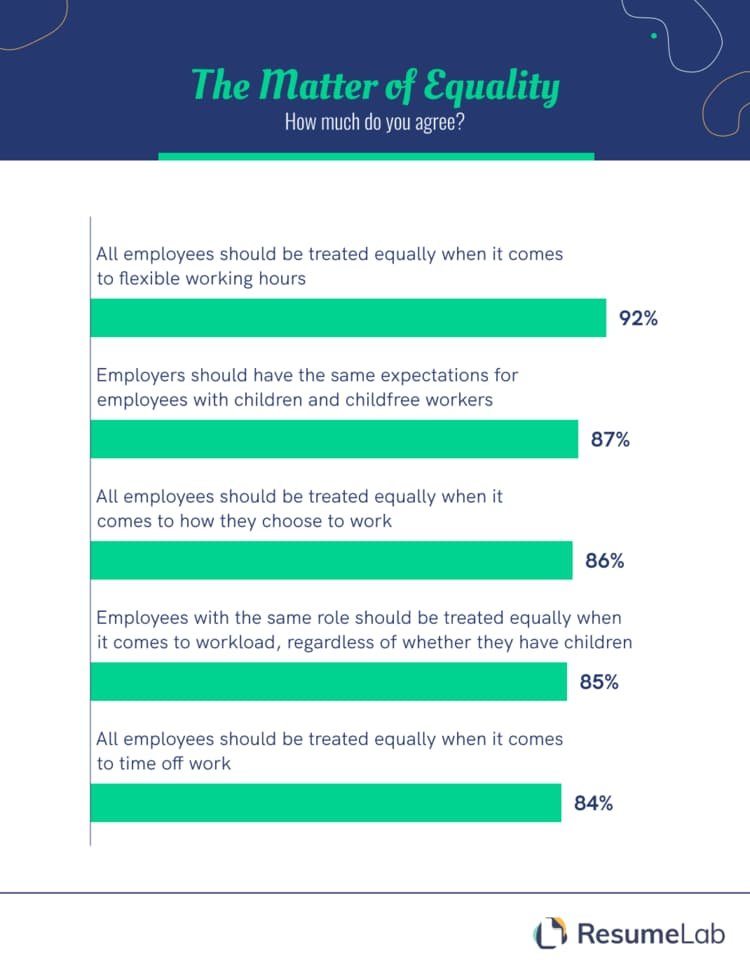
92% of respondents are convinced that all employees should be equally treated regarding flexible working hours.
87% think that employers should have the exact expectations for employees with children and childfree workers.
Equality between parents and childless people is also found when talking about the mode of work (remote or office-based). 86% believe that employees should be equally treated regarding how they choose to work.
Most of the respondents, 85%, share the view that employees with the same role should be equally treated when it comes to workload, regardless of whether they have children.
And last but not least, 84% agree that employees should be equally treated when it comes to time off work.
As you can see, in the end, we found aspects that apply both to people with and without children. And both sides agree here, attributing great importance to equality. This is good because it is an essential aspect of our lives, especially our professional lives.
Ideal worker vs. ideal parent
There are no winners or losers. But there is a win-win situation. It assumes a perfect scenario in which:
Employees without children understand that parents need more time and flexibility to take care of their kids.
Parents understand that childfree coworkers have a life outside work, and they don’t use “I have children” as an excuse.
We should stop embracing two conflicting norms: the “ideal worker” sacrificing for work and coworkers, and the “ideal parent” thinking only about family and ignoring the needs of childfree colleagues.
So, let’s travel the road of mutual understanding, choosing the scenario that currently fits our situation.
Methodology
The findings presented were obtained by surveying 938 respondents using a bespoke online polling tool. All respondents included in the study passed an attention-check question. They were asked a series of questions related to their opinions on differences in how parents and childfree employees are treated at work. These included yes/no questions, scale-based questions relating to levels of agreement with a statement, questions that permitted the selection of multiple options from a list of potential answers, and questions that allowed open responses.
Limitations
The data we are presenting rely on self-reports from respondents. As experience is subjective, we understand that there are many potential limitations with self-reported data as some participants and their answers might be affected by recency, selective memory, attribution, exaggeration, self-selection, non-response, or voluntary response bias.
Some questions and responses have been rephrased or condensed for clarity and ease of understanding for readers. In some cases, the percentages presented may not add up to 100 percent; depending on the case, this is either due to rounding or due to responses of “neither/neutral/unknown” not being presented.
Dominique is a career expert specializing in resume and cover letter writing advice. Having worked for both start-ups and corporations, she knows all the ins and outs of the recruitment process. At ResumeLab, Dominique shares her knowledge with job seekers at all stages of their career paths, from interns to directors to C-suite members.
SHRM President and Chief Executive Officer Johnny C. Taylor, Jr., SHRM-SCP, is answering HR questions as part of a series for USA Today.
Do you have an HR or work-related question you’d like him to answer? Submit it here.
When I told my employer I wanted to resign to take a new job, my employer offered me a salary increase of 10 percent above my pending position and 27 percent above my current position. Is this a common practice? If accepted, would I burn a bridge with the prospective employer? —Lidia
Johnny C. Taylor, Jr.: In today’s ultra-competitive labor market, it is common for an employer to counter an employee’s new job offer with a salary increase. For employers, retention is at a premium as they seek to avoid the replacement costs of recruiting and retraining new employees. This practice can be more prevalent in specific industries where there is high demand for certain positions. If you accept the higher salary, yes, it could burn a bridge with your prospective employer, but your prospective employer is likely aware of the challenge of finding talent and may anticipate a counter from your current employer.
Before you decide, revisit your original reason for seeking another job. If earning more money is your priority, then engaging in the counteroffer process may be an effective way to secure a higher salary. However, if the reason you’re looking to leave is a lack of career growth, culture misalignment or working for a difficult manager, a higher salary will not serve those interests. Allow your career priorities to inform your decision.
I’ll add this: Carefully analyzing the reasons you are seeking to leave your current employer may help determine if accepting a counteroffer is beneficial to you. It will also prevent you from eventually leaving your company in the next six months or a year because you still aren’t satisfied with your work there. If burning bridges with the prospective employer concerns you, be honest with the organization. Explain that you did not anticipate a counteroffer and, upon further reflection, you are choosing to stay. However, if the new job suits your career desires and goals, confidently move forward along your career path.
I run a New Jersey logistics facility overseeing 170 employees. Now that recreational marijuana use is legal in New Jersey, can we still screen for marijuana in drug testing? —Reilly
Johnny C. Taylor, Jr.: The legalization of recreational marijuana does not necessarily change what employers can do in terms of drug testing. Your company has a few options to consider under the legislation:
Employers can continue testing job candidates utilizing a traditional five-panel drug test.
Even if a job candidate tests positive for THC (marijuana’s active ingredient), an employer may not refuse to hire them solely based on the drug test results.
If an employer wants to eliminate marijuana use from the equation, it could change its drug-testing policy and ask candidates to submit to a four-panel test that omits THC—or it could take things a step further and remove drug testing from the hiring process entirely.
What about drug tests for current employees? Employers can still conduct random testing and testing based on reasonable suspicion of workplace usage. THC generally stays in users’ systems for a long time, which may make it difficult to determine when an employee used marijuana or if they used it at work. If you choose to maintain a drug-free workplace, document and demonstrate a good-faith belief that an employee has violated policy. The new legislation also requires employers to conduct a physical evaluation to determine if an employee is under the influence at work.
Be sure to review your drug-free workplace policies with appropriate legal counsel to determine the best path forward for your business. Whatever you decide, I hope you have a safe, healthy and productive workplace.
As chief administrative officer of Humana Inc., Tim S. Huval has a long list of responsibilities. He oversees HR, health and well-being, marketing, enterprise change and agility, workplace experience, inclusion and diversity, and safety and security. As a member of Humana’s management team, he helps set the strategic direction of the health insurance company, which is based in Louisville and had revenue of $83 billion in 2021.
None of that seemed very important three years ago, when Huval was struck out of the blue by a mysterious, life-threatening illness. Doctors were flummoxed by his condition—he was in a coma and on a ventilator—and unable to identify a cause. They feared he would not survive, but Huval rallied and ultimately recovered.
“I came out of that with a relentless focus on the purpose of my life and on making a difference for others,” he says.
Huval will be a main stage speaker at the SHRM Annual Conference & Expo 2022, to be held June 12-15 in New Orleans. We asked him to share some of his views on HR and on life.
Your responsibilities at Humana go well beyond human resources. In what areas would you recommend that HR practitioners increase their exposure, and why?
At Humana, we believe digital, data and analytics will be critical to creating value. Technologies like artificial intelligence, machine learning and automation have enormous potential to transform how we do business. It’s important to create value not only by using these technologies, but also by making sure they enable new ways of working that can be scaled across the whole organization.
Also, culture is more important than ever. Evolving hybrid ways of working are a differentiator and are changing the way companies think about talent strategies.
The last few years have been difficult emotionally and physically for workers. What has Humana done to support its employees during this time?
We care for our teammates on every level. We created special benefits and resources—like helping employees with young children get child care, providing special paid time off for those who needed it, and providing virtual care from doctors and therapists. We covered all of our employees’ COVID-19-related medical costs and ensured that workers had access to vaccinations when they became
available.
We also learned a lot about how we can work differently. Virtual ways of working prompted a new way of thinking about what work environments should look like. As we head back to the offices, we are keeping flexible ways of working in place so people can better balance what’s needed at home and at work.
“Cause the Effect” is the theme of SHRM’s Annual Conference. How can HR professionals Cause the Effect in their organizations?
HR has a unique view of how an organization’s actions affect employees at every stage of their work experience. From recruitment and onboarding to ongoing professional development, HR has an opportunity to make a difference. We strive daily to create exceptional employee experiences with every interaction and make Humana a place people want to be to grow their careers. Even when employees leave the organization, we want them to leave as advocates. There have been a lot of situations where someone leaves only to return, and we are better for it.
Your career has taken you from computer manufacturing to banking to health care. Would you suggest other HR professionals try to gain experience in a range of industries?
Yes, I strongly encourage others to be open to working across different industries, even in different line and operational roles. It can help you be more effective because you are exposed to different perspectives that you can build on. That being said, I’ve also grown and learned by taking on stretch opportunities within the same organization. The bottom line is that whether a person works in different industries or seeks different opportunities in their current industry or company, it’s important to keep taking risks in order to learn and grow.
You recently recovered from a life-threatening illness that puzzled doctors. What do you take away from such a sobering experience?
Sobering is one word for it. When you’re suddenly faced with a serious illness with a very small chance of survival, your perspective changes quickly. One day I was healthy. The next day I was fighting for my life, fighting for one more chance to talk to my kids and wife, fighting for the chance to make a difference. I remember thinking what I would do if I was given one more chance. It made me fearless in pursuing things rather than overthinking them. I now have a relentless focus on the purpose of my life and try to make a difference in someone’s life daily. I try to be more present—at work, at home, with friends and family. I live each day to the fullest.
Interview by Tam Harbert, a freelance technology and business reporter based in the Washington, D.C., area.







 Horgan’s Arlington, Va.-based company provides customized training and consultation in areas such as program design and management and employee development. CoLabL has partnered with the Society for Human Resource Management (SHRM) and the SHRM Foundation in the past to design and facilitate a variety of their mentorship programs.