
New Grads Use ChatGPT in Job Search

?Class of 2023 graduates are using ChatGPT in their communications with potential employers. Seventy percent of college seniors use artificial intelligence to craft resumes and cover letters, according to a new report, What the Class of 2023 Wants: How to Attract and Retain the Class That’s Never Satisfied, from LaSalle Network, a national staffing and recruiting firm in Chicago. It conducted the survey of 2,756 college seniors in March.

A separate report released May 2 by software development company iCIMS in Homdel, N.J., uncovered similar findings: 47 percent of 1,000 U.S. college seniors surveyed in March are interested in using ChatGPT or similar generative AI chatbots to write their resume or cover letter, while 25 percent of respondents said they have already done so.

Woe to the job candidate whose use is discovered. Among 500 HR professionals, 39 percent said it was “a deal breaker” for job seekers overall and 43 percent said it would sink the hiring chances of entry-level candidates.

The generative AI writes the resume or cover letter based on prompts from the job seeker, peppering the communique with keywords from the job description. But just as applicants want an authentic view of employers, employers want a true representation of the job seeker, noted Laura Coccaro, iCIMS chief people officer.

“As HR professionals, we want to be sure we’re getting an authentic view of who someone is,” when looking at cover letters and resumes, she said. “You want it to be original content when you’re hiring someone.”

[SHRM members-only resource: Using Artificial Intelligence for Employment Purposes

Manage Expectations

New grads also expect transparency—and speed—from their new bosses. They want jobs, and they want them fast; 64 percent told iCMIS they expect the process to take three weeks or less.

“They expect the [hiring] process to take three weeks and [involve] three interviews,” Coccaro said. “As employers, we know it’s going to take more than three interviews. This is really a gap in terms of expectations and reality.”

Leverage technology when communicating with candidates to manage their expectations and keep them engaged, she advised. If possible, send text messages apprising candidates of the hiring timeline.

The messaging has to be authentic to the organization, not just a generic acknowledgment of the job application, she added. Keep candidates interested by providing on-demand information such as employee testimonials on how the organization supports their whole selves.

“It’s very, very powerful in terms of demonstrating an authentic message that’s coming directly from employees,” Coccaro said.

Graduates also want quick career movement—54 percent of college seniors expect to be promoted within their first year, LaSalle found.

To meet that expectation, LaSalle suggests employers showcase advancement opportunities early and often, consider expanding promotion tracks, and provide new hires with a sample timeline and curriculum to follow, including training from internal and external sources. As part of their 90-day onboarding plan, consider partnering new graduates with management to build a career map.

Other Findings

  • College seniors want job stability and a high starting salary. 

These tied as students’ top priority, followed by overall benefits (74 percent, 74 percent and 66 percent, respectively), a separate survey from Handshake found. The online recruiting platform for higher education students and alumni surveyed 1,432 job seekers from the classes of 2022 and 2023 in June and July 2022. 

  • They want pay transparency. 

Forty percent of college seniors would not apply to a job if the posting did not include a salary range and 30 percent of male graduating seniors would not apply, iCIMS found. Additionally, 2023 graduates expect an average starting salary of $66,467. That’s more than $8,000 over what employers expect to pay entry-level candidates but down from the 2022 graduates’ $70,000 salary expectations.

Employers need to articulate their total rewards package as a way to manage salary expectations, Coccaro advised.

  • They want mental health therapy coverage. 

This is the No. 1 employer benefit for 40 percent of graduating seniors, followed by medical coverage and flexible spending accounts, according to LaSalle’s report.

“They want to make sure they were able to go to therapy and it wasn’t a taboo subject at the company,” said Sirmara Campbell, CHRO at LaSalle Network.

Employers should highlight mental health perks and benefits for new employees, such as employee resource groups, stress management training or time off during the workday to attend therapy sessions, LaSalle suggests in its report.

  • They want financial benefits. 

Fifty percent want bonuses or overtime pay for working beyond their contracted hours; 42 percent want 401(k) matches; 34 percent want financial advisory programs, such as on investing and home buyers; and 28 percent want student loan repayment programs, iCMIS found.

  • They’re open to other offers. 

Thirty-six percent of graduating seniors who accepted job offers continued to apply elsewhere, LaSalle found, and 16 percent would be open to other opportunities if they arose. Hang on to those new hires by creating a sense of belonging after the job offer is accepted, Campbell advised. Have a touchpoint every two to three weeks “to make them feel they’re part of the company before they even start.” Employers can try:

–Sending a care package during finals week.
–Allowing them to start working part time before graduating.
–Taking them to lunch or happy hour ahead of their first day.
–Providing training materials ahead of their start date.
–Setting them up with a mentor.
–Hosting an office tour and meet-and-greet with the team; consider scheduling it on a day when a fun activity takes place. 

  • They want to work, even if the job isn’t in their area of study. 

Nearly all college seniors—97 percent—iCIMS surveyed have considered alternate job options, including taking a job unrelated to their major, and 40 percent are applying to a wider variety of industries to increase their employment chances.

“What this means is we have a group of individuals being realistic about how their skills translate,” Coccaro said. “They’re thinking creatively” about how their skills can transfer beyond their area of study.

She advised employers to have realistic expectations.

“Think about a way of applying training [and] upskilling opportunities, and [creating] a path for those that are coming in” to obtain the skills and experiences they may have missed because of the pandemic.

“I would encourage employers to look left and look right,” she recommended, “what other skill sets [do they have] that’s maybe close enough?”

  • They’re open to temp work. 

Eighty-five percent would accept temporary roles, LaSalle found. Campbell, who has worked at LaSalle for 25 years, started in a temporary role as a receptionist.

“I was able to test out the company and have a working interview with the company. They were able to test me out, I was able to see if I liked that company … and felt like I belonged in [its] culture,” she recalled. “It’s a great way for a candidate and organization to see if they mesh.”

  • They would relocate. 

Sixty-seven percent told Handshake they would change cities for the right job—where there were advancement opportunities, the cost of living is lower, or in-person workplace attendance is flexible.

  • They job hop. 

Ninety-three percent who accepted a job offer are confident or very confident they will retain their job for at least six months, LaSalle found, while 34 percent expect to stay a year or less at their first employer.

Almost half plan to stay two years or less. By comparison, in 2022 only 3 percent said they planned to stay less than one year, and 33 percent planned to stay less than two years.

Campbell advised having career-related conversations with new employees to make them aware of how your organization can help them achieve their goals. Once you know their aspirations, point to a current employee in that role and explain their career trajectory.

  • They want stability. 

iCIMS found 35 percent of its respondents see themselves on a long-term career path with an employer and 64 percent see the value of longevity with an organization.

Given their pandemic experience, graduating seniors “understand what instability looks like, and they want the complete opposite when looking for their first job,” Coccaro said.

  • They prefer hybrid schedules. 

Seventy percent prefer working from home two to three days per week, similar to 2022 graduates, LaSalle found.

“This class realizes they need to be in the office, having that connection with people,” Campbell said. “They love the flexibility, but there are some people who have not accepted remote jobs because they want to build [workplace] relationships.”

Handshake also found a preference for hybrid schedules: 55 percent of respondents said it’s important they are allowed to work remotely, but only 15 percent want a fully remote schedule while 23 percent want a fully in-person schedule.

*They may not be available. Some graduating seniors are considering taking a year off to attend graduate school (34 percent); take time for other activities, including travel (33 percent); or complete a post-graduation internship (31 percent), according to iCIMS.
Ask HR: What Should I Do if An Employee Shows Signs of Mental Distress?

SHRM President and Chief Executive Officer Johnny C. Taylor, Jr., SHRM-SCP, is answering HR questions as part of a series for USA Today.

Do you have an HR or work-related question you’d like him to answer? Submit it here.
 

I supervise a group of six employees at a logistics services company. I suspect one of my employees is showing signs of clinical anxiety. Should I approach them to address it? How can I support them?–Lisa

Johnny C. Taylor, Jr.: I appreciate you wanting to support one of your employees, but I want to caution you to keep your focus on the employee’s work and behavior and not try to “diagnose” them. I always recommend referring employees to trained medical professionals for health matters. And because of the stigma attached to mental health, which can discourage openness about mental health, leave it to the professionals.

Show support by being available to listen to your employee. If they share their struggle, encourage them to utilize an employee assistance program, use their time-off balances or take personal mental health days as needed.

Under the Americans with Disabilities Act (ADA), you can make certain medical inquiries of employees in very limited situations. You should not ask employees about health conditions without having a reason considered “job related and consistent with business necessity.” If your employee poses a direct threat to themselves or others, an employer could make a medical inquiry in that instance.  

If your employee’s performance is not up to expectations, you may want to address their performance with them directly. However, if their behavior or conduct just seems “off,” you can be less formal. See if the employee has all the tools or time frames needed to successfully complete their job duties.

If they disclose that they have a mental health condition, you should engage in the interactive process under the ADA. The interactive process can help determine if an accommodation is needed and if providing an accommodation is reasonable or causes an undue hardship on the business. An employee with a disability may still be held to the same performance expectations as employees without disabilities.

As a workplace leader, you can always address your team as a whole without singling out a specific individual. Emphasize in team meetings what resources are available to protect mental wellness, especially during periods of high stress. It can also help to talk about the steps you take to protect your own mental health. Workers often take cues from their leaders. So it is important for leaders to set the tone for what they want to see in the workplace.

Touch base frequently with all your employees to stay aware of their needs. Listening to them promotes openness, awareness and understanding. Prioritizing mental health not only protects your workers, but it also protects the workplace.

I witnessed a co-worker of mine be targeted with inappropriate sexual comments. However, she does not want to report it. Am I obligated to report what I have seen?–Sandra

Johnny C. Taylor, Jr.: It is understandable for your co-worker to be uncomfortable escalating or talking about experiencing sexual misconduct. However, showing concern and support can help them feel better about taking necessary action.

While there aren’t any federal regulations requiring you to report inappropriate sexual conduct directed at co-workers, many employers have a workplace-harassment policy that covers sexual harassment and retaliation. I recommend you review your company’s relevant policies. If you are required as a witness to report any kind of inappropriate conduct, then by all means do so.

However, if your company’s policies don’t require you to report it, you may want to consider your options and what is best for all involved. This could be very tricky especially when you want what’s best for your co-worker and your workplace.

You could encourage your co-worker to consider speaking with the alleged harasser and let them know their comments were inappropriate. If you witnessed the harassing comments, and if you are comfortable and feel safe doing so, address the person who is inappropriately targeting your co-worker. Respectfully let them know you witnessed the behavior and make clear this behavior is inappropriate and not tolerable. Unfortunately, most of the time, behavior like this will not stop until someone steps up and says something.

If the inappropriate comments continue or there is other harassing behavior, explain to your co-worker that you aren’t comfortable not saying anything to anyone. Encourage them to report it to HR or upper management and support them through the process by voicing your general concerns, even if they don’t speak up.

Workers play a vital role in creating and protecting their workplace culture. Realistically, HR can’t be everywhere and see everything. Neither can managers or senior leadership. So being intentional about what you want and, in this case, don’t want in your workplace is important. Taking action to protect your co-workers and yourself is wholly appropriate. 

Reimagining the Performance Review

After an annual review that lasted about 10 minutes, a New Jersey-based account coordinator knew it was time to leave the public relations agency where he had worked for almost a year. 

The 25-year-old, who requested anonymity, asked for the meeting because his boss hadn’t mentioned any formal assessment process, nor had his manager ever critiqued his work. The coordinator says he sat with a trio of senior executives who didn’t ask him any questions beyond how he would rate himself. He says they ignored his requests for guidance on how to advance at the agency. 

“What I was really looking for was feedback from them on how I can improve, how I can establish myself at that agency,” he says. “At the end of it, there was no mention of next steps. I was very much in the dark.” 

His story is an all-too-typical example of the problems with performance reviews. Now more than ever, employees want to know where they stand and how to further their careers, but most organizations do not effectively deliver that information. 

This example also illustrates one of the common failures in performance management: limiting reviews to once or twice a year without having any other meaningful career discussions in between. Nearly half (49 percent) of companies give annual or semiannual reviews, according to a study of 1,000 full-time U.S. employees released late last year by software company Workhuman. 

 ‘The performance management design itself is not evolving as quickly as the objectives and the purpose that we have set out for what we want it to do.’
Lesli Jennings

The only thing worse than doing one review per year is not doing one at all, experts say. The good news is that only 7 percent of companies are keeping employees in the dark about their performance, and 28 percent of organizations are conducting assessments quarterly, the Workhuman study found.

A Pervasive Problem

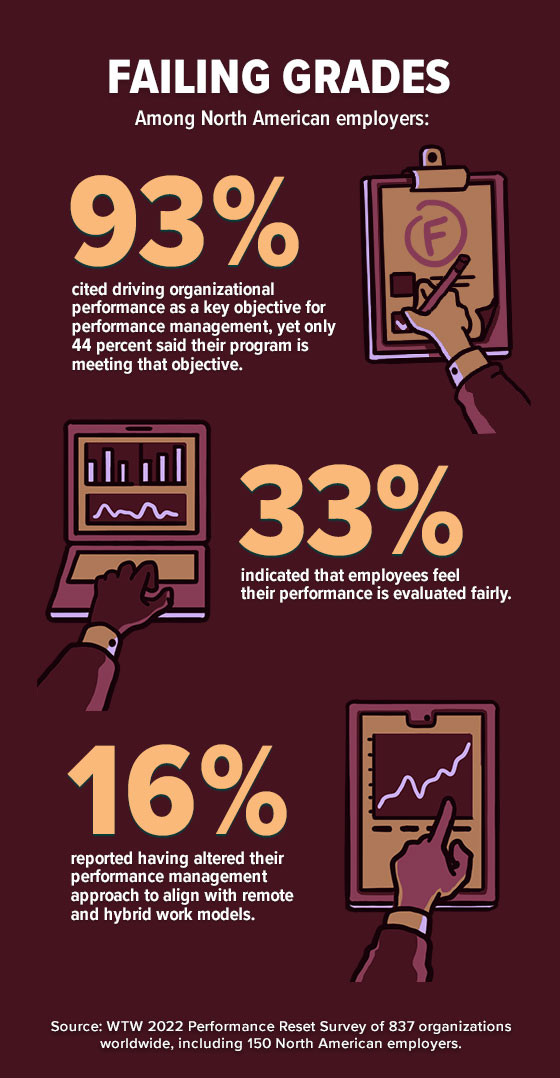
However, this doesn’t mean that more-frequent formal meetings or casual sit-downs between supervisors and their direct reports are solving the performance review quandary either. Only about 1 in 4 companies in North America (26 percent) said their performance management systems were effective, according to a survey of 837 global companies conducted last fall by consulting firm WTW. And only one-third of the organizations said employees felt their efforts were evaluated fairly. 

Meanwhile, a Gallup survey conducted last year found that 95 percent of managers are dissatisfied with their organization’s review system.

The problem is not new, though it is taking on greater importance, experts say. Millennials and members of Generation Z crave feedback and are focused on career development. Meanwhile, the tight labor market has companies searching for ways to keep high-performing employees in the fold. Less than 20 percent of employees feel inspired by their reviews, and disengaged employees cost U.S. companies $1.6 trillion per year, according to Gallup.

Lesli Jennings, a senior director at WTW, says part of the issue is that reviews are now so much more than a discussion of past performance. They also include conversations about career development, employee experience and compensation. 

“The performance management design itself is not evolving as quickly as the objectives and the purpose that we have set out for what we want it to do,” Jennings says. 

Review Practices, Systems Are Unreliable

Some argue it’s time to completely scrap annual reviews and stop using scales composed of numbers or adjectives to rate employees. 

“Every single human alive today is a horribly unreliable rater of other human beings,” says Marcus Buckingham, head of people and performance research at the Roseland, N.J.-based ADP Research Institute. He says people bring their own backgrounds and personalities to bear in reviews in what is called the “idiosyncratic rating effect.” As a result, the ratings managers bestow on others are more a reflection of themselves than of those they’re reviewing.

 ‘Every single human alive today is a horribly unreliable rater of other human beings.’
Marcus Buckingham

Buckingham adds that very few positions have quantifiable outcomes that can be considered a measure of competence, talent or success. It’s possible to tally a salesperson’s results or test someone’s knowledge of a computer program, he says, but he’s baffled by attempts to measure attributes such as “leadership potential.”

“I’m going to rate you on a theoretical construct like ‘strategic thinking’? Everybody knows that’s rubbish,” Buckingham says. He adds that performance reviews that offer rankings give “data that’s just bad,” and he insists that companies rely on data analytics because they don’t trust their managers’ judgment. But instead of working on improving their managers’ skills, they put data systems in place. 

“Because we don’t educate our managers on how to have some of these conversations, we’ve decided that the solution is to give them really bad ratings systems or really bad categorization systems,” Buckingham says. 

‘Data-Driven’ Ratings Can Hurt Employees

Ratings aren’t likely to disappear anytime soon, however. “Data-driven” has become a rallying cry for companies as they seek to operate more efficiently. Organizations are trying to measure everything from sales to productivity, though such efforts can cause turmoil and hurt some individuals’ careers.

A June 2022 study of nearly 30,000 workers at an unnamed North American retail chain found that women were more likely to receive higher overall ratings than men, though women were ranked lower on “potential.” 

In that study, women were 12 percent more likely to be given the lowest rating for potential, as well as 15 percent and 28 percent less likely to receive the middle and highest potential ratings, respectively, according to the professors who conducted the study: Alan Benson of the University of Minnesota, Danielle Li of the Massachusetts Institute of Technology and Kelly Shue of Yale University. The authors also found that women were 14 percent less likely to get promoted than men. “Because potential is not directly observed,” they noted, “these assessments can be highly subjective, leaving room for bias.” 

Meanwhile, in January, a manager at Irvine, Calif.- based video game developer Blizzard Entertainment balked after being told to lower an employee’s rating to fulfill a quota. Blizzard has a “stack ranking” system that rates employees on a bell curve and requires a certain percentage of staff to receive low grades. The manager, Brian Birmingham, refused to downgrade an employee from “successful” to “developing” to satisfy the system and told colleagues he was resigning if the policy wasn’t changed. 

Birmingham left abruptly one afternoon and did not go in to work the next day, which he says Blizzard interpreted as his resignation. Blizzard did not respond to requests for comment.

 ‘I feel like the conversation about how to improve your career, what the expectations are for your job and what it will take to get to the next level are all things you can do without a rating.’
Brian Birmingham

Stack ranking became popular in the 1980s after it was embraced by General Electric. Its adoption has waned, though several tech companies continue to use it. Google and Twitter relied on stack ranking to decide who to let go in their recent rounds of layoffs, according to published reports.

Birmingham says this type of system can cause anxiety and competition, which can kill team cohesion, and that arbitrary lower ratings adversely affect compensation and promotion potential. These systems can also suggest that a manager is ineffective. “It implies that as managers, we basically have not done our job to hire them and train them appropriately or terminate them if they really aren’t working out,” he says.

Birmingham says he is not opposed to ranking systems but doesn’t think they’re necessary. “I feel like the conversation about how to improve your career, what the expectations are for your job and what it will take to get to the next level are all things you can do without a rating,” he explains.

Measurements Matter

Grant Pruitt, president and co-founder of Whitebox Real Estate, does not give any type of rating in his performance reviews, though he believes in using data to track his employees’ performance. “What isn’t measured can’t be managed,” says Pruitt, whose company has about 20 employees in several offices across Texas. 

At the beginning of the year, Whitebox employees set goals with their managers. Discussions are held about what benchmarks are reasonable, and these targets can be changed if there is a meaningful shift in business conditions. Team leaders hold weekly department meetings with their direct reports to discuss what’s happening and track progress. Managers hold quarterly private reviews with individuals to dig deeper into whether they’re meeting their goals and if not, why.

“Was it an achievable goal? Realistic? If it was, then what do we need to do to make sure we don’t miss it the next time?” Pruitt says. Whitebox switched to quarterly reviews about four years ago to address problems earlier and avoid having issues fester, he adds.

It’s easier to set goals for people in sales than for those in other departments, Pruitt notes. However, he adds that executives need to brainstorm about targets they can use for other roles. For example, administrative employees can be rated on how quickly and efficiently they handle requests.

Pruitt maintains that the goal system makes it easier to respond when an employee disagrees with their manager about their performance review because there are quantitative measures to examine. The data also helps eliminate any unconscious bias a manager may have and helps ensure that a leader isn’t just giving an employee a good rating because they work out at the same gym or their children go to school together.

“I think that’s really where the numbers and the data are important,” Pruitt says. “The data doesn’t know whose kids play on the same sports team.”

Whitebox employees are also judged on how well they embrace the company’s core values, such as integrity, tenacity and coachability. Some of those values may require more-subjective judgments that can be more important than hitting quantifiable goals. 

Pruitt acknowledges there were occasions when he looked the other way with a few individuals who were “hitting it out of the park,” even though he believed they lacked integrity. But eventually, he had to let them go, and the company lost money.

“They really came back to bite me,” Pruitt says.

Grades Are Good

Diane Dooley, CHRO of Iselin, N.J.-based World Insurance Associates LLC, also believes establishing quantitative methods to gauge employees’ performance is essential. “We are living in a world of data analytics,” she says. The broker’s roughly 2,000 employees are rated on a scale of 1 to 5.

ATW_Infographics_marijuanaatwork_Graph1_560x610.png

World Insurance has taken numerous steps to remove bias from reviews. For example, last year the company conducted unconscious-bias training to help managers separate personal feelings from performance reviews. And all people managers convene to go over the reviews they’ve conducted. Dooley says this process gives everyone a chance to discuss why an employee was given a certain rank and to question some decisions. “We want to make sure we’re using the same standards,” she explains.

Currently, World Insurance conducts reviews only once a year because it’s been on an acquisition binge and hasn’t had time to institute a more frequent schedule. That will change eventually, says Dooley, who adds that she wants to introduce department grids that show how an employee’s rank compares to others on the team. 

“It’s just a tool that helps the department or the division understand where their people are and how we can help them collectively,” says Dooley, who has used the system at other companies. 

Dooley says she isn’t worried about World Insurance holding reviews only annually, because good managers regularly check in with their employees regardless of how frequently reviews are mandated.

Such conversations can easily fall through the cracks, however. “Managers want to manage the employees, but they get so caught up in the company’s KPIs [key performance indicators] and making sure that they’re doing everything that they need to do,” says Jennifer Currence, SHRM-SCP, CEO of WithIN Leadership, a leadership development and coaching firm in Tampa, Fla. “It’s hard to set aside the time.” 

WTW’s Jennings adds that managers sometimes avoid initiating conversations with employees who are not performing well. Such discussions are often difficult, and managers may not feel equipped to conduct them. 

“Having to address underperformers is hard work,” Jennings says. 

Additionally, experts say, coaching managers to engage in such sensitive discourse can be expensive and time-consuming.

‘Have More Regular Conversations’

Finding the right formula for performance reviews is tricky. The company’s size, values, industry and age all play a role. Currence says businesses need to think about the frequency and purpose of these meetings. Some managers may have weekly discussions with their direct reports, but the conversations might center on status updates as opposed to performance. 

“We need to have more regular conversations,” Currence says. “There has to be a happy balance.”

San Jose, Calif.-based software maker Adobe Inc. was a pioneer when it eliminated annual reviews in 2012 after employees said assessments that look backward weren’t useful, and managers lamented how time-consuming they were. Instead, Adobe introduced quarterly check-ins and did away with its numerical ratings system, even though the company is “data-driven,” according to Arden Madsen, senior director of talent management.

“We focus on employees and managers having a rich, two-way feedback conversation,” Madsen says. “Often in traditional performance management systems, there’s too much focus on the number.” 

Adobe’s system has changed over the years as the company grew from about 11,000 employees in 2012 to around 28,000 today. In the beginning, employees were not asked a universal set of questions and the information gathered was not stored in a central place accessible to all. In 2020, Adobe instituted three or four questions that must be asked at each quarterly meeting, one of which is whether the employee has feedback for the manager. Other topics covered depend on the employee, their role and their goals.

Madsen says asking consistent questions and making reviews easily accessible are important, as internal mobility within the company has grown. 

Like many businesses, Adobe separates conversations about performance from discussions about raises and bonuses, even though they’re intertwined. 

“Money is so emotionally charged,” says WithIN Leadership’s Currence. “When we tie performance review conversations with money, we as human beings do not hear anything about performance. We only focus on the money.”

212156_SubstanceAbuse_Sidebar-1000x250.png
  1. DON’T limit conversations to once or twice per year. It’s important to deal with any problems as they arise; don’t let them fester.
  2. DO set performance goals and expectations at the beginning of the year so employees understand their responsibilities.
  3. DO explain how each employee’s position, as well as each department, fits into the company’s overall strategy. This will help employees understand why their job matters.
  4. DO simplify the process. There’s no need for a double-digit number of steps or numerous questions that require long-winded answers.
  5. DO consider a 360-degree approach. Input from employees’ colleagues or from other managers can help give a fuller picture of employees’ capabilities and contributions.
  6. DON’T ignore employees who you don’t always see. You may not see some of your reports as often as others, especially if they work remotely, but that doesn’t mean they’re not working hard.
  7. DO be sensitive to “recency bias,” which is basing a review on an employee’s most recent performance while ignoring earlier efforts. Don’t let recent mistakes overshadow the employee’s valuable accomplishments.
  8. DO solicit feedback from employees. Reviews should be a two-way conversation, not a lecture.
  9. DO train managers to give advice calmly and helpfully. This is especially important when leaders must call out an employee’s subpar performance.
  10. DON’T discuss compensation during reviews. Employees are likely to be so focused on learning about a raise or bonus that they won’t pay much attention to anything else.

Theresa Agovino is the workplace editor for SHRM.


Explore Further

SHRM provides resources and information to help leaders better evaluate their employees’ performance.

Giving Feedback: Pack It with Nutritional Value

?You’re lying in bed, inwardly cringing as you think about having that conversation tomorrow—where you’ll have to tell an employee to her face that her work is subpar and corrective measures are needed.

“Those conversations are what make people nervous and frustrated and sometimes make them leave their jobs,” said Shari Harley, founder and president of Candid Culture, an international training and consulting firm based in Denver. Harley, who worked in HR for eight years, offered advice during her presentation, “What to Say When You’ve Waited Too Long: Giving Useful Feedback” at the SHRM Talent Conference & Expo 2023 in Orlando, Fla.

Oftentimes conversations about workplace behavior and performance are frustrating for the individual receiving the feedback because it lacks specifics. The manager uses what Harley calls “Cap’n Crunch” terms—verbiage that, like the children’s cereal, lacks nutritional value. Telling the employee she has a bad attitude, is not detail-oriented or is unmotivated is not specific, Harley said. The employee leaves the conversation not knowing how to correct the problem.

“This is all opinion, and opinion is subjective and … why people refuse to sign appraisals,” she explained. “You haven’t given them enough information to be helpful. People leave this conversation [thinking], ‘OK, I’m in trouble but I don’t know why I’m in trouble.’ “

Instead, Harley recommends sharing an example of how a bad attitude affected customer service, or when a lack of detail hurt a project. She offered the following formula for delivering feedback:

  1. Introduce the conversation: : “I need 10 minutes with you.” If the conversation is being conducted remotely, make sure the employee has privacy. 
    “Feedback’s always tricky and always emotional. Human beings don’t like to be told they’re wrong,” Harley said. Oftentimes they become emotional because they care enough about their job to get upset.

  2. State your motive for the conversation: “I care about your career, and I want you to be successful. As your manager, my job is to support that, and I’m seeing something that’s impacting you negatively and I want to tell you about it.”

    This is the “why” of the conversation and builds trust at the start, Harley explained. 

  3. Describe the behavior: “I’ve noticed … .” If the performance issue is not something you have witnessed, you must validate the issue, such as through confidential phone calls with individuals who did observe the behavior. In this case, start the conversation by saying, “I’m aware … .” Do not say, “Someone told me,” because the employee’s attention will be on trying to figure out who that “someone” was.

    Concrete examples are a must when meeting with the employee.

    “If I do not have a specific example” of the problem, Harley said, “I don’t give the feedback.”

    Also, don’t overwhelm the employee with your feedback. Harley recalled a young employee whose very detailed manager gave her 24 things to work on during her performance review.

    “I give a maximum of three things—preferably one or two,” she said. “If someone gets too much feedback in a short amount of time … performance dips.”

  4. State the impact of the employee’s behavior. For example, a manager is
    concerned after overhearing an employee speaking condescendingly about an
    initiative the manager introduced at a recent meeting. Although the manager
    asked team members for their questions and concerns, the employee sat quietly. The
    manager’s aim in the feedback scenario is to curb the negative behavior and assure
    the employee that team members can speak freely; not doing so can undercut the
    initiative and contribute to poor morale.

  5. . Ask for the employee’s perception of the situation. Expect the employee to be defensive, but defensiveness is not a performance issue, Harley pointed out.

    During the conversation, assure the employee: ” ‘I know this is hard and I want you to think about it, and let’s talk again in a week.’ ” Harley advised. “Time in feedback is people’s friend. In a week it’ll be a different conversation.”

    Another approach is to suggest the employee talk to two or three close friends or family members about the feedback and ask if they can validate the behavior in question. Then meet again with the manager in a week.

  6. Ask the employee for ideas on how to address the issue at hand. The employee
    who was uncomfortable speaking up during a meeting may suggest e-mailing or meeting
    privately with the manager about any concerns. 

  7. Build an agreement on next steps: Acknowledge the awkwardness of the conversation and promise to provide regular feedback in the future.  

  8. Say “Thank you.”

The point of feedback is to offer enough information that the person knows what behaviors to continue and what behaviors to change, but the feedback needs to be specific and timely. When done right, Harley said, it’s like a GPS system for job performance.

“How long do we wait to give feedback at work sometimes, when someone is a little bit off track?” Harley asked. No one wants to exit the wrong ramp or be headed miles and miles out of their way, just as employees don’t want to learn their performance has been steering them in the wrong direction for weeks and weeks.

The Bumpy Path to Leadership for Women

?Historically, women have held fewer leadership positions than men.

Federal data shows that women account for 47 percent of the U.S. workforce but just 31 percent of top executive roles. Many factors contribute to this discrepancy, including the reality that women face challenges that men do not when attempting to advance their careers.

However, both women and men in executive positions can help reverse this trend in a myriad of ways, according to Jennifer McCollum, CEO of Linkage, a women’s leadership development firm acquired by SHRM in 2022.

“It is up to all of us to change the face of leadership,” she said. “Men, we can’t do this without you.”

McCollum spoke about the unique path and hurdles that women face as they ascend the leadership ranks, as well as the role of companies in supporting their professional goals, during her session at the SHRM Talent Conference & Expo 2023 in Orlando on April 17.

The Exhaustion of Meeting Stereotypes

McCollum, author of the upcoming book In Her Own Voice: A Woman’s Rise to CEO: Overcoming Hurdles to Change the Face of Leadership (BenBella Books, 2023), began by discussing how the COVID-19 pandemic had devastating effects on working women.

Women lost millions of jobs in 2020 largely because many were in the industries most impacted by the pandemic, such as hospitality, tourism and retail. McCollum said many left their jobs by necessity because women are more likely than men to feel responsible fora “second shift,” which can include child care, elder care and house care.

Those still in the workforce constantly shift between fulfilling the expectations of being seen as a stereotypical leader—displaying traditionally male characteristics such as aggressiveness and competitiveness—and the expectations of being a woman—displaying traditionally female characteristics like being kind, cooperative and collaborative.

“For women, this burden is being seen as one or the other, not both,” she said. “If we’re too feminine, we’re not ‘tough or strong enough for the big job,’ but if we’re too masculine, we’re too ‘ambitious or aggressive.’ “

These stressors have led to high rates of burnout: In 2022, about 43 percent of women reported burnout compared with 31 percent of men, according to a report on women in the workplace by LeanIn.org and McKinsey & Co.

“Women are even more burned out than we were a year ago,” McCollum said. “The gap in the burnout rate between men and women has doubled.”

Women Are Making Some Progress in Leadership Roles

Advancing women is good for business.

Research shows that companies with women well-represented in executive roles are more likely to outperform their male peers and have been shown to achieve greater effectiveness, employee retention and client satisfaction.

McCollum said women make “very effective leaders,” especially considering leaders are now expected to be inclusive, open, transparent, empathetic and vulnerable. These characteristics are often seen in female leaders.

But, as she noted, these traits often do not help women ascend into executive roles. For example, women make up more than 70 percent of the health care workforce but hold just 25 percent of leadership positions in the health care industry.

“The path to leadership for women is different,” McCollum said. “The hurdles are higher.”

There has been some progress: For the first time, more than 10 percent of Fortune 500 companies are run by women—although just 1 percent of the total are women of color. And the number of women at the C-suite level has increased by nearly 7 percent in the past five years.

“We’re progressing, even if it’s not as fast as we would like,” McCollum said. “But we need to see those statistics evolve faster because the business case is so clear for diversity in leadership.”

Women Still Lack Sponsorship, Support Systems

McCollum explained that female leaders perform better, stay at their companies longer and advance professionally when organizations address several critical dimensions:

Culture. Do women feel valued and respected in the organization?

People systems and processes. Do women have equal opportunities in the hiring process, access to stretch assignments or promotions?

Executive action. Are the executives taking action to support and sponsor women in the organization?

Focused leadership development. Does the organization provide effective development for women?

Women historically have not received the same support as men in the form of feedback, coaching and mentorship. The benefits of sponsorship, in particular, can enable women to receive critical feedback, advance in their careers and feel a sense of belonging at work, McCollum said.

However, a report by Harvard Business Review indicated that many companies have halted formal sponsorship programs, citing pushback from executives who feel they are being asked to advocate for people they either don’t know well or don’t think are ready.

A lack of sponsorship can keep women from fulfilling their professional potential, McCollum suggested.

“It’s natural to hire, engage, support and promote people who look like you,” she said. “But unless we do something different, the leadership majority will stay the majority for many more years.”

Viewpoint: Should You Let Employees Break the Rules to Make Customers Happy?

?Editor’s Note: SHRM has partnered with Harvard Business Review to bring you relevant articles on key HR topics and strategies.

Organizations are increasingly relying on technology to deliver simple transactions in a standardized way. Things like self-order kiosks at McDonald’s, bank mobile apps for check deposits and FAQ chatbots that enable consistent and efficient service delivery to customers. Most day-to-day service encounters, from mobile ordering for a cup of coffee to returning products online, are relatively simple and straightforward.

However, not all customer needs and wants can be met in these ways. Despite the widespread use of technology, frontline employees continue to play an important role in delivering quality customer service, especially when automation cannot help solve complex customer problems. For example, when support from a virtual agent does not help with their issue, customers call in and receive tech support from a live agent.

Furthermore, customers’ needs, problems or demands are often unique, distinct, complex or irregular. As a result, employees sometimes encounter challenging situations where it may be difficult for them to successfully help or satisfy a customer when they try to work within the bounds of their organization’s rules. In fact, service employees may be faced with a dilemma: What should they do in situations where providing an excellent customer experience and ensure satisfaction requires them to break, bend or deviate from an organizational rule or procedure?

We refer to such behaviors as pro-customer rule breaking, and it often involves adapting service delivery, communicating information differently than parameters or scripts allow, or using resources in ways that defy prescribed rules or expectations set by their organization. Examples include a retail employee granting extensions to a customer requesting product return that is a few days beyond the 15-day return policy, a salesperson arranging for the product to be repaired free of charge when a warranty has expired, and an airline employee helping passengers who missed their flight rebook another flight service at no extra cost.

Does rule-breaking by frontline service employees help build a genuine relationship with customers by adding a human touch to service? And can it ultimately be a key differentiator at your organization and enhance customer loyalty?

Why Employees Should (Sometimes) Break the Rules

Marketing research sheds light on the positive customer outcomes of pro-customer rule breaking. Bank employees, for example, are required to follow a clear and well-established set of standard procedures and processes for most of their retail banking services, including personal loans, merchant services and payment services. Thus, customers tend to recognize even small rule breaking or deviating behaviors from their bank’s service providers. In a survey, retail bank customers reported feeling indebted when their service provider, for example, skipped unnecessary paperwork in order to serve them in an efficient manner or waived small bank fees that unfairly penalized them.

Customer indebtedness in turn was positively associated with something called “service friendship” — friendship between customer and service provider — which improves customer commitment, satisfaction and loyalty. Customers also perceive pro-customer rule breaking as employees’ sacrificial behaviors to help them, which creates a sense of imbalance in their exchange relationship with employees. This generates customers’ sense of obligation to repay for a bank employee’s favor, like buying more products and continuing their business with the bank in the future.

Similarly, while employees in the luxury hotel industry are supposed to provide consistent service, they strive to leave a good impression with their customers by tailoring to individual preferences and delivering personalized service at the same time. A survey of employee-customer pairs at a luxury hotel restaurant found that customers felt more grateful, loyal and satisfied when, for example, their service provider, despite the “no free food” policy, offered free desserts or drinks that pair nicely with the main dish to help enhance customers’ dining experience.

How Employees Feel About Breaking the Rules

As supported by marketing research findings, customers clearly recognize when employees take risks to be helpful, and research shows that pro-customer rule breaking has desirable customer outcomes. But how do employees feel who are breaking or deviating from rules to better serve customers? Does pro-customer rule breaking only elicit guilt in employees, given the rule breaking? Or could it also have a beneficial impact on employee outcomes?

We found that rule breaking highlights employees’ prosocial intention to help or better serve customers. By attempting to problem-solve for customers in challenging service encounters, pro-customer rule breaking can positively impact employees themselves through fulfilling their basic psychological needs for autonomy, competence and relatedness.

Across two studies we found that employees who broke a rule in this manner felt more autonomous, competent and connected to their customers. These employees were less emotionally exhausted, more satisfied with their job and were more likely to share with their organizations their concerns, ideas and suggestions to improve existing rules and practices for customer service. While some research has found that employees feel guilty breaking the rule, in ours, participants who engaged in pro-customer rule breaking did not report experiencing more guilt compared to those who did not engage in it.

How can your organization put these findings into practice? We offer three suggestions.

Use caution in evaluating employee rule breaking behaviors.

Managers and organizations often view pro-customer rule breaking as negative employee behavior that needs to be discouraged. In performance appraisals, for example, managers may evaluate employee rule violations negatively and assume that they occurred exclusively out of an employee’s self-interest or malicious intent to cause harm. However, this may not be the case. Therefore, rule breaking behaviors in serving customers should be evaluated with caution.

For example, managers could speak to employees with an open mind and genuine interest to find out why they engage in and how they feel about their rule breaking. As demonstrated by our research, employees who break rules for pro-customer reasons tend to be fulfilled and gain positive feelings about their job, despite their seemingly deviant behavior. Also, if possible, customer feedback should be solicited when evaluating employees’ rule breaking to better understand the nature of the interaction. All of this highlights that employees’ customer-oriented prosocial intention in breaking rules needs to be carefully considered.

Make customer service-related rules flexible and empower employees.

Organizations should acknowledge that for service employees, sometimes rules may be at odds with trying to fulfill both the organizations’ expectations for appropriate employee behavior and customers’ expectations for exceptional service. Companies could make certain rules flexible to accommodate different customer needs or redesign jobs so employees can have greater autonomy in how they serve customers.

Some organizations are known for empowering their employees in these ways. For instance, employees at Southwest Airlines are encouraged to deviate from the service script sometimes and offer a personalized experience to their customers. And every employee at Ritz-Carlton can spend up to $2,000 per guest, per day, without asking permission from a supervisor, to resolve a problem and create a memorable experience for their guests. Empowering employees and equipping them with the right resources may help prevent employees feeling that breaking rules is the only way to serve customers in dynamic situations.

Listen to frontline employees to make changes in service-related procedures.

Employees serving customers on the frontline have ample opportunities to observe changing customer needs and preferences and to detect when organizational rules and procedures may no longer be effective or appropriate. They can be a key driver of innovation in customer service. Information collected from employees about their rule breaking incidents may signal to managers that a certain rule currently in effect may need to be revisited; this is particularly the case when the same rule has been repeatedly violated by different employees for pro-customer reasons. For example, when the 15-day return policy is deemed unreasonable and contributing to customer dissatisfaction and operational inefficiency, employees may suggest a 30-day return policy.

Above and beyond having post-hoc conversations, managers may consider making it a routine practice to chat with frontline employees about the challenging service situations they have experienced and how they have managed them. This will encourage employees to share any unpleasant experiences on the frontline, disclose their rule breaking behaviors and their intent behind them, or voice disagreements or concerns about established rules and procedures.

When Rule-Breaking Backfires

Of course, we are not encouraging employees to always break the rules in serving customers. In our research, potential negative implications of rule violation as reported by participants were relatively minor. However, in settings where potential negative implications of rule violation are severe (for example, safety-related rules in health care), organizations should clearly communicate to their employees why and how their rules are important for organizational effectiveness. Without this, employees may break an essential organizational rule, sometimes for prosocial reasons, as they feel that this rule is inadequate or inappropriate to ensure good customer service. Therefore, clear communication and education about organizational rules should help reduce the possibility that employees break rules due to inaccurate or insufficient understanding of the rationale underlying them.

Another setting that warrants special attention is when service employees find themselves being pressured by some customers and go above and beyond — but only for these customers. That is, employees may be forced to engage in rule breaking in response to entitled customers who demand preferential rewards, special treatment and extra consideration, in order to avoid customer complaints, which are usually an important measure of job performance for service employees. Different from pro-customer rule breaking primarily driven by one’s own prosocial intent, rule breaking primarily due to customer pressure but against employees’ discretion can add stress to service employees and threaten their well-being. Thus, manager support is critical in serving entitled customers. Having conversations with employees about their rule breaking incidents can also reveal details of such situations, helping managers learn when their employees may need their support and how.

Breaking or deviating from organizational rules to go above and beyond in challenging service encounters certainly places more demand on service employees, as it requires extra effort and courage. However, as much as customers benefit from pro-customer rule breaking, service employees can also benefit from being motivated and having an enhanced sense of accomplishment. Employees’ deviant-but-constructive behavior can help transform problems into compelling experiences for customers and employees, and can be a vital strategy for achieving exceptional performance in customer service and maintaining a competitive edge.

Su Kyung (Irene) Kim, Ph.D., is a Lecturer/Postdoctoral Research in the Organizational Behavior and Human Resources Division at the University of British Columbia Sauder School of Business. Yujie Zhan, Ph.D., is an Associate Professor of Organizational Behavior and Human Resource Management in the Lazaridis School of Business and Economics at Wilfrid Laurier University.

This article is adapted from Harvard Business Review with permission. ©2023. All rights reserved.

Study: How Employers Can Recruit More Black Students as Interns

?Employers looking to recruit and retain interns from historically Black colleges and universities (HBCUs) and predominantly Black institutions (PBIs) would be well served by forging relationships with these schools, according to a study from the National Association of Colleges and Employers (NACE).

That was among the recommendations from NACE’s report, Recruiting for Equity at HBCUs and Beyond: Current Practices and Pitfalls, based on interviews the association conducted over 18 months with 17 senior recruiters and leaders from 17 NACE-member employers. All respondents were HR professionals or senior staffers working in diversity, equity, inclusion and belonging.

The study was released during the NACE HBCU Summit in March.

The research was done as a case study in partnership with the Center for the Study of HBCUs at Virginia Union University, an HBCU in Richmond, Va. Researchers focused on internships as a way to recruit for equity—employers’ current strategies and practices, where HBCUs and PBIs fit into those strategies and practices, and employers’ understanding of the impact that recruiting for equity has on the company’s vision, mission and goals.

Internships are one of the main ways that employers recruit entry-level college graduates, NACE noted.

“If internship programs are diverse and equitably developed, then they can be an effective way of directly influencing the diversity of the company’s incoming cohort of early career individuals,” the organization said in a summary.

What Researchers Found

Partnering with HBCUs and PBIs can create sustainable pathways for recruiting Black students as interns.

Campus career centers may often be one- or two-person shops. With an employer partnership, “centers can focus more of their time on that employer and make sure their students are getting great service and the employers are getting great service,” explained Josh Kahn, NACE associate director of research and public policy and co-leader of the research.

Additionally, former interns may bring in other students from their schools, and those whom the employer hires post-internship can serve as mentors to fellow alumni.

“You’re building momentum, you’re building trust, you’re building your brand on campus. It seems [to be] a really strong way to build a bench” of future employees, Kahn said.

Organizations’ designated leaders lack clarity about basic concepts such as diversity, equity and inclusion—and the difference between equity and equality.

“Equality is making sure everyone is treated the same,” Kahn explained. Equity means “making sure people have what they need to be successful,” such as workplace accommodations.

Employers can provide professional development so leaders have a clearer understanding of these terms, he advised. An organization also needs to be united around its internship goals.

“We found some folks thought equality was the goal, and other folks said equity was the goal,” Kahn said. Without that clarity, people in those organizations were pulling in different directions.

“Whoever is leading these [internship] efforts should be included in the C-suite … so a comprehensive plan can be developed that considers the entire organization,” Kahn said. “As they’re embedded in the C-suite, these plans will be given more resources, more time, more priority” in overall organizational planning.

There is a lack of trust among students from HBCUs and PBIs toward predominately white organizations.

“There’s the question [of] whether the work setting will be inclusive and welcoming and if I [as a student from an HBCU or PBI] will have a sense of belonging,” Kahn said.

“If I don’t trust the company to provide that type of setting, I may not want to become an intern there. This aspect is critical in building positive relationships” and is one area where having a strong relationship with the campus career center can be an advantage.

Additional resources are needed to help employers connect with HBCUs and PBIs.

“We heard a lot of talk about how it’s important to recruit a diverse workforce, but [organizations] don’t know how to find the HBCUs in their area,” Kahn said. He shared the following resources:

A list of 107 HBCUs identified by the U.S. Department of Education.
A list of PBIs, which are educational institutions whose student population is at least 40 percent Black. The list is from the Office of Inclusive Excellence at University of California, Irvine, and can change as the percentage of Black students shifts from year to year.

Going Beyond the Basics

Employers can also attract students from HBCUs and PBIs by doing the following:

Foster a sense of belonging.

Convey to interns “that they are valued, their work is valued, that their contributions are valued and they’re not here just to get tasks done,” Kahn said. Invite them to meetings they would not otherwise attend, give them a chance to speak up at those meetings and don’t have them attend “just to take notes.”

And while social activities are important, be thoughtful about the ones provided.

“Golf may not be a social experience that students from HBCUs feel welcomed at, or feel like they belong at,” Kahn pointed out as an example.

Assess your program to learn what did and didn’t work. Be intentional, scientific and use data to drive change.

Kahn recalled one company in the case study that analyzed its hiring data to discern any racial disparities during hiring and onboarding.

It found that few Black students applied for its internships online. And while in-person fairs were popular with these students, they often did not complete the pen-and-ink or PDF application while there or have their resume with them as required.

“The online system requires the resume to be uploaded and all the necessary fields to complete the application, but in person, sometimes small errors like this could slip through,” Kahn explained. “To help standardize the whole process and put the online fail-safes in place, the company began requiring its recruiters to bring laptops/tablets to their career fairs.”

The organization only knew to make this adjustment, he said, from doing an audit of their data. 

Other SHRM Resources:
Internship Programs Help Small Companies Find Employees, HR Magazine, winter 2022
‘Intern Queen’ Shares Insights with Employers: A Q&A, SHRM Online

Ask HR: How Can Stay-at-Home Parents Stay Connected with the World of Work?

?SHRM President and Chief Executive Officer Johnny C. Taylor, Jr., SHRM-SCP, is answering HR questions as part of a series for USA Today. 

Do you have an HR or work-related question you’d like him to answer? Submit it here.


I plan to take a hiatus from my career as a project manager to commit to full-time parenting of my preschool-age children. What can I do as I leave and while I am away to ease re-entry into my field?–Tyler

Johnny C. Taylor, Jr.: First, congratulations on your decision. Being a parent is incredibly rewarding, demanding and important. You can do many things to stay relevant and ease your re-entry into the workforce once you decide you are ready to return to your career.

As you prepare to leave your current position, make sure you do so on a good note. Review and comply with your employer’s resignation policy, as many organizations ask for at least two weeks’ notice or if you can work an extended notice period in either a full- or part-time capacity. Because hiring and training a new employee can take a while, your employer would undoubtedly appreciate it. Thank your employer and co-workers for the opportunity you had to work with them and offer your help in any way you can during your final weeks. And then “keep the door open” for the opportunity to return at some point in the future.

Once you are a full-time parent, make time to stay relevant in your industry. Consider taking professional development classes, obtaining or maintaining industry-specific credentials, reading business articles and listening to podcasts related to your career field. Stay connected on LinkedIn and volunteer while keeping tabs on your former co-workers and industry friends. Like many professionals, you’ve likely encountered multiple recruiters during your career. Keep track of contacts during your hiatus, as they may come in handy down the line.

Adapting to technology is one of the more critical hurdles for people returning to work. Workplace innovation is constantly accelerating, so do your best to stay current. Look for some devices or apps to sharpen your tech skills and make your daily life easier.

As your young children become a little more self-sufficient, consider taking on a project (paid or unpaid) as a consultant/gig worker. Not only might it give you some extra “play” money, but it will provide real-life experience and a portfolio you can share with prospective employers once you decide to return to full-time work.

Finally, technical skills are essential, but you should also lean into your “power” skills, such as organization, communication and collaboration, which are always in demand and bring value to almost any position or industry.

When you are ready to re-enter the workforce, be sure your resume documents everything you’ve done to stay current in your industry. Contact your former employer if you want to work for them again. If not, reach out to your network via former co-workers, LinkedIn and other networking sites. Once you’ve decided where you want to apply, create a cover letter with a tailored resume to grab the recruiter and hiring manager’s attention. Highlight your qualifications, education and experience. While applying and interviewing for jobs, take a more assertive approach to networking. Attend events relevant to your career field or join a local chapter of a professional association. Meeting new people in your industry can open doors for new opportunities both now and in the future.

By taking these steps, you can remain relevant while being a full-time stay-at-home parent and ease your way back into your career field once you are ready. Best wishes in your transition!

My wife is pregnant and works at a manufacturing facility. While primarily working in an office, she occasionally visits the factory floor. She recently slipped on some oil and fell. She was uninjured. Would I be out of line speaking to a plant manager or HR about safety at their facility?–Erwin

Johnny C. Taylor, Jr.: Congratulations to you and your wife on the pregnancy. I’m relieved your wife’s fall didn’t result in injury.

If you and your spouse both work for the same employer, it may be appropriate for you, as an employee, to follow the proper protocols for communicating your concerns about workplace safety conditions. 

But if you are not an employee, do not reach out to your wife’s employer. As a former CHRO, I can tell you there is nothing more off-putting than hearing from a spouse or parent of an employee about work matters. Whenever I received such calls, I would respectfully but firmly remind the caller that I only take calls about workplace matters from my employees, unless the employee’s injury has rendered them incapable of raising the concerns. I cannot caution you enough against taking this step.

Ultimately, the relationship should be between the employer and the employee, not between the employer, the employee and the employee’s family. Indeed, your concern for the safety of your wife and unborn child is warranted. However, it would be better to channel your concern into encouraging your wife to address HR with any appropriate safety concerns. If she wants your support in approaching HR or management, you can help her think through how to approach the situation and which key points to share, but leave the actual outreach to her. 

Jessica Blodgett Joins SHRM EPAC

?Jessica Blodgett, SHRM-CP, has been named to the Emerging Professionals Advisory Council (EPAC) for the Society for Human Resource Management (SHRM) for a two-year term. She is director of people, culture, and communities at CMMB, an international NGO.  

EPAC participants are SHRM members who have held an HR or related position for three to five years, and preferably have experience as a SHRM student chapter leader. They have, at minimum, a bachelor’s degree related to HR.

EPAC consists of 10 members representing SHRM’s five regions—North Central, Northeast, Southeast, Southwest and Pacific West. Council involvement offers leadership, speaking and travel opportunities, including attendance at the SHRM Annual Conference & Expo 2023.

SHRM Online spoke with Blodgett about her HR journey.

Her HR experience: At CMMB, Blodgett oversees all high-level HR matters across the organization. She is part of a three-person HR team that is separate from the organization’s international HR component.

Previously, she worked at Global Citizen as global manager, people and culture; senior talent acquisition specialist for technology consultancy InRhythm in the greater New York City area; and talent acquisition specialist for New Jersey-based Tekmark. 

Her schooling: Blodgett received her bachelor’s degree in international business from Berkeley College. She earned a master’s degree in human capital analytics and technology at New York University (NYU). During her internship at the Equal Employment Opportunity Commission, she was part of a cohort working on a capstone project that researched the use of artificial intelligence (AI) in employment; their research served as the foundation for a paper they wrote on the benefits, threats and level of transparency of AI in various stages of the employee life cycle. 

Additionally, she was part of a small group from the Human Capital Department of NYU’s School of Professional Studies that traveled to Buenos Aires, Argentina, to learn how human capital analytics and technology can be applied to the future of work. They worked in collaboration with the city government.

While working on her graduate degree, Blodgett was active as a dean’s scholar, working with a group of seven high school students throughout the year to prepare them for college, and she volunteered with nonprofit New York Cares, conducting mock interviews for Spanish-speaking individuals.

Her SHRM involvement: Blodgett was treasurer for the SHRM student chapter at NYU while in graduate school.

Why HR? “I knew I wanted to do something in the international space but wasn’t sure what exactly as I was finishing my undergraduate work” at Berkley College, Blodgett said.

Her first job, which she held during the last semester of her senior year, was as a temp. That job transitioned into a receptionist role, and from there, Blodgett became a coordinator for her employer’s recruitment process. Working as a recruiter prompted her to pursue her master’s degree in the HR generalist area rather than switch majors.

“And then my world really expanded and made me fall in love with all things HR—except comp and benefits,” she said with a laugh. “It was while I was in the HR generalist program that I decided I wanted to focus on people analytics.”

Is there an area of HR you would like to specialize in some day? Blodgett would like to specialize in global HR, with a great interest in HR compliance and law.

“I really love labor law, HR analytics, people analytics and how we can use data to make employees’ lives [and the employee experience] more efficient,” and how their data can be protected.

Her advice: Develop a penchant for curiosity. Her curiosity about the SHRM student chapter and EPAC “opened up even more opportunities” to develop as an HR professional. 

“It’s just recently I’ve learned there are so many avenues [of HR] and communities to be part of.”

Role of EPAC Members

The group meets virtually each month to:

  • Provide feedback or suggestions to SHRM on potential and existing services and experiences for the betterment of emerging professionals (EPs) within the SHRM community.
  • Assist SHRM with identifying strategies for gaining and retaining EP members.
  • Encourage recognition of EP programs that chapter and state council affiliates lead.
  • Connect with other EP members using social media and various local events and activities.
  • Promote and coordinate the establishment and support of activities at the local level, and strategies that help SHRM student members transition from school into the workforce as emerging professionals. 

SHRM Specialty Credentials Evolve with New Talent Development Program

?SHRM’s Education Team is adding a new program offering to the specialty credential library later this year—the Talent Development Specialty Credential (TDSC). Here’s how the program is being designed and the benefits that earning this specialty credential will bring to your organization.

The TDSC is a redesign of SHRM’s Learning and Development (L&D) program. Instead of redesigning the live L&D program, discussions with stakeholders indicated that the program should be upgraded to a specialty credential. The focus of the specialty credential is on talent development (TD) with some key concepts of L&D, talent management and career management.

L&D focuses on what the learner wants and needs, the needs of the organization and recruiting top talent. TD refers to efforts to build upon employees’ existing skills to meet organizational objectives and to ensure succession planning roles are filled with the right people. It is the process of identifying new skills (via upskilling and reskilling) and opportunities to help achieve organizational goals, and it is the key function that ensures organizations have the right people, with the right skills, at the right time. While TD focuses on internal development to fill roles and meet organizational objectives, creating a brand and a culture of continuous learning and development to entice candidates are also important to include in this specialty credential.

The TDSC will help organizations meet their strategic objectives, engage employees, entice candidates, create a high-performing workforce and ensure smooth leadership transitions. As the title of this article suggests, we’re breaking out of our norm with the TDSC and taking calculated risks with highly innovative hybrid design concepts and deployment tools.

There has been a standard approach to the design and development of a specialty credential that has worked well over the years. However, for this new TDSC program, we will push the envelope to appeal to early-career HR professionals and to bring a more innovative approach to our design using the latest technologies for synchronous and asynchronous learning.

The synchronous, or live, portion of the TDSC will be divided into three sessions. Each session will include an introduction and content review, a midpoint check-in, and a capstone presentation, feedback and conclusion session. The live portion will be a total of 15 learning hours for which SHRM-CPs and SHRM-SCPs will earn PDCs toward recertification. The first session will be seven hours long, the check-in will be two hours long, and the final session will be six hours long. There is additional information below that talks about how to expand the number of learning hours and PDCs earned to 22 by completing additional learning components required to earn the TDSC.

A few key items to know as you consider adding this new program to your learning plans:

  • Any learner, member or nonmember, who wants to take the content-only portion of the live program can do so and earn 7 PDCs. With this option, the program essentially becomes a one-day course.
  • The initial session and the capstone assessment presentation and feedback session will be delivered both virtually and in-person, but the check-in session will be virtual only.
  • Minimal slides with comprehensive instructor notes, a participant guide and train-the-trainer components will be included. We envision co-facilitation for the live program. Given that this is an innovative design and delivery of content, a train-the-trainer guide and a live train-the-trainer session with instructors will be conducted and include the instructional designer, a learning management system specialist and a specialist from the program’s team. 

Additional Participant Requirements

To earn the TDSC, participants will also be required to complete an additional seven hours of asynchronous learning from the list below. This seven hours plus the 15 live program hours discussed above equals 22 hours/PDCs for the entire specialty credential.

  • SHRM leadership video on talent development—30 minutes.
  • Main podcast—30 minutes.
    • Experts in leadership training and coaching will participate in the podcast. The concept for the podcast is training leaders.
  • eLearning modules—1.5 hours.
    • Assessing skills and abilities.
    • Creating development plans (entry, midlevel and senior level).
    • Succession planning.
  • Micro learning groupings—30 minutes.
    • Trends/Landscape.
    • The TD model.
    • Animated hyper story gamification.
  • Capstone Activity—4 hours. 

Capstone Activity and Presentation as a Final Assessment

The capstone activity and presentation requirement will be introduced in the first live session and participants will submit their capstone write-up before the last live session. The goal is to have instructors review the capstone write-up before the last live session to provide optimal feedback and coaching during the capstone session.

Concept

We will create at least three scenarios about various fictional organizations that require participants to analyze the scenario and then take action steps to resolve the issues. Participants will choose one, complete the analysis, formulate resolutions and present their findings.

The three outcome choices will be:

  1. Develop a comprehensive succession plan.
  2. Conduct a skills gap analysis.
  3. Develop a strategic plan to create a culture of continuous learning and development. 

Learning objectives for each capstone will include:

  • Analyze the scenario and identify the issues that need to be resolved.
  • Select the appropriate plan and processes for solving the issues.
  • Create the plan and supporting documentation.
  • Present and defend your findings during the capstone presentation. 

We look forward to developing this new specialty credential and implementing these innovative approaches. Most of all, we want to guarantee that participants walk away with the knowledge to build successful TD programs in their organizations. Make plans now to add this program to your L&D journey.

Ann Godmere is SHRM’s senior instructional designer.

Subscribe to our Newsletter