Data Leads CHROs to Proper Decision-Making

?The role HR plays on companies’ executive teams continues to grow by leaps and bounds. So much so that Zig Serafin, CEO of Qualtrics, said the head of HR is now one of the top two positions at the leadership table.

Helping HR leaders tackle their company’s most crucial issues is data. It is driving discussions and decisions more than ever. It can be discovered in real time, analyzed and implemented at the operational level to improve performance.

HR’s role really took off at the onset of COVID-19, when the HR department was where leaders went first, Serafin said when he addressed the SHRM Annual Conference & Expo 2023 as the opening Main Stage speaker.

“HR is in the middle of all the big topics now,” he said, citing AI, adjusting to the digital world and retention as other key issues.

His session, “Leading the Way: How CHROs are Shaping the Future of Work,” also addressed work/life balance and the importance of connecting with employees on a regular, emotional level.

“We see today’s leading companies striving to get closer to their customers, learning more about them and what drives their behavior,” Serafin said. “The same can be said for companies about their employees.

“You can’t just go around and take an annual survey. You must do it regularly and try to get ‘under the surface.’ And it’s not just the CEO doing this, it has to occur at the manager and teammate levels, too.”

Companies are facing one of their greatest inflection points today when it comes to AI’s ability to empower workers to improve their workflows by leaving many mundane tasks to technology.

This “always on” technology also can be delivered in real time and combined with existing unstructured information and even social media to improve processes on a continuous feedback loop.

These uses also play well to improve employee retention. Workplaces prioritizing the employee experience by listening and acting on data yield nearly two and a half times greater retention, according to Serafin.

However, data alone is not enough, he said. With talent and career opportunities more available than ever, role fit, flexibility and workload are the most important factors driving attraction and retention for high-performing employees.

Serafin mentioned telecom company Lumen Technologies, which found that technicians who felt a strong connection to their companies were nine times more likely to stay to make sure the customer was 100 percent satisfied.

While listening is important, Serafin said leaders sometimes can learn a lot without having to ask questions. “If a worker is sending emails at 10 p.m., what does that tell you about the company culture?” he said.

“Look at call center volume. If calls are taking longer than normal and you have to answer the same question repeatedly, there’s probably something that needs to be fixed. Data can help to relieve operational friction.”

As for the new work boundaries that employees are setting post-pandemic, Serafin said they are all about well-being. “As HR leaders, you need to pay attention to the ‘whole person’ with regard to your employees.”

He said when leaders set policies—such as for a return to office—they need to be “vulnerable” in their actions, test things and realize they aren’t always going to get it right the first time.

Lauren Weiss, HR manager of the Union League of Philadelphia, said Serafin’s points about the importance of in-person versus remote working situations stood out.

Additionally, “As leaders, listening to your employees as well as other leaders when it comes to setting office policies is really important,” Weiss said.

Linda Cunningham, associate director of HR for the University of Nebraska Medical Center, Omaha, said she was impressed with Serafin’s advice to lead with humility.

“Leaders are often programmed to think they know all of the answers,” Cunningham said. “But they need to look to others and to use data to figure out the ‘why’ something is happening.”

William Nestor III, chief administrative officer for health care company CareAbout in New York, said Serafin’s comments on the financial value of the employee experience (EEX) were impactful.

“While the intrinsic value of EEx drives many of us—especially those in the HR field—the extrinsic value is critical to C-suites, investors and markets,” Nestor said. “Companies with better EEX significantly outperform the overall stock market.

“I can attest to not only the accuracy of Zig’s point, but the profound impact it has had on my ability to help dedicate our time, attention and resources to the employee experience. We have already begun to see our return on those investments, and the future looks even better.”

Paul Bergeron is a freelance writer based in Herndon, Va.

SHRMLabs Better Workplaces Challenge Cup Finalist: Inuka

?The 2023 SHRMLabs Better Workplaces Challenge Cup competition highlights the most innovative HR technology startups today.

Two finalists were selected from over 450 initial submissions. They will make their last pitch to a panel of judges as well as an audience of investors, leading HR professionals, fellow innovators and the media.

The pitch fest will be held June 12 at the SHRM Annual Conference & Expo 2023 (SHRM23) in Las Vegas.

Here’s a look at one of the finalists, Inuka, based in Amsterdam. Robin van Dalen

Robin van Dalen, co-founder and co-CEO of Inuka, spoke with SHRM Online about the product and how it improves work and the practice of human resources.

SHRM Online: What does your product do?

van Dalen: Inuka’s award-winning innovation helps organizations enhance their employees’ performance and well-being by fostering resilience. We offer a proven method that improves problem-solving skills and builds resilient teams, creating a culture that embraces change. Our solution delivers three critical aspects in one comprehensive solution:

  • Our world-class coaching method, developed from 15 years of scientific research, helps 9 out of 10 people feel better after just four sessions. Employees become more independent and can solve problems faster without burdening managers.
  • We provide a baseline, progress tracking and comparison to benchmarks for your employees’ well-being, as well as deep data insights for organizations to tailor their people strategies, enabling measurable improvements in well-being for everyone.
  • Our program is accessible to all types of workers, cultures and maturity levels, with a friendly price, and provides a significant return on investment and a solid business case for investing in employee well-being.

SHRM Online: How does your technology improve the workplace?

van Dalen: Inuka is a game changer in workplace improvement. Our solution supports employees in becoming problem-solving pros and feeling better in short, powerful steps, enabling increased vitality and resilience for your workforce. The burden on managers is reduced since employees can first speak with their coach to address challenges and formulate their own solutions.

In addition to tailored support for employees, the organization receives deep data insights on the root causes of stress in their organization or team, and can use these insights to tailor strategy, policies, processes and culture to address workplace well-being and performance holistically and strategically. This “golden data” is aggregated from anonymous coaching conversations, meaning no additional surveys, just meaningful insights, effortlessly generated.

SHRM Online: What specific HR problem does it solve?

van Dalen: In today’s fast-paced and ever-changing world, organizations need their employees to be engaged, productive and able to adapt to rapid change. Contrast this with the post-Covid reality of a human energy crisis, where many employers struggle with presenteeism and absence, as well as how to attract and retain top talent. These top employees, particularly under [age] 40, are voting with their feet and choosing organizations where they can grow their career, at the same time as feeling vibrant and well. Previous employer support options such as offering a healthy lunch, access to a psychologist or group mindfulness sessions are not sufficient and offer no measurable tracking or impact. At Inuka, we recognize the need for a smarter solution that utilizes proven effective methods, with measurable impact to support employee well-being and productivity, both at an individual and an organizational level.

Should Algorithms Make Layoff Decisions?

Headlines continue to be dominated by news of widespread layoffs in technology, finance and other sectors. Many companies reducing their workforces cite reasons such as overzealous hiring during the pandemic, an uncertain economy and lower-than expected revenues. 

Recent research by Capterra, a software review company in Arlington, Va., suggests that while the rationales for those layoffs may have varied, there was likely a common denominator: reliance on algorithms and HR software to determine who got to stay and who was shown the door.

Capterra found that 98 percent of HR leaders said they would rely on algorithms and software to determine layoffs, if needed, in 2023. More than one-third said they would rely solely on data fed into algorithms to come up with recommendations to reduce labor costs in a recession.

Rise in Data-Driven Decision-Making

The use of AI-powered analytics to make downsizing decisions reflects the continuation of a trend that began more than a decade ago. A push from the C-suite to become more data-driven, coupled with the emergence of sophisticated people analytics software, has made HR much more tech-enabled. HR industry analysts say this has led to the growing use of next-generation tools that can crunch vast amounts of data from different HR systems to generate recommendations and insights.

Yet whether the use of algorithms to make layoff decisions is a sound practice has sparked debate in the HR community. While some applaud it as a long-overdue use of more objective and quantitative data, others caution that the limitations of algorithms can lead to biased layoff decisions.

The rapid adoption by organizations of ChatGPT and other generative AI tools to automate tasks such as writing e-mails, crafting computer code and creating job descriptions is another sign to some that the use of algorithms has achieved new value and acceptance in the workplace. For skeptics, however, the inaccuracies and canned responses that ChatGPT can generate raise red flags about an overreliance on algorithms to drive critical workforce decisions or create key messaging.

The Capterra study found that when organizations want layoff recommendations based on performance rather than on job role, they typically feed four primary types of data into algorithms: skills data, performance data, work status data (e.g., full-time, part-time or contractor), and attendance data. The software analyzes that information and follows guidelines provided by HR and other functions to determine how many employees should be laid off in given areas.

One surprise from the Capterra research, according to some experts, is that once-popular “flight-risk data”—predictive analytics that forecast which employees are most likely to leave a company by evaluating such metrics as time since last promotion, performance reviews, pay level and more—ranked at the very bottom of data types most often used to make layoff decisions. 

“It may be an indication that flight-risk metrics have fallen out of favor,” says Brian Westfall, a principal HR analyst at Capterra. “It’s interesting, because you’d think if you had reliable analytics showing someone might be thinking of leaving the company anyway, those people could be made top candidates for layoff before cutting other employees.”

Screen Shot 2023-05-23 at 71748 AM.png

Algorithms Grow More Sophisticated

Westfall says algorithms used for performance-based layoff decisions are typically part of third-party vendors’ software platforms. He maintains that when properly tested for bias and proven to be reliable and valid, many of these algorithms can now instill greater trust among human resource professionals when it comes to making accurate and fair recommendations. 

“The algorithms have improved to a point where you often don’t need a data scientist in the HR department to analyze data,” Westfall says. “Being more data-driven in decision-making is largely a positive for HR, because I don’t think any organization wants to return to the flawed practices of the past, like last-in, first-out kind of layoff decisions.”

David Brodeur-Johnson, employee experience research lead with Cambridge, Mass.-based research and advisory firm Forrester, says using recommendations produced by algorithms has its place—as long as those outputs are applied with the appropriate amount of human review or interpretation.

“Using well-tested and validated algorithms allows you to get insights at scale about employee performance that are difficult to get any other way,” Brodeur-Johnson says. “The problem can be that a worker’s value, or what they actually contribute to an organization’s success, may not be represented in the metrics the algorithm is using for its recommendations. HR leaders also need to have a good understanding of what algorithms can’t tell you when making layoff decisions based on performance.”

For example, Brodeur-Johnson says there may be a seasoned employee working in a call center who’s one of the few in the unit capable of resolving complex customer problems.

“Metrics used to measure performance that are fed into an algorithm may show that employee’s call volume is lower than others and the time spent on each call is somewhat longer than what’s expected,” he says. “But because of that person’s ability to successfully resolve problems, they’re why so many customers say in surveys they’ll continue to do business with the company.”

Laura Gardiner, a Memphis, Tenn.-based director analyst in Gartner’s HR practice, agrees that there are positives to HR using more quantitative data to make layoff or labor cost-reduction decisions—but with an important caveat.

“That approach requires that the data going into the algorithm and the processes used to collect that data are without bias, accurate and represent relevant criteria in terms of evaluating someone’s performance,” she says. “That’s not always a given.”

To that end, Gardiner cites research showing an ongoing lack of confidence in the performance management process used in many organizations. A recent Gartner study found that 62 percent of HR business partners believe their companies’ performance management processes are susceptible to bias. 

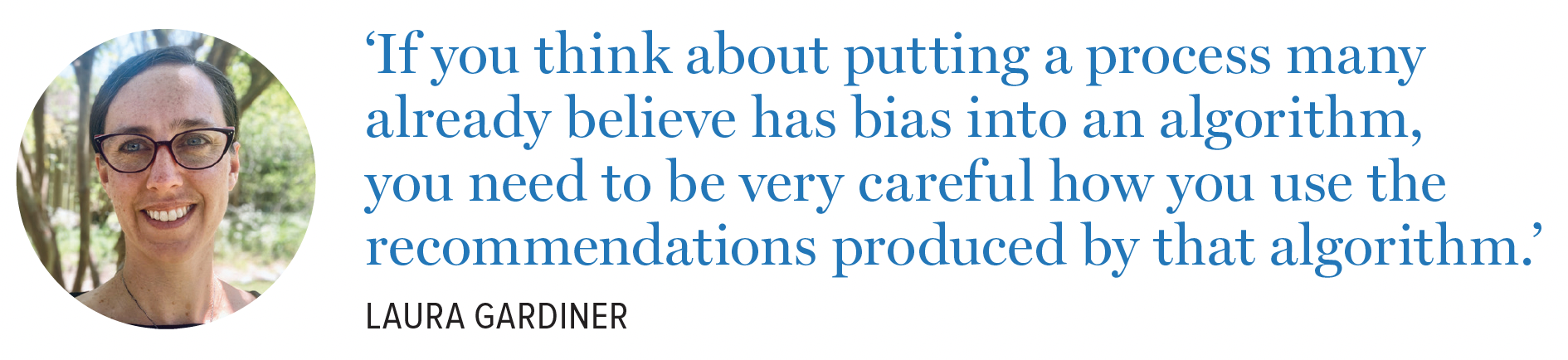
“If you think about putting a process many already believe has bias into an algorithm, you need to be very careful how you use the recommendations produced by that algorithm,” Gardiner says. 

Get to Know Your Vendor’s Algorithms

Most algorithms used by organizations to guide layoff decisions are part of technology vendors’ software platforms, rather than developed in-house. HR industry analysts say that means HR should apply an extra level of scrutiny to those vendors’ algorithms to ensure they’re reliable, valid, privacy-conscious and transparent. 

For starters, HR leaders should ask vendors about their bias-testing practices and whether an independent third party has audited the algorithms. Such audits should ideally occur at regular intervals throughout the year. Bringing in IT specialists and attorneys can also help HR assess vendors’ AI tools.

“I think the cautions in using either externally or internally created algorithms are the same, because even if you’re building that algorithm in-house, it’s usually not the person creating it who truly understands its data sources,” says Laura Gardiner, a Memphis, Tenn.-based director analyst in Gartner’s HR practice. 

“The concern overall should be, do you really know what’s being fed into the algorithm and have you tested the outcomes?” she says. “If an organization feels it has fully validated the outcomes of the algorithm and it has quality data going in, then the concerns will be fewer.”

Brian Westfall, a principal HR analyst at Capterra, a software review company in Arlington, Va., advises HR leaders to make sure they have a crystal-clear understanding of how a vendor’s algorithms work. Some vendors still prevent users from “peering behind the curtain” to get details of how the AI truly functions, allegedly to protect intellectual property or to simplify the process for HR professionals who may not be tech-savvy.

At a minimum, HR analysts and legal experts say, vendors should ensure—and HR should verify—that protected employee data such as race, gender, disability or age isn’t being fed into algorithms to make layoff decisions. 

But far more due diligence is encouraged.

“You want to know what data points the algorithms look at, how they are weighted and how the algorithm actually works in making recommendations,” Westfall says. “If you’re just buying a software product off the shelf that advertises slick predictive analytics and promises to deliver accurate recommendations without doing your homework, you risk investing in something that can create biased or flawed decisions.” —D.Z.

Bring a Critical Eye

Westfall says HR leaders should apply a healthy skepticism when using algorithms to make performance-based downsizing decisions. “They need a good understanding of the biases that can influence the data and the process,” he says. 

For example, Capterra’s findings stressed that relying too heavily on algorithms to make layoff decisions could cause decision-makers to miss factors such as whether employees have a poor or biased manager, whether they lack adequate resources or support to work effectively, and whether the software was tracking the right metrics to accurately gauge performance.

Only 50 percent of the HR leaders surveyed by Capterra were “completely confident” that algorithms or HR software would make unbiased recommendations, and less than half were comfortable with making layoff decisions based primarily on that technology.

“There’s a dichotomy where organizations want to rely more on objective performance data to make layoff decisions, but they also understand the process that’s generating their performance data can be flawed,” Westfall says. 
Screen Shot 2023-05-23 at 71800 AM.png

Uncovering Hidden Value

Gardiner says employers should exercise caution when using certain data, such as employee skills, to make layoff recommendations—which almost two-thirds of respondents in the Capterra study reported doing. 

“The algorithms used typically don’t monitor how those skills are being collected and placed into a skills database or how they’re validated,” Gardiner says. “Does the dataset being used have all of an employee’s updated skills on file? These are the types of questions you need to ask.”

She says algorithms also have limitations because they can’t apply true “human context” to workforce reduction recommendations.

“Say you have an all-star employee who’s done fantastic work for a decade but who is currently going through some sort of temporary personal crisis,” Gardiner says. “Depending on how you select and use performance data, an algorithm might recommend laying that person off based only on recent performance. That’s why human context and observation should always be part of these decisions.”

Performance data used in many algorithms also doesn’t factor in intangibles. Employees who volunteer to train co-workers, for example, help to build and sustain a positive workplace culture. “Someone observing on the ground would see that value, but if that kind of data isn’t being captured in an algorithm, it won’t be factored into a layoff recommendation,” Gardiner says.

Brodeur-Johnson recommends broadening the type of data used to make merit-based layoff decisions beyond single manager evaluations to include tools such as 360-degree surveys that feature peer reviews. “You want a more complete picture of the circumstances employees are working under,” he says.

The Right Mix of Data and Instinct

Gardiner believes organizations should seek a balance of algorithmic and human data points when making decisions that have such a big impact on people’s lives.

“There should always be a balance of manager or peer evaluation with system-generated data,” she says. “What that balance is will depend on the quality of your data and the quality of your management. Has the organization invested heavily in manager training and retraining around performance management? Is your data reliable, mature and validated?”

Ben Eubanks is chief research officer at Lighthouse Research, an HR advisory and research firm in Huntsville, Ala., and the author of Artificial Intelligence for HR (Kogan Page, 2018). He says it’s important to remember that algorithms aren’t the only source of biased recommendations. Humans have long been guilty of making biased hiring or firing decisions, and AI is trained on large datasets based on historic human choices. 

“There’s always some bias in our decisions as humans,” Eubanks says. “But if there’s an awareness of that problem and organizations can combine human judgment with what’s ideally more unbiased data around employee performance or skills generated by algorithms, it creates better outcomes.”  

Dave Zielinski is a freelance business journalist in Minneapolis.

illustration by Michael Korfhage.

How ‘Creator’ Platforms, ChatGPT Are Transforming Corporate Learning

?The learning and development (L&D) team at ZoomInfo, a software company in Vancouver, Wash., had a dilemma. The team wanted to start creating short instructional videos to help new customers and employees learn the ins and outs of using the ZoomInfo platform. But while these learning professionals had an abundance of instructional design and teaching expertise, they had few video production skills.

The team resolved that problem when they discovered an artificial intelligence-powered video-editing app that enables not only L&D practitioners but subject matter experts (SMEs) outside of the training function to quickly create and distribute high-quality learning videos.

Vince Gorski, manager of learning and development for ZoomInfo, said his team now uses the video-editing platform from vendor Descript to create instructional videos that range from basic tips to the most advanced features of the ZoomInfo platform.

“Video production is new to our team, so having simple, easy-to-understand editing functionality was critical,” Gorski said. “The tool has a screen-recording feature and can transcribe while recording, and also allows us to edit video content the same way you edit a text document, so it’s super easy.”

Creator Platforms, ChatGPT Transform Learning

New video-editing apps, along with ChatGPT and “creator” platforms developed by learning technology vendors, are helping organizations meet the growing need for workforce reskilling by expanding the pool of experts who can quickly create learning content. Vendors with creator platforms that enable employees to author learning content include Fuse Universal, 360Learning, Articulate, Udemy and more.

A Gartner survey of HR leaders found that learning and development is one of their top targets for investment this year. The survey also found that L&D offerings aren’t keeping up with the pace of change in organizations, and that less than half of employees surveyed agree that the learning their companies provide is relevant to them.

Josh Bersin, a global industry analyst and CEO of HR advisory firm The Josh Bersin Company, said creator platforms allow regional L&D teams and SMEs to create and distribute training that’s customized to local needs faster than corporate learning functions can.

“These tools are meeting a huge demand for training that corporate learning departments often aren’t able to fulfill,” Bersin said.

For example, in the past if a sales manager wanted to create a short, custom training course to help sales staff develop certain skills, the manager would have to make a formal request to the learning department for it, Bersin said.

“But it might be three months or more before an instructional designer built that course, often because corporate learning is so busy or is under-resourced,” he said. “By using a creator platform, an SME in sales could use AI-driven tools like ChatGPT or course templates to build a series of videos or lessons teaching those skills that might be ready in weeks rather than months.”

Bersin knows of one European railroad company that’s used a creator platform in that fashion. “A safety engineer in the company built a whole curriculum on safety protocols that was so successful it replaced most of the training created by the corporate learning function on the topic,” he said. “There are many people who are skilled at authoring content and teaching others who don’t work in the learning department.”

Udemy’s creator platform helps users assemble courses in a variety of formats, including a mix of video and text content, interactive elements like quizzes and practice tests, and supplementary resources, said Scott Rogers, senior vice president of supply strategy at Udemy.

Articulate’s 360 authoring platform allows users to jump-start e-learning creation with pre-built courses and course templates. Designers can choose from thousands of templates—including popular topics like compliance and diversity, equity and inclusion—and customize content for specific company needs, according to an Articulate spokesperson. Users can export courses to a learning management system (LMS), the Web or other distribution tools.

To help nonlearning professionals build instructionally sound content, creator platforms offer design tips, guidelines and templates. Udemy, for example, has a lesson called “How to Create a Course” that has been completed by more than 900 aspiring instructors. Articulate offers training resources, support and a free community of learners called E-Learning Heroes to give novice instructional designers guidance as they build their first learning courses. 

Experts say HR or learning leaders considering investing in creator platforms should ensure the system has robust administrative and reporting tools. “Implementing these platforms turns people loose to build a large amount of new learning content, so you need good data reporting to determine which courses are working and which aren’t,” Bersin said.

Using ChatGPT to Build Learning Content

Many of these creator platforms now have built ChatGPT into their applications, allowing users to create learning courses, step-by-step tutorials, summaries of long-form content and quizzes by using prompts or questions posed to the AI tool. Articulate, for example, has embedded ChatGPT in its 360 course authoring tool.

“It helps speed up development and get creators past the ‘blank page’ challenge when sitting down to craft learning content,” said an Articulate spokesperson. “AI is used as a thought partner to help speed the content writing process.”

Bersin said those creator platforms that haven’t yet incorporated ChatGPT-4—the technology’s most recent version—likely soon will. “Most of the vendors are working on it,” he said, citing one provider in particular—Sweden-based Sana Labs—as an innovator in using generative AI. “It’s both an authoring system and a learning management system,” Bersin said of Sana Labs. “Users can upload content like documents, checklists, process guides and PowerPoint slides, and the AI builds learning courses around the content.”

Creator platforms also are now offering courses designed to teach employees how to use ChatGPT. Udemy, for example, already has 400 dedicated ChatGPT courses on its platform.

Power of Video-Editing Apps

In addition to creator platforms, L&D departments have a burgeoning number of video-editing apps like Descript—which soon will add ChatGPT-4 to its suite of editing tools—to choose from to create instructional videos. Descript uses a text-to-speech feature, automatically transcribing recordings in multiple languages. The system allows users to edit videos like they would a text document and to arrange visuals as they would on a presentations slide.

Harmony Jiroudek, customer success manager with Descript, said the growing need to reskill employees makes it important for L&D teams to have user-friendly video creation tools at their disposal. “Most L&D practitioners aren’t professionally trained video editors,” she said. “They need simple but powerful tools that help them save time and produce instructionally sound, engaging learning videos.”

Gorski of ZoomInfo said using Descript has brought new efficiencies to his L&D team’s video-production process. “Before finding the app we recorded content with one tool and edited in another, so we wasted a lot of time exporting and uploading files,” Gorski said. “We love having the ability to complete the steps to produce training videos with just one tool.”

Other features in the app make it easier to create high-quality video, Gorski said. “A tool called Studio Sound has been a game changer for us,” he said. “With one click it removes background noise and enhances overall audio quality, making it sound like we’re using a professional recording studio.”

Dave Zielinski is principal of Skiwood Communications, a business writing and editing firm in Minneapolis.

How to Build a Better Professional Network

A professional network can be an important tool for advancing your career. But not everyone knows how to network effectively, and many are afraid to even try. That’s a missed opportunity, experienced networking experts say.

Having a professional network can be enormously helpful for identifying job leads, according to Judy Schoenberg, co-founder of EvolveMe, a New York City-based career consulting firm for midcareer women. “We know that 80 percent of new roles are secured by personal and professional connections,” she says. “It really behooves you to go out there and make the connections.”

The importance of professional networks to career advancement is well-documented in social science research. On top of opening doors to job and business opportunities, having connections can lead to “broader and deeper knowledge, improved capacity to innovate, faster advancement, and greater status and authority,” according to researchers Francesca Gino, Maryam Kouchaki and Tiziana Casciaro, who described their findings in the Harvard Business Review.

Pandemic-related shutdowns put the kibosh on traditional networking events such as conferences, SHRM chapter meetings and other gatherings where people can meet face-to-face in a professional setting. The good news is that many of those activities are ramping up once again. Meanwhile, the absence of opportunities for people to gather in person over the last three years has elevated the importance of no- or low-cost online networking sites such as LinkedIn and created demand for paid online networking services like EvolveMe and California-based Athena Alliance, a networking tool for executive women. 

There is no consensus as to whether it’s better to build a professional network online or in person; there are strong proponents of each approach, and many find it worthwhile to establish business relationships in both environments. Here are some tips for getting started:

Understand what networking is and what it isn’t. If you find the mere idea of networking painful, you’re not alone. Many people are turned off by the thought of schmoozing with strangers, says Mark Herschberg, a career advisor at MIT and author of The Career Toolkit: Essential Skills for Success That No One Taught You (Cognosco Media, 2021). Some fear being judged or seen as unworthy. Others equate networking with asking for special favors. Many worry that they just aren’t good at networking and avoid it altogether.

But given the potential payoffs, Herschberg advises people who resist networking to reframe their thinking. Networking isn’t the same as making a sales pitch, he maintains. Effective networking involves “building an equal, balanced relationship with give-and-take on both sides. If you’ve ever had a friend, you know how to network,” he says.

Start with who you know and build from there. You don’t need a handful of business cards or a LinkedIn account to begin building your network, according to Ashley Fernandez, a career coach and HR consultant in Cherry Hill, N.J. 

“Your workers, your friends and even people you meet in the park are part of your network,” she says.

Still, it’s important to recognize that a network populated exclusively with friends and family may have limited utility. 

A recent MIT study found that on LinkedIn, you’re more likely to land a new job through someone you have “weak ties” with than through someone you know better. That’s because the people you know well may have social networks that closely resemble your own, which may not add much new job-seeking value for you. Your more casual acquaintances, on the other hand, have social networks that overlap less with yours and may provide connections or information you would not otherwise be able to access, the MIT researchers found.

Be interested, not just interesting. When meeting new people, be mindful of your role in the conversation. 

Avoid the common mistake of monopolizing the dialogue to prove how smart you are, advises career counselor Jane Horowitz, founder of Chicago-based More than a Resume. 

“Gathering knowledge about people, careers and jobs is a worthwhile networking goal on its own,” she says. “Ask insightful questions and then listen, really listen.”

Be a giver. Keep in mind that in a true network, the information flow has to go both ways.

“Seeking assistance with candidate recommendations or receiving business opportunity referrals is predicated on you having freely shared at an earlier point in the relationship,” says Bradford Frank, a tech recruiter with the business consultancy Korn Ferry. 

Stay positive. Most people have a dominant motivational focus—what psychologists refer to as either a “promotion” or a “prevention” mindset, according to researchers Gino, Kouchaki and Casciaro. Those focused on promotion think primarily about the growth, advancement and accomplishments that networking can bring them. Those with a prevention mindset see networking as something they are obligated to take part in for professional reasons.

The importance of remaining positive about networking—which may be a particular challenge for people who are shy or introverted—is borne out through research. 

In one study of college students, working adults and an additional sample of 174 lawyers, researchers documented the effects of both types of thinking. Promotion-focused people networked because they wanted to and approached the activity with excitement, curiosity and an open mind about all the possibilities that might unfold. Prevention-focused people saw networking as a necessary evil and felt inauthentic while engaged in it, so they did it less often.

Avoid politics. Talking politics with co-workers has always been risky, and the same is true of discussing the topic with the people in your professional network. 

The safest approach, and the one most likely to keep your network intact, is to avoid discussing hot-button topics.

“Why risk alienating the contacts you’ve worked so hard to cultivate?” asks Harold Datz, a Washington, D.C.-based labor law attorney who has taught classes in conflict resolution. “In most business settings, it’s best to leave topics like politics, religion and sex at the door.”   

Rita Zeidner is a freelance writer in Falls Church, Va.

Illustration by Mr.Timoty/iStock.

Learn to Love Networking

“I hate networking” is a familiar refrain. But in today’s world, networking is a necessity—and fortunately, an aversion to it can be overcome. Drawing on research experiments and on studies at a large law firm, the authors of a recent study identified four strategies that can help people become more excited about and effective at building relationships:

  • Focus on learning. If you adopt a “promotion mindset” and concentrate on the potential positives of networking, you’re more likely to perceive the activity as an opportunity for discovery rather than a chore.
  • Identify common interests. By considering how your goals align with those of people you meet, networking will feel more authentic.
  • Think broadly about what you can give. You have something valuable to offer, whether it’s knowledge, gratitude or recognition. Remember that.
  • Find a higher purpose. When you frame networking in terms of a larger goal—say, the collective benefits for your company—the activity will feel more authentic and will lead to connections that bear fruit for everyone.

Source: Harvard Business Review.

Taking the Wheel

For 75 years, SHRM and HR professionals have worked together to drive historic change in the world of work. During that time, substantial workplace changes have occurred. While some of these transformations are still underway, HR professionals now have another destination entered into their GPS: a better employee experience. 

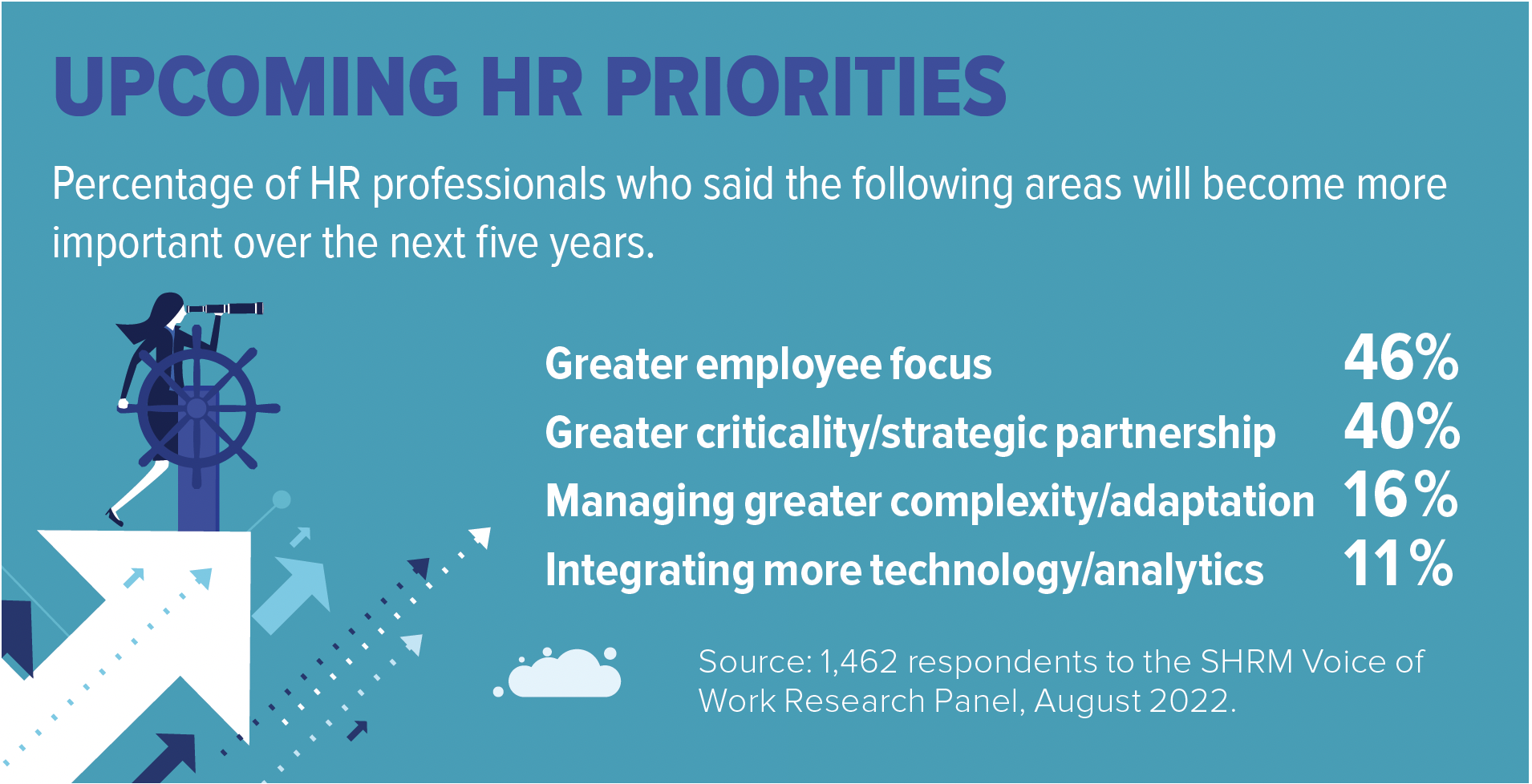
This effort has gained momentum since the pandemic began, with HR often leading the charge. Almost half of HR professionals surveyed in August 2022 predicted a greater focus on employees within the next five years. Additionally, in February 2023, when asked to select what activities their organization’s HR department should prioritize, the top-ranked answer from HR professionals was “create a positive employee experience.”

We know HR wants to head in this direction, but how can we get there—or to other desired destinations—when the route to change can be bumpy? 

Various estimates suggest that more than half of organizational change efforts fail. Although the reasons for failure are many, HR professionals are capable of taking the wheel and keeping change on track. When change involves employee experience, two critical goals emerge: demonstrating the need for change and aligning systems to support, rather than constrain, change. 

Screen Shot 2023-05-19 at 91438 AM.png

Igniting Change

Just like the spark that ignites an engine, HR professionals can leverage data to ignite change. This starts with convincing leaders that change is needed. When making our case, we too often focus on getting people to understand the need to change when it’s just as important, if not more so, to get them to feel the need to change. Put differently, we must appeal to leaders’ rational and emotional sides. HR is well-positioned to do both. 

For a multitude of organizational issues, and especially when it comes to the employee experience, HR has the tools to diagnose what’s happening and why. This includes assessing what good employee experience means in your organization and determining how close you are to delivering on it. 

By collecting robust employee data, HR can highlight numerical evidence (e.g., important trends) to substantiate desired changes. Further, HR can interview employees and convey their stories to humanize numerical evidence and evoke emotional investments in change.  

Supporting Change

Just like a suspension system supports the movement of a car, organizational systems are vital to supporting change. Luckily, HR typically controls one of the most important organizational systems affecting change: the talent management system. 

HR can assess whether the various talent management components support the desired change. With the employee experience, for instance, HR can ensure that professional development programs for people managers target effective leadership skills. Talent management system components that are not realigned to turbocharge this change may become obstacles constraining it. As an example, if people managers are expected to execute newly desired skills but their performance is formally assessed on the old, pre-change skills, not much is likely to change. 

By leveraging data-driven insights and aligning talent management systems, HR can ignite and support change—including creating a better employee experience—for many miles.   

Katrina P. Merlini, Ph.D., is a senior researcher of thought leadership for SHRM Research.

Illustration by Yutthana Gaetgeaw/iStock.

Look for ‘Pockets of Opportunities’ 2023 Grads Advised

?Job growth among people ages 20 to 24 is expected to be 25 percent lower this year compared with 2022. Hiring in May 2023 is forecast to grow at a slightly lower rate than last year, as well, according to a report from Gusto, a San Francisco-based HR and payroll platform.

However, there are “pockets of opportunities” where full-time hiring is predicted to increase in industries and geographic areas new graduates may not have considered.

Unexpected jobs could include e-commerce managers in the food and beverage industry and software engineers in retail firms as businesses expand in new ways post-pandemic.

“A lot of these grads with software development degrees are going to look for a job in the tech industry or consulting firms—traditional paths after college—and may not look to food and beverage firms or in the retail industry for their first job out of college,” said Gusto economist Luke Pardue. He is an Economic Policy Fellow at Aspen Economic Strategy Group in Washington, D.C., and holds a doctorate in workplace trends research.

Industries such as retail and food and beverage “have undergone such a large technological change since the pandemic,” he pointed out.

“So much of their [companies’] presence depends on being online, and these new young graduates have the skills to help them out.” 

Industries with the highest forecasted increase in full-time hiring of 20- to 24-year-old job seekers:

Industry Job Growth,
May 2022
Job Growth,
May 2023
(Forecast)
Percentage Point
Change in Hiring
Food & Beverage 5.3% 9.6% + 4.3
Retail 5.2% 7.7% + 2.5
Education 6.1% 7.2% + 1.1
Accounting 1.9% 2.4% + 0.5
Health Care & Social Assistance 5.8% 5.9% + 0.1
Source: Gusto.      

Gusto’s forecasts of overall and industry-level employment growth rates are based on the hiring rates of the prior two months and monthly seasonal patterns. The forecasts for 2023 are based on monthly data from January 2019 to March 2023, using data from more than 300,000 small and midsize businesses that are on Gusto’s platform. It tracked industries and cities where new graduates are most likely to find jobs this year and where they can expect to earn the highest salaries, adjusted for cost of living.

Best Cities and Salaries for New Grads

Cities with the highest hiring rates.

San Jose, Calif., tops the list of U.S. metropolitan areas with the highest hiring rate of new college graduates, increasing 9.8 percent from April 2022 to April 2023.

It was followed by:

  • Houston (8.5 percent increase).
  • Dallas (8.2 percent increase).
  • Nashville (8.1 percent increase).
  • New York City (8.0 percent increase).
  • Philadelphia, Miami and Boston (each 7.9 percent increase).
  • Austin and Atlanta (each 7.8 percent increase).

Highest salaries for new graduates.

Gusto used the Cost of Living Index from The Council for Community and Economic Research to determine where a new graduate’s paycheck stretched the furthest among the top 10 fastest-hiring cities.

“San Jose is the only city where new grads can expect to earn six figures,” Pardue said, noting an average starting salary of $102,000 for individuals working in software and technical roles. The city is seeing a lot of growth in high-tech manufacturing, in large part because of the growth in the semiconductor industry there, he explained. California also is a state with many small and midsize businesses, he pointed out, something new job seekers should keep in mind as larger tech firms cut their staffs.

The average salary in San Jose for a full-time tech manufacturing employee ages 20 to 24 is $98,500. However, grads should consider the cost of living when evaluating the starting salary. In San Jose, a $102,000 salary “feels more like $60,000 to $70,000,” Pardue said.

The cost of living in Houston is 8 percent lower than the national average, making the $60,000 average starting salary in management, scientific, and technical consulting services there “feel like $65,000 when compared to the national average,” according to the report. 

New York City appears the least affordable city on Gusto’s list, with cost of living 127 percent higher than the national average—making a starting salary of $72,000 in software publishing feel like $31,000.

Flexible work schedules. The 20-24 age group prefers a hybrid schedule that allows them to be in the office several days a week to develop networking and mentoring opportunities, Gusto found.

“New grads want some aspect of in-person [interaction],” Pardue said. “They are not necessarily looking for fully remote work, but flexibility is a key area where businesses can compete for these younger workers,” especially in industries looking for workers with specific skills. Among 20- to 24-year-old full-time workers in San Jose, 23 percent are working fully remote schedules. In Houston, 16 percent are doing so.

“Flexibility is the No. 1 thing that these companies can use to attract new talent,” Pardue said. “There’s a lot of talk about the cooling job market and [hiring] power coming back into the employer’s hands, but attracting the right person is still super important,” and flexibility is one of the keys to “attract that perfect candidate.”

New graduates are willing to move for a good role and benefits.

A survey from Handshake, an online recruiting platform for higher education students and alumni, found 67 percent of 1,432 job seekers said they would change cities for the right job—where there were advancement opportunities, the cost of living is lower, or in-person workplace attendance is flexible. The survey was conducted from June 13 to July 6, 2022, with students from the classes of 2022 and 2023.

‘So Much Opportunity’

A March survey of 1,000 U.S. college seniors by recruitment software provider iCIMS found 40 percent were applying to a wider variety of industries to increase their employment chances.

“What this means is we have a group of individuals being realistic about how their skills translate,” Laura Coccaro, iCIMS chief people officer, told SHRM Online. “They’re thinking creatively” about how their skills can transfer beyond their area of study.

Pardue’s No. 1 piece of advice for new graduates: “Don’t be discouraged by the headlines [about layoffs] or initial roadblocks in the job search. There is so much disruption going on but there’s so much opportunity.

“Find the job that is still is the right fit” but remember, he added, that you are “so early in your career, there’s always going to be time to find that perfect job down the line.” 

Other SHRM Resources:

Recruiting Generation Z: Find Ways to Stay Visible, SHRM Online, May 2023
New Grads Use ChatGPT in Job Search, SHRM Online, May 2023

Addressing Imposter Syndrome: What Employers Can Do

?Have you ever feared that you’ll be “found out” as a fraud, not equipped to handle a job or new responsibility? That feeling is called imposter syndrome—a term coined in 1978.

However, “syndrome” is a misnomer, said Maureen Calabrese, chief people officer at Modern Health, a mental well-being platform based in San Francisco.

Calling this feeling a syndrome “mythologizes feeling uncertain,” she said. “At any point in someone’s career, they’re going to feel they’re out of their depth, and I think that’s a normal part of how you grow in a career.”

Calabrese pointed to a survey KPMG conducted in 2020 of 750 executive-level women: 75 percent said they’d experienced imposter syndrome at some point.

When that many women report feeling this way, “it’s less a syndrome and actually almost a natural workplace phenomenon,” Calabrese said. “High performers hold themselves to an exceptionally high standard, and that high standard gets misconstrued [as] ‘I have to know everything, and I have to know it at the exact moment.’ “

But executive women are not the only ones who experience this uncertainty.

In a recent survey by staffing and recruiting firm LaSalle Network of 2,756 graduating college seniors in the U.S., 32 percent doubted their skills, talents and accomplishments as they prepared to enter the workforce this year. Another survey by business communication provider Moneypenny conducted in 2022 of 2,000 U.S. workers, found that 32 percent have felt like an imposter in the workplace. The highest percentages were among younger workers:

  • 46 percent of workers ages 18 to 24.
  • 40 percent of those ages 25 to 34.
  • 31 percent of those ages 35 to 44.
  • 18 percent of those ages 45 to 54.
  • 19 percent of those ages 55 to 64.
  • 8 percent of those ages 65 and older.

Other studies have found that members of ethnic and racial minority groups also frequently report feeling like frauds or undeserving of their role.

“Societal stereotypes about competence based on gender, race, age, language, class and/or disability make some groups especially susceptible to imposter syndrome,” the Imposter Syndrome Institute says on its website. 

What Employers Can Do

Discussions about imposter syndrome often focus on the individual, but few focus on examining how the work culture may be perpetuating these feelings, according to Miguel Joey Aviles, chief belonging officer at Puerto Rico-based consultancy MJA & Co. LLC.

Before founding his company, Aviles was the first civilian diversity and inclusion chief in the history of the U.S. Coast Guard and held leadership positions at the departments of Defense, Interior and Homeland Security.

Aviles and Michelle E. Rosa, MJA International’s chief empowerment officer, will co-present the concurrent session “Belongingness: The Antidote to Workplace Imposter Syndrome” on June 13 at the SHRM Annual Conference & Expo 2023.

They and others shared strategies employers can use to help boost employees’ confidence.

  • Foster belongingness.

Having a safe place where employees can express their self-doubt helps create belongingness, Aviles said.

“A leader needs to create a combination of safe spaces” ranging from one-on-one meetings to employee or business resource groups to town halls, he said.

  • Create a culture where it’s OK to fail.

When you feel like an imposter, Rosa said, there’s the fear you will be fired if you fail, and so you become very risk-averse.

“We need to help individuals feel it’s OK to fail” while establishing a healthy response to failure, she said.

It’s also important that leaders talk about their own failures, Aviles said, because doing so offers assurance that employees can learn and grow from the mistakes they make.

  • Provide mentors and allies.

KPMG found its survey respondents were better able to manage imposter syndrome as they progressed in their careers by meeting with mentors and seeking advice from people they trusted.

Rosa said she has long experienced imposter syndrome as a Latina working in cybersecurity. Talking to a mentor or former supervisor about her work and capabilities has helped her deal with feeling that she was a fraud, she said.

Calabrese said it also helps to have allies who can be supportive of your capabilities even when you’re not around.

  • Promote a collaborative culture.

This type of culture “enables people to feel comfortable voicing their ideas and concerns and builds a team that shares the same vision and succeeds together,” KPMG said in its report.

It recommended leaders encourage training on leading with empathy “and focus on encouraging teamwork, creativity and collaboration.”

  • Prioritize inclusion and diversity.

Identify and remove barriers affecting people of color, the National Institutes of Health suggested in a blog post. This can be done by providing mentoring opportunities; highlighting and emphasizing employee achievements; and increasing representation in the workplace.

  • Provide training.

“When as an organization you create space for people to learn, people are more willing to take risks, to try things,” Calabrese said. “That organization is saying, ‘We’re looking for you to develop new skill sets and develop and grow.’ “

How HR Professionals Can Leave a Powerful Legacy

?Trent Savage figures the best HR legacy he can leave before he retires is to help make the profession less about hiring and firing and more about enabling employees to do great work.

That’s the legacy the 50-year-old CHRO is actively working to build at Mountain American Credit Union in Aline, Utah. He’s doing it by trying to make HR less transactional, such as by encouraging the use of new technologies to handle minor tasks so that his HR staff can focus on more substantive issues. He’s also working to build stronger department leadership and free up HR executives to engage at a more strategic level.

“I’m passionate about raising the bar of HR,” he said.

Before we die, many of us put serious thought into the legacy we leave behind for our family, friends and former colleagues. But what about before retiring as an HR executive?  How many of us think about—or even plan for—our workplace legacy?

Retirement preparation involves more than financial planning and figuring how to positively fill in the hours after you retire. It also means actively planning how to leave the HR profession—at least within your own company—in a better place than it was when you started.

That planning typically includes training the next generation of employees who will replace you. It’s especially beneficial if that planning comes earlier in your career, but with extra effort, you can still pull it off during your later years, according to senior executives who have been in the same situation.

“Legacy answers the question: Why am I here?,” said Marshall Goldsmith, a New York Times best-selling author based in Nashville who is widely regarded as one the world’s top executive coaches.

Few things are more cosmically important than leaving a legacy, said Goldsmith, a fellow at the National Academy of Human Resources. And, yes, there is an almost Zen-like quality to it.

“In HR in particular, the whole mission should be: How can I continue to make a difference when I’m no longer at this company?” he asked. The key is to not wait. “You do it every day by making a difference in someone’s life in a way that will ultimately help them to help other people.”

Leaving a legacy, he explained, is about moving far beyond short-term achievement and results and, instead, taking the time near the end of each workday to ask yourself: “How did I choose to spend my time today, and how meaningful was that?”

Trent Savage said he has adopted that approach, and it’s been very effective. “Too often, HR teams get mired down in process, policy and transactional work that doesn’t add value,” he said. “We need to change that viewpoint.”

That’s one reason Savage has built out a 10-year leadership strategy by identifying and rewarding strong leadership behaviors, including coaching and development, at Mountain America, which boasts more than 2,200 employees and 1.1 million members.

“We’ve developed and established a clear leadership model that defines what great leaders are. A lot of organizations say they want to do this but never put in the effort,” he explained, adding that the leadership model includes an embrace of mentorship, which is another aspect of the legacy he wants to leave behind.

For example, Savage is a graduate of Brigham Young University and is chair of the school’s HR advisory council. In that capacity, he regularly meets with students who have reached out for his mentorship. He also serves as a mentor to several Mountain America employees, and he particularly enjoys mentoring those who are outside of the HR department.

One key to successfully leaving behind a workplace legacy, he said, is to start thinking about it long before you reach the end of your career. Once you have developed the basic skills to be successful, he said, it’s time to start sharing that expertise with others. “If you have the skill set, share it.”

Mentorship Is Critical

At 56, Mike Bergen leads the global HR practice at Kingsley Gate Partners, a New York City-based executive search firm with 350 employees in 35 countries. He’s been in the HR field since 1989, with stints at General Electric and Citibank, and his specialty is identifying senior HR talent at the executive level.Mike Bergen

Bergen said he’s laser-focused on his legacy. “It’s all about finding the time to pivot away from what I’m doing to achieve my career goals and, instead, help others with their careers.”

Bergen’s interest in leaving a legacy that improves the HR profession is very personal, he explained, because he has four adult children in their 20s, two of whom are in the HR profession. The way he figures it, he’s mentoring at least six people right now, including two women. “Half of my life is now spent developing younger people,” he said.

However, Bergen’s mentorships are not formally structured. “When someone comes to me with a challenge, I tell them how I handled similar challenges in the past,” he shared.

Perhaps the best way he is cementing his own legacy is by empowering people to step up and make decisions, he said, as well as learn from their own mistakes. At the same time, he’s learned to mentor not just younger employees but older workers, too. 

“I don’t discriminate in sharing wisdom,” Bergen said.

Not About Money or Title

Another wise move when building a legacy is to avoid thinking that your legacy has anything to do with salary, promotions or resume-building achievements, said Andrew Thorn, president of Legacy University in Nephi, Utah, a private school dedicated to helping people understand their legacy. Thorn refers to himself as a legacy guide.

“Your legacy is more about the future than the past,” he said. In particular, when working in a hybrid environment, there is no better way to leave a legacy than to let your co-workers take the reins, Thorn said. “What works is to empower people and create space for them to do their best work every single day,” he said, adding that legacy is about willingly passing the baton. “There are few things more fulfilling.

“If your legacy at work is that you were good at pushing Button A, that will not be fulfilling,” Thorn added. “But if your legacy at work is helping others learn how to push the right button, that will be very fulfilling.”

Bruce Horovitz is a freelance writer based in Virginia.

Recruiting Generation Z: Find Ways to Stay Visible

?There are some common mistakes employers should avoid when recruiting and hiring new graduates for entry-level positions, according to Yvonne Bell.

She is senior vice president of people and culture at D2L, a learning platform headquartered in Cambridge, Ontario, Canada, and has served as recruitment specialist for Toyota Motor Manufacturing and associate recruiter and HR manager for KPMG Canada, both in Cambridge. Her work has included college recruitment.

Employers damage their talent pipeline at colleges and universities when they don’t maintain their reputation with students or their connections to the schools, or when they stop investing in cooperative work programs that Bell said are “vital” to an employer’s recruitment efforts.

Companies then have to rebuild that trust and connection if they decide to resume those relationships a year or two later.

Bell suggested the following strategies for employers looking to attract and retain the newest entrants to the workforce:

  • Implement a campus ambassador program.

Students who have successfully completed cooperative education or internship programs with D2L are tapped to serve as campus ambassadors.

“They connect with students … and promote us on LinkedIn,” Bell explained. “We expect them to be visible on campus to go to D2L events and also go to other campus-related events we wouldn’t be at [to] represent D2L … mainly talking about what their experience was, talking about the culture, our hiring, and kind of acting like a semi-recruiter on campus.”

  • Provide campus support.

Companies can provide guest speakers or classroom equipment and encourage their employees to participate in alumni events. D2L also has employees who teach at various colleges.

“We definitely support [our employees] if people want to do those sorts of things,” Bell said.

  • Be visible beyond the college campus.

“We’re active on LinkedIn; we also sponsor hackathons,” Bell said. Additionally, the company is relaunching D2L Night School, which it ceased during the pandemic, to be offered one night each quarter on various career topics. For example, during the first quarter of 2020, the program featured a panel of D2L employees discussing imposter syndrome.

  • Explain how the job seeker’s work contributes to the organization’s mission.

“Some [employers] don’t talk about how their role makes a difference,” Bell said.
Members of Generation Z—the youngest cohort in the workforce—report more unhappiness than their senior counterparts, according to a 2023 report from Cangrade, a talent management provider. 

“It’s reasonable to assume that Gen Z [whose oldest members are 26] is generally working entry-level roles,” Cangrade said in its report. “Almost every entry-level role will be filled by Gen Z by 2030. The nature of entry-level roles can create job dissatisfaction, particularly for a technologically advanced workforce looking for professional development.”

  • Use your rewards package to connect with students.

For example, if your organization offers paid time off for employees to volunteer and the job candidate has indicated on their resume that they’ve done volunteer work, point out how their interest can be accommodated.

In addition, professional development is important to Generation Z, but “I think [employers] fail to invest [in it] as much as they probably could,” Bell said.

Mental wellness is another area employers should emphasize when attracting and retaining young job seekers, she noted. SHRM research found that 61 percent of Generation Z respondents said they would strongly consider leaving their current job if offered a new one with significantly better mental health benefits. 

Monster’s 2023 State of the Graduate Report found that 92 percent of 1,000 new and soon-to-be college graduates it surveyed said it’s important they feel comfortable discussing mental wellness at work.

D2L holds employee-run mental health panels where people talk about their mental health challenges “in a really safe environment,” Bell said.

  • Be genuine.

Bell also emphasized the importance of making sure the message employers give job seekers during the hiring process is authentic. For example, the culture espoused during an interview—such as the importance of work/life balance—should match the new employee’s reality at work.

After the new employee has been on the job for a little while, “ask them if what we told you in the interview process is what you experienced,” she said. “Let’s get better at training managers [and] do a feedback loop of continuous improvement” in the organization.

Subscribe to our Newsletter