Building Workplace Culture in a Virtual Environment

?Can technology adequately support company culture in a hybrid or remote work environment? That’s the question being asked by HR stakeholders now that virtual work is here to stay and as tech companies are introducing new features to address the lack of in-office spontaneity that can encourage free-flowing creativity while staving off employee burnout.

Since the pandemic began, company culture has been under pressure. The Great Resignation, 1 million U.S. deaths from COVID-19, racial injustice and the fight for union representation at several prominent organizations are just some of the societal trends that have raised workers’ concerns and suspicions about how far companies will go to support their employees.

At the same time, a new wave of technological advancements has introduced new opportunities to capture workers’ behaviors, their patterns of thinking and their sentiments. Chief among those technologies is artificial intelligence.

Machine learning allows the technology to adapt to the individual, as opposed to previous big data tools that required workers to adapt to the technology, observed Paul Rubenstein, chief people officer at Visier, a people analytics company headquartered in Vancouver, British Columbia, Canada.

“We have to start seeing ourselves in the technology,” he said. “I don’t think it’s about technology replacing human interaction, I think it’s about us using the technology to its fullest rather than being constrained or trapped by the technology and the way someone else designed it,” Rubenstein said.

He added that a shift has occurred in the types of data that companies can collect on employees. Employers long have collected data such as when employees started their day, what they are working on and how many hours they worked, but this kind of data is not enough to effectively create a positive work experience, especially in the virtual work world.

“Employees should be able to look at data and see that they are not connected to enough people or they only talk to the same people or they are isolated. People need to see themselves in the data because it holds a mirror up to them. That’s the first big shift. We have to have data gathering and data dissemination that helps everyone see a more human truth,” Rubenstein said.

Using employee data to make decisions will be critical for employers as they figure out the best way to improve the remote worker experience, especially if employers want to raise engagement and get the best performance from their employees.

In a survey conducted by Workday, 268 HR leaders were asked to rank the most important issues that they think will accelerate digital transformation across the wider business: 50 percent cited positive employee experiences as the most important issue. In second place, 45 percent of respondents said an increased focus on diversity, equity and inclusion is the most important.

To create positive experiences, technology companies are focusing on providing digital solutions that collapse the distance between employees and employers and digitize the aspects of work that occur during those unstructured, spur-of the-moment encounters. The aim is to incorporate human behavior into their software.

For example, Zoom has added gesture recognition features that allow users to raise their hands or give a thumbs-up when users want to express their feelings without interrupting the speaker.

Salesforce’s Slack recently introduced huddles, an audio-only conversation feature that the company says is designed to re-create—to the extent that technology can—the spontaneity of a quick in-office water-cooler-type meeting or a pause at a colleague’s desk to ask a question. The tool can also be used to help re-create a physical space where entire teams can convene, like marketing teams that often work together throughout the day.

Oracle recently introduced the Oracle ME (My Experience) platform, which consists of six modules that target corporate culture. The tools offer workflow guidance to help workers complete professional and personal activities ranging from onboarding or transferring to a new role to getting married or having a baby.

Additionally, Oracle ME makes it easier for employees to foster continuous engagement between employees and managers. The platform also helps to keep the workforce informed of changes, reinforce organizational culture and nurture connections among employees. This ultimately enhances workplace belonging and development.

According to Zachary Chertok, research manager in employee experience at Needham, Mass.-based International Data Corporation, when employers think about elements of the physical workplace, they have to consider how they’ll equip both the organization and its employees with the tools to stay connected, engaged, collaboratively innovative and creative in problem-solving, regardless of the employees’ work environment.

Employees, Chertok said, have to think about how they can work in a way that lets them set the pace, tone and equation for what work/life balance means for them.

“We are in an age where, at a strategic level, we are looking at the role that technology and, to a slightly lesser extent, data and prescriptive services plays in guiding organizations to that personal equity,” Chertok said.

He added, “It’s no longer about one policy for everybody, it’s about, ‘Where can we introduce flexibility within the job and office and work requirements at the role level and at the personal level?’ and making sure that those resources and choices are as equitably distributed as possible.”

In the effort to grow a company culture that will thrive in the remote and hybrid work model, Rubenstein said technology will have to do a better job of capturing and managing the kinds of spontaneous experiences that employees have with each other in traditional office environments.

“We need digital technologies that see how employees interact so that we can create an actual map of interactions and make sure that we are not leaving the best people behind,” Rubenstein said.

Nicole Lewis is a freelance journalist based in Miami.

Digital Transformation and HR: Playing a Role, Making an Impact

?”Digital transformation” is a phrase that’s tossed around a lot these days. But what does it mean? And, specifically, what does it mean for HR professionals? There’s a good chance that digital transformation efforts are taking place in your organization. If they’re taking place without you, or if you have a role on the sidelines, these initiatives may be doomed from the start.

The Mandate for Digital Transformation

The Hackett Group has identified supporting enterprise digital transformation as one of the top HR priorities for 2022—and it’s a priority that is likely to continue long beyond that. They write: “The pandemic accelerated enterprise digital transformation of market offerings, processes, and ways of working. HR organizations must step up their game in areas that can directly affect the success of these programs, such as leadership, culture, skills development, and change management.”

Practitioners agree. “The biggest trend for managing a remote/hybrid workforce in 2022 will be the continued rapid convergence of the workplace and technology and digital disruption of the HR department,” said Patricia Sharkey, SHRM-SCP, head of HR at IMI People, based in Nashville, Tenn. “Companies across the U.S. are actively seeking tech solutions that help centralize processes, keep a pulse on employees, assist with COVID tracing and tracking, and create and maintain a virtual culture of visibility, transparency and responsiveness.”

Stepping Up: HR’s Role in Digital Transformation

Automation and artificial intelligence, said Sharkey, will play a major role in the evolution of the workplace. But HR needs to take a front and center role in leading the transformation, which can be challenging.

“Fairly or unfairly, the perception of HR from most CIOs I’ve worked with is that they are focused on compliance and risk reduction,” said Ben Grinnell, a managing director and an IT and HR expert at North Highland Consulting in London.

Grinnell recommended that “HR work with business leaders to define a strategic sourcing model to which the organization can commit.” It’s important, he said, for HR to “recognize that building a sustainable capability in-house is a huge undertaking, requiring leadership, people development, career paths, roles and skills clarification, and a culture of lifelong learning and feedback.”

HR’s role here is critical, he said. “Without the workforce properly prepared in advance to engage, transformation efforts are dead-on-arrival and a waste of money,” he warned, pointing to research cited by Harvard Business Review indicating that without these advance preparations, “70 percent of corporate transformation efforts are doomed to fail.”

While digital transformation is an organizational initiative and not limited to HR, people are the common denominator.

Jason Keogh, Field CTO at 1E—a London-based company that specializes in digital employee experience, pointed out: “Every time an employee touches a keyboard or moves a mouse, they have a digital experience––and while IT is responsible for these interactions, digital employee experience [DEX] has a major impact on HR, as ‘IT friction’ can be a determining factor in employee satisfaction.”

Keogh said he’s seen that friction in workplaces worldwide. “Employees who suffer from a lack of cohesion endure a poor digital experience and will become increasingly frustrated by their inability to complete everyday tasks,” he said. That frustration, he noted, can lead to turnover.

It’s important for HR and IT teams to work together to reduce this friction, he added. HR also plays an important role in working across the organization to ensure understanding and support. Digital transformation is an organizationwide initiative—and one that is ongoing.

Digital transformation, said Kelli Trujillo, San Francisco-based chief people officer at digital customer experience company Hero Digital, is not a single-step process, but “a constantly evolving focus on your overall strategy and what matters most to employees, customers and clients.” It’s a job that’s never done, she said. “No company is ever fully ‘digitally transformed,’ because it’s about how people live and work tomorrow, next year and beyond.”

Digital Transformation in Action

Alix McCabe, chief human resources and communications officer at global trade credit insurer Allianz Trade North America, said, “Digital transformation is all about actively leveraging technology and data to help us steer our people strategy in a future-focused way.” HR, McCabe said, “is uniquely positioned to provide value-added business insights about a company’s most critical investment—its people.” Unfortunately, she added, “many HR teams struggle with legacy or disparate [human resource information] systems, manual processes and competing daily priorities that hinder our ability to be as data-driven and forward-looking as we’d like to be.”

Cohesive people operations, McCabe said, require embracing a digital mindset. They also require collaboration.

“We’ve learned that a dedicated project team comprised of HR, operations, IT and relevant business experts is a winning model for us,” she said. “Any successes we’ve achieved in digital transformation have been hinged on gaining input and active collaboration across functions and departments.” It has also been critical to foster true support from top-level leadership, she said, including the CEO.

McCabe offered some important advice to HR professionals involved in digital transformation efforts: Don’t be afraid to fail. “Not every new tool or system is going to be a smashing success,” she said. “We have to embrace a test-and-fail mentality and be willing to challenge the way things have ‘always’ been done. I can think of several digital tools or processes that we’ve piloted in the past four years that didn’t deliver as expected. This doesn’t mean we should give up. Rather, we collected our learnings and used them to inform the next initiative.”

Along the way, make sure that you’re maintaining a strong focus on communication and collaboration.

Communication and Collaboration: Key Best Practices

Don’t underestimate the power of transparent, frequent communication, McCabe said—and not just after decisions have been made or it’s time for training on new systems and processes to begin. “It can be tempting to fall into the trap of refraining from communicating until a project is complete,” she said. “We’ve found that regular communication to all stakeholders in the midst of a digital project—regardless of whether everything is on track—works wonders in terms of gaining interest, understanding and buy-in.”

Trujillo agreed. You’ll miss opportunities, she said, if you fail to “collaborate and engage your business partners and employees in the workplace evolution.”

That engagement, just like digital transformation efforts themselves, must be ongoing. Keogh pointed to employee sentiment analysis—one element of DEX—as a way to “audit employees’ opinions of systems once they’re in place to ensure they’re not hindering productivity or general happiness.” The employee experience, he stressed, is a critical factor in the digital workforce to avoid driving up costs, reducing security or creating organizational friction.

Finally, Trujillo cautioned, despite the major investment in technology that will be required in any digital transformation effort, “never lead with technology.” Instead, she said: “Start with leadership; your culture; and an in-depth understanding of how your people work, how they want to be hired and where they want to be.”

Lin Grensing-Pophal is a freelance writer in Chippewa Falls, Wis.

Gamification Advances Post-Pandemic

?Ask the people in your next meeting to share the name of their favorite game from childhood and you’re likely to get a wide range of responses as they happily reminisce about tag, hopscotch, Monopoly, marbles and more. It’s not just children who like playing games, of course. We all do.

That reality isn’t lost on proponents of gamification. In fact, according to a TalentLMS survey, 89 percent of employees say that gamification makes them feel more productive, and 88 percent say it makes them feel happier at work. Gamification has a marked impact on training effectiveness, too, with 83 percent of those who had received gamified training saying it made them feel motivated, compared with only 61 percent who felt the same way after receiving non-gamified training.

Gamification in the workplace today can run the gamut from traditional analog activities like scavenger hunts to high-tech, AI-fueled interactions incorporating augmented or virtual reality. Whatever the format, research supports the idea that gamifying learning works.

Better Learning Results Through Gamification

Some of the challenges with the adoption of gamification prior to the pandemic may have been potential confusion between gamification and video games.

“It seems in the last few years, it’s finally sunk in that gamification and gaming aren’t necessarily the same thing,” said Courtney Bentley, senior director of customer success at Open LMS. Effective gamification doesn’t have to be about advanced technology and astronomical development costs, she said.

“It’s much more common and cost-effective to mix smaller interactive exercises to reinforce concepts,” Bentley said. “Instead of [trainers] thinking they always have to spend months with a programmer developing virtual reality simulations, we’re seeing the use of images and video that are readily available overlaid with interactive hotspots. And instead of full game simulations, organizations are incorporating badges with leaderboards and sometimes allowing learners to exchange their digital recognition for real-world discounts to other courses or branded swag in the company store.”

Research has long supported the idea that people learn more from doing than from simply listening to lectures. The National Training Laboratory’s “learning pyramid,” or “cone of learning,” indicates that learners remember only about 5 percent of what they hear in a lecture, but 75 percent of what they learn through practical doing. Gamification offers the opportunity to practice while not only learning, but also having fun.

In fact, the fun element helps to enhance engagement—and learning.

Making Gamification Fun

Andrew Phelps is the co-founder and CEO of IncentivePilot, a company that offers gamified and automated contests and engagement tools.

“The key to successful gamification is fun,” he said.

Five years ago, he added, companies weren’t really ready to embrace the idea of fun at work. “Gamification was dismissed as a threat to professional efficiency or dictated from the top down with so much buzz-killing bureaucracy that it was doomed to fail from the beginning,” Phelps said.

That has changed, he said, thanks in some degree to the pandemic. As organizations of all types and sizes had to embrace remote and hybrid work, they faced new challenges in keeping employees engaged.

“With some new credibility and a super-charged demand for engaging employees, gamification is poised for a comeback as organizations search for anything that will help them solve their talent retention problems,” he said.

Bentley agrees. “Gamification has been in the background for a very long time,” she said. “The pandemic and shift to online for so many users have really just propelled the pace and forced us to consider more intrinsic motivation rather than relying on external factors—less sticks, more carrots.”

Gamification in Practice

Like many companies, Glovo, an on-demand courier service provider with 5,000 employees operating in 20 countries, was challenged during the pandemic to onboard and train staff remotely. It decided to introduce gamification into the mix and worked with Totara to make it happen.

“It was a huge hit,” recalls Miquel Gomez Roura, who was the global training manager for Glovo at the time. “One aspect of the program was that we had our own company currency they earned as they moved through the programs. They could then cash out into their country’s currency and trade in for items ranging from toasters to high-end bicycles.”

The solution was a success, he added, for onboarding and training. In addition, he said, “it really created a culture of closeness, despite the pandemic-caused physical separation.”

Tiffany Hiscock, senior consultant with The Vaya Group, a global leadership consultancy, said that HR and learning and development pros can achieve some key goals by incorporating gamification into their training efforts:

  • Boosting productivity and engagement.
  • Strengthening teamwork and increasing social interaction. This is something that has been especially important for employees in remote and hybrid settings during the pandemic. “Gamification elements include a competitive element which allows employees to engage each other in friendly competition and bond while learning crucial areas of their job,” Hiscock said.
  • Enhancing the corporate image. Gamification, she said, can help an organization “stand out and be viewed by competitors, employees and the public as innovative, dynamic and contemporary.”
  • Encouraging creative innovation. Simulations can help employees think unconventionally, Hiscock said. “This prepares them for bewildering situations they could face in the real world and promotes creativity and problem-solving.”
  • Pointing to next steps. Employees get instant feedback through gamification and, Hiscock said, “can improve their performance by following the action steps that will advance them.”

Phelps recommended starting small with gamification. “Play a five- or 10-minute game with your team and see how people react,” he suggested. “It will likely take a few times for people to loosen up in a traditionally stiffer culture.”

He also suggested layering games on top of other initiatives. “For example, if the organization is trying to hit a new sales goal, create a contest that rewards sales activity with participation in a companywide game.”

Bentley added that HR should also weigh the costs and benefits of gamification options as they would with any training initiative.

“If a lightweight image map with hotspots, immediate feedback and a gold star at the end proves to increase retention for basic safety training for all employees, it may free up the budget to create a VR simulation on a million-dollar piece of rescue equipment that you hope to rarely need to use,” she said. “Smaller gamification elements like badges, leaderboards and smaller modules are just as important as larger-scale initiatives as they can work to your advantage to hook learners and keep them coming back.”

Finally, Phelps cautioned, don’t try to outsource the process. “There are a lot of good resources out there, but someone needs to own gamification inside your organization for it to be successful.”

Lin Grensing-Pophal is a freelance writer in Chippewa Falls, Wis.

Balancing High Touch with High Tech Improves Recruiting Results

?Like many recruiting functions that do high-volume hiring, the talent acquisition team at Houston Methodist Hospital uses artificial intelligence to lift some of its burden in sourcing, screening and scheduling interviews for the many candidates it considers and hires each year.

But unlike some recruiting groups, the hospital’s Houston-based team believes the power of technology only goes so far. Recruiters use chatbots on the front end of the process to connect faster with candidates around the clock, but the goal is to quickly hand them off to human recruiters for more in-depth relationship building. The belief is that adding more high touch—human interaction in business operations—to the high-tech process can help the hospital stand apart in a highly competitive recruiting environment.

“Even before the pandemic, we’d created what we call our ‘know me’ personalized journey about how to engage candidates in a more personalized and human way,” said Tom Vernon, vice president of talent and experience at Houston Methodist Hospital, in a presentation at the spring HR Technology Conference & Exposition.

Balancing Tech with Human Connection

The hospital’s recruiters employ chatbots from tech vendor Paradox to help prequalify candidates with screening questions, automatically schedule interviews and send reminders. One of the biggest benefits of the technology is the ability to connect with candidates 24/7.

For example, the hospital often hires travel nurses from different states who work onsite for a few weeks or months.

“One of the first hires we made using the bots was a nurse working an ICU night shift in another state who had an interaction with our bot on a break, immediately got scheduled with a recruiter and began working for us 21 days later,” Vernon said.

Carlos Fernandez, a director of talent acquisition for the hospital, said the hospital hired 7,000 employees in 2021 as it expanded operations, but it also had to fill positions because of staff turnover. Using the bots helped the recruiting team keep its time-to-hire performance essentially flat during the pandemic, which executives viewed as a success given the challenge of hiring in a difficult market.

“Our goal is to use technology to connect with candidates faster, more efficiently and effectively,” Fernandez said during the presentation. “But our strategy also is to get to know candidates personally as early as possible in the sourcing process and introduce them to our culture.”

Vernon said the recruiting team adjusted how it balances high touch with high tech during the pandemic.

“The speed and efficiency created by the bots doesn’t replace the quality of our people and our culture,” he said. “It’s great on the front end for assessing candidates and getting them scheduled for interviews. But our recruiters and hiring managers can really make the difference on the back end of the process.”

The use of chatbots frees up recruiters to highlight and reinforce the hospital’s culture, which Vernon said is a big part of its employee value proposition.

“We strive to support our candidates and employees as whole people and see work as just one subset of life,” he said. “Candidates join our hospital because they come to understand our values are real to us. If a candidate were to walk the halls of our hospital and ask employees what drew them here and what keeps them here, many would say it’s because of how we live our values every day.”

Fernandez said the recruiting team has a clear-eyed view of the strengths and limitations of technology.

“You can have great technology in place, but if you don’t have the right follow-up from human recruiters, there will be gaps in the process,” he said. “It’s about having the right people behind the technology to connect with candidates.”

Tech Maturity Leads to Emphasizing High Touch

Some research shows that the longer many recruiting organizations use artificial intelligence tools, the more they begin to emphasize and develop the interpersonal skills of their recruiters.

For example, in a 2021 study by Lighthouse Research and Advisory, respondents who reported they’d been using chatbots and conversational recruiting tools for two or more years were twice as likely to prioritize relationship skills when upskilling recruiting teams than other respondents in the study. The research includes responses from 800 talent acquisition leaders based primarily in North America.

Ben Eubanks, chief research officer for Lighthouse Research and Advisory in Huntsville, Ala., said when employers have AI-based tools embedded in the recruiting process to handle routine transactional tasks, they often turn their attention to other areas such as building deeper relationships with key candidates.

“When it comes down to it, many of the simple questions asked by candidates don’t qualify as ‘building a relationship’ because recruiters can often answer them on autopilot,” Eubanks said. Using AI-based tools on the front end of the hiring process can free up recruiters to do more intensive relationship building at other stages of the process, he said, whether that be virtually or in person.

[SHRM members-only HR Q&A: What is artificial intelligence and how is it used in the workplace?]

Permission to ‘Fail Fast’

The Houston Methodist Hospital HR group’s innovative use of recruiting technology has positioned it as something of an incubator and thought leader for the rest of the organization on how to smartly employ AI. Human resources created its own “center for innovation” that is part of a larger hospital initiative seeking ways to introduce digital innovation to the organization, Vernon said.

“Everyone wants to succeed, but we decided to give ourselves permission to ‘fail fast’ in using new technologies,” Vernon said. “Many times, with innovation, you try to sustain an initiative that isn’t meeting your objectives for too long. But when we clearly see that something isn’t working, we’ll stop the pilot test and reinvest in something else, applying the lessons we learned going forward.”

Fernandez said the talent acquisition team constantly monitors and evaluates new technologies to see if they might improve recruiters’ performance or enhance the candidate experience. Most recently, that included assessing platforms that can make it easier to create and deploy employee-generated video testimonials as a recruiting tool.

A decision to move to a new applicant-tracking system contributed to improving the drop-off rate on candidate applications by 30 percent, Fernandez said.

Hospital recruiters also use automated texts to help counter the rise in “ghosting,” which is when candidates drop out of the hiring process or don’t show up for  jobs once hired. The team sends automated reminder texts to candidates at three stages of the process—when a job offer is in the works, when a pre-onboarding process gets underway and when that process is complete.

The recruiting technology platform also has self-service features that allow candidates to access their online application at any time to check where they stand at different stages of the hiring process.

“The idea is to have constant communication and stay more engaged with candidates at all stages of the process,” Fernandez said.

Dave Zielinski is principal of Skiwood Communications, a business writing and editing company in Minneapolis.

How Alternative Credentials Can Help You Find Employees

?Tiffany Brown spent five years in accounting before deciding to change professions. She had always had an interest in computer science, but with degrees in English and business, she didn’t see how a career switch was feasible. 

Then, she participated in a six-month development boot camp, which helped her build the foundational skills needed to transition from accounting to computer science. It prepared her for the next step—IBM’s apprenticeship program. 

“I realized it was the perfect opportunity because I wouldn’t have to go back to college to get another four-year degree,” says Brown, who went on to earn several other credentials and now has a successful career as a software developer in the global chief data office at IBM.

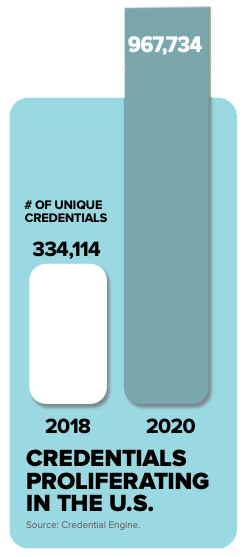
“Alternative credentials,” such as the ones Brown attained, are increasingly available in the form of micro-credentials, digital badges and industry-recognized certificates. They’re less expensive than a college degree and designed to help prepare workers for better jobs. 

But even as business leaders complain about a global talent shortage, research shows that employers often don’t recognize such credentials, preferring the more familiar practice of evaluating job candidates based on their college degrees and experience. HR professionals and hiring managers frequently have difficulty understanding the relevancy of alternative credentials. There can also be a technical obstacle: The automated applicant tracking systems used by many companies to screen candidates often don’t recognize credentials, according to recent research from the Society for Human Resource Management (SHRM).

IBM is ahead of the game in many respects. Six years ago, the tech giant began revising its job descriptions to focus on skills and not just educational attainment. On average, 50 percent of the company’s posted positions in the U.S. don’t require a bachelor’s degree. 

“We call these ‘new-collar jobs,’ and they’re aligned to careers that require the right set of skills and a commitment to lifelong learning,” says Tommy Wenzlau, talent leader for new-collar initiatives at IBM, which employs more than 250,000 workers globally. “New-collar roles are in some of technology’s fastest-growing fields, including data science, cloud computing, application development, cybersecurity and digital design.”

In addition, IBM’s apprenticeship program gives candidates without advanced degrees an opportunity to build new technical skills and earn industry-recognized credentials while getting paid. In 2017, the program launched three career tracks and now has more than 10 job areas, including marketing, cybersecurity, data science, design and sales.

“This program is an important talent pipeline for IBM, specifically for our new-collar jobs,” Wenzlau says.
Quote1.png

On the Rise

Credentials offer ways of demonstrating skills in fields that don’t feature a required occupational licensure or a traditional two- or four-year college degree. They can be delivered through methods such as apprenticeships; boot camps; and industry-recognized certificates, including for Intuit Bookkeeping, Salesforce Administrator and Project Management Professional. 

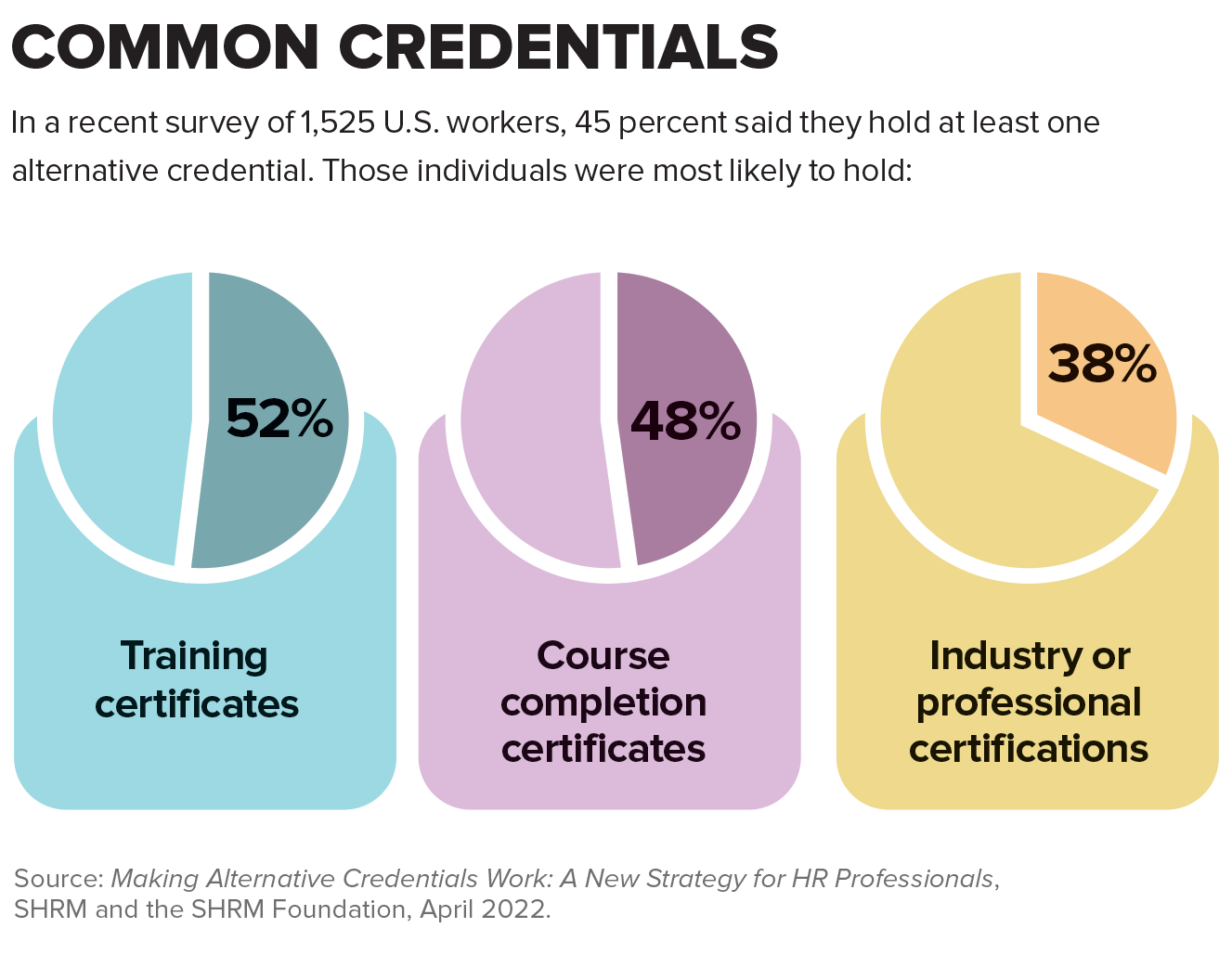
About 45 percent of 1,525 U.S. workers surveyed hold an alternative credential, according to Making Alternative Credentials Work: A New Strategy for HR Professionals, a research report released in April by SHRM and the SHRM Foundation and funded by a grant from Walmart. Of those, 68 percent believe it has helped them progress in their careers. 

Alternative credentials often appeal to workers who have taken more-circuitous routes to their fields: veterans, military spouses, young adults who bypassed college, caregivers re-entering the workforce and career switchers.

Since 2019, college enrollment overall has dropped 5 percent, with the number of newly enrolled freshmen down 9 percent, according to the National Student Clearinghouse Research Center. 

Many prospective students cite the high cost of college and pandemic disruptions as reasons for not enrolling. Instead, high school graduates are deferring college, going directly into the workforce or military, or educating themselves outside of the college degree system. For instance, almost 9 in 10 members of Generation Z say they’re learning through alternative means such as YouTube videos, certificate programs and internships, according to a January 2022 Intelligent.com survey. 

Kate Markin Coleman, co-author of Growing Fairly: How to Build Opportunity and Equity in Workforce Development (Brookings Institute Press/Ash Center, 2022), says the pandemic has prompted more interest in online learning.

“Candidates with industry-recognized certifications have taken the initiative to enroll in programs designed to augment their current skill set,” Coleman says. “Their completion of the training modules demonstrates—even more than a general education—their readiness for jobs requiring those skills.

“In a period of labor shortage, certifications expand the pipeline of talent to which HR directors have access and provide an alternative vetting mechanism for HR directors struggling to discern preparation in a competitive market.”

Info1.png


Evaluation Time

Credentialed employees are viewed as better performers by a majority of 500 U.S. executives and 1,200 supervisors surveyed by SHRM. Workplace leaders also consider alternative credentials valuable for employee development and believe employees who earn them gain more credibility. 

Yet executives, supervisors and HR professionals still place a higher value on work experience and traditional college degrees than on alternative credentials, the SHRM report found. Additionally, evaluating alternative credentials is seen by some HR professionals and hiring managers as too complicated and time-consuming.

Industry-recognized certifications represent one of the fastest-growing types of alternative credentials because the courses required to attain them cover clearly defined skills, require learners to pass an exam and are aligned to industry needs. Typically, the certifications are completed within three to six months and cost between $50 and $1,000 each, less than one unit in one course for a four-year college degree. 

Supervisors and HR professionals consider industry-recognized certifications the most compelling alternative credential, according to the SHRM survey.

The Google Career Certificates program was implemented in 2018 when the company began offering its Google IT Support Certificate on online education platform Coursera. In 2021, Google added three new certificates that can be completed within three to six months and don’t require prior experience or a college degree: Data Analytics, Project Management and UX Design (user experience design). 

In the fall of 2021, Deloitte US hired 14 graduates through the Grow with Google program. 

“The roles we hire for are very specific,” says Martin Kamen, a principal and human capital cloud leader at consulting and advisory firm Deloitte US, which has more than 120,000 employees. “The Grow with Google program gives us people with skills [that are] in high demand and brings us a diverse set of practitioners as well. The certificate program opened up a whole other recruiting pool for us, especially in underrepresented communities.” 

Walmart also has partnered with Grow with Google, as well as with U.S. Department of Labor Registered Apprenticeship Programs and the U.S. Chamber of Commerce. 

At Walmart, “we don’t think of it as credential-based hiring; we think of it as skill-based hiring,” says Brynt Parmeter, senior director of talent acquisition for the retail giant, which has 2.3 million employees. 

Walmart has had early success in finding software engineers through the Google program.Graphic22.png
“For some time, there has been a shortfall of people to fill those roles, and we’ve worked through different partnerships to allow us to identify software engineers,” he says. “We work with a number of boot-camp-style approaches. It’s a great way to find talent through short-term and immersive training programs. They center on real-world scenarios and tasks in their training experiences.”

Certifications are also “stackable,” meaning individuals can earn a series of certificates, building on the knowledge gained in the first course. 

“Aspiring workers often add certifications over the course of their careers,” says Coleman, who, in addition to being an author, has held various leadership positions in the corporate and nonprofit world. “Stackable skills and related certifications can produce substantial upward mobility. In the hiring process, HR directors are challenged to evaluate qualifications. Degrees are one recognizable way to filter candidates; so are alternative credentials and certifications. In such cases, the position skill required and the certification skill verified allow one-to-one alignment in a way that more general degree terminology does not.”

Salesforce, a customer relationship management software company based in San Francisco, offers many certifications, but the most popular is the entry-level Salesforce Administrator Certificate, which demonstrates a holder’s knowledge in cloud computing, enterprise software and how to use Salesforce tools effectively. The training to be a Salesforce Administrator is free online at Trailhead.com, and the exam costs about $200. 

“The average person with no experience could get upskilled, certified and connected to a job in a six-month window,” says Jared Crain, director of workforce development, Salesforce military. “It’s disrupting the way Americans look at careers. When I grew up, you needed to get a degree to unlock a career. Now, we’re seeing individuals with no degrees, a few years of military experience, and one or two Salesforce certifications get first job offers of $85,000-plus. We had a veteran with a GED get his first job offer at $125,000. The paradigm is shifting rapidly.”

How to Start

To make alternative credentials part of a company’s recruitment and hiring strategy, experts recommend HR professionals take the following steps:

Communicate with hiring managers. HR professionals must work with hiring managers to understand the skills needed to perform specific jobs. 

“The first piece is clarifying what knowledge, skills and abilities the hiring manager needs for this role specifically,” Crain says. “See if there is a certification for all of these skills that would demonstrate proficiency in these areas to you.

“We’ve gotten to a point in the labor market where I can apply for 100 jobs in 30 minutes,” he continues. “Overloaded HR professionals are trying to screen and identify quality candidates. If you have 500 applicants, the easiest gate is, ‘Do you have a degree?’ But it’s an arbitrary selection. Some of these positions don’t need the skills coming out of a higher education degree. If hiring managers can communicate the specific skills in the role, it would shape who to interview. Certifications give hiring managers a way to do that. It opens your aperture. Certifications give a different perspective that recruiters can use to screen candidates.”

Determine which positions are eligible for alternative credentialing. IBM’s HR team looks first at what the company needs. “We look for roles that are in demand across our business and offer opportunities for career growth,” Wenzlau says. “From there, we engage subject matter experts who can help evaluate which skills are required for success. We have a new-collar talent team that partners with our enterprise skills team and talent acquisition to effectively conduct the analysis and ensure our job descriptions reflect the needs of the position.”

HR professionals trying to implement these strategies at their organizations should change their recruitment and hiring strategy to account for this new type of candidate. 

“Look at processes, systems, job descriptions, assessment strategies, interview training, sourcing strategies and manager training,” Wenzlau advises.

He also cautions HR professionals to be aware of how this transformation is viewed by current employees.

“Be transparent about the rationale for re-credentialing and emphasize skill requirements as a tool to attract the best talent, ensure equity and meet the skills demand in the industry,” he says. “By focusing on new-collar jobs, we want to shift mindsets in our industry and make tech more diverse and inclusive.”

Change job descriptions to reflect skills, not degrees. At Macy’s Technology, a 1,400-employee company headquartered in Duluth, Ga., the HR team is revamping job requirements and its criteria for evaluating candidates. 

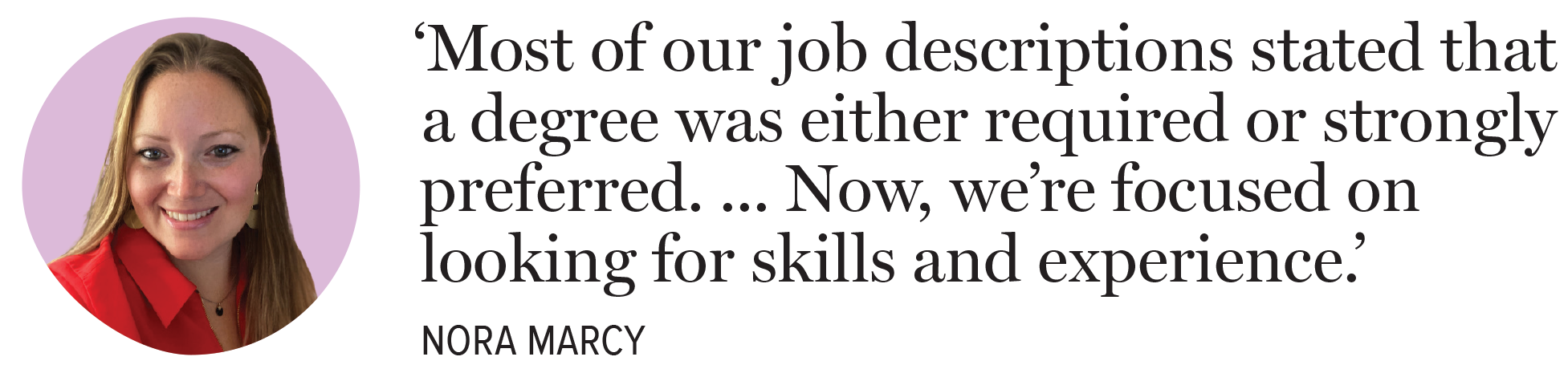
“Most of our job descriptions stated that a degree was either required or strongly preferred. We’re moving away from that,” says Nora Marcy, vice president, HR business partner, at Macy’s. “Now, we’re focused on looking for skills and experience. It’s no longer a priority how someone developed the skill and the knowledge we need. Instead, it’s about making sure they have the behavior and technical skill that will allow them to succeed.

“We’re taking this approach with almost all of our technology roles, including software engineering positions supporting our stores, call centers, website, mobile app, distribution centers, merchandising organization and our corporate functions,” she says. 

Tweak applicant tracking systems. HR professionals who value candidates with alternative credentials might not learn about them because of barriers erected by their applicant tracking systems. Almost half (45 percent) of the 1,129 HR professionals surveyed by SHRM said their organizations use automated pre-screening to review job applicant resumes. But only one-third of them said their automated systems recognize alternative credentials.

Depending on the applicant tracking system, the fix could be as simple as altering the fields on the “education” portion of the application or adding a “certifications” and “alternative learning” section. For example, at Macy’s Technology, “a candidate can include certifications as part of education in their online application,” Marcy says.

A long-term solution is advocated by the nonprofit Jobs for the Future, the U.S. Chamber of Commerce and others. They propose a system that allows employees to record their work and training accomplishments digitally, in a verifiable form that can be shared with employers.

The easily accessible files are called “learning and employment records” (LER). One significant LER effort involves the IBM Learning Credential Engine. 

“The IBM effort uses blockchain to create a cumulative, verified chain of a worker’s credentials, tying together their education and experience and the skills they have built,” Coleman says. “Certificates and badges have emerged as signals of achievement.”

Applicant tracking systems can filter for specific certifications, but it’s important to spell out the certification name completely to avoid missing a skilled and qualified candidate, says Joe Cahill, chief customer officer at the Project Management Institute, an association for project professionals based in Newtown Square, Pa. Also, be sure to add commonly used abbreviations for the certification. “For example, the Project Management Professional certification offered by our organization is commonly known as the PMP certification,” he says.

Train HR and hiring managers. HR professionals must gain familiarity with the types of alternative credentials available, especially the certifications and skills they impart, to effectively interview and evaluate candidates. Certain certification providers, such as Grow with Google, also have their own certificate graduate resume systems, which may require some initial training. 

“Get recruiting teams up to speed on this,” Deloitte’s Kamen recommends. “We did a training for our recruiters to show them how to use the Grow with Google recruiting tool.”

If HR professionals expand their search methods beyond the traditional bachelor’s or associate degrees, they will find a throng of candidates with the skills they need, earned through unconventional means. This will be a boon not only for those individuals, but also for the companies they serve.

The same is true when hiring HR professionals. SHRM offers two certifications—the SHRM Certified Professional (SHRM-CP) and the SHRM Senior Certified Professional (SHRM-SCP)—and a number of specialty credentials, including ones for talent acquisition and inclusive workplace culture.  

“If we want to win and find ways to attract talent, we must be open to considering alternative methods of finding and attracting talent,” Marcy says. “If we don’t, our competition will—and we will fall behind.”    

Kathryn Tyler is a freelance writer and former HR generalist and trainer in Wixom, Mich.

The Benefits of Alternative Credentials

Hiring candidates with alternative credentials can help your organization accomplish the following:

Increase the talent pool. “It can absolutely increase the qualified candidate pool, but by how much depends on the industry and role,” says Joe Cahill, chief customer officer at the Project Management Institute, an association for project professionals based in Newtown Square, Pa. 

“By branching out and looking for candidates with certifications, whether or not they hold a college degree, organizations can fill these important roles while ensuring these new hires have the right qualifications,” he explains.

Increase candidate diversity. “Skill-based hiring reduces barriers to entry that disproportionately affect minority workers,” says Kate Markin Coleman, co-author of Growing Fairly: How to Build Opportunity and Equity in Workforce Development (Brookings Institute Press/Ash Center, 2022). 

Research suggests that employers rely more heavily than is necessary on college degrees as a proxy for job preparedness.

“College degree requirements disproportionately disadvantage people of color,” Coleman says. “Yet many individuals without degrees possess the fundamentals that qualify them for jobs requiring advanced skills.” 

Brynt Parmeter, senior director of talent acquisition for retail giant Walmart, agrees.

“If you’re not doing a skill-based approach, you’re missing a whole range of talent,” he says. “We have significantly increased the quality and quantity of our candidates when we lean into this. We achieve much higher diversity, equity and inclusion outcomes when we use skill-based pathways.”

Macy’s Technology, which is headquartered in Duluth, Ga., has leveraged partnerships with organizations such as Google Career Certificates Consortium, Women in Technology’s Single Mothers Program, Pyramid Academy, Workforce Optimization Services and Techbridge, says Nora Marcy, vice president, HR business partner, at the company. 

“We’re also able to help our communities and give well-deserved opportunities to qualified, skilled individuals who have been passed over by other organizations,” she notes. “Hiring for roles is just as much about hiring for aptitude and attitude as it is for skill. If we can bring someone onto the team who shows they have personal drive and desire to succeed, we can teach them the skills they may be lacking.” 

Increase the number of candidates with job-specific skills. A new employee with a four-year college degree in computer science might have to be trained in an employer’s software programs. However, a new hire who comes on board with an industry-recognized certificate in the software the company uses already knows how to navigate the program and requires less on-the-job training.

“Industry-recognized certifications prove the candidate has mastered a skill set that is highly specific to their role,” Cahill says. “And because many of these certifications require putting hours into ongoing education, they also suggest the candidate is up-to-date on the latest industry practices.” —K.T.


SHRMLabs Better Workplaces Challenge Cup Finalist: Included

?The 2022 SHRMLabs Better Workplaces Challenge Cup competition highlights the most innovative HR technology startups today.

Four finalists were selected from over 150 initial submissions. They will go on to make their last pitch to a panel of judges as well as an audience of investors, leading HR professionals, fellow innovators and the media. The pitch fest will be held June 14 at the SHRM Annual Conference & Expo 2022 (SHRM22) in New Orleans, and the winner will be announced from the SHRM22 Main Stage by SHRM Chief Knowledge Officer Alex Alonso, Ph.D., SHRM-SCP.

Here’s a look at one of the finalists: Included, based in the Seattle area. Laura Close

Laura Close, co-founder and chief business development officer at Included, spoke with SHRM Online about the product and how it improves work and the practice of human resources.

SHRM Online: What does your product do?

Close: Included helps companies hire and retain a diverse workforce and drive measurable progress on diversity, equity and inclusion (DE&I) goals. The platform provides step-by-step guidance based on your own people data trends. Included makes sure you never miss an opportunity to hire the most qualified diverse talent. The technology guides diversity hiring success by:

  • Integrating with your existing people data systems.
  • Supporting DE&I benchmarking and representation goals for HR and talent acquisition leaders.
  • Locating equity gaps in the hiring funnel. Included’s bias detection engine shows you where and why each demographic group leaves your hiring funnel so that you can make process improvements.
  • Delivering customized data-driven guidance to increase and convert to hire more underrepresented candidates.
  • Analyzing DE&I source performance data, which saves time and budget and instantly shows which sources yield the most robust results.
  • Delivering DE&I operations for the complete employee lifecycle and predictive analytics with artificial intelligence.
  • Tracking DE&I progress to help leaders calibrate policies and processes.

SHRM Online: How does the technology improve the workplace?

Close: Diverse teams drive innovation, allow businesses to capture increased market share and drive revenue outcomes; Included helps you get there. Our product empowers HR leaders to take a data-based approach to DE&I and builds psychological safety and trust with data transparency and accountability. On the talent acquisition side, we help recruiters to make the right decisions and take action at the right time to attract highly qualified diverse candidates and move them through the hiring funnel. We unlock companies’ ability to build a more diverse, equitable and inclusive workplace.

SHRM Online: What specific HR problem does the technology solve?

Close: In the current talent crisis, candidates, employees and regulatory agencies are demanding that companies have a DE&I strategy—so having DE&I technology is a huge competitive advantage. Included is defining a new category of HR software called DEI Tech, made to meet the market’s demands. For a long time now, companies have had sophisticated tools for sales, finance and marketing. Now, HR has the tools they need to digitally transform DE&I. Included optimizes the technology you already own with the data you already have. We’ll meet you where you’re at. Our product integrates with a company’s HRIS, ATS and other people data systems to support your DE&I strategy with goal setting, operations and compliance. It’s impossible to do this at scale with manual methods. Included does the heavy lifting so HR professionals can focus on what they love: delighting candidates and employees with an inclusive, equitable journey.

SHRMLabs Better Workplaces Challenge Cup Finalist: Automation Workz

?The 2022 SHRMLabs Better Workplaces Challenge Cup competition highlights the most innovative HR technology startups today.

Four finalists were selected from over 150 initial submissions. They will go on to make their last pitch to a panel of judges as well as an audience of investors, leading HR professionals, fellow innovators and the media. The pitch fest will be held June 14 at the SHRM Annual Conference & Expo 2022 (SHRM22) in New Orleans, and the winner will be announced from the SHRM22 Main Stage by SHRM Chief Knowledge Officer Alex Alonso, Ph.D., SHRM-SCP.

Here’s a look at one of the finalists, Automation Workz, based in Detroit. Ida Byrd-Hill

Ida Byrd-Hill, founder and CEO of Automation Workz, spoke with SHRM Online about the product and how it improves work and the practice of human resources.

SHRM Online: What does your product do?

Byrd-Hill: The Automation Workz Life Culture Audit is a mobile app assisting HR professionals and corporate leaders to motivate front-line workers to digital career and training success. The Life Culture Audit reduces turnover and absenteeism by coaching front-liners through coding games and creation of their life vision so they realize they have the skills and potential success for new digital careers. 

Acknowledging a front-line worker’s vision and goals allows for their humanity and purpose, setting up commitment to career development, training and a positive performance cycle. Gartner found that when corporate goals are tied to workers’ personal goals, those workers were 17 percent more productive than other employees—and almost twice as likely to stay at their organization.

SHRM Online: How does the technology improve the workplace?

Byrd-Hill: Front-line workers, mainly people of color, are not as valued as they should be around the world. They are compensated below a living wage and are rarely groomed for higher-paying careers. Automation Workz created the Life Culture Audit for recruitment, performance management and digital career training assessment to highlight their value.

  • Recruitment: Leaders can fine-tune the selection of purpose-driven front-liners to reduce turnover and absenteeism. Individuals, by completing soul-searching reflection, will develop their purpose, eliciting long-term commitment.
  • Performance management: Very few managers know the personal vision or goals of their front-liners and hence rarely build their performance expectations to align with their WIIFM (What’s in It for Me) philosophy.
  • Digital career training assessment: While every front-liner does not need to learn how to code computer software, they do need to think, act and thrive in a world of robotics, AI, data analytics, autonomous vehicles and other emerging tech.

SHRM Online: What specific HR problem does the technology solve?

Byrd-Hill: Front-liners are seeking higher-paying careers. Many corporations are afraid they will not achieve a positive ROI if they invest in digital reskilling for front-liners to acquire higher-paying jobs. Hence, these workers do not feel valued, trusted or empowered. Consequently, front-line workers are not committed to their job, their work schedule, fellow colleagues or customers. This lack of commitment has turned into high turnover, high absenteeism and supply chain issues, leading to declining business growth in 2022.

Ontario: Employers to Disclose Electronic Monitoring to Workers

?Ontario will become the first province in Canada later this year to require employers to disclose electronic monitoring policies to their employees working at the office, in the field or at home.

Bill 88, the Working for Workers Act 2022, which became law in April, will protect workers’ privacy by requiring transparency from employers on how they track their employees’ use of computers, cellphones, GPS and other electronic devices. Ontario employers now have to disclose their use of webcams for monitoring purposes, observing keystrokes, screen activity and online chats in the workplace, stated Simmy Sahdra, a lawyer with McCarthy Tétrault in Toronto.

“Everything our government is doing is about building an economy that works for workers,” Ontario’s Minister of Labor Monte McNaughton said in a statement. “These generational changes are the first of their kind—not only in Canada but across North America.”

This legislation comes on the heels of Ontario’s right to disconnect from work policy.

“Ontario is taking a lead in the country in terms of modernizing its employer requirements with a view to create more transparency,” said Khalfan Khalfan, a lawyer with Stikeman Elliott in Toronto.

A December 2021 Ipsos survey revealed that 89 percent of people in Ontario believe that the workplace has changed permanently due to COVID-19. As a result, workers in Ontario said the province needs to update its employment regulations.

Electronic Monitoring in Ontario

Employers in Ontario with 25 employees or more on Jan. 1, 2022, need to have an electronic monitoring policy prepared by Oct. 11, explained Hilary Page, partner at SpringLaw in Toronto. They must then roll this policy out to employees within 30 days.

Legal experts say an electronic monitoring policy should include:

  • Whether the employer monitors employees’ electronic devices.
  • If employees are monitored, then employers must provide a description of how and in what circumstances the employer may monitor employees and set out the purposes for which information obtained through electronic monitoring may be used by the employer.
  • The date the employer prepared the policy, and if updated, the date of any policy changes.

Ontario’s Ministry of Labor has yet to provide detailed guidance on what employers need to incorporate in their respective policies, according to Khalfan. The legislation also does not define electronic monitoring.

“Employers still need to be mindful of how and in what circumstances they’re electronically monitoring their workforce,” Khalfan added. “The introduction of an electronic monitoring policy is not free reign for employers to monitor their employees without restriction.”

Before this policy requirement, employers should not have been taking any steps to spy on employees without having a valid business reason, Page noted.

“Many employment contracts will have a provision setting out that the employer generally has a right to access their own equipment and see what the employee is doing on that equipment,” Page continued. “Employers would likely never have a justification for intruding into an employee’s personal life by spying through their webcam.”

Privacy Legislation in Canadian Provinces

Experts say it is too soon to tell whether other Canadian provinces will follow in Ontario’s footsteps. Organizations in Alberta, British Columbia and Quebec are covered by provincial privacy legislation that governs how they deal with employees’ personal information, said Tushar Anandasagar, a lawyer with Gowling WLG in Waterloo, Ontario.

“Ontario employers do not have similar provincial privacy legislative obligations to consider in comparison to provinces such as British Columbia, Alberta or Quebec, where there are existing overarching statutory privacy obligations that an employer must abide by,” Sahdra added.

Page said she thinks other provinces could follow suit over time. “This policy requirement is addressing a need that has arisen out of the pandemic and the shift to working from home. Employees are wondering if they are being watched by their employers and employers are figuring out how to best manage employees remotely.” 

Modernizing Privacy Best Practices

Employers and HR professionals in Ontario now have an opportunity to examine the current system they have in place before developing a policy about their electronic monitoring practices, said Hina Ghaus, a lawyer with Gowling WLG in Waterloo.

Employers and HR professionals should take the following steps during the next six months:

  • Review the company’s existing procedures such as its social media policy and e-mail monitoring system to be compliant with privacy best practices.
  • Do the homework before developing an internal policy. For example, if an employer has remote staff, then the policy must disclose to them when monitoring might take place and why.
  • Conduct an internal assessment with IT teams and third-party service providers.

“The new legislation is going to help kickstart the conversation employers need to have with their IT teams and third-party service providers when it comes to their existing monitoring practices,” Khalfan said. “This might make employers realize where they have gaps in their security infrastructure and where they may be overreaching.”

Maintaining strong privacy practices can also establish a better workplace culture to increase mutual trust among employers and employees in Ontario, Sahdra said.

Catherine Skrzypinski is a freelance writer based in Vancouver, British Columbia.

AI Adoption Will Cause Workforce Reorganization

?Human resource executives at companies that are investing in artificial intelligence (AI) technology can expect to scout for higher-skilled IT workers as demand for their skills rises. They will also be faced with managing labor composition disruptions and workforce reorganizations as more companies use AI’s predictive technology capabilities to solve business problems.

In a recently published research paper titled Firm Investments in Artificial Intelligence Technologies and Changes in Workforce Composition, professors from Columbia University; the University of California, Berkeley; and the University of Maryland pored over almost a decade’s worth of data and found that AI adoption will change the employment landscape as well as HR managers’ priorities.

Researchers examined changes in labor outcomes from 2010 to 2018 using several datasets, sourced from Cognism Inc., a London-based sales intelligence firm.

Researchers also used 180 million job postings provided by Boston-based Burning Glass Technologies, an analytics software company that conducts research on labor market trends. The data details job descriptions and specific requirements such as years of education and experience.

Additional data sources were wage and education data grouped by commuting zone from the U.S. Census Bureau’s American Community Survey and wage and employment data grouped by industry from the U.S. Census Quarterly Workforce Indicators. From Compustat, researchers obtained firm-level data on operational variables such as sales, cash and assets.

The research shows that when companies invested in AI, there was a corresponding demand for workers who possess undergraduate and graduate degrees in the science, technology, engineering and mathematics (STEM) fields.

“As firms invest in AI, they tend to transition to more educated workforces, with higher shares of workers with undergraduate and graduate degrees and more specialization in STEM fields and IT and analysis skills,” the report stated. “Furthermore, AI investments are associated with a flattening of the firms’ hierarchical structure, with significant increases in the share of workers at the junior level and decreases in shares of workers in middle-management and senior roles.”

Junior level workers are those with less than two years of experience, or have two to five years of experience but do not manage anyone directly.

A junior-level worker entering the workforce will know more about how to use AI data to make predictions, said Alex He, co-author of the report and assistant professor of finance at the Robert H. Smith School of Business at the University of Maryland. This is a shift from the days when managers were the ones who analyzed AI data, gained insights and made decisions accordingly.

In short, AI empowers junior-level workers—a shift that has implications for the worker and manager relationship.

“We found that AI is making the firm less top-heavy and flatter. It’s not surprising, because AI has the ability to make predictions, and that makes the entry-level workers more capable to make decisions. They can do more, and there is less need for middle managers,” He said.

As companies that invest in AI operate with more employees in entry-level or single contributor roles and fewer workers in either middle management or senior positions, He predicted that several issues will arise that HR executives will be forced to manage in a restructured workforce.

“For example, right now, entry-level employees are paid less and managers are paid more, but if there are fewer managers, you can afford to pay the entry-level workers more to attract the required skills,” He said.

Another significant finding is that there are some jobs that can’t be replaced no matter how much investment is made in AI technology.

“Interestingly, firms that invest more heavily in AI do not reduce their demand for some of the skill groups that are most often predicted to be replaced by AI, such as customer service, HR, and legal,” the report stated.

James Hodson is a co-author of the report. He is the chief science officer at Cognism and chief executive officer at the AI for Good Foundation, a nonprofit organization headquartered in Berkeley, Calif. Hodson said HR managers have an opportunity to use AI to hire highly skilled people, to reskill and train people faster, and to build more productive teams. AI also allows HR managers to track data on employees, which can help HR managers understand workers better.

However, the report’s findings present both difficulties and opportunities for HR managers who will be asked to oversee an AI-induced workforce reorganization while maintaining or even advancing the competitive advantage of their companies.

“In general, HR executives need to be aware of managing organizational change, especially when it relates to the adoption of AI technology. Essentially, AI is bringing the HR function to the forefront of the business,” Hodson said.

Nicole Lewis is a freelance journalist based in Miami.

AI Adoption Will Cause Workforce Reorganization

?Human resource executives at companies that are investing in artificial intelligence (AI) technology can expect to scout for higher-skilled IT workers as demand for their skills rises. They will also be faced with managing labor composition disruptions and workforce reorganizations as more companies use AI’s predictive technology capabilities to solve business problems.

In a recently published research paper titled Firm Investments in Artificial Intelligence Technologies and Changes in Workforce Composition, professors from Columbia University; the University of California, Berkeley; and the University of Maryland pored over almost a decade’s worth of data and found that AI adoption will change the employment landscape as well as HR managers’ priorities.

Researchers examined changes in labor outcomes from 2010 to 2018 using several datasets, sourced from Cognism Inc., a London-based sales intelligence firm.

Researchers also used 180 million job postings provided by Boston-based Burning Glass Technologies, an analytics software company that conducts research on labor market trends. The data details job descriptions and specific requirements such as years of education and experience.

Additional data sources were wage and education data grouped by commuting zone from the U.S. Census Bureau’s American Community Survey and wage and employment data grouped by industry from the U.S. Census Quarterly Workforce Indicators. From Compustat, researchers obtained firm-level data on operational variables such as sales, cash and assets.

The research shows that when companies invested in AI, there was a corresponding demand for workers who possess undergraduate and graduate degrees in the science, technology, engineering and mathematics (STEM) fields.

“As firms invest in AI, they tend to transition to more educated workforces, with higher shares of workers with undergraduate and graduate degrees and more specialization in STEM fields and IT and analysis skills,” the report stated. “Furthermore, AI investments are associated with a flattening of the firms’ hierarchical structure, with significant increases in the share of workers at the junior level and decreases in shares of workers in middle-management and senior roles.”

Junior level workers are those with less than two years of experience, or have two to five years of experience but do not manage anyone directly.

A junior-level worker entering the workforce will know more about how to use AI data to make predictions, said Alex He, co-author of the report and assistant professor of finance at the Robert H. Smith School of Business at the University of Maryland. This is a shift from the days when managers were the ones who analyzed AI data, gained insights and made decisions accordingly.

In short, AI empowers junior-level workers—a shift that has implications for the worker and manager relationship.

“We found that AI is making the firm less top-heavy and flatter. It’s not surprising, because AI has the ability to make predictions, and that makes the entry-level workers more capable to make decisions. They can do more, and there is less need for middle managers,” He said.

As companies that invest in AI operate with more employees in entry-level or single contributor roles and fewer workers in either middle management or senior positions, He predicted that several issues will arise that HR executives will be forced to manage in a restructured workforce.

“For example, right now, entry-level employees are paid less and managers are paid more, but if there are fewer managers, you can afford to pay the entry-level workers more to attract the required skills,” He said.

Another significant finding is that there are some jobs that can’t be replaced no matter how much investment is made in AI technology.

“Interestingly, firms that invest more heavily in AI do not reduce their demand for some of the skill groups that are most often predicted to be replaced by AI, such as customer service, HR, and legal,” the report stated.

James Hodson is a co-author of the report. He is the chief science officer at Cognism and chief executive officer at the AI for Good Foundation, a nonprofit organization headquartered in Berkeley, Calif. Hodson said HR managers have an opportunity to use AI to hire highly skilled people, to reskill and train people faster, and to build more productive teams. AI also allows HR managers to track data on employees, which can help HR managers understand workers better.

However, the report’s findings present both difficulties and opportunities for HR managers who will be asked to oversee an AI-induced workforce reorganization while maintaining or even advancing the competitive advantage of their companies.

“In general, HR executives need to be aware of managing organizational change, especially when it relates to the adoption of AI technology. Essentially, AI is bringing the HR function to the forefront of the business,” Hodson said.

Nicole Lewis is a freelance journalist based in Miami.

Subscribe to our Newsletter