
Increase Your Persuasiveness with These 6 Principles

?Do you want to be more persuasive in your HR role? Incorporate herd mentality, fidelity, reciprocity, authority, scarcity and likeability, said Brad Karsh, CEO and founder of JB Training Solutions, a Chicago-based learning and development company.

Karsh shared those secrets of success during a June 13 concurrent session, “Become an InfluenceHR,” at the SHRM Annual Conference & Expo 2022 in New Orleans.

At the core of persuasiveness is understanding the person or audience and adapting your message accordingly, not being manipulative, Karsh said.

“Persuasion starts with that most human of skills—empathy,” he said, quoting Robert B. Cialdini, an American psychologist and author of Influence: The Psychology of Persuasion (Harper Business, revised edition 2006).

Karsh explained each of the six principles of persuasiveness:

Herd Mentality

“There’s safety in numbers. We kind of like to do what everybody does,” Karsh said.

The comfort of knowing what others are doing when making a business decision can be supplied by getting buy-in from others, offering relevant case studies and presenting a trio of options.

For example, you can use this approach to convince management to implement a new performance management system that you’re recommending, by:

  • Noting you’ve run this idea by 15 managers who all loved it, or pointing out that the system has been tested with three internal groups who all liked it.
  • Sharing a case study of what a leading Fortune 500 company has done with the system.
  • Presenting three options, not necessarily all cost-related. 

Option one might include mostly elements of the current performance management system, option two might include both new elements and those of the current system, and option three might include only new elements.

Fidelity

Fidelity is the idea of defending a commitment you have made. And whether that commitment is to a sports team or a business decision, when challenged, individuals tend to hold fast and defend their choice.

You can tap into this feeling of fidelity by posing questions designed to elicit agreement, Karsh advised. The conversation might look something like this:

“You agree our current system could be better? And you’d agree that we need to deliver feedback more regularly? Then you’d also agree that in order to do that, we need to make sure our people have the right system?”

Follow this up by asking what drawbacks your audience sees in the organization’s current system, and ask permission to research different systems.

Reciprocity

Reciprocity is the idea of exchanging something for mutual benefit, such as bringing a dessert to share for a friend who is hosting a dinner party. In the business world, you can use reciprocity to gain concessions for an idea you are pitching. Or it might be as simple as thanking your audience for taking time to discuss the new system because it shows their concern for the organization.

A part of reciprocity may involve making concessions, Karsh noted, because this recognizes your audience’s concern while allowing what you’re pitching to be considered on a trial basis. For example, if management balks at introducing a wholly new system, suggest it be tried as a pilot program.

Authority

Get backing for your idea from someone in your organization who is seen as credible and has authority—and make that approval known.

Also, if presenting to key stakeholders, consider inviting a high-level member of your organization who likes your idea to your presentation.

And don’t forget to dress with authority when making your presentation. Suits and uniforms convey a sense of professionalism, Karsh advised.

Scarcity

The idea that a product is scarce or an opportunity is fleeting can persuade others to take action, Karsh said. It could be a small window in being first to market, an expiration date or limited supply of a product you are recommending to your organization. If that is the case, include that information in your presentation.

Management may find it compelling to know, for example, that the price for the new system you are recommending increases in four weeks or a decision is needed by a given date in order for the organization to launch it by an important deadline.  

Likability

Being someone who is trustworthy and likable can go a long way in being influential, Karsh noted. He cited findings by Harvard social psychologist Amy Cuddy, who found likability is driven by: 

  • Listening more than you talk.
  • Shifting the spotlight to others.
  • Giving before you receive.
  • Not acting self-important.
  • Admitting your failings.

Integrity is at the core of being persuasive, Karsh noted.

“When it is done the right way,” he said, quoting Dorie Clark, author and professor at Duke University’s Fuqua School of Business, “persuasion is simply a subset of effective communication.”

Ensure Discipline Is Well-Documented

Discipline and termination should always be well-documented, but how exactly? Adam Rosenthal, an attorney with Sheppard Mullin in San Diego and Los Angeles, provided some tips on such documentation during a June 14 concurrent session at the SHRM Annual Conference & Expo 2022 in New Orleans.

Disciplinary issues became particularly acute during the pandemic, according to one school administrator from Texas attending the session, called “The Art of Disciplining, Separating and Laying Off Employees: Ethical Considerations and Effective Strategies for HR Professionals and In-House Attorneys in Workplace Investigations and When Making Difficult Personnel Decisions.” She told SHRM Conference Today that some teachers refused to wear masks or they let their students not wear masks, despite school rules. These acts rose to the level of insubordination, and discipline had to be considered, she noted.

Documentation

Adam RosenthalFive things every disciplinary documentation should include, according to Rosenthal, are:

  • Evidence that prior to the write-up, the employee knew the employer’s expectations.
  • Evidence that the employer’s expectations were appropriate, lawful and consistent with the job duties and business needs.
  • Evidence that the employee did not meet the employer’s expectations.
  • A clear statement of the employer’s expectations going forward.
  • A clear statement regarding the consequences of failing to meet the employer’s expectations.

The first of these is particularly important, Rosenthal emphasized.

He noted that as a general precaution, even in at-will states, the decision to terminate should be:

  • Based on legitimate business reasons.
  • Supported by ample documentation.
  • Consistent with the employer’s policies.
  • Conducted in good faith.
  • Made for good cause (not “for cause”), which means for a fair and honest reason, regulated by good faith, that is not trivial, arbitrary,  capricious, unrelated to the business needs or goals, or pretextual.

The employer should provide a termination letter, not a form, to an employee who is being discharged and specify the reason why the person is being fired, Rosenthal recommended. Avoid a laundry list of reasons why the person is being let go. That can backfire, he cautioned.

Managers often are reluctant to fire employees, he noted. Managers often want to be liked, may not know how to discipline employees or fear being accused of unlawful retaliation. All in all, it’s just hard to terminate workers, Rosenthal noted.

Attorneys’ Role

When a worker needs to be disciplined or fired, employers don’t always go running to legal counsel for advice, nor should they, Rosenthal said. It’s more appropriate for HR to seek attorneys’ input when another attorney has contacted them or the legal issues aren’t clear, he noted.

Not all complaints are equally serious, but there should be some formal investigation of all of them, he said. Otherwise, plaintiffs’ attorneys may ask why a formal investigation wasn’t conducted.

Lawyers often lead investigations, but they rarely make the final employment decisions at the investigations’ end. That typically should be the managers’ call, he said.

Attorney-Client Privilege

In order for attorney-client privilege to apply, HR needs to ask legal counsel for input on a legal question. If the lawyer addresses only business decisions without answering any legal questions, the privilege won’t apply.

This privilege is important because if litigation ensues, the other side can’t access certain information discussed between HR and the attorney.

However, just because HR labels some communications privileged doesn’t mean the privilege can’t be waived. For example, the privilege could be waived if HR has a conversation with someone—other than the attorney—who has no need to know about the privileged information

Once waived, the privilege typically can’t be restored. That’s a great loss, because attorney-client privilege facilitates open lines of communication between HR and the lawyer, which helps the lawyer provide the best legal advice, Rosenthal noted.

When the Investigator Is an Attorney

Rosenthal also provided information for when the workplace investigator is an attorney.

In this circumstance, the attorney needs to tell the employee that the attorney is gathering facts to provide legal advice to the company and that the attorney represents the company, not the employee personally—the so-called Upjohn warning.

The attorney also should explain that for a discussion to be subject to the privilege, it must be kept in confidence. The employee participating in the investigation should be told that except for their own attorney, they may not disclose the substance of the interview to any third party, including other employees or anyone outside the company.

The lawyer also should say that this notice has been provided to every employee interviewed as part of the investigation.

Exit Interviews

Corporate attorneys sometimes want to be present at exit interviews.

If they are present, they must provide the Upjohn warning, Rosenthal said. In addition, the attorneys might have to be a witness should litigation ensue.

Transgender Man Discusses How Companies Can Become an Ally to LGBTQ Workers

?At 15, Ben Greene came out as transgender.

The decision wasn’t easy. Greene struggled with his identity for years, which caused intense anxiety and depression. He didn’t know who he wanted to be and wondered if his family and friends could love who he truly was. While he received mostly positive responses to coming out, some of his loved ones harbored feelings of sadness.

“When I first came out, my friends and family thought I’d be a completely different person; they said that they’re grieving the person who I was,” Greene said. “But I said I’m the same person you know and love. I just look a little different—and I’m a whole lot happier.”

He said the decision changed his life. Greene is now a St. Louis-based public speaker, consultant and LGBTQ-rights activist. He has shared his journey with audiences of college students, business leaders, religious worshippers and government officials while also educating them on the importance of LGBTQ inclusion.

Greene discussed the experiences of the transgender community as well as the tools required to meet their needs during the concurrent session “Transgender Inclusion: What It Means, Why It Matters and What You Can Do to Be an Ally” on June 14 at the SHRM Annual Conference & Expo 2022 in New Orleans.

Greene reviewed the difference between sexual orientation and biological sex, why you should avoid using a transgender worker’s birth name, how there are a spectrum of genders and the evolution of gender over the centuries.

He noted how some countries have gender roles that differ greatly from those in the U.S. For example, Finnish fathers spend more time with their children than do mothers.

“Many years ago, it was OK for men to wear dresses,” Greene explained. “Then one day, they just decided that wasn’t OK anymore, and society accepted that.”

Why Transgender Workers Often Don’t Come Out

Greene also covered another difficult decision LGBTQ people face: coming out at work.

He referred to a 2020 study showing that 38 percent of LGBTQ workers were out to all their colleagues. Two years later, the Williams Institute in Los Angeles found that less than 30 percent of LGBTQ workers were out to all their co-workers—nearly a 9 percentage-point decrease from 2020.

More than half of transgender employees are not comfortable being out at work, according to a study by McKinsey and Company. And 2 in 3 remain in the closet in professional interactions outside their own companies.

Greene outlined some reasons why many LGBTQ employees do not come out at work:

  • Fear of being stereotyped.
  • Possibility of making people uncomfortable.
  • Possibility of losing connections or relationships with co-workers.
  • People might think they would be attracted to them.

“I’ve spoken with some [transgender] people who say they’re waiting to come out at work until it’s safe to come out,” Greene said. “It is painful to have to lie or conceal who you are at work.”

[SHRM members-only toolkit: Employing Transgender Workers]

How to Become an Ally

Greene implored companies not to wait to implement inclusive practices until a transgender worker comes out. Having support systems in place before they’re needed shows a dedication to a company’s inclusivity.

Additional tips Greene offers included:

  • Allow employees to use the bathrooms that make them most comfortable.
  • Be mindful and respectful when you choose to ask questions.
  • Encourage and support employees sharing their pronouns.
  • If you misgender someone, apologize, correct yourself and move on.
  • Ask how you can help a specific employee and listen to what they say.

Debra Baker, HR manager for Fountain-Fort Carson School District in Fountain, Colo., said some HR representatives, like herself, do not have enough exposure to the transgender community and therefore might not fully understand which inclusive practices to implement.

“I think there’s a lot of fear in the world right now,” she said. “I think there’s not enough education, and too many people judge before they get to know someone. I think we as HR professionals need more exposure and to embrace the transgender community so we can learn.”

Greene also said many people, particularly co-workers, might have questions for transgender people who are out. But he explained that it is important to ask appropriate questions. When determining if a question is appropriate, ask yourself:

  • Is this something I could easily Google? For example, “What is trans?”
  • Is this an appropriate question? How would I feel if this person asked me this question in this setting? Do I need to know the answer to this, or am I just curious?
  • Am I open to being corrected? It’s OK if your language isn’t perfect if you ensure you’re open to learning about the ways language is evolving, Greene noted.

“Make sure you have policies, structure and culture in place,” Greene said. “These allyship tips aren’t a big lift for you. But the impact on transgender people changes their lives.”

Improving Mental Health Means Working at It Every Day

?Burnout must not be the price one pays for success.

That’s a credo many have come to appreciate since the COVID-19 pandemic struck the world, and few would deny that declining mental health is part of the collateral damage of the pandemic.

Arianna Huffington, founder and CEO of workplace behavior change tech company Thrive, tackled this topic and the many mental health issues facing HR teams and their employees during the general session, “Shifting Mental Health Awareness into Action in the Workplace,” held June 14 at the SHRM Annual Conference & Expo 2022 (SHRM22). The session was moderated by Melissa Anderson, SHRM-SCP, SHRM board chair.

The topic of how to improve mental health is dominating conversation in the workplace, as about 1 in 3 workers say they would opt for better mental health benefits over higher pay; though executive teams have been slow to embrace the trend, with only about one-third acting on those wishes, Anderson said, citing SHRM research.

‘Microsteps’ Make a Macro Difference

While many of the issues that are causing stress and anxiety seem huge—the pandemic, inflation, worker shortages and political strife—Huffington said HR teams can help support their workforce through “microsteps“—science-backed actions that are “too small to fail” and can lead to lasting change.

“Mental health is what happens in the ‘everyday,’ and as HR teams, you should be aware of that; it’s not just something someone can handle by having a really good therapy session with a counselor,” Huffington said. “Stress is unavoidable, we know. But preventing accumulated stress is something people can take care of.”

Huffington said that taking 60- to 90-second microstep breaks to get away from creeping stress or anxiety will “help you to get rid of that obnoxious roommate you have living in your head, making your life more difficult.”

She said these microsteps—such as listening to a relaxing song, walking around a room, or looking at photos of friends or family members that bring joy—have proven more beneficial than trying to take on a personal behavioral overhaul that might seem ideal, but is ultimately overwhelming and then abandoned after a few weeks.

Sleep, Good Nutrition, Healthy Choices

“Recovery and recharging are two of the most important ways to improve your performance,” Huffington said, emphasizing the need to get proper sleep and “cognitive nutrition,” which is food that helps our brains function more effectively.

She said that better sleep can come with sacrifices to a person’s social life, but that “you don’t want to drag yourself through things every day” and then resort to eating sugar-filled foods when you become sleep-deprived.

Regular movement—just walking around—during the day is valuable, she added. You don’t have to spend a lot of time in the gym.

Smartphone Addiction Afflicts Too Many

Smartphone addiction continues to bog down productivity in workers and young people.

“Scrolling before bedtime is not a way to relax before bed, and though more than 70 percent of us go to bed with our phones, it’s better to leave them in a room outside the bedroom to recharge overnight,” she said.

Speaking of unplugging, Huffington advised that workers—especially remote workers—set a time when their work days are done and stick to it. “We all know we could work well into the night, but that’s not healthy,” she said.

She also advised using the first five minutes of your day to mentally plan out what you hope to achieve that day, “and not having turned on your phone first thing in the morning will help to guarantee that [is how that] time is spent.”

These can all be big changes for many, and Huffington said HR plays a key role in making that change happen.

“HR departments need to be at the center of that change, and they must come equipped with the data they need to validate the plans that they are putting forth,” she said.

[SHRM and Thrive have partnered to urge business leaders to support employee mental health and well-being. To join the pledge or learn more, visit pledge.thriveglobal.com.]

‘Entry Interviews’ Put New Hires’ Minds at Rest

Another tip she offered was to hold “entry interviews” with employees—the opposite of exit interviews.

“For every new hire, make the first day be one where you find out what that employee enjoys to do outside of the workplace and ask them how the company can help to support that,” she recommended. “Doing this will help them manage any potential stress, and also it’s a way for the company to show its employees that workers should feel comfortable about being able to discuss that about their personal lives in an accepting way.”

Huffington said one leading CEO she recently spoke to set his company’s values as excellence, equity and joy, as a way of indicating to employees that the company supports their mental well-being.

“Something for employees and HR teams to remember is that when a person’s mental health is in good order, the system is rigged in their favor,” she noted.

SHRM22 attendees had positive things to say about Huffington’s session.

Ash Diveley, SHRM-CP, HR manager at Berry Global, a plastic packaging manufacturer in West Paducah, Ky., said microsteps can really help.

“And it was interesting that [Huffington] pointed out that self-care doesn’t have to be something you do for yourself, but can be something you do for others,” Diveley added. “I would agree that getting proper sleep is important—and sometimes to do that, you have to make sacrifices by not trying to do everything.”

Tina Nava, SHRM-CP, HR payroll manager at financial planning company The Practice Advisory Group in Houston, said she found it refreshing “to hear someone at that level taking the subject of mental health so seriously, speaking so powerfully and positively about it.”

 “It’s great to see that she has gone down the evidence road and translated what she learned into doable, human steps that we can take in a positive way,” said Wilson Wong, head of insights and futures at the Chartered Institute of Personnel and Development in London. “We’re all daunted by change, but by combining the employee experience, mental health and the customer experience, it can create a truly human-focused workplace.”

Paul Bergeron is a freelance writer based in Virginia.

Tips for Building an Inclusive Hybrid Workplace

The COVID-19 pandemic upended the way people work by forcing many to work from home. Now, hybrid work is again changing workplaces by introducing a complex mix of remote and in-person employment models.

“Disruption came to us in ways that no one could have foreseen,” said Sonia Aranza, CEO and principal consultant at Aranza Communications in Washington, D.C., speaking June 13 at the SHRM Annual Conference & Expo 2022 in New Orleans.

“Employers now need to be intentional about shaping the new culture at work,” with some workers back at their worksites, some remaining remote and many working in different kinds of hybrid situations, she said during her concurrent session, “Do’s and Don’ts of an Inclusive Hybrid Workplace Culture.”

Who Gets to Choose?

Aranza invited audience members to share current work arrangements at their organizations. Among the responses:

  • At a mortgage business with 400 employees, back-office workers were told the CEO likes to see them in the workplace. So, they’re coming in for the three days a week that the CEO is in the office.
  • An energy business has empowered department heads, not HR or the CEO, to decide whether team members must come back to the office. Because department leaders know their people and their job functions, they are best situated to make decisions about working onsite, hybrid or remotely. But another audience member whose business lets managers make these decisions said it had created hard feelings among employees whose managers told them they had to be back in the office when others, working for different managers, were allowed to stay remote.
  • A nonprofit media company with 20 people asked workers what they wanted, and most preferred to be back in office two to three days a week. Most of the staff, however, are younger workers, and their more-senior colleagues said they would be happy to keep working remotely.

Others shared that their companies decided to be fully remote, fully onsite or adopt a hybrid approach, based on needs of the specific business and factors such as size, workforce demographics and industry.

Advantages to Remote Work

During the pandemic, “many companies switched to remote work on the fly and hoped for the best,” Aranza said. Research now shows that implementing a hybrid work model thoughtfully and with attention to detail yields better results in employee morale, productivity and retention.

Nearly half (48 percent) of about 1,700 surveyed workers in the U.S. said they will “definitely” seek a remote position for their next job, newly released research by the SHRM Research Institute shows.

Among the advantages of remote work, Aranza noted, are “no commute and no office drama.” Remote workers are productive and can often work with fewer disruptions.

Remote work also eliminates geographic constraints and allows companies to tap into talent across the globe. “Businesses can reduce facility costs and even lease unused office space,” she said.

Issues to Address

Under a hybrid work model, “decide if you will require workers to put in a percentage of hours in the office, such as 25 percent of hours onsite, or if you’ll require a percentage of the workforce to be in person at any time, such as 50 percent of workers onsite,” Aranza said.

“How does working at the office versus remote affect employee promotions? That’s an important question,” she said.

HR should be aware that remote workers may be less visible to those with power and influence (bosses, other managers and leaders). Organizations may need to create ways to ensure everyone has visibility by sharing the accomplishments of remote employees.

Hybrid and remote work will affect different workers in different ways, Aranza said. For example, not all employees have a spare bedroom that can be turned into a home office, and some are working in the kitchen, where their spouse or partner may also be working.

Employees working onsite at the office have faster access to technology, infrastructure and peer social support services. They also have greater access to information, including informal hallway chats.

Extroverts, in particular, may miss in-person social interactions that energize them.

Some of these issues can be remedied through interactive technology, or perks such as reimbursements for setting up at-home workspaces, Aranza said.

Other tips include the following:

  • Select a hybrid workplace model that works for your particular company and your employees’ needs. Invite diversity of thought and approaches when making these decisions.
  • Be intentional and creative to make access to resources and social support available to remote workers.
  • Educate everyone on the skills needed to thrive in a hybrid environment.

“Disruption happened,” Aranza said, and “the remote/hybrid genie is not going back in the bottle. Determine the approach that makes sense for your company and for your employees’ morale, productivity and overall well-being.”

Related SHRM Article:

Make the Hybrid Connection, All Things Work, April 2022

New Colorado Law Automatically Seals Older Criminal Records

?Colorado Gov. Jared Polis has signed the Clean Slate Act into law, allowing for arrest records that don’t result in a conviction and certain older criminal records to be automatically sealed. Colorado is the seventh state to pass a clean slate law, joining Connecticut, Delaware, Michigan, Oklahoma, Pennsylvania and Utah.

Clean slate laws are getting broad bipartisan political, business and community support, partly because of the severe staffing shortages being reported by employers.

We’ve gathered articles on the news from SHRM Online and other outlets.

Colorado’s Law

Under the new law, records would be automatically sealed after a set amount of time, so long as the person has not committed any new offenses.

Civil infractions would be eligible for sealing after four years since the final disposition; petty offense or misdemeanor records after seven years; and felonies after 10 years since the final disposition or release from jail, whichever comes later. Violent crimes, such as murder, assault, sexual assault and robbery, will not be eligible for sealing.

(Denver ABC 7)

Patchwork of State and Local Laws Grows in 2022

Numerous cities, counties and states continue to pass laws limiting the information that can be obtained by employers during the pre-employment screening process.

(SHRM Online)

SHRM Finds Increasing Support for Hiring People with Criminal Records

Recent research from the Society for Human Resource Management (SHRM) found that people in the U.S. embrace the idea of second chances and would be proud to work for an employer—and would patronize a business—that hires people who have a criminal record or who have been incarcerated.

(SHRM Online)

Do Employers Rely on Background Checks Too Much?

Most background checks in the U.S. run smoothly and effectively, in compliance with the federal Fair Credit Reporting Act. However, a worrying minority of cases show not only gaps in the system but also egregious examples of either abuse or poor oversight. It’s also clear that background checks are not a failsafe and should be only one element of staffing security.

(SHRM Online)

Ask Background-Screening Companies the Right Questions

?There’s a lot about criminal background checks that some background-screening companies would rather employers not know. That’s why HR professionals should always inquire about the quality of the data the companies are using.

Employers are “responsible for background-check results [from] a background-screening company,” said Debra Keller, president and chief compliance officer of Total Insight Screening in the Evansville, Ind., area, during her concurrent session at the SHRM Annual Conference & Expo 2022 on June 13 in New Orleans. “Know the questions to ask.”

Megan Magaña, vice president of human resources for Union Square Credit Union in Wichita Falls, Texas, said she was attending the session because “you never know what you don’t know.” Magaña also was interested in tips on how to avoid incurring liability.

National Criminal Search

A comprehensive background check includes a national criminal search, Social Security number trace and county searches for seven years of address history.

There’s no central repository for a national background check, Keller noted. Instead, background-check companies search administrative offices of the courts; state and national sex offender registries; city, county and state police departments; and county courthouses, among other sources.

There are about 650 million records that are worth searching, Keller said. If a background-screening firm says it’s searching 2 billion records, that’s a red flag. Don’t mistake quantity for quality, she cautioned.

If the background-check firm isn’t explaining how many files it is searching, it should be, she stated.

Some states have incomplete information. Louisiana and California only have parole records, for example.

“Not everyone is released on parole,” Keller noted.

Data Aggregators

Background-screening firms buy national data from data aggregators, and there are about eight aggregators in the country. Background screeners often ask employers what filters they want on the background data, such as exact matches of first and last name and birth date. Keller recommended not searching for exact matches, particularly since some states do not provide birth dates.

Some data aggregators provide information on arrests, which employers shouldn’t rely on. Otherwise, they risk a lawsuit from the Equal Employment Opportunity Commission, she noted.

Some county data is updated daily with some aggregators. Other data aggregators update their data only monthly. Employers should require their background-screening companies to provide their source list of data aggregators for national criminal data, so employers can see if data is gathered frequently or not, she noted.

“Bigger is not always better,” Keller remarked.

County Searches

County searches are typically conducted by county research partners. Some researchers just rely on online information, which is not always up-to-date, while others go into the courthouses to get the latest records.

One exception is in Alabama, where the state ensures online information on criminal records is updated, Keller said.

In other instances, the county research partners are just “data dumpers,” providing only mass data that may or may not have been obtained in person. “Who knows what’s in there?” Keller noted.

Ask who the background screener’s county research partner is and whether it’s ever been sued for passing information that’s incorrect, she recommended.

State and Federal Searches

Some states provide state searches, but employers should rely on these only when background screeners have searched all counties in the state.

If an employer is in a certain industry, like banking, or with the government, the employer may need a federal background search of all U.S. federal courts. This search is to identify crimes like drug convictions, kidnapping and money laundering.

Quality Assurance

Background-screening firms also should make sure the data they receive is about the individual for whom the employer requested a background check.

“Ask questions about quality assurance,” Keller said.

In addition, she cautioned the audience not to run civil background checks. “Don’t care about [job applicants’] personal business,” she said. “Don’t do it. It is trouble.”

How to Create an Inclusive Space for LGBTQ Workers

?For decades, employers could legally discriminate against LGBTQ workers.

That changed only two years ago, when the U.S. Supreme Court ruled in Bostock v. Clayton County that federal law protects LGBTQ workers from discrimination. The landmark ruling extended protections to millions of workers nationwide and changed the landscape for LGBTQ rights in the workplace for companies with 15 or more employees.

Yet many LGBTQ workers still find themselves feeling excluded, unwelcome and uncomfortable in their workplaces, which can increase stress levels and create additional psychological and physiological effects on these individuals.

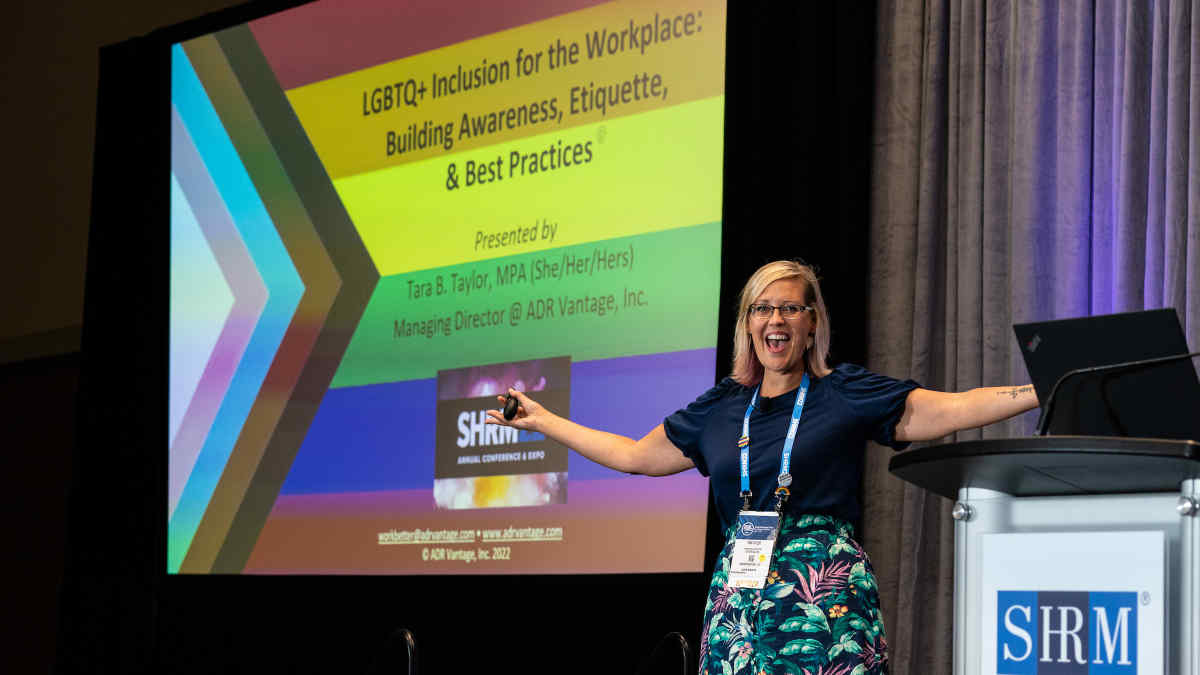
On June 13, Tara Taylor, managing director of the Washington, D.C.-based business consultation firm ADR Vantage Inc., discussed the importance of LGBTQ inclusion in the workplace during a concurrent session, “LGBTQ+ Workplace Inclusion: Awareness, Etiquette, & Best Practices,” at the SHRM Annual Conference & Expo 2022 in New Orleans.

“Eight percent of the U.S. population openly identifies as LGBTQ,” Taylor said. “That is more than 25 million people, and 88 percent of them are employed. If you don’t think they are in your workplace—they are.”

Pronouns Explained

Taylor, who leads ADR Vantage’s diversity, equity and inclusion (DE&I) consulting practice, began the session by familiarizing the audience with LGBTQ-inclusive terms and appropriate pronoun usage, such as:

  • Traditional feminine: She/her.
  • Traditional masculine: He/his.
  • Gender-neutral: Ze/zir or they/their.

She also explained the differences between sex and gender:

  • Biological sex: The label you are assigned by a doctor at birth based on the genitals you’re born with and/or the chromosomes you have.
  • Gender: A social and cultural construct. It’s how your identity relates to society’s idea of what it means to be a woman, man, neither or a mix of many genders.
  • Gender identity: One’s innermost concept of self as male, female, a blend of both or neither. Different cultures have different standards for the ways that people are expected to behave based on their gender.
  • Gender expression: The different ways you convey your gender, including your attire, behavior and appearance.
  • Sexual orientation: Who you are attracted to.

“Identity doesn’t always match behaviors, actions, appearance and outward expression,” Taylor said. “Remember that next time someone doesn’t identify as binary. It’s up to them to decide their own identity. It’s not our job to decide for them.”

Best Practices for Companies to Consider

Taylor also outlined several tips for employers to consider when creating a more inclusive workspace for LGBTQ employees, including:

  • Do not limit forms to “male” and “female.” You can communicate inclusion by instead asking, “What is your gender?”
  • Avoid using “other” as a gender option on forms. As Taylor said, “Nobody wants to be an ‘other.’ “
  • Do not say “Miss,” “Ms.,” “Mrs.” or “Mr.” in e-mail correspondence unless you know how people describe themselves. Instead, you could use words like “applicant,” “client,” “customer” or “colleague.”
  • Tweak your HRIS system to increase inclusivity. Ask your IT department about adding gender options.
  • Be prepared to adapt to name changes. Workers who get married or divorced often change their names. It can be done for transgender employees just as easily.
  • Avoid saying “sir” and “ma’am.” As Taylor explained, “I know it’s hard and it relates to culture. But this small thing can help break down barriers.” This is especially true when first meeting colleagues—don’t try to guess their identities. Also, bypass terms like “guys” or “ladies” when referring to groups, even when they seem applicable.
  • Add your pronouns to your e-mail signature. Taylor said that this shows that employers “get it.” You can do it on your social media profiles, as well.

Employers should also learn more about the experiences of LGBTQ employees, become more familiar with inclusive language and terms, and examine their organizations to identify and eliminate practices that could be deemed exclusive to LGBTQ workers, Taylor said.

[SHRM members-only toolkit: Ensuring Workplace Inclusion for LGBTQ Employees]

She also noted that many companies are still unsure how to handle bathrooms for transgender workers. But she reminded the audience:

  • Companies cannot ask employees to provide any medical or legal documentation regarding their gender identity in order to access bathroom facilities.
  • Employees should not be required to use a facility apart from other employees because of their gender identity.
  • Workers may not be limited by using facilities that are an unreasonable distance or travel time from the worksite.

Christina Lara, HR manager for Gila River Sand and Gravel Corp. in Sacaton, Ariz., said the information in Taylor’s presentation is good knowledge for HR representatives and business leaders to consider.

“The information about how to handle preferred pronouns was particularly insightful,” Lara said. “That way you don’t pinpoint a specific gender. I will absolutely bring the information I learned back with me to my work and implement these practices as much as possible. All HR representatives should.”

Gap International’s Alignment Factors Reinforce Resilience

?The COVID-19 pandemic hit organizations hard, but those that were resilient may have had something to set them apart, says a new study: the ability to create a sense among employees that their contributions were vital to their employer’s goals—and the organization’s survival—during a time of upheaval.

Researchers from Gap International and the SHRM Research Institute examined the following factors that created alignment and these factors’ relationship with organizational resiliency during the COVID-19 pandemic:

  1. Purpose: the power and connection between any individual and the largest expression of the organization’s reason for being in existence.
  2. Ownership: the degree to which individuals hold themselves personally accountable for the performance of their organization.
  3. Risk: the freedom to challenge the status quo, communicate unconventional ideas and take bold actions.

Purpose                                                                                                                               

More than 600 senior leaders from organizations characterized as resilient and non-resilient were asked about their standings on each of the three factors. 

As expected, researchers found senior leaders in resilient organization had higher standings on the Purpose factor compared to those in non-resilient organizations. This finding was in line with Gap International’s previous research examining these factors, showing that:

  • Teams with a strong sense of purpose are energized and eager to deliver results that positively affect the organization’s future.
  • Employees who have a shared sense that their work is meaningful feel they are all working toward a higher purpose.
  • Employees who have a high sense of purpose in their work are more likely to take on greater and more important leadership responsibilities.
  • Employees who have a sense of purpose in their work are more likely to perform outside of their job expectations and create new opportunities to fulfill the organization’s vision.
  • Teams and team members who have a sense of purpose enjoy going to work, are fulfilled by what they do, believe they are contributing to the organization’s success and feel they can face challenges.

“A company’s purpose can serve as a North Star during times of ambiguity,” but purpose often doesn’t happen automatically, the report researchers said. Developing purpose takes honest, thorough discussions.

However, such discussions “compete with other agenda items, and therefore often people just don’t get around to it,” researchers noted.

“It is likely that the more resilient organizations were having these conversations before and during the pandemic.”

Ownership

Gap also found that employees’ feelings of ownership for their work reinforce organizational resilience. When that ownership is strong, employees:

  • Regard their work as integral to the organization’s success.
  • Hold themselves accountable for that success.
  • Are willing to express views outside the scope of their roles and responsibilities because they want to make an overall impact and feel they can do so. 
  • Feel supported enough to express unpopular views and deliver bad news.
  • Communicate their concerns and ideas about the organization’s performance to people who can take action.

“It is so natural for people to own their part, thinking that is primarily how they can contribute to their organization’s success,” the researchers pointed out. A resilient organization, though, is one “where people go beyond their part and … understand that the whole is greater than the sum of its parts.

“It appears that during the pandemic, resilient organizations were indeed creating a sense of mutual ownership,” researchers noted.

Risk 

Somewhat surprisingly, researchers found that all senior leaders had relatively low standings on the Risk factor and resilient organization had lower standings on the Risk factor compared to those in non-resilient organizations.

Alex Topakbashian, vice president at Gap International and responsible for the company’s Breakthrough Diagnostics practice, noted that when things are going well, people are less likely to introduce change or take action that they think poses a risk. People are more willing to try unconventional approaches, he said, when left with no other options.

“Leaders of resilient organizations simply made decisions and took actions that they saw were necessary,” Topakbashian said. “Therefore, what might have felt like a risk in normal times was simply what needed to get done during the crisis.”

When it comes to risk-taking, senior leaders at resilient organizations may have been less willing to challenge the status quo and try new ideas, according to the report. The study suggests several reasons for this:

  • Senior leaders may not see a need to change if their organization seems to be doing well.
  • Senior leaders may be more committed to how things currently operate.
  • Senior leaders may fear their organization could not withstand much more change while in the throes of the pandemic.

Regardless of the reason for being risk-averse, “this is an area of potential concern for organizations,” researchers noted, “because risk is often vital for creativity, innovation and potentially overcoming future adversities.” 

Research Pinpoints Factors of Organizational Resiliency

?When COVID-19 hit the world in 2020, some organizations crumpled to their knees, closing their doors and laying off employees. Others were able to weather the storm of a pandemic. Why were some better able to survive—and sometimes thrive—in the face of adversity?

Research from the Society for Human Resource Management (SHRM) and Gap International released June 14 found that having prepared leaders who could swiftly size up the crisis’ implications, take quick action, and engage key staff members and their networks were crucial to helping organizations surmount the pandemic’s challenges. The research also found that employees can better cope with stress and change when their supervisors and workgroups practice inclusivity.

“A resilient organization can keep the workforce going through crisis and protect staff and stakeholders,” said Johnny C. Taylor, Jr., SHRM-SCP, SHRM president and chief executive officer. “The best leaders responded to obstacles with next-level ingenuity—their organizations are not only surviving, but thriving.

“Leaders can protect their employees and businesses by engaging in swift and continuous communication, removing obstacles to employee empowerment, and ensuring their cultures reinforce collaborative and adaptive behaviors.”

The organizational resiliency findings are based on a survey conducted in March with 620 U.S. senior leaders.

Resilient organizations have the resources needed to withstand emergencies. Employers were more likely, for example, to have people working in risk or crisis management. They had strong internal social networks: employees knew who to approach for assistance, and other people were available to fill in if key workers were unavailable.

Organizations were distributed into one of four categories as measured by productivity, finances and employee attitudes before, during and after the pandemic:

  • Thrivers. These companies functioned better post-pandemic when compared to their pre-pandemic levels.
  • Persisters. They exhibited little or no change.
  • Survivors. These companies bounced back to pre-pandemic levels.
  • Decliners. They functioned worse compared to their pre-pandemic level.

Findings on employee resilience are based on a March survey with 1,007 U.S. employees working in professional or non-managerial roles. Employee resilience was characterized as low, average or high, based on a behavioral measure.

Keys to Organizational Resiliency

Among the factors that resilient organizations shared:

  • Leaders were more likely to make information and expertise accessible to employees and decision-makers and elicit feedback on how effective their actions were in responding to the pandemic.
  • Leaders broke down bureaucratic barriers, brought employees on board to enact change and coordinated the workings of the organization more effectively as a way to usher in changes.
  • Leaders were more likely to empower employees to use their knowledge in new ways and recognize out-of-the-box thinking.
  • Leaders actively listened for problems before the pandemic occurred, had plans for when unexpected situations arose and practiced those plans. 
  • Leaders practiced inclusive decision-making and supported inclusive cultures.

By establishing norms to value differences, leaders were likely able to leverage diverse experiences and ways of thinking. Inclusive cultures foster a sense of belonging, which may help employees support one another—and convince employees to stay with the organization during turbulent times.

Perhaps surprisingly, changing products or services in reaction to the pandemic did not drive resilience, the report found, nor did having remote or hybrid workforces. There was no evidence organizations were more resilient, whether or not any of these factors were present.

Other factors played more influential roles in an organization’s resiliency, according to the report. 

“From these findings, we see that various companies changed products and/or services in response to the pandemic. However, changes don’t always equate to success,” said Katrina Merlini, researcher, thought leadership, in the SHRM Research Institute. “This is not necessarily surprising as scholars have estimated that around 70 percent of organizational change efforts fail.

“Changes are more likely to succeed,” she added, “when they are compatible with the organization’s culture and when there are strong change leaders at the helm.”

Keys to Employee Resiliency

Employees who worked for supervisors who practiced inclusiveness and who worked in inclusive groups may feel more supported, “fostering their coping capabilities,” the report suggests.

“[Employees] may be more likely to voice their unique ideas and contributions regarding better ways to adapt” when they have a supervisor and workgroup who value their uniqueness.

Having access to team members and social resources—such as communication platforms like Slack—also contributed to employee resilience during the pandemic. This access fostered camaraderie, provided a way for workers to share their personal experiences and offered an outlet for co-workers to assist colleagues in managing increased workloads, researchers suggest.

This is not surprising, said Alex Topakbashian, vice president at Gap International and responsible for the company’s Breakthrough Diagnostics practice.

“When leaders and teams actively build strength in their relationships, as the study shows, they become well-prepared to deal with the unexpected,” he said. “Our experience suggests that when we are not dealing with the pressure of an externally driven crisis, camaraderie can even serve as a platform to create resilience that propels the organization forward, beyond the normal, everyday results.”

Leaders’ empathy also contributes to employee resiliency, according to the report. Leaders who understand and care about employees can “buffer the effects of adversity,” researchers noted.

But being resilient, they pointed out, doesn’t fall solely on the shoulders of individual employees or leaders. Resiliency has to be fostered and cultivated by organizational culture and resources and through workgroup and supervisor behavior.

“We may not be able to predict with certainty the next major adverse event,” the researchers conclude in the report. However, these findings “may help senior leaders brace for and overcome the impact of future adversities.”

Subscribe to our Newsletter