
Will Remote Work Undermine Diversity Efforts?

?Jasmine Lewis doesn’t want to return to the office because she’s tired of painting a smile on her face.

Lewis is a vice president at a Houston-based home services firm and holds an unofficial role as “Black translator.” The 41-year-old says her colleagues constantly ask her what Black people think about various issues, sometimes even texting her on weekends. 

“I am not your performative Black person,” Lewis says. “Translating is exhausting.” 

At least when she’s home, she says, there’s no need to mask her irritation since her colleagues can’t see her face. 

Avoiding such tokenism and assorted microaggressions from co-workers is just one reason Lewis prefers working from home. Remote work also eliminates a time-sucking commute and would allow her to be physically closer to her soon-to-arrive baby daughter. 

“Motherhood changes the way you look at things,” Lewis says.

Many other women and people of color share Lewis’ desire to work from home full time. In fact, workers from those demographics are more likely than white men to say they would rather work remotely, according to new research, primarily because they want to escape the barrage of microaggressions they are often subjected to in the workplace. (Microaggressions are comments or actions that subtly and often unconsciously or unintentionally express prejudice toward a member of a marginalized group.)

Women add that working from home provides freedom to deal with family responsibilities such as child care. 

But granting the wishes of women and people of color may endanger their careers and companies’ attempts to diversify their upper ranks as employers face a new challenge presented by remote and hybrid work arrangements: proximity bias. Many experts worry—and surveys confirm—that managers may forget about people they don’t encounter daily and may grant promotions and high-profile assignments to those in the office. That becomes an even bigger problem if white men make up the bulk of the in-office workforce. 

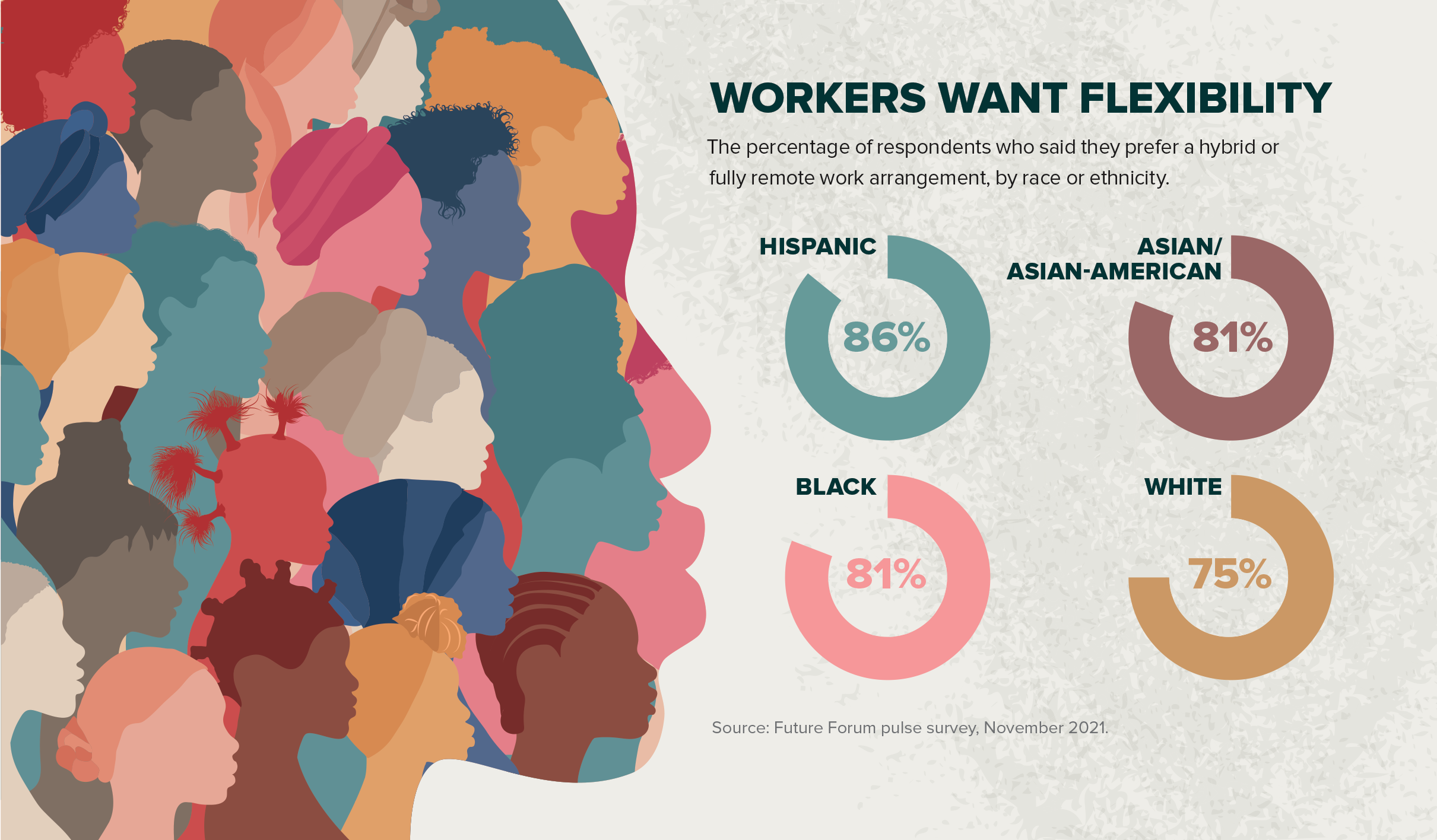
More than 80 percent of Black and Asian or Asian-American knowledge workers in the U.S. say they would prefer hybrid or fully remote work arrangements, as do 86 percent of Hispanic individuals. Three-quarters of white employees feel the same, according to the results of a November 2021 pulse survey of 5,421 U.S. workers from Future Forum, a research consortium set up by Slack. (Unlike those employed at stores, factories or hospitals, knowledge workers tend to have jobs that can be done remotely.) The survey also showed that Black and Hispanic workers’ sense of belonging and fair treatment grew sharply when they worked at home. 

Meanwhile, 52 percent of women say they enjoy working remotely and would like to continue to do so, compared with 41 percent of men, according to a recent Harris poll. More than 60 percent of women say they feel more energized working from home, and 58 percent say they are more engaged. Roughly 50 percent of men say they feel more energized and engaged when working from home. 
graphic 3.png

Stubborn Resistance

Managers, however, don’t hold remote work in high regard. Nearly 70 percent of supervisors believe that remote workers are more easily replaceable than onsite workers, according to a study released last July by the Society for Human Resource Management. About 42 percent of supervisors say they sometimes forget about remote workers when assigning tasks, and nearly three-quarters say they would prefer all of their subordinates to be in the office.

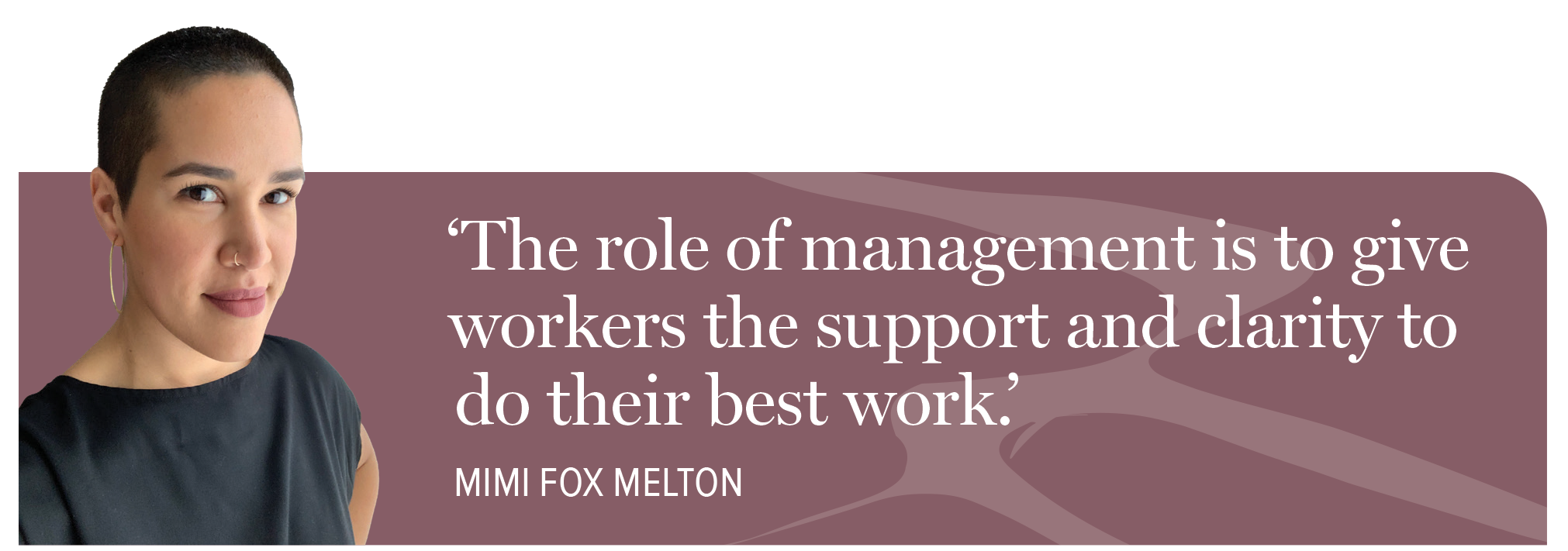
“Managers are kind of shrugging their shoulders and saying, ‘Yes, you can be remote, but it will impact your career,’ ” says Mimi Fox Melton, chief executive officer at Code2040, a San Francisco-based nonprofit dedicated to diversifying the tech industry. 

“The role of management is to give workers the support and clarity to do their best work,” Melton adds. “It’s not a worker’s job to make sure they are in the line of sight of a manager and wave their hands and say, ‘Look at me.’ ” 

Companies hope to avoid proximity bias by training managers to be more inclusive so remote workers’ careers don’t stall. Employers are also upgrading technology for more-seamless remote interactions, while simultaneously encouraging senior executives to demonstrate that remote work is acceptable by engaging in it, too. Others are hiring directors of remote or hybrid work to better accommodate the transition. 

This is all happening as more companies consider achievement of diversity goals when making decisions about executive compensation. Salesforce, for example, announced in February that it was linking executive pay to diversity goals. 

The last thing companies need is more obstacles to achieving diversity, experts agree. White men hold about 62 percent of C-suite positions, compared with white women at 20 percent, according to a 2021 survey by LeanIn.org and McKinsey & Co. The disparity is more acute with people of color: Men of color hold 13 percent of C-suite roles, while women of color hold only 4 percent.
quote 1.png

Uncertainty Reigns 

As companies struggle to improve their diversity, equity and inclusion (DE&I) programs, they’re also scrambling to create plans for hybrid work.

“No one’s figured this all out yet,” says Elena Richards, chief diversity and inclusion officer at KPMG. “Communication will be key.”

Of course, it’s possible that DE&I programs will get a boost from remote work. Job candidates are no longer limited by geography, and a broader range of mentors and sponsors may be available if meetings don’t need to be office-based. Remote work also levels the playing field for those who dislike office schmoozing and socializing. 

Remote or hybrid work makes employers look at employees’ work product rather than their bubbly presence at the watercooler, says Pam Cohen, chief research and analytics officer of WerkLabs, the research division of The Mom Project, a Chicago-based company that provides job-placement services and other support for mothers in the workplace. 

However, Cohen notes that employers still must make deliberate efforts to include remote workers in planning and decisions.

“Executives need to realize that remote and flexible working is just the way things are now,” she says, “and they need to communicate an air of respect” for employees who are embracing it.

Fears of enabling a two-tiered employee system pushed some companies, such as San Francisco-based file-hosting service Dropbox, to select a remote-first strategy. “Hybrid approaches may also perpetuate two different employee experiences that could result in barriers to inclusion and inequities with respect to performance or career trajectory,” the company wrote in an October 2020 blog post. “These big-picture problems are nonstarters for us.” 

About 40 percent of executives say their top concern about remote work is that inequities will emerge between those working primarily in person and those working primarily remotely, according to the Future Forum survey. Some workers are worried, too: 43 percent believe working onsite will be better for their careers, according to a survey by meQuilibrium and Executive Networks.

There is evidence that remote workers don’t receive the recognition they deserve. A study by Stanford economists concluded that employees who worked remotely reduced their rate of promotion by half, even though they were more productive than those working in the office. The research, which was published in 2015 in The Quarterly Journal of Economics and followed employees who worked at a travel agency in China, has found a new audience amid the move to hybrid work.

photo2.png

Managers Are Key

Leading a team made up of a mix of fully remote and mainly in-office employees is especially challenging for managers because when people are out of sight, they are often also out of mind. 

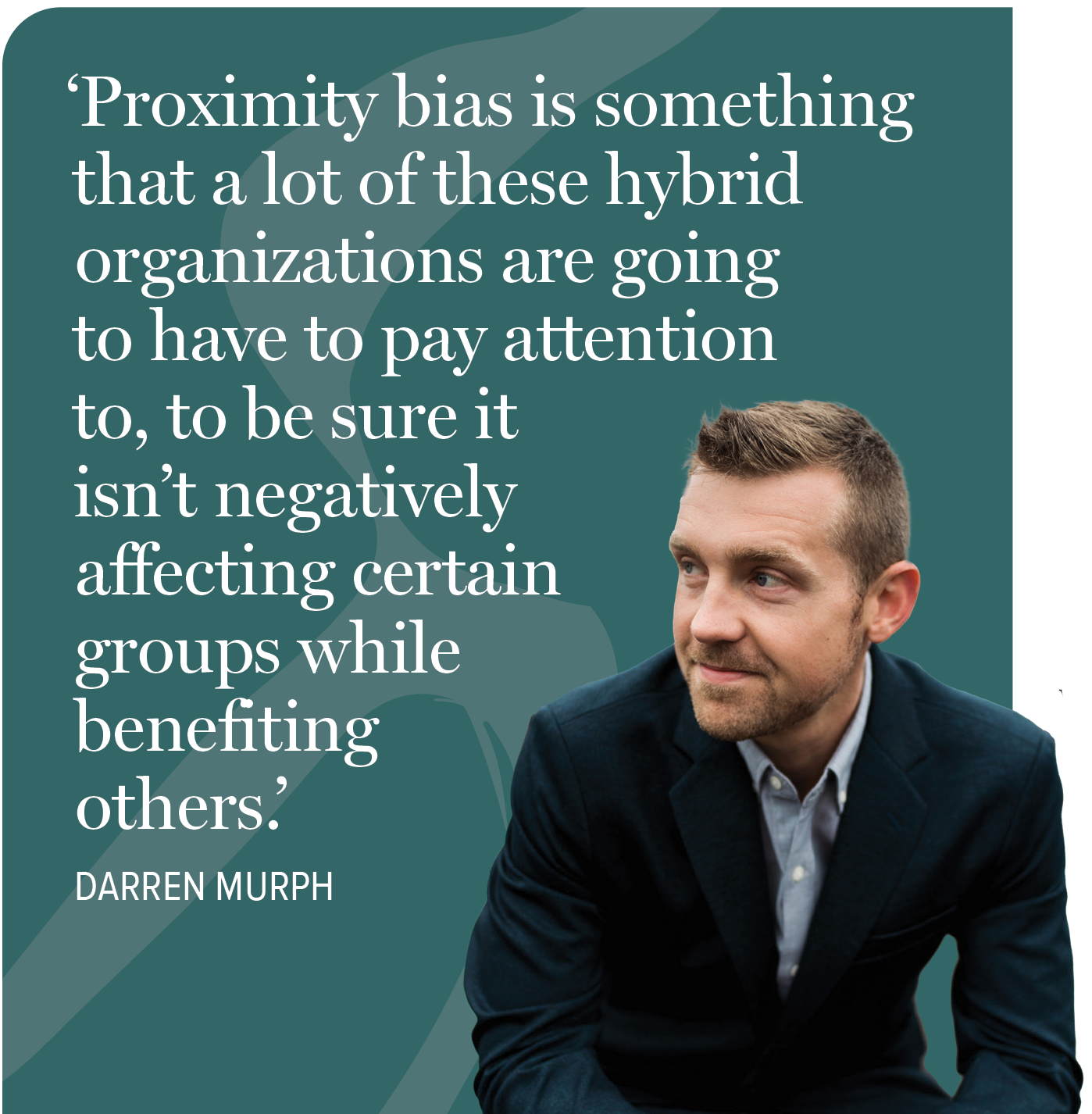
“Proximity bias is something that a lot of these hybrid organizations are going to have to pay attention to, to be sure it isn’t negatively affecting certain groups while benefiting others,” says Darren Murph, head of remote at GitLab Inc., a San Francisco-based software company whose workforce is fully remote. “Without intentionality, hybrid work can be the worst of both worlds.”

It’s rare for companies to designate one person to ensure that remote work works. A study conducted last year by Gartner found that only 14 percent of companies either had or were planning to add in the next two years a “head of hybrid work effectiveness.” However, 57 percent of companies said they either had or would add a head of integrated talent management. That role could certainly include oversight responsibilities related to hybrid and remote work, says Caroline Walsh, a vice president in Gartner’s HR practice. Walsh also predicts that corporate DE&I departments will eventually oversee remote-work issues. 

Regardless of what the position is called, Walsh says “organizations must enforce flexibility evenly. The principle must be entrenched in the culture.” 

HubSpot, a Cambridge, Mass.-based software maker, has created a workshop for its managers to teach them how to create a cohesive, equitable team in the hybrid environment.quote2.png
“Enabling managers is absolutely key,” says Celeste Narganes, director of diversity, inclusion and belonging at HubSpot. 

In the workshop, managers learn that if some employees plan to attend a meeting virtually, everyone should attend virtually to create inclusivity. Managers are also instructed to make sure everyone has a chance to contribute. They’re further asked to initiate regular check-ins with individuals on the team and to remember that everyone has different life experiences. 

“Intentionality is the theme,” Narganes says. 

The word “intentionality” is often used by executives to describe how they’ll ensure diversity goals aren’t lost in a hybrid environment, begging the question whether companies were previously intentional in executing DE&I programs. 

“Most people don’t check in to ask people how they’re feeling,” Narganes says. “You have quotas to hit. You have numbers to hit. You’re driving toward progress. In most cases, that’s what folks are focused on.” 

She isn’t worried about the hybrid environment undermining diversity goals. In fact, she notes, the availability of hybrid work has benefited Black and Indigenous individuals, as well as other people of color: Workforce participation for people in these demographics increased to 34.7 percent last year from 27.4 percent in 2020. 

HubSpot also has been able to expand its candidate pool through relationships with Path Forward and DreamCorps, two nonprofits working to diversify the tech industry. Narganes adds that the company has also strengthened its international leadership development programs and allyship efforts. 

Sidebar.png

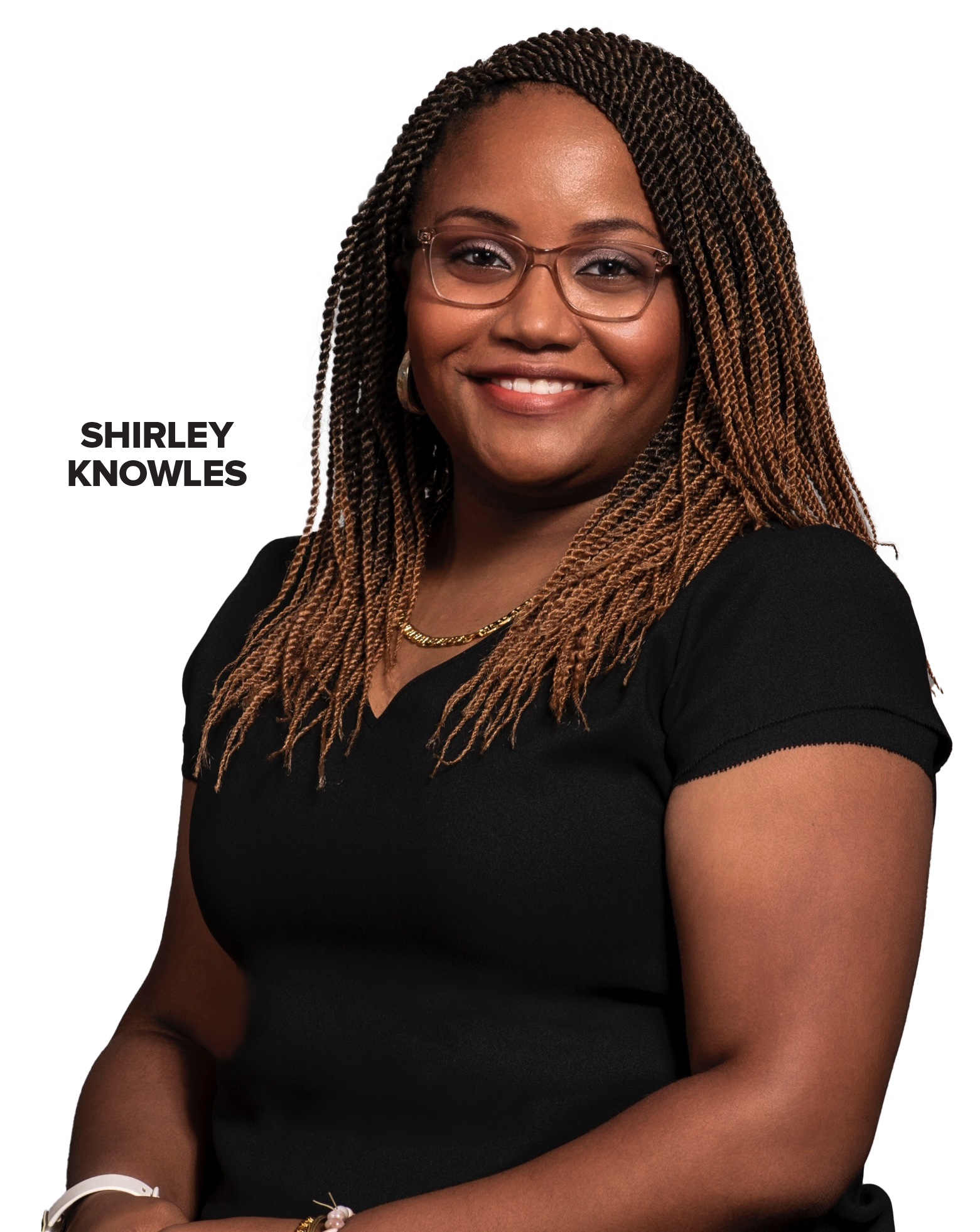
Shirley Knowles2.pngShirley Knowles’ mind was racing as a male colleague started petting her braid and asking her questions about her hair, such as the cost and time spent on styling.

“You’re thinking, ‘Who is this? Why are they touching me? What gives them the right?’ ” Knowles says. 

At the same time, she was contemplating how to respond. She knew that if she objected too strongly, she might be labeled “the angry Black woman.”

“You’re doing all this math in your mind when you’re a person of color,” says Knowles, recalling the incident that occurred at a previous employer. “I just gave a short answer and walked away.” 

Knowles currently is chief diversity and inclusion officer at Progress Software, based in Burlington, Mass.

Many Black women can relate to similar incidents in which co-workers asked overly personal questions, made inappropriate comments or touched them without permission—and the stress it caused them. The behavior exhibited by Knowles’ male co-worker is an example of a microaggression, which is defined as a comment or action that subtly and often unconsciously or unintentionally expresses a prejudiced attitude toward a member of a marginalized group.

Chester Pierce, a Black psychiatrist and Harvard University professor, coined the term in the 1970s to describe the subtle, everyday discriminatory treatment Black people endure from white people. Over time, microaggressions have a negative, cumulative effect. Many can occur just as easily via Zoom as in person. 

Derald Wing Sue, a professor of counseling psychology at Columbia University in New York City, has studied how microaggressions affect other marginalized groups, and now the term has been expanded to include women, other people of color and members of the LGBTQ community. 

There are three types of microaggressions:

Microassaults are intentional insults or actions designed to hurt someone, such as using an ethnic slur or walking to the other side of the street to avoid passing certain individuals.

Microinvalidation is an effort to discredit or disparage the experiences of someone who is part of an underrepresented group. An example is telling a woman who describes being harassed that she probably misunderstood what was happening.

Microinsults are comments that disrespect someone’s racial heritage or identity. An example is telling someone that they don’t look Hispanic. 

Microaggressions are particularly insidious because people often aren’t deliberately trying to be mean or insulting. 

Progress Software’s diversity training includes a session on how to have inclusive conversations. Part of the session includes breaking employees into groups to role-play in different scenarios. 

“You have to reach people in a very real way,” Knowles says. —T.A.

New Approaches

Taking a creative approach to scheduling can further help ensure that hybrid work doesn’t undermine diversity goals, says Jessica Jackson, Ph.D., global clinical diversity, equity, inclusion and belonging manager at Modern Health, a San Francisco-based mental health benefits platform for employers. For example, companies can consider having all employees work remotely three days a week and come to the office on the same two days for meetings. 

Another option is to rotate those who come into the office so everyone has the opportunity to work in person with the supervisor. However, managers must explain the reason behind the plan so employees understand the purpose.

“As humans, we will participate in what helps us to belong,” Jackson says. “People will want to participate.” 

Lewis isn’t concerned that women or people of color will be held back by working remotely, noting that individuals from marginalized groups weren’t getting promoted when they were in the office.

“I could be in somebody’s face all day, and it didn’t matter,” says Lewis, who notes that she’s talking about former workplaces, not her current employer, which she doesn’t want identified. “People will always find you when they want you to do the work.”

Still, some companies are taking extra steps to guard against proximity bias. San Francisco-based Iterable, a consumer marketing company, initiated a “calibration committee,” which consists of six senior executives who ensure that promotion decisions are fair and impartial. Team leaders fill out detailed forms explaining why they believe a certain person merits a promotion. The committee then studies the proposals for signs of bias, comparing promotion rates of remote and hybrid workers to those who work onsite.

“We want to make sure we’re not being unfair to anyone,” says Markita Jack, Iterable’s head of DE&I.

Altria Group Inc. is also looking at promotions through a DE&I lens. Last year, the Richmond, Va.-based tobacco company created an inclusion, diversity and equity ratings system for its people managers, with results based on employee surveys. Starting this year, only those ranked as an “advocate” or “ally” of underrepresented groups are eligible for a promotion. 

“The ratings are a way to get at accountability,” says Michael Thorne-Begland, Altria’s vice president and chief inclusion, diversity and equity officer.

The company also plans to track promotions based on where an employee works to ensure that hybrid and remote workers aren’t climbing the ladder at a slower pace than their colleagues. 

About one-third of the company’s employees are eligible to work remotely at least part time, Thorne-Begland says, and decisions about what’s possible will be made through discussions with their managers.

“This model is about employee empowerment,” he says. “Managers are expected to support them to the extent that they can.”

Thorne-Begland says an internal survey found that senior executives were most likely to want to work in the office. However, he says, Altria’s CEO has told them that they should work outside the facility at least one day a week. 

“We want our actions to be in line with what we said,” he says. “Employees need to see you at home or Starbucks.”  

Theresa Agovino is the workplace editor for SHRM.

How Alternative Credentials Can Help You Find Employees

?Tiffany Brown spent five years in accounting before deciding to change professions. She had always had an interest in computer science, but with degrees in English and business, she didn’t see how a career switch was feasible. 

Then, she participated in a six-month development boot camp, which helped her build the foundational skills needed to transition from accounting to computer science. It prepared her for the next step—IBM’s apprenticeship program. 

“I realized it was the perfect opportunity because I wouldn’t have to go back to college to get another four-year degree,” says Brown, who went on to earn several other credentials and now has a successful career as a software developer in the global chief data office at IBM.

“Alternative credentials,” such as the ones Brown attained, are increasingly available in the form of micro-credentials, digital badges and industry-recognized certificates. They’re less expensive than a college degree and designed to help prepare workers for better jobs. 

But even as business leaders complain about a global talent shortage, research shows that employers often don’t recognize such credentials, preferring the more familiar practice of evaluating job candidates based on their college degrees and experience. HR professionals and hiring managers frequently have difficulty understanding the relevancy of alternative credentials. There can also be a technical obstacle: The automated applicant tracking systems used by many companies to screen candidates often don’t recognize credentials, according to recent research from the Society for Human Resource Management (SHRM).

IBM is ahead of the game in many respects. Six years ago, the tech giant began revising its job descriptions to focus on skills and not just educational attainment. On average, 50 percent of the company’s posted positions in the U.S. don’t require a bachelor’s degree. 

“We call these ‘new-collar jobs,’ and they’re aligned to careers that require the right set of skills and a commitment to lifelong learning,” says Tommy Wenzlau, talent leader for new-collar initiatives at IBM, which employs more than 250,000 workers globally. “New-collar roles are in some of technology’s fastest-growing fields, including data science, cloud computing, application development, cybersecurity and digital design.”

In addition, IBM’s apprenticeship program gives candidates without advanced degrees an opportunity to build new technical skills and earn industry-recognized credentials while getting paid. In 2017, the program launched three career tracks and now has more than 10 job areas, including marketing, cybersecurity, data science, design and sales.

“This program is an important talent pipeline for IBM, specifically for our new-collar jobs,” Wenzlau says.

Quote1.png

On the Rise

Credentials offer ways of demonstrating skills in fields that don’t feature a required occupational licensure or a traditional two- or four-year college degree. They can be delivered through methods such as apprenticeships; boot camps; and industry-recognized certificates, including for Intuit Bookkeeping, Salesforce Administrator and Project Management Professional. 

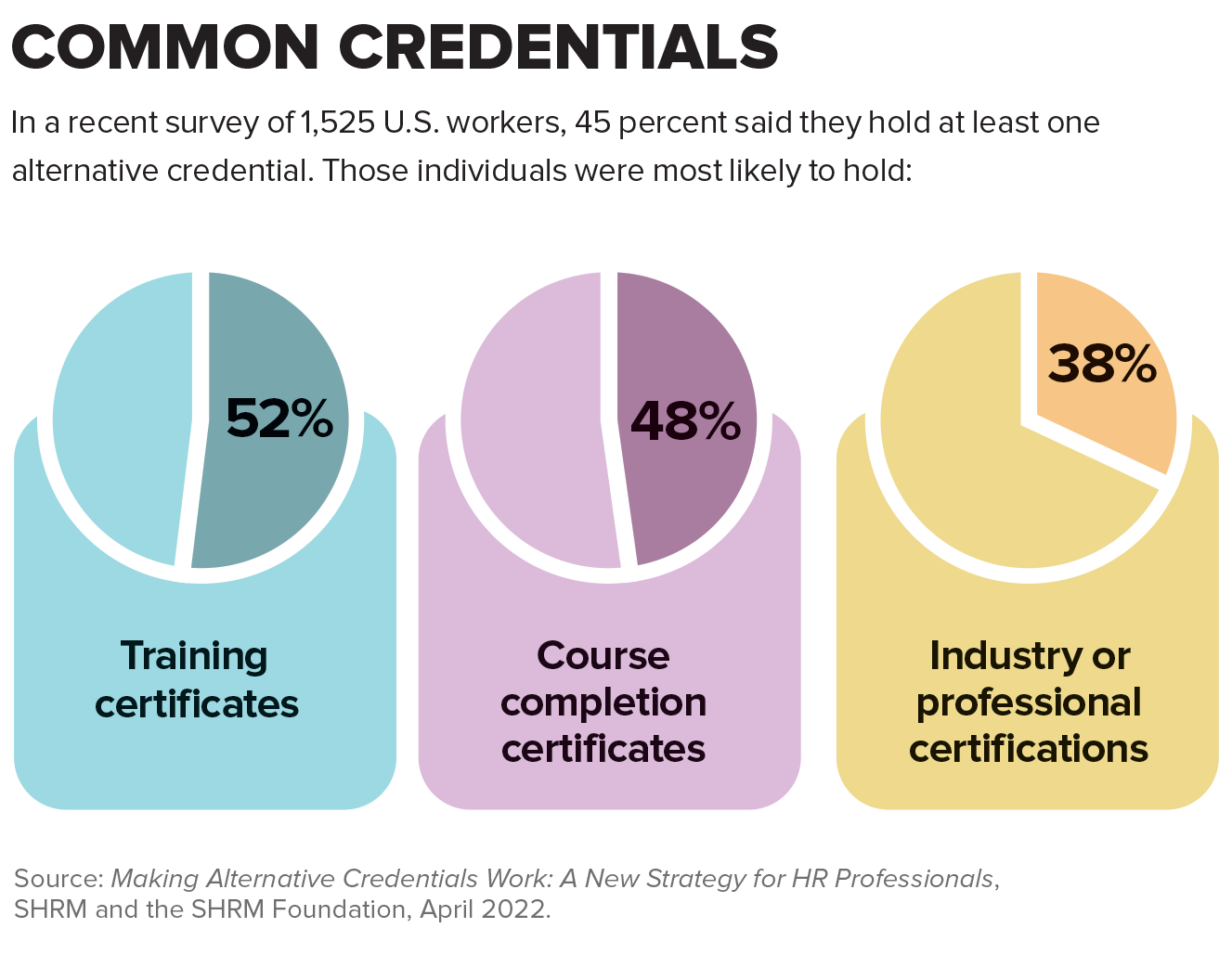
About 45 percent of 1,525 U.S. workers surveyed hold an alternative credential, according to Making Alternative Credentials Work: A New Strategy for HR Professionals, a research report released in April by SHRM and the SHRM Foundation and funded by a grant from Walmart. Of those, 68 percent believe it has helped them progress in their careers. 

Alternative credentials often appeal to workers who have taken more-circuitous routes to their fields: veterans, military spouses, young adults who bypassed college, caregivers re-entering the workforce and career switchers.

Since 2019, college enrollment overall has dropped 5 percent, with the number of newly enrolled freshmen down 9 percent, according to the National Student Clearinghouse Research Center. 

Many prospective students cite the high cost of college and pandemic disruptions as reasons for not enrolling. Instead, high school graduates are deferring college, going directly into the workforce or military, or educating themselves outside of the college degree system. For instance, almost 9 in 10 members of Generation Z say they’re learning through alternative means such as YouTube videos, certificate programs and internships, according to a January 2022 Intelligent.com survey. 

Kate Markin Coleman, co-author of Growing Fairly: How to Build Opportunity and Equity in Workforce Development (Brookings Institute Press/Ash Center, 2022), says the pandemic has prompted more interest in online learning.

“Candidates with industry-recognized certifications have taken the initiative to enroll in programs designed to augment their current skill set,” Coleman says. “Their completion of the training modules demonstrates—even more than a general education—their readiness for jobs requiring those skills.

“In a period of labor shortage, certifications expand the pipeline of talent to which HR directors have access and provide an alternative vetting mechanism for HR directors struggling to discern preparation in a competitive market.”


Info1.png


Evaluation Time

Credentialed employees are viewed as better performers by a majority of 500 U.S. executives and 1,200 supervisors surveyed by SHRM. Workplace leaders also consider alternative credentials valuable for employee development and believe employees who earn them gain more credibility. 

Yet executives, supervisors and HR professionals still place a higher value on work experience and traditional college degrees than on alternative credentials, the SHRM report found. Additionally, evaluating alternative credentials is seen by some HR professionals and hiring managers as too complicated and time-consuming.

Industry-recognized certifications represent one of the fastest-growing types of alternative credentials because the courses required to attain them cover clearly defined skills, require learners to pass an exam and are aligned to industry needs. Typically, the certifications are completed within three to six months and cost between $50 and $1,000 each, less than one unit in one course for a four-year college degree. 

Supervisors and HR professionals consider industry-recognized certifications the most compelling alternative credential, according to the SHRM survey.

The Google Career Certificates program was implemented in 2018 when the company began offering its Google IT Support Certificate on online education platform Coursera. In 2021, Google added three new certificates that can be completed within three to six months and don’t require prior experience or a college degree: Data Analytics, Project Management and UX Design (user experience design). 

In the fall of 2021, Deloitte US hired 14 graduates through the Grow with Google program. 

“The roles we hire for are very specific,” says Martin Kamen, a principal and human capital cloud leader at consulting and advisory firm Deloitte US, which has more than 120,000 employees. “The Grow with Google program gives us people with skills [that are] in high demand and brings us a diverse set of practitioners as well. The certificate program opened up a whole other recruiting pool for us, especially in underrepresented communities.” 

Walmart also has partnered with Grow with Google, as well as with U.S. Department of Labor Registered Apprenticeship Programs and the U.S. Chamber of Commerce. 

At Walmart, “we don’t think of it as credential-based hiring; we think of it as skill-based hiring,” says Brynt Parmeter, senior director of talent acquisition for the retail giant, which has 2.3 million employees. 

Walmart has had early success in finding software engineers through the Google program.Graphic22.png

“For some time, there has been a shortfall of people to fill those roles, and we’ve worked through different partnerships to allow us to identify software engineers,” he says. “We work with a number of boot-camp-style approaches. It’s a great way to find talent through short-term and immersive training programs. They center on real-world scenarios and tasks in their training experiences.”

Certifications are also “stackable,” meaning individuals can earn a series of certificates, building on the knowledge gained in the first course. 

“Aspiring workers often add certifications over the course of their careers,” says Coleman, who, in addition to being an author, has held various leadership positions in the corporate and nonprofit world. “Stackable skills and related certifications can produce substantial upward mobility. In the hiring process, HR directors are challenged to evaluate qualifications. Degrees are one recognizable way to filter candidates; so are alternative credentials and certifications. In such cases, the position skill required and the certification skill verified allow one-to-one alignment in a way that more general degree terminology does not.”

Salesforce, a customer relationship management software company based in San Francisco, offers many certifications, but the most popular is the entry-level Salesforce Administrator Certificate, which demonstrates a holder’s knowledge in cloud computing, enterprise software and how to use Salesforce tools effectively. The training to be a Salesforce Administrator is free online at Trailhead.com, and the exam costs about $200. 

“The average person with no experience could get upskilled, certified and connected to a job in a six-month window,” says Jared Crain, director of workforce development, Salesforce military. “It’s disrupting the way Americans look at careers. When I grew up, you needed to get a degree to unlock a career. Now, we’re seeing individuals with no degrees, a few years of military experience, and one or two Salesforce certifications get first job offers of $85,000-plus. We had a veteran with a GED get his first job offer at $125,000. The paradigm is shifting rapidly.”

How to Start

To make alternative credentials part of a company’s recruitment and hiring strategy, experts recommend HR professionals take the following steps:

Communicate with hiring managers. HR professionals must work with hiring managers to understand the skills needed to perform specific jobs. 

“The first piece is clarifying what knowledge, skills and abilities the hiring manager needs for this role specifically,” Crain says. “See if there is a certification for all of these skills that would demonstrate proficiency in these areas to you.

“We’ve gotten to a point in the labor market where I can apply for 100 jobs in 30 minutes,” he continues. “Overloaded HR professionals are trying to screen and identify quality candidates. If you have 500 applicants, the easiest gate is, ‘Do you have a degree?’ But it’s an arbitrary selection. Some of these positions don’t need the skills coming out of a higher education degree. If hiring managers can communicate the specific skills in the role, it would shape who to interview. Certifications give hiring managers a way to do that. It opens your aperture. Certifications give a different perspective that recruiters can use to screen candidates.”

Determine which positions are eligible for alternative credentialing. IBM’s HR team looks first at what the company needs. “We look for roles that are in demand across our business and offer opportunities for career growth,” Wenzlau says. “From there, we engage subject matter experts who can help evaluate which skills are required for success. We have a new-collar talent team that partners with our enterprise skills team and talent acquisition to effectively conduct the analysis and ensure our job descriptions reflect the needs of the position.”

HR professionals trying to implement these strategies at their organizations should change their recruitment and hiring strategy to account for this new type of candidate. 

“Look at processes, systems, job descriptions, assessment strategies, interview training, sourcing strategies and manager training,” Wenzlau advises.

He also cautions HR professionals to be aware of how this transformation is viewed by current employees.

“Be transparent about the rationale for re-credentialing and emphasize skill requirements as a tool to attract the best talent, ensure equity and meet the skills demand in the industry,” he says. “By focusing on new-collar jobs, we want to shift mindsets in our industry and make tech more diverse and inclusive.”

Change job descriptions to reflect skills, not degrees. At Macy’s Technology, a 1,400-employee company headquartered in Duluth, Ga., the HR team is revamping job requirements and its criteria for evaluating candidates. 

“Most of our job descriptions stated that a degree was either required or strongly preferred. We’re moving away from that,” says Nora Marcy, vice president, HR business partner, at Macy’s. “Now, we’re focused on looking for skills and experience. It’s no longer a priority how someone developed the skill and the knowledge we need. Instead, it’s about making sure they have the behavior and technical skill that will allow them to succeed.

“We’re taking this approach with almost all of our technology roles, including software engineering positions supporting our stores, call centers, website, mobile app, distribution centers, merchandising organization and our corporate functions,” she says. 

Tweak applicant tracking systems. HR professionals who value candidates with alternative credentials might not learn about them because of barriers erected by their applicant tracking systems. Almost half (45 percent) of the 1,129 HR professionals surveyed by SHRM said their organizations use automated pre-screening to review job applicant resumes. But only one-third of them said their automated systems recognize alternative credentials.

Depending on the applicant tracking system, the fix could be as simple as altering the fields on the “education” portion of the application or adding a “certifications” and “alternative learning” section. For example, at Macy’s Technology, “a candidate can include certifications as part of education in their online application,” Marcy says.

A long-term solution is advocated by the nonprofit Jobs for the Future, the U.S. Chamber of Commerce and others. They propose a system that allows employees to record their work and training accomplishments digitally, in a verifiable form that can be shared with employers.

The easily accessible files are called “learning and employment records” (LER). One significant LER effort involves the IBM Learning Credential Engine. 

“The IBM effort uses blockchain to create a cumulative, verified chain of a worker’s credentials, tying together their education and experience and the skills they have built,” Coleman says. “Certificates and badges have emerged as signals of achievement.”

Applicant tracking systems can filter for specific certifications, but it’s important to spell out the certification name completely to avoid missing a skilled and qualified candidate, says Joe Cahill, chief customer officer at the Project Management Institute, an association for project professionals based in Newtown Square, Pa. Also, be sure to add commonly used abbreviations for the certification. “For example, the Project Management Professional certification offered by our organization is commonly known as the PMP certification,” he says.

Train HR and hiring managers. HR professionals must gain familiarity with the types of alternative credentials available, especially the certifications and skills they impart, to effectively interview and evaluate candidates. Certain certification providers, such as Grow with Google, also have their own certificate graduate resume systems, which may require some initial training. 

“Get recruiting teams up to speed on this,” Deloitte’s Kamen recommends. “We did a training for our recruiters to show them how to use the Grow with Google recruiting tool.”

If HR professionals expand their search methods beyond the traditional bachelor’s or associate degrees, they will find a throng of candidates with the skills they need, earned through unconventional means. This will be a boon not only for those individuals, but also for the companies they serve.

The same is true when hiring HR professionals. SHRM offers two certifications—the SHRM Certified Professional (SHRM-CP) and the SHRM Senior Certified Professional (SHRM-SCP)—and a number of specialty credentials, including ones for talent acquisition and inclusive workplace culture.  

“If we want to win and find ways to attract talent, we must be open to considering alternative methods of finding and attracting talent,” Marcy says. “If we don’t, our competition will—and we will fall behind.”    

Kathryn Tyler is a freelance writer and former HR generalist and trainer in Wixom, Mich.

The Benefits of Alternative Credentials

Hiring candidates with alternative credentials can help your organization accomplish the following:

Increase the talent pool. “It can absolutely increase the qualified candidate pool, but by how much depends on the industry and role,” says Joe Cahill, chief customer officer at the Project Management Institute, an association for project professionals based in Newtown Square, Pa. 

“By branching out and looking for candidates with certifications, whether or not they hold a college degree, organizations can fill these important roles while ensuring these new hires have the right qualifications,” he explains.

Increase candidate diversity. “Skill-based hiring reduces barriers to entry that disproportionately affect minority workers,” says Kate Markin Coleman, co-author of Growing Fairly: How to Build Opportunity and Equity in Workforce Development (Brookings Institute Press/Ash Center, 2022). 

Research suggests that employers rely more heavily than is necessary on college degrees as a proxy for job preparedness.

“College degree requirements disproportionately disadvantage people of color,” Coleman says. “Yet many individuals without degrees possess the fundamentals that qualify them for jobs requiring advanced skills.” 

Brynt Parmeter, senior director of talent acquisition for retail giant Walmart, agrees.

“If you’re not doing a skill-based approach, you’re missing a whole range of talent,” he says. “We have significantly increased the quality and quantity of our candidates when we lean into this. We achieve much higher diversity, equity and inclusion outcomes when we use skill-based pathways.”

Macy’s Technology, which is headquartered in Duluth, Ga., has leveraged partnerships with organizations such as Google Career Certificates Consortium, Women in Technology’s Single Mothers Program, Pyramid Academy, Workforce Optimization Services and Techbridge, says Nora Marcy, vice president, HR business partner, at the company. 

“We’re also able to help our communities and give well-deserved opportunities to qualified, skilled individuals who have been passed over by other organizations,” she notes. “Hiring for roles is just as much about hiring for aptitude and attitude as it is for skill. If we can bring someone onto the team who shows they have personal drive and desire to succeed, we can teach them the skills they may be lacking.” 

Increase the number of candidates with job-specific skills. A new employee with a four-year college degree in computer science might have to be trained in an employer’s software programs. However, a new hire who comes on board with an industry-recognized certificate in the software the company uses already knows how to navigate the program and requires less on-the-job training.

“Industry-recognized certifications prove the candidate has mastered a skill set that is highly specific to their role,” Cahill says. “And because many of these certifications require putting hours into ongoing education, they also suggest the candidate is up-to-date on the latest industry practices.” —K.T.

AI Adoption Will Cause Workforce Reorganization

?Human resource executives at companies that are investing in artificial intelligence (AI) technology can expect to scout for higher-skilled IT workers as demand for their skills rises. They will also be faced with managing labor composition disruptions and workforce reorganizations as more companies use AI’s predictive technology capabilities to solve business problems.

In a recently published research paper titled Firm Investments in Artificial Intelligence Technologies and Changes in Workforce Composition, professors from Columbia University; the University of California, Berkeley; and the University of Maryland pored over almost a decade’s worth of data and found that AI adoption will change the employment landscape as well as HR managers’ priorities.

Researchers examined changes in labor outcomes from 2010 to 2018 using several datasets, sourced from Cognism Inc., a London-based sales intelligence firm.

Researchers also used 180 million job postings provided by Boston-based Burning Glass Technologies, an analytics software company that conducts research on labor market trends. The data details job descriptions and specific requirements such as years of education and experience.

Additional data sources were wage and education data grouped by commuting zone from the U.S. Census Bureau’s American Community Survey and wage and employment data grouped by industry from the U.S. Census Quarterly Workforce Indicators. From Compustat, researchers obtained firm-level data on operational variables such as sales, cash and assets.

The research shows that when companies invested in AI, there was a corresponding demand for workers who possess undergraduate and graduate degrees in the science, technology, engineering and mathematics (STEM) fields.

“As firms invest in AI, they tend to transition to more educated workforces, with higher shares of workers with undergraduate and graduate degrees and more specialization in STEM fields and IT and analysis skills,” the report stated. “Furthermore, AI investments are associated with a flattening of the firms’ hierarchical structure, with significant increases in the share of workers at the junior level and decreases in shares of workers in middle-management and senior roles.”

Junior level workers are those with less than two years of experience, or have two to five years of experience but do not manage anyone directly.

A junior-level worker entering the workforce will know more about how to use AI data to make predictions, said Alex He, co-author of the report and assistant professor of finance at the Robert H. Smith School of Business at the University of Maryland. This is a shift from the days when managers were the ones who analyzed AI data, gained insights and made decisions accordingly.

In short, AI empowers junior-level workers—a shift that has implications for the worker and manager relationship.

“We found that AI is making the firm less top-heavy and flatter. It’s not surprising, because AI has the ability to make predictions, and that makes the entry-level workers more capable to make decisions. They can do more, and there is less need for middle managers,” He said.

As companies that invest in AI operate with more employees in entry-level or single contributor roles and fewer workers in either middle management or senior positions, He predicted that several issues will arise that HR executives will be forced to manage in a restructured workforce.

“For example, right now, entry-level employees are paid less and managers are paid more, but if there are fewer managers, you can afford to pay the entry-level workers more to attract the required skills,” He said.

Another significant finding is that there are some jobs that can’t be replaced no matter how much investment is made in AI technology.

“Interestingly, firms that invest more heavily in AI do not reduce their demand for some of the skill groups that are most often predicted to be replaced by AI, such as customer service, HR, and legal,” the report stated.

James Hodson is a co-author of the report. He is the chief science officer at Cognism and chief executive officer at the AI for Good Foundation, a nonprofit organization headquartered in Berkeley, Calif. Hodson said HR managers have an opportunity to use AI to hire highly skilled people, to reskill and train people faster, and to build more productive teams. AI also allows HR managers to track data on employees, which can help HR managers understand workers better.

However, the report’s findings present both difficulties and opportunities for HR managers who will be asked to oversee an AI-induced workforce reorganization while maintaining or even advancing the competitive advantage of their companies.

“In general, HR executives need to be aware of managing organizational change, especially when it relates to the adoption of AI technology. Essentially, AI is bringing the HR function to the forefront of the business,” Hodson said.

Nicole Lewis is a freelance journalist based in Miami.

AI Adoption Will Cause Workforce Reorganization

?Human resource executives at companies that are investing in artificial intelligence (AI) technology can expect to scout for higher-skilled IT workers as demand for their skills rises. They will also be faced with managing labor composition disruptions and workforce reorganizations as more companies use AI’s predictive technology capabilities to solve business problems.

In a recently published research paper titled Firm Investments in Artificial Intelligence Technologies and Changes in Workforce Composition, professors from Columbia University; the University of California, Berkeley; and the University of Maryland pored over almost a decade’s worth of data and found that AI adoption will change the employment landscape as well as HR managers’ priorities.

Researchers examined changes in labor outcomes from 2010 to 2018 using several datasets, sourced from Cognism Inc., a London-based sales intelligence firm.

Researchers also used 180 million job postings provided by Boston-based Burning Glass Technologies, an analytics software company that conducts research on labor market trends. The data details job descriptions and specific requirements such as years of education and experience.

Additional data sources were wage and education data grouped by commuting zone from the U.S. Census Bureau’s American Community Survey and wage and employment data grouped by industry from the U.S. Census Quarterly Workforce Indicators. From Compustat, researchers obtained firm-level data on operational variables such as sales, cash and assets.

The research shows that when companies invested in AI, there was a corresponding demand for workers who possess undergraduate and graduate degrees in the science, technology, engineering and mathematics (STEM) fields.

“As firms invest in AI, they tend to transition to more educated workforces, with higher shares of workers with undergraduate and graduate degrees and more specialization in STEM fields and IT and analysis skills,” the report stated. “Furthermore, AI investments are associated with a flattening of the firms’ hierarchical structure, with significant increases in the share of workers at the junior level and decreases in shares of workers in middle-management and senior roles.”

Junior level workers are those with less than two years of experience, or have two to five years of experience but do not manage anyone directly.

A junior-level worker entering the workforce will know more about how to use AI data to make predictions, said Alex He, co-author of the report and assistant professor of finance at the Robert H. Smith School of Business at the University of Maryland. This is a shift from the days when managers were the ones who analyzed AI data, gained insights and made decisions accordingly.

In short, AI empowers junior-level workers—a shift that has implications for the worker and manager relationship.

“We found that AI is making the firm less top-heavy and flatter. It’s not surprising, because AI has the ability to make predictions, and that makes the entry-level workers more capable to make decisions. They can do more, and there is less need for middle managers,” He said.

As companies that invest in AI operate with more employees in entry-level or single contributor roles and fewer workers in either middle management or senior positions, He predicted that several issues will arise that HR executives will be forced to manage in a restructured workforce.

“For example, right now, entry-level employees are paid less and managers are paid more, but if there are fewer managers, you can afford to pay the entry-level workers more to attract the required skills,” He said.

Another significant finding is that there are some jobs that can’t be replaced no matter how much investment is made in AI technology.

“Interestingly, firms that invest more heavily in AI do not reduce their demand for some of the skill groups that are most often predicted to be replaced by AI, such as customer service, HR, and legal,” the report stated.

James Hodson is a co-author of the report. He is the chief science officer at Cognism and chief executive officer at the AI for Good Foundation, a nonprofit organization headquartered in Berkeley, Calif. Hodson said HR managers have an opportunity to use AI to hire highly skilled people, to reskill and train people faster, and to build more productive teams. AI also allows HR managers to track data on employees, which can help HR managers understand workers better.

However, the report’s findings present both difficulties and opportunities for HR managers who will be asked to oversee an AI-induced workforce reorganization while maintaining or even advancing the competitive advantage of their companies.

“In general, HR executives need to be aware of managing organizational change, especially when it relates to the adoption of AI technology. Essentially, AI is bringing the HR function to the forefront of the business,” Hodson said.

Nicole Lewis is a freelance journalist based in Miami.

MPs vote against further NHS workforce planning requirements

Organisations representing doctors and nurses have expressed their disappointment at MPs’ decision to reject a proposal for greater NHS workforce planning requirements.

During a final reading of the Health and Social Care Bill this week, MPs tabled a motion against an amendment that would have required the government to provide current and future workforce estimates within the NHS and social care at least every three years, as well as assessments of how these compared with projections of the workforce needed to meet demand.

The amendment, which came from the House of Lords, received support from hundreds of organisations including those representing NHS management, charities, patient groups, think tanks, royal colleges and professional bodies.

MPs, including health minister Edward Argar, felt the amendment was “unnecessary”.

Former health secretary Jeremy Hunt, who supported the amendment, asked MPs: “What precisely is unnecessary about an amendment that simply requires independent, regular estimates of the numbers of doctors and nurses we should be training?”

“Why on earth would we not want to train more doctors and nurses, if we looked objectively at the challenges facing the NHS today? We last debated this on the day the Ockenden report was published… The key recommendation in that report was for 2,000 more midwives and 500 more obstetricians, and that would not have been necessary had this amendment been in place,” said Hunt.

“I am afraid that, by voting down a simple request for independent estimates of the number of doctors and nurses we should be training, the government are actively choosing to sweep the problem under the carpet.”

MPs voted against the NHS workforce planning bill amendment 278 to 182. The bill has now received royal assent to become the Health and Social Care Act.

Professor Martin Marshall, chair of the Royal College of General Practitioners, said MPs rejection of the amendments was a letdown.

“Over 100 health organisations (including all medical Royal Colleges), two former NHS chief execs and a former health secretary supported the workforce planning amendment – but that wasn’t enough,” he said in a series of tweets.

“The government hasn’t set out the number of staff our NHS needs. The NHS needs a plan and the #HealthandCareBill was a prime opportunity to achieve this.”

Pat Cullen, chief executive and general secretary of the Royal College of Nursing, said tens of thousands of nursing vacancies are contributing to treatment delays.

“All major healthcare organisations asked these elected representatives to publish an assessment of how many nursing staff and others are needed to provide safe patient care,” said Cullen.

“Nursing staff will continue to demand action on behalf of patients and the public. We’ll not stop fighting for safe staffing. Only by having enough staff, who have the right skills and are paid fairly for their safety-critical work, will patients get the high-quality care they deserve.”

Cullen added that nurses should “raise concerns about safe practices wherever they work”.

Dr Adrian Boyle, vice president of the Royal College of Emergency Medicine, said: “The current pressures on the health service are unsustainable and substantially driven by widespread workforce shortages across all grades and departments. These shortages are further exacerbated by an inability to retain existing staff facing burnout, distress, and moral injury, resulting in the loss of senior staff to early retirement and junior staff who quit the profession.

“Having an independent review of health and social care workforce projections for five, 10 and 20 years’ time would have been the welcome starting point for a fully funded workforce plan – which appears to have been scuppered. For Members of Parliament in the House of Commons to vote down this amendment is a failure to the NHS and Social Care and a failure to the workforce that has been pushed to its limit for over two years.”

Workforce planning opportunities on Personnel Today

Browse more workforce planning jobs

Google adds London offices and aims for 10k headcount

On top of the vast building under construction in King’s Cross, the web giant has now bought 408,000 sq ft of offices in Bloomsbury.

The post Google adds London offices and aims for 10k headcount appeared first on Personnel Today.

Financial services workers call for flexibility

More than half of employees in financial services would like to see changes to their working week post-Covid, according to a survey.

The post Financial services workers call for flexibility appeared first on Personnel Today.

Spain to trial four-day working week

The Spanish government has agreed to trial a four-day working week for companies interested in the idea.

The post Spain to trial four-day working week appeared first on Personnel Today.

Could a blockchain health record help HR handle the pandemic?

There could be a need for employees to share health credentials once the pandemic recedes. IBM is one of the companies developing secure ‘health passports’. 

The post Could a blockchain health record help HR handle the pandemic? appeared first on Personnel Today.

Building skills the top priority for HR leaders in 2021

Gartner study also finds a lack of diversity is undermining confidence and trust in leadership.

The post Building skills the top priority for HR leaders in 2021 appeared first on Personnel Today.

Subscribe to our Newsletter